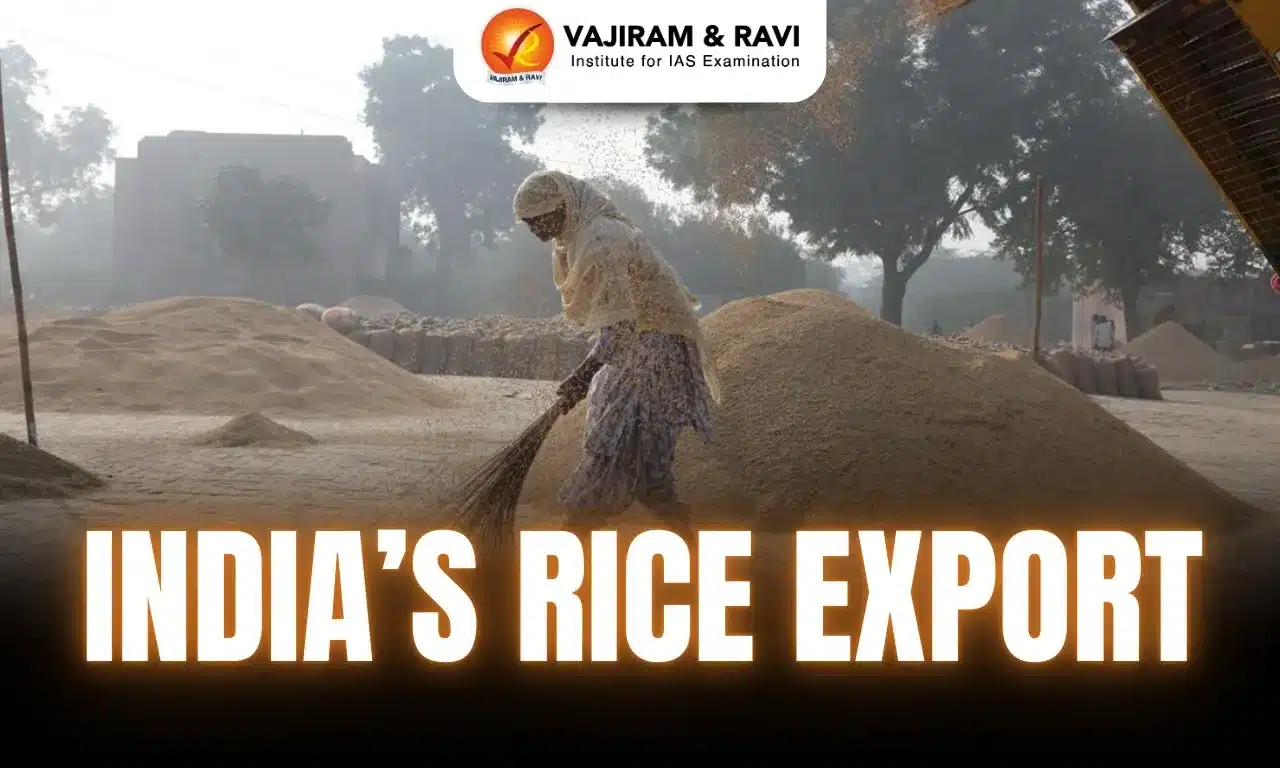
India’s Rice Exports Latest News
- India, the world’s largest rice exporter, witnessed a sharp rebound in rice exports in 2025 after the Union government lifted all export restrictions imposed during 2022–23.
- The move has significant implications for global food prices, food security, agricultural trade policy, and India’s role in the Global South.
Key Developments
- Sharp rise in rice exports:
- India’s rice exports rose 19.4% in 2025 to 21.55 million metric tonnes, the second-highest on record.
- This is close to the 2022 peak of 22.3 million tonnes. Exports had stood at 18.05 million tonnes in 2024.
- Increased Indian supply pushed Asian rice prices to their lowest level in nearly a decade.
- This has also reduced shipments from Thailand and Vietnam, India’s key competitors.
- Composition of exports:
- Non-Basmati rice:
- Exports surged 25% to 15.15 million tonnes. Major destinations are Bangladesh, Benin, Cameroon, Ivory Coast, Djibouti.
- This indicates India’s role in food security for developing countries, especially Africa.
- Basmati rice:
- Exports increased 8% to a record 6.4 million tonnes. Key buyers are Iran, UAE, and the United Kingdom.
- This reflects strong demand for premium agricultural exports.
- Non-Basmati rice:
- India’s dominance in global rice trade:
- India exports more rice than the combined exports of Thailand, Vietnam, and Pakistan.
- This reinforces India’s position as a “food security provider” in the developing world.
Reasons for Export Rebound
- Policy relaxation: The government lifted the last export curbs in March 2025, including bans and minimum export prices. These curbs were earlier imposed to control domestic inflation and food prices.
- Record domestic production: Improved supplies due to record rice output, ensuring domestic availability.
- Price competitiveness: Indian rice is priced lower than Thailand and Vietnam, helping India regain lost global market share.
Overview of India’s Rice Production and Exports
- Production overview:
- Leading producer: India is the top global rice producer, surpassing China, accounting for roughly 40% of global supply.
- Major producing states: Include Uttar Pradesh, Telangana, West Bengal, Punjab, and Chhattisgarh.
- Record output: Production reached a record 137.8 million tonnes (LMT) in 2023-24, with forecasts for even higher output in 2025-26.
- Success is attributed to: Favorable monsoons, increased planting area, technological advancements like the introduction of high-yielding dwarf varieties (e.g., IR-8, Jaya), and policy support. Though, India is facing scrutiny over water-intensive farming.
- Export dominance:
- Top exporter: India leads the world in rice exports, often exceeding the combined exports of the next three largest exporters.
- Major destinations: Key markets include Bangladesh, Benin, Nepal, UAE, Iran, and European nations, with new markets emerging.
Challenges and Way Ahead
- Balancing domestic food security: With export competitiveness. Strengthen buffer stock management to avoid abrupt export bans.
- Risk of price volatility: If exports surge during weak monsoon years. Adopt a predictable and transparent export policy to enhance farmer confidence.
- Overdependence on rice exports: May discourage crop diversification. Use rice exports as a tool of food diplomacy, especially with Africa and South Asia. Encourage value-added rice products to increase export earnings.
- Climate risks: Affecting future production consistency. Promote climate-resilient rice varieties and water-efficient practices.
Conclusion
- India’s post-curb rice export surge underscores the country’s pivotal role in global agricultural markets and food security.
- While competitive pricing and policy relaxation have strengthened India’s export leadership, a calibrated approach balancing domestic food security, farmer welfare, and global responsibility will be crucial for sustainable agricultural trade governance.
Source: TH
India’s Rice Exports FAQs
Q1: How did the lifting of rice export curbs affect India’s position in the global rice market?
Ans: It led to a 19.4% rise in exports, helping India regain market share and reinforce its dominance as the world’s largest rice exporter.
Q2: What is the impact of India’s rice export rebound on global food prices and food security?
Ans: Higher Indian supplies pushed Asian rice prices to a decade-low, easing food costs for import-dependent developing countries, especially in Africa.
Q3: What is the difference between trends in basmati and non-basmati rice exports?
Ans: Non-basmati exports rose sharply by 25% driven by developing country demand, while basmati exports grew 8% to a record level due to premium markets.
Q4: Why is India’s rice export policy significant for its agricultural trade and foreign relations?
Ans: It influences farmer incomes, domestic price stability, and enables India to exercise food diplomacy with the Global South.
Q5: What are the key challenges associated with India’s rising rice exports?
Ans: Challenges include domestic price volatility and climate risks, which can be managed through buffer stocks, predictable export policy, etc.