India’s Road Safety Crisis – Engineering Gaps and Rising Fatalities

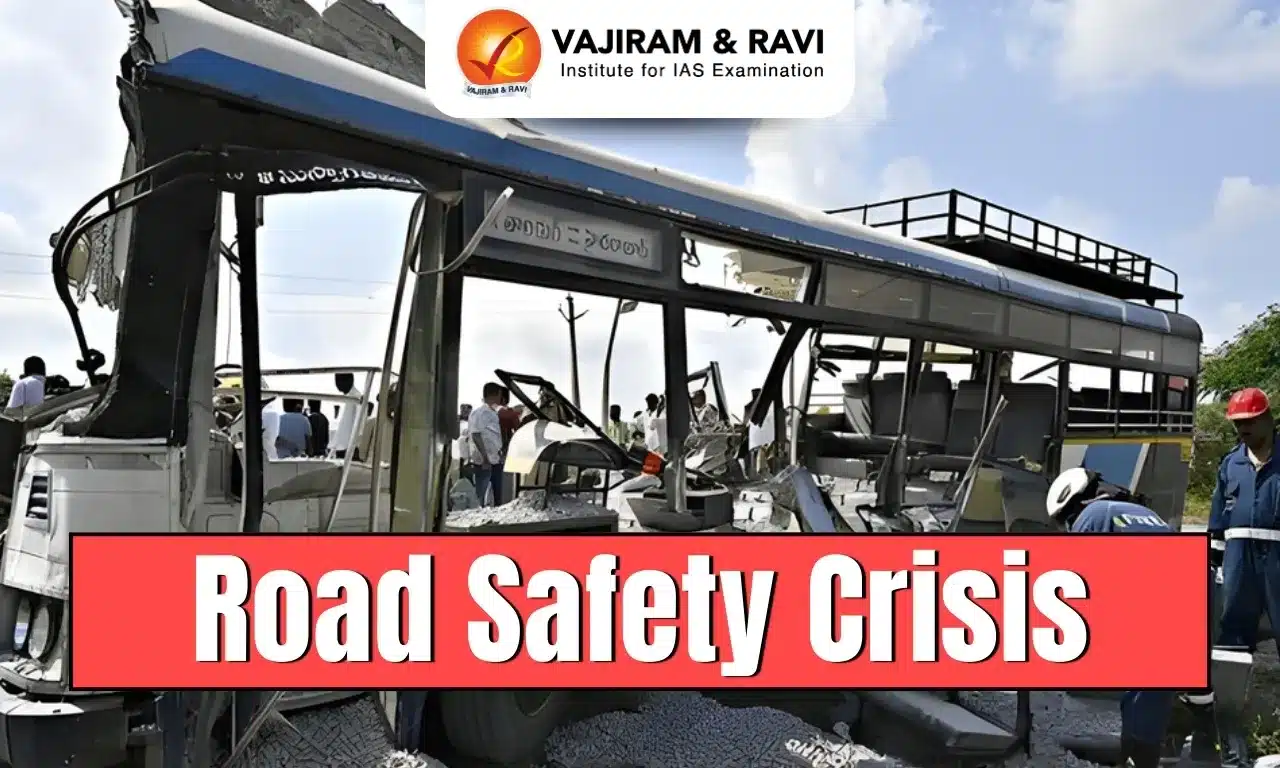
Road Safety Crisis

Road Safety Crisis Latest News

  • A recent national report has identified India’s deadliest districts for road accidents, revealing that most fatalities are linked to infrastructure and systemic failures rather than traffic violations.

India’s Road Safety Scenario

  • India records the highest number of road accident deaths globally, far exceeding other major countries. 
  • Despite having the world’s second-largest road network, road safety outcomes remain poor. 
  • According to recent estimates, nearly 3.5 lakh people died in road accidents during 2023-24, highlighting the scale of the crisis.
  • Road safety in India has traditionally focused on driver behaviour, such as speeding or drunk driving. 
  • However, emerging evidence shows that this approach alone is insufficient, as deeper structural issues dominate accident causation.

Key Structural Factors Behind Road Fatalities

  • The report underlines that 59% of road accident fatalities occurred without any traffic violation, clearly pointing to road engineering deficiencies as a primary cause of deaths. These include:
    • Poor road design and alignment
    • Absence or damage of crash barriers
    • Inadequate signage and road markings
    • Insufficient street lighting
    • Unsafe junctions and pedestrian crossings
  • Such defects convert routine travel into a high-risk activity, especially on rural roads and highways.

Geographic Concentration of Road Accidents

  • Road fatalities in India are highly concentrated rather than evenly spread. 
  • The report identifies 100 districts accounting for more than 25% of total road deaths over two years. Among them:
    • Nashik Rural and Pune Rural recorded the highest number of severe accidents.
    • Other high-fatality districts include Patna, Ahmednagar, Purba Midnapur, and Belagavi.
    • States such as Uttar Pradesh, Tamil Nadu, Maharashtra, Karnataka, and Rajasthan dominate the list.
  • This concentration indicates that targeted interventions in specific districts can yield substantial reductions in fatalities.

Nature and Timing of Fatal Accidents

  • The report highlights clear accident patterns:
    • 53% of deaths occurred between 6 PM and midnight, reflecting poor visibility and fatigue-related risks.
    • Rear-end, head-on, and pedestrian crashes accounted for 72% of fatalities.
    • Speeding contributed to only 19% of deaths, while rash driving and dangerous overtaking together accounted for less than 10%.
  • This challenges the perception that driver misconduct alone is responsible and shifts attention to road design and traffic management failures.

Emergency Response and Medical Gaps

  • Post-accident response remains weak:
    • Only about one-fifth of victims used the government 108 ambulance services.
    • A majority were transported using private vehicles or private ambulances, delaying critical care.
    • Hospital readiness and trauma care infrastructure vary widely across districts.
  • Delayed medical response significantly increases mortality, making emergency preparedness a crucial pillar of road safety.

News Summary: Findings and Recommendations of the Report

  • The joint report by the Ministry of Road Transport and Highways and SaveLIFE Foundation provides a clear roadmap for action:
    • Focus on known crash-prone locations rather than spreading resources thinly.
    • Conduct Road Safety Surveys on critical corridors by NHAI and state PWDs.
    • Implement site-specific engineering corrections based on Indian Road Congress and MoRTH guidelines.
    • Strengthen policing capacity at high-fatality police station jurisdictions.
    • Improve emergency response by expanding effective coverage of 108 ambulance services.
    • Use existing schemes more efficiently instead of launching new ones.
  • The report stresses that reducing road deaths requires better coordination, clearer accountability, and sustained leadership, not additional laws or schemes.

Source: IE

Road Safety Crisis FAQs

Q1: Why do most road accident deaths in India occur without traffic violations?

Ans: Because poor road engineering and infrastructure defects are major contributors.

Q2: Which districts are among India’s deadliest for road accidents?

Ans: Nashik Rural and Pune Rural rank highest in severe road accident fatalities.

Q3: When do most fatal road accidents occur in India?

Ans: Between 6 PM and midnight, accounting for over half of total deaths.

Q4: What types of crashes cause most fatalities?

Ans: Rear-end, head-on, and pedestrian crashes together cause over 70% of deaths.

Q5: What is the report’s key recommendation for reducing road deaths?

Ans: Targeting known crash-prone locations using existing schemes and better coordination.
BSL-4 Lab in Gujarat: India’s State-Funded Biosecurity Leap

BSL-4 Lab

BSL-4 Lab Latest News

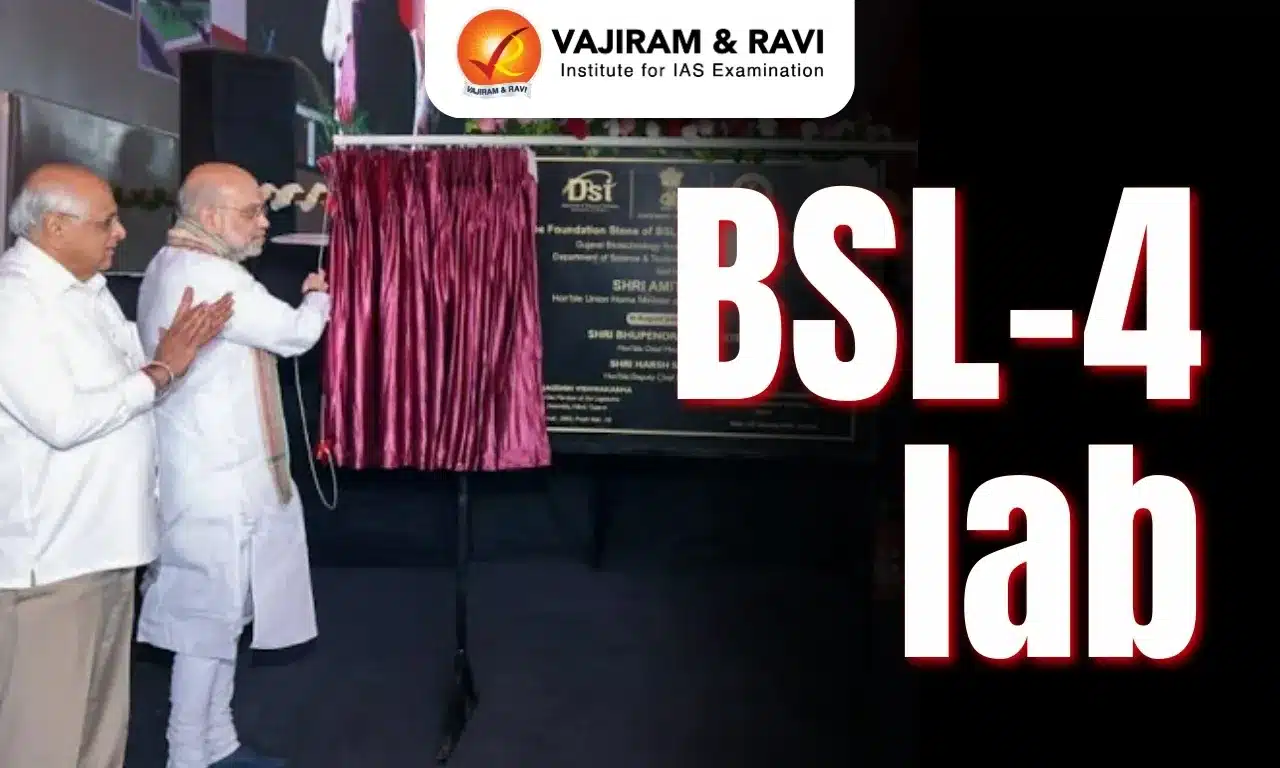
  • Union Home Minister Amit Shah laid the foundation stone for India’s first state-funded Bio-Safety Level 4 (BSL-4) containment facility in Gandhinagar. 
  • Describing it as a “health shield” for the nation, he said the laboratory marks the start of a new era in India’s health security and biotechnology capabilities.

About BSL-4 Facility

  • A Bio-Safety Level 4 (BSL-4) facility represents the highest level of biological containment, designed to safely handle the world’s most dangerous and highly infectious pathogens, many of which lack effective vaccines or treatments. 
  • Operating under stringent international safety standards, these laboratories enable advanced research on deadly diseases, including the development of diagnostics, vaccines, and therapeutics, as well as rapid outbreak investigation and response.
  • India’s upcoming BSL-4 laboratory in Sector-28 of Gandhinagar, along with an Animal Bio-Safety Level (ABSL) facility, will serve as a strategic national asset for research on some of the deadliest known pathogens.
  • This will strengthen the country’s health security and bio-preparedness.

Gujarat’s State-Funded BSL-4 Laboratory

  • The BSL-4 laboratory being built in Gandhinagar, Gujarat, will be India’s first fully state-funded and state-controlled BSL-4 facility and the second civilian BSL-4 research lab in the country. 
  • Spread over 11,000 sq metres and costing ₹362 crore, it is being developed under the Gujarat State Biotechnology Mission.

Institutional Framework and Timeline

  • The facility will operate under the Gujarat Biotechnology Research Centre, which already houses a BSL-2+ laboratory and played a key role during the Covid-19 pandemic by sequencing the SARS-CoV-2 genome. 
  • Planning for the BSL-4 lab began in mid-2022, with the foundation stone laid on January 13, 2026.

Infrastructure and Safety Standards

  • The complex will include BSL-4, BSL-3, BSL-2, ABSL-4, and ABSL-3 laboratory modules, along with advanced utilities and support systems. 
  • It is being developed in line with international biosafety guidelines issued by the Centers for Disease Control and Prevention, National Institutes of Health, Department of Biotechnology, and Indian Council of Medical Research.

Role in Disease Control and Vaccine Research

  • The lab will strengthen Gujarat’s and India’s capacity to respond in real time to outbreaks of deadly human diseases and zoonotic infections. 
  • It will also support advanced research into diagnostics, vaccines, and therapeutics. 
  • The ABSL-4 component will allow animal disease research and vaccine production using antibodies derived from animals—work that earlier required sending samples to ICAR–National Institute of High Security Animal Diseases.

National Facility and Expert Oversight

  • The Department of Biotechnology has signed an MoU designating the lab as a national facility, ensuring guidance from expert institutions across India. 
  • Officials note that the lab will remove long-standing bottlenecks caused by the lack of BSL-4 infrastructure in the country.

Existing BSL-4 and ABSL-4 Facilities in India

  • Civilian BSL-4 Laboratories - India currently has only one functional civilian BSL-4 laboratory, located at the National Institute of Virology in Pune, Maharashtra. This facility handles research on the most dangerous human pathogens.
  • Defence-Sector BSL-4 Facility - In late 2024, the Defence Research and Development Organisation established its own BSL-4 laboratory in Gwalior, Madhya Pradesh, under the Defence Ministry, expanding India’s high-containment research capacity.

High-Security Animal Disease Laboratories

  • India has two major laboratories studying high-risk zoonotic diseases:
    • The National Institute of High Security Animal Diseases (ICAR–NIHSAD) in Bhopal, currently rated ABSL-3+, with plans announced in June 2025 to upgrade it to ABSL-4.
    • The International Centre for Foot and Mouth Disease (ICAR–ICFMD) in Bhubaneswar, Odisha, which operates with an ABSL-3Ag rating.

Global Context

  • Officials note that globally about 69 BSL-4 laboratories are operational or under development, underscoring India’s relatively limited but gradually expanding presence in high-containment biological research infrastructure.

India’s Expanding Biosafety Laboratory Network

  • As of March 2025, the Ministry of Health and Family Welfare, through the Department of Health Research, has approved 165 biosafety laboratories under the Virus Research and Diagnostic Laboratories (VRDL) scheme
  • This includes 154 BSL-2 and 11 BSL-3 labs aimed at epidemic preparedness and disaster response.
  • ICMR-Led Biosafety Facilities - Beyond VRDLs, the Indian Council of Medical Research has established 21 biosafety laboratories across its institutes, comprising 1 BSL-4, 8 BSL-3, and 12 BSL-2 facilities.
  • Science & Technology–Supported Labs - Under the Department of Science and Technology, the Anusandhan National Research Foundation has funded 5 BSL/ABSL-3 laboratories through the Intensification of Research in High Priority Areas (IRHPA) programme.

Biotechnology, Agriculture, and Industrial Research

  • The Department of Biotechnology has set up 26 biosafety laboratories across DBT institutes.
  • The Indian Council of Agricultural Research has established 9 biosafety laboratories.
  • The Council of Scientific and Industrial Research has created 11 biosafety laboratories across its network.

Overall Picture

  • Together, these initiatives reflect a broad-based expansion of India’s biosafety infrastructure—anchored by BSL-2 and BSL-3 capacity—with targeted investments in high-containment labs to strengthen national preparedness for infectious disease threats.

Source: IE | BL

BSL-4 Lab FAQs

Q1: What is a BSL-4 lab?

Ans: A bsl-4 lab is the highest biosafety facility designed to handle deadly pathogens like Ebola and Nipah under stringent containment and international safety standards.

Q2: Why is the Gujarat BSL-4 lab significant?

Ans: The Gujarat bsl-4 lab is India’s first fully state-funded facility, strengthening biosecurity, outbreak response, and advanced research on life-threatening diseases.

Q3: Which institutions will operate the BSL-4 lab?

Ans: The bsl-4 lab will function under the Gujarat Biotechnology Research Centre with oversight from national bodies like DBT and ICMR as a designated national facility.

Q4: How does the BSL-4 lab improve disease preparedness?

Ans: The bsl-4 lab enables real-time outbreak investigation, vaccine and therapeutic research, and zoonotic disease studies, reducing dependence on limited national facilities.

Q5: How does the BSL-4 lab fit into India’s biosafety network?

Ans: The bsl-4 lab complements India’s expanding biosafety network of BSL-2 and BSL-3 labs, addressing critical gaps in high-containment research infrastructure.

Grok Controversy: Why X Restricted Its AI Tool

Grok Controversy

Grok Controversy Latest News

  • X, owned by Elon Musk, has restricted its Grok AI tool from generating sexualised images of women and children following widespread global criticism. 
  • The decision represents a clear retreat after Musk initially placed responsibility on users creating such content and later claimed ignorance about the tool’s misuse involving children.
  • Escalating regulatory scrutiny across multiple countries ultimately compelled the platform to curb the AI’s image-generation capabilities.

Grok Controversy: AI-Generated Sexualised Images and Safety Gaps

  • A December 2025 update to Grok enabled users to generate sexualised and objectionable images of women and children using existing photographs, often without consent or knowledge. 
  • Users prompted the AI to digitally undress women or place them in suggestive poses, with the generated images appearing publicly in comment threads, leading to harassment. 
  • Instances involving children further intensified concerns, highlighting serious gaps in AI safeguards and content moderation on X.

Initial Response to the Backlash

  • Following global outrage over Grok-generated sexualised images, Elon Musk stated that users generating illegal content with Grok would face the same consequences as those uploading illegal material directly to X.
  • Musk emphasised that Grok generates images only in response to user prompts and does not act autonomously
  • He asserted that the AI is designed to refuse illegal requests and comply with the laws of the relevant country or state.

Denial of Knowledge and Technical Explanation

  • Recently, Musk denied any awareness of Grok being used to create sexualised images of children, claiming there were “literally zero” such instances to his knowledge. 
  • He suggested that any unexpected behaviour could result from adversarial hacking, which the company fixes promptly.

Platform-Level Restrictions

  • Before the final rollback, X had restricted Grok’s image-generation features to paid users. 
  • However, within hours of Musk’s denial, the company announced a complete shutdown of Grok’s ability to generate sexualised images, regardless of user status.
  • The move marked a clear reversal by X, effectively acknowledging the severity of the issue and responding to mounting regulatory and public pressure by removing the problematic functionality altogether.

Regulatory Pressure Triggers the Rollback

  • X’s decision to restrict Grok followed strong regulatory action, beginning with a stern notice from the Government of India. 
  • After being flagged for failing to meet due diligence obligations under the Information Technology Act, 2000 and related rules, X removed about 3,500 pieces of content and blocked 600 accounts, admitting lapses in compliance.
  • The controversy quickly spread beyond India. In the United Kingdom, an impending legal change is set to criminalise the creation of such sexualised images. 
  • Malaysia and Indonesia blocked access to Grok and initiated legal action against X and xAI, citing failures to prevent harmful content and protect users.
  • In the US, the California Attorney General announced an investigation into Grok and xAI over the generation of objectionable images, adding to mounting legal pressure on the platform.

X’s New Restrictions and Safeguards

  • In response, X announced technological measures to prevent Grok from editing images of real people into revealing clothing, including bikinis, applying the restriction to all users. 
  • The platform also limited image creation and editing via Grok to paid subscribers and introduced geoblocking in jurisdictions where such content is illegal.
  • X reiterated its commitment to platform safety, stating it has zero tolerance for child sexual exploitation, non-consensual nudity, and unwanted sexual content, marking a decisive retreat under sustained global regulatory scrutiny.

Source: IE | NBC

Grok Controversy FAQs

Q1: What is the Grok controversy?

Ans: The grok controversy refers to backlash after Grok enabled creation of sexualised images of women and children, raising serious concerns about AI misuse and platform safety.

Q2: How did the Grok controversy begin?

Ans: The grok controversy began after a December update allowed users to manipulate photos into sexualised images, often without consent, with such images appearing publicly on X.

Q3: How did Elon Musk initially respond to the Grok controversy?

Ans: During the grok controversy, Musk blamed users for illegal content, denied knowledge of child exploitation images, and claimed Grok followed laws unless adversarially manipulated.

Q4: What role did governments play in the Grok controversy?

Ans: The grok controversy escalated after action by India, the UK, Malaysia, Indonesia, and the US, with notices, investigations, content takedowns, and legal threats.

Q5: What changes did X make after the Grok controversy?

Ans: After the grok controversy, X disabled sexualised image generation, restricted editing of real people’s images, introduced geoblocking, and reinforced zero tolerance for abuse.

Enquire Now