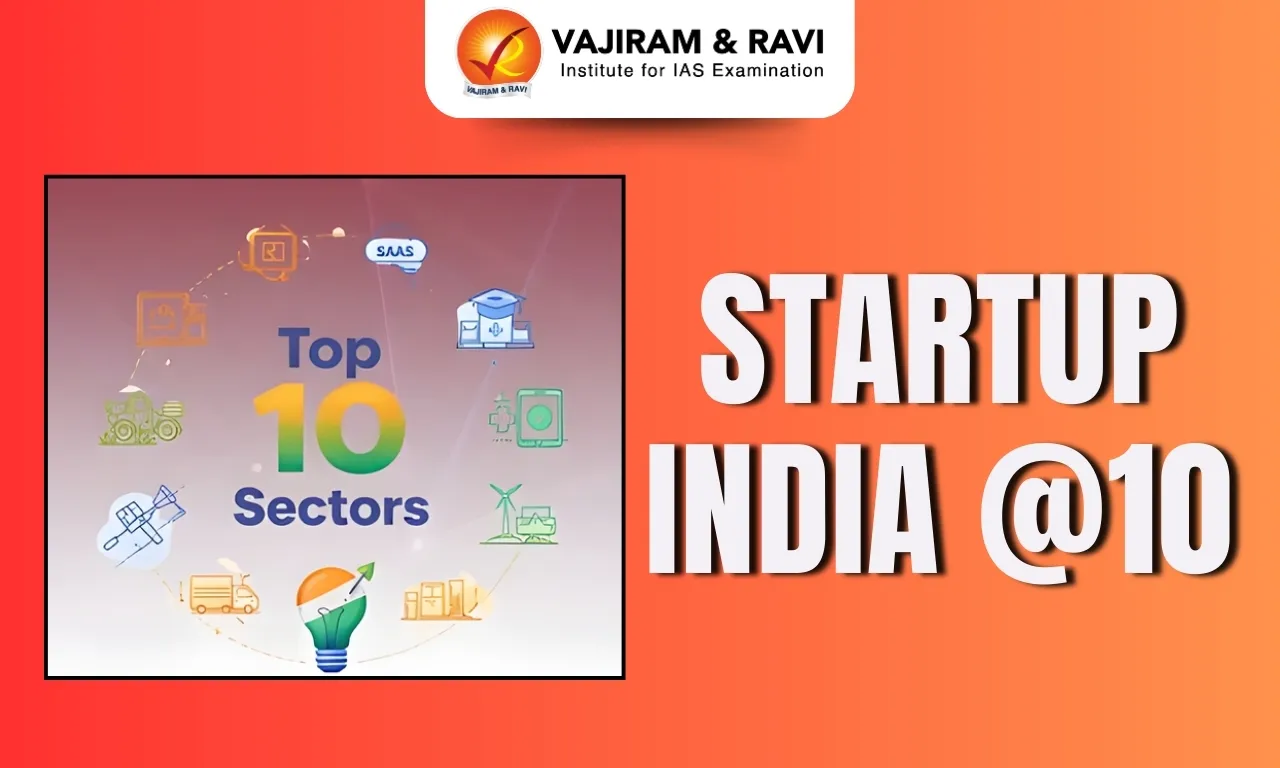
Startup India @10 – From Policy Initiative to National Innovation Revolution

Startup India @10

Startup India @10 Latest News

  • On January 16, 2025 (National Startup Day), the Prime Minister of India addressed the startup ecosystem on the 10th anniversary of the Startup India scheme, launched on January 16, 2016
  • He highlighted record growth in startup registrations, changing attitudes towards risk-taking, and India’s ambition for global leadership in deep tech and indigenous AI.

The Startup India Scheme

  • It is a flagship Government of India initiative, launched in 2016, to foster a robust ecosystem for innovation and entrepreneurship, transforming India into a nation of job creators through support pillars
    • Simplification & Handholding, 
    • Funding Support, and 
    • Incubation & Industry-Academia Partnership. 
  • It offers benefits like tax exemptions, easier compliance, seed funding, and mentorship to eligible startups, promoting economic growth and large-scale job creation. 

Key Highlights of Startup India’s Decade-long Journey

  • Record growth in startup ecosystem:
    • Nearly 44,000 startups registered in 2025 — highest annual addition since inception. India is now the 3rd largest startup ecosystem globally.
    • Growth trajectory: Less than 500 startups, and 4 unicorns in 2014. Over 2 lakh DPIIT-recognised startups, and about 125 active unicorns in 2025.
    • Impact: Startups → Unicorns → IPOs → creates a virtuous cycle of job creation, and innovation-led growth.
  • Cultural shift - Mainstreaming risk-taking:
    • Risk-taking is now socially accepted and respected, unlike earlier stigma. Shift from job-seeking mindset to job-creating mindset.
    • Expansion of entrepreneurship beyond elite families to middle class and poor - boosting entrepreneurial culture, risk capital, and demographic dividend.
  • Government support and funding ecosystem:
    • ₹25,000 crore invested via Fund of Funds for Startups (FFS).
    • Fund of Funds 2.0 (₹10,000 crore) approved in April 2025 to focus on deep tech sectors (Artificial Intelligence (AI), Machine Learning, Quantum technologies, Defence & Aerospace).
    • Objective: To provide patient risk capital due to long gestation periods.
  • Strategic focus on indigenous AI and manufacturing:
    • PM’s call for indigenous AI solutions developed by Indian talent and hosted on Indian servers (data sovereignty).
    • IndiaAI Mission: 38,000+ GPUs onboarded to democratise access to computing power.
    • Emphasis on: Manufacturing, global-standard products, and leadership in new technologies (not mere partnerships) - boosting strategic autonomy, economic security, and data sovereignty.
  • Inclusivity in the startup revolution:
    • Women-led startups: For example, over 45% recognised startups have at least one woman director/partner. India is the 2nd largest ecosystem of women-led startups globally.
    • Geographical spread: Rapid rise in tier-2, tier-3 cities and rural areas. Focus on solving local and grassroots problems - promoting inclusive growth, women entrepreneurship, and regional balance.
  • Regulatory reforms and ease of doing business:
    • Jan Vishwas Act: Decriminalised over 180 provisions - promoting Ease of Doing Business, and trust-based governance.
    • Key enablers: Self-certification under multiple laws, simplified mergers and exits, and reduction in Inspector Raj.
    • Innovation ecosystem strengthened through Atal Tinkering Labs, hackathons, and incubation support.
  • Sectoral breakthroughs enabled by policy support:
    • Defence and space: iDEX enabled startup participation in defence procurement. The space sector opened to private players, with about 200 space startups gaining global approvals.
    • Drone sector: Removal of outdated rules unlocked innovation.
    • Government e-Marketplace (GeM): Nearly 35,000 startups and small businesses are onboarded on GeM, and have received more than 5 lakh orders worth over Rs 50,000 crore, highlighting public procurement reforms.

Challenges and Way Ahead

  • Sustaining funding: During global economic uncertainties. Expand access to risk capital and advanced infrastructure (GPUs, labs).
  • Bridging deep tech talent and R&D gaps: Strengthen deep tech ecosystems through academia–industry collaboration. Integrate startups with national missions (AI, defence, space, climate tech).
  • Ensuring quality scale-up: Enhance domestic manufacturing under startup-led innovation.
  • Managing cybersecurity: Ensuring data governance in AI-driven growth.
  • Avoiding regional and sectoral concentration: Focus on export-oriented and globally competitive startups.

Conclusion

  • As India marks a decade of the Startup India Initiative, the country’s startup ecosystem stands at an inflection point - moving decisively from rapid expansion to sustainable scale and deeper integration with the real economy.
  • It represents not merely scale, but structural transformation built on demographic advantage, digital public infrastructure, and a sustained reform agenda. 
  • As India advances towards a $7.3 trillion economy by 2030 and the broader vision of Viksit Bharat 2047, startups are poised to remain central to the country’s development trajectory.

Source: TH | IE

Startup India @10 FAQs

Q1: How has the Startup India scheme transformed India’s entrepreneurial ecosystem over the last decade?

Ans: A cultural and structural shift from job-seeking to job-creation, expanding startups and making India the world’s third-largest startup ecosystem.

Q2: Why is the government focusing on deep-tech startups under the Fund of Funds 2.0?

Ans: They require patient risk capital due to long gestation periods and are critical for India’s strategic autonomy in AI, defence.

Q3: What is the significance of indigenous AI development for India’s economic and strategic security?

Ans: Indigenous AI developed by Indian talent on Indian servers strengthens data sovereignty, reduces external dependence.

Q4: How has regulatory reform contributed to the success of India’s startup ecosystem?

Ans: Measures like the Jan Vishwas Act, self-certification, have lowered compliance burden and fostered trust-based innovation.

Q5: What is the role of inclusivity in strengthening India’s startup revolution?

Ans: Increased participation of women, rural youth, and tier-2/3 cities has broadened innovation, and ensured regional balance.
Pax Silica and MSP: Why India Joined Late

Pax Silica

Pax Silica Latest News

  • India’s belated induction into US-led initiatives like Minerals Security Partnership and Pax Silica has evoked a sense of déjà vu among policymakers. 
  • As with MSP—where India joined a year after launch—its entry into Pax Silica came after the initiative was already underway, seen largely as a conciliatory gesture amid efforts to steady bilateral ties.
  • The significance lies in what these groupings signal about the emerging global tech order, especially as countries reorganise supply chains in strategic sectors with Chinese presence.
  • Platforms like Pax Silica could shape rules by addressing chokepoints in inputs such as magnets and critical minerals—effectively determining where leverage will sit.
  • India’s initial exclusion, followed by a late inclusion, carries a subtle message: strategic goodwill alone may not suffice. 
  • To be a partner of first choice in US-led initiatives, India must be seen as bringing tangible capabilities and value to the table in shaping resilient, rules-setting supply chains.

About Pax Silica

  • Pax Silica is a US-led strategic initiative aimed at countering China’s dominance in next-generation technologies. 
  • It seeks to reduce “coercive dependencies” and protect materials and capabilities foundational to artificial intelligence, enabling aligned nations to develop and deploy transformative technologies at scale.

Objectives and Scope

  • According to the US State Department, Pax Silica is designed to build a secure, prosperous, and innovation-driven silicon supply chain.
  • It aims to ensure access across the entire AI stack—from critical minerals and semiconductor chips to security and logistics infrastructure.

Key Thrust Areas Under Pax Silica

  • Under Pax Silica, participating countries aim to:
    • Pursue joint ventures and strategic co-investments
    • Protect sensitive technologies and critical infrastructure from undue foreign control
    • Build trusted technology ecosystems spanning ICT systems, fibre-optic cables, data centres, foundational AI models, and applications

Founding Members and Their Strengths

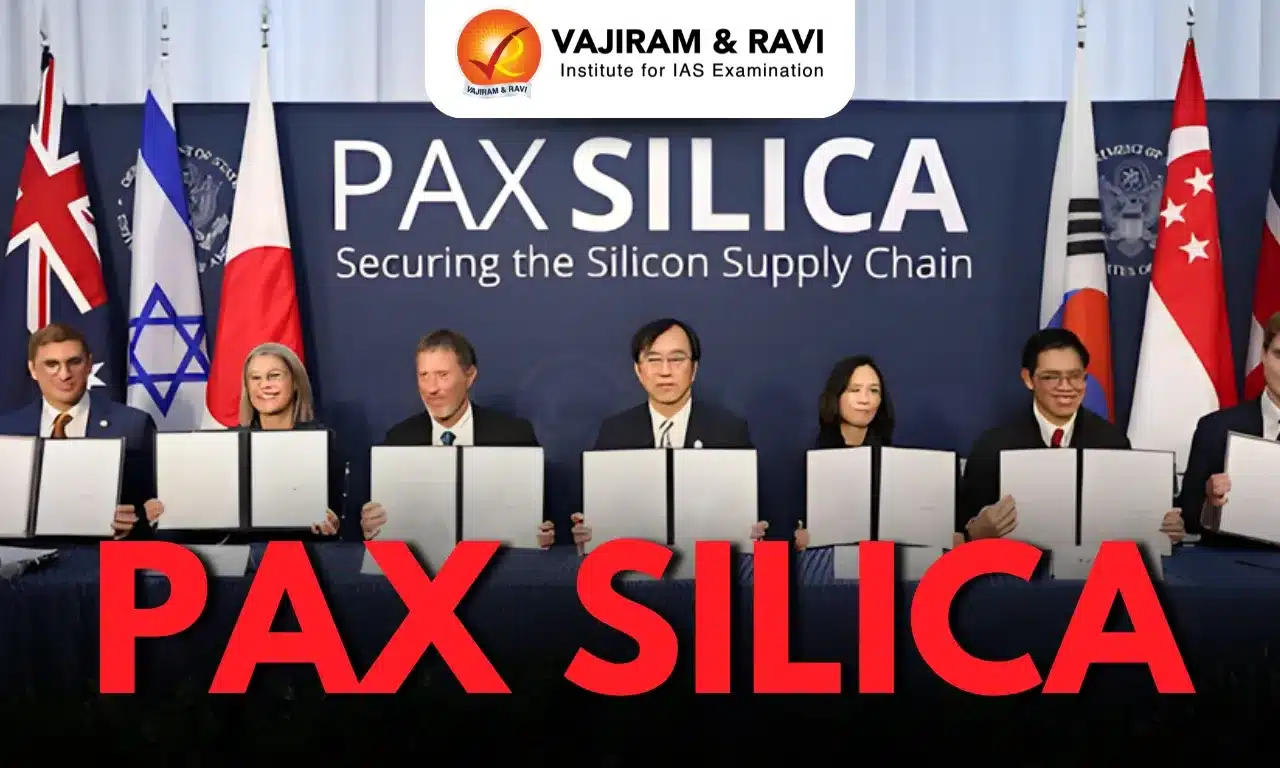
  • The inaugural Pax Silica Summit brought together Japan, the Republic of Korea, Singapore, the Netherlands, the United Kingdom, Israel, the United Arab Emirates, and Australia
  • These countries collectively host key companies and investors that power the global AI and semiconductor supply chain, reflecting their technological or resource-based leverage.

Why India Was Initially Excluded from Pax Silica

  • Pax Silica aims to secure supply chains spanning critical minerals, energy inputs, advanced manufacturing, and semiconductors. 
  • India’s initial absence reflects perceptions that it lacks decisive edge technologies or control over key resources central to the grouping’s objectives.

What the Selected Countries Bring

  • Each of the eight founding members offers a distinct strategic advantage:
    • The Netherlands controls specialised lithography machines vital for chipmaking.
    • Japan and South Korea bring deep technology and manufacturing expertise.
    • Australia contributes critical mineral reserves and mining capabilities.
    • Israel is a global innovation and technology hub.
    • Singapore serves as a major transhipment and logistics hub.
    • The UK offers strengths in services and technology.
    • The UAE has rapidly built AI capabilities and supporting infrastructure.

A Familiar Pattern from MSP

  • A similar logic shaped the initial membership of the Minerals Security Partnership, where early partners included countries with clear mineral, technology, or institutional advantages. 
  • India joined later, despite its efforts to position itself as a node in global supply-chain realignment as firms diversify away from China.

The Takeaway for India

  • The common thread among the founding members is a tangible lead in AI or semiconductor supply chains—an area where India currently lacks comparable processing capacity and expertise. 
  • As with earlier initiatives such as the MSP, this gap explains India’s absence at the outset.
  • The exclusion underscores a consistent message: entry into US-led strategic groupings hinges on demonstrable capabilities and leverage—not just intent. 
  • To be a first-choice partner, India must strengthen its control over critical inputs, technologies, or platforms that shape supply-chain rules.

Shared Challenge: China’s Critical Minerals Dominance

  • Experts point out that China’s dominance in critical minerals has created sharp global price gaps, disadvantaging non-Chinese supply chains. 
  • While this opens space for India to attract US investment, it also raises risks of Chinese coercion as India deepens alignment with Washington.
  • US Treasury Secretary Scott Bessent framed China’s export controls as “China versus the rest of the world,” calling for support from Europe, India, and Asian democracies.
  • Despite this rhetoric and shared concerns, India remained outside Pax Silica’s initial list, underscoring a gap between strategic alignment and perceived capabilities.

Source: IE | IE

Pax Silica FAQs

Q1: What is Pax Silica?

Ans: Pax Silica is a US-led initiative to secure AI and semiconductor supply chains by reducing dependence on China and coordinating trusted partners across minerals, chips, and logistics.

Q2: Why is Pax Silica important for India?

Ans: Pax Silica matters for India because it signals where future leverage in AI, semiconductors, and critical minerals will lie as countries reshape global technology supply chains.

Q3: Why did India join Pax Silica late?

Ans: India joined Pax Silica late because it lacks strong processing capacity, edge technologies, and control over critical inputs compared to founding members with established leverage.

Q4: How is Pax Silica similar to MSP?

Ans: Pax Silica mirrors MSP in prioritising countries with tangible capabilities in minerals and technology, where India was initially excluded and later admitted after diplomatic lobbying.

Q5: What is the key lesson from Pax Silica for India?

Ans: Pax Silica shows India must build concrete capabilities in critical minerals, processing, and advanced manufacturing to be a first-choice partner in US-led strategic groupings.

POCSO Law and Romeo-Juliet Exception: SC’s Rethink

Pocso Law

Pocso Law Latest News

  • The Supreme Court of India has urged the Union Law Secretary to consider steps to prevent the misuse of the Protection of Children from Sexual Offences (POCSO) Act, 2012, particularly in cases involving consensual adolescent relationships.
  • While setting aside an Allahabad High Court order on age determination in a bail matter, a bench of Justices recommended exploring a “Romeo-Juliet clause”. 
  • Such a provision would exempt consensual sexual activity between teenagers close in age from criminal prosecution, an approach followed in several countries, including the US.
  • The observation comes amid a pending public interest litigation on the age of consent and reflects growing judicial concern over the blanket criminalisation of consensual sexual acts between minors under the existing POCSO framework.

POCSO Act: Balancing Child Protection and Adolescent Autonomy

  • Under the Protection of Children from Sexual Offences Act, 2012, anyone below 18 is considered a child, and the law does not recognise consent by minors.
  •  As a result, all sexual activity involving a minor is criminalised, irrespective of whether it is consensual or non-exploitative.
  • In its recent judgment, the Supreme Court of India acknowledged that while POCSO is a “solemn articulation of justice” aimed at protecting children from abuse, its misuse has created a “grim societal chasm”. 
  • The court observed that the law is often invoked by families to oppose consensual relationships between adolescents, raising concerns about over-criminalisation and the denial of young people’s autonomy.

Growing Momentum for Reform

  • The demand to amend the Protection of Children from Sexual Offences Act, 2012 has gained renewed traction through a pending public interest litigation before the Supreme Court of India concerning safeguards for women in sexual offence prosecutions.

Arguments for Adolescent Autonomy

  • Senior Advocate Indira Jaising, assisting the court as amicus curiae, has argued for either reading down the age of consent or introducing statutory exceptions. 
  • In her submissions, she contended that blanket criminalisation violates adolescents’ fundamental rights under Articles 14, 15, 19, and 21 of the Constitution.

‘Evolving Capacity’ and the Mature Minor Doctrine

  • Jaising maintained that adolescents aged 16–18 possess an “evolving capacity” to make informed decisions about sexual autonomy. 
  • Drawing on the common law “mature minor” doctrine, she argued that treating all under-18s as incapable of consent ignores scientific realities, including the biological onset of puberty.

Proposal for a Close-in-Age Exception

  • To address misuse of the law, Jaising proposed a “close-in-age” or “Romeo-Juliet” exception. 
  • Under this approach, consensual relationships between adolescents close in age—such as a 16- and 17-year-old—would not attract criminal liability, preventing unnecessary incarceration under the POCSO framework.

Union Government’s Case for Retaining the Existing Law

  • The Union Government of India has opposed any reduction in the age of consent or the creation of legislative exceptions under the POCSO Act, 2012. 
  • In its submissions before the Supreme Court of India, it argued that fixing the age of consent at 18 is a deliberate and carefully considered choice to provide an absolute protective shield for children.

Rationale: Vulnerability and Strict Liability

  • The government maintained that minors lack the legal and developmental capacity to give meaningful consent. 
  • It defended the Act’s strict liability framework—where consent is irrelevant—on the ground that children are especially vulnerable to manipulation and coercion by adults, including those in positions of trust.

Concerns Over Dilution and Misuse

  • According to the government, introducing exceptions or lowering the age of consent could create loopholes that allow child abuse and trafficking to be disguised as consensual relationships. 
  • Diluting the age threshold, it warned, would revive the very mischief the law was enacted to address.

Preference for Judicial Discretion

  • The Centre argued that relief in hard cases should come through judicial discretion exercised on a case-by-case basis, rather than through statutory dilution of protections built into the law.

Law Commission’s View

  • In 2023, the Law Commission of India also advised against lowering the age of consent to 16. 
  • However, it acknowledged the concern by recommending guided judicial discretion in sentencing for cases involving tacit consent by adolescents aged 16–18, instead of creating a blanket statutory exception.

Data Highlights Misuse and Unintended Consequences of POCSO

  • Empirical evidence supports judicial concerns over the application of the POCSO Act, 2012. 
  • A study by Enfold Proactive Health Trust and UNICEF found that nearly 25% of POCSO cases in Maharashtra, Assam, and West Bengal between 2016 and 2020 involved consensual “romantic” relationships between adolescents.
  • The data indicates frequent misuse of the law by families to control daughters’ choices, particularly in inter-caste or inter-religious relationships. 
  • Beyond legal misuse, the criminalisation of adolescent sexuality has serious public health implications. 
  • Mandatory reporting under POCSO compels doctors to inform police about underage pregnancies or sexual activity, discouraging adolescents from accessing essential sexual and reproductive healthcare due to fear of prosecution.

Conclusion

  • The Supreme Court’s recent judgment underscored that this problem cannot be resolved through case-by-case discretion alone. 
  • It signalled the need for a structural legislative solution, warning that when a law designed to protect children is misused as “a tool for exacting revenge”, the very idea of justice risks being inverted.

Source: IE | NDTV

[youtube url="https://www.youtube.com/watch?v=U3-iN2NjNeQ" width="560" height="315"]

Pocso Law FAQs

Q1: Why is the POCSO law under scrutiny?

Ans: The POCSO law is under scrutiny because it criminalises all sexual activity involving minors, including consensual adolescent relationships, leading to misuse and unjust prosecutions.

Q2: What is a Romeo-Juliet exception in POCSO law?

Ans: A Romeo-Juliet exception in POCSO law would exempt consensual sexual relationships between adolescents close in age from criminal liability for statutory rape.

Q3: What did the Supreme Court observe about POCSO law?

Ans: The Supreme Court said the POCSO law, though meant to protect children, is often misused by families, creating a societal chasm and criminalising adolescent autonomy.

Q4: What arguments support reforming the POCSO law?

Ans: Reform advocates argue the POCSO law violates adolescents’ fundamental rights, ignores evolving capacity, deters healthcare access, and leads to incarceration in non-exploitative cases.

Q5: Why does the government oppose changes to the POCSO law?

Ans: The government says strict POCSO law protections are essential to prevent child abuse, warning that exceptions could create loopholes enabling exploitation and trafficking.

Guidelines on Religious Structures in Wildlife Sanctuaries

Wildlife Sanctuaries

Wildlife Sanctuaries Latest News

  • An apex wildlife advisory body has prepared draft guidelines regulating the diversion of forest land inside wildlife sanctuaries for religious structures. 

Background: Protected Areas and Legal Framework in India

  • India’s wildlife sanctuaries and national parks are governed under the Wildlife (Protection) Act, 1972, which aims to protect wildlife habitats from human-induced pressures. 
  • Any non-forest activity within protected areas is highly regulated and generally discouraged unless it meets strict conservation criteria.
  • Additionally, the Forest (Conservation) Act, 1980, places restrictions on the diversion of forest land for non-forest purposes. 
  • As per this law, forest land diversion after 1980 requires explicit approval from the central government, reinforcing the principle that ecological protection must take precedence over development or encroachment.

Role of the National Board for Wildlife

  • The Standing Committee of the National Board for Wildlife (SCNBWL) is an apex advisory body under the Ministry of Environment, Forest and Climate Change. 
  • It evaluates proposals related to infrastructure and land-use changes within protected wildlife habitats.
  • The Committee’s recommendations play a critical role in determining whether activities within sanctuaries align with conservation objectives. 
  • The formulation of guidelines on religious structures falls within this mandate, given the potential ecological consequences of such constructions.

Context for Framing the Guidelines

  • The issue gained prominence following a proposal involving the Balaram Ambaji Wildlife Sanctuary in Gujarat, where diversion of forest land was sought for a religious establishment. 
  • Although initial approval was granted, it was later revoked after concerns were raised about the absence of recorded forest rights and the risk of setting a precedent.
  • This episode highlighted the lack of a uniform framework to assess similar proposals across States. 
  • It also exposed governance gaps in cases where religious sites exist within forested areas but lack legal recognition in settlement records.

Key Provisions of the Draft Guidelines

  • The draft guidelines prepared by the apex wildlife body lay down the following principles:
    • Post-1980 constructions on forest land are to be treated as encroachments as a general rule.
    • Regularisation of existing structures may be considered only in exceptional cases where the State government provides a reasoned and documented justification.
    • Expansion of religious structures within sanctuaries is generally prohibited. Limited expansion may be allowed only if required for managing ecological conflict or essential public utilities.
    • Case-by-case scrutiny is mandated, with final decisions resting with the central government after ecological assessment.
  • These guidelines are currently under deliberation by State governments before final adoption. 

Balancing Faith, Ecology, and Governance

  • India’s forests often contain sacred groves, caves, and pilgrimage sites that predate modern conservation laws. 
  • While cultural and religious practices are constitutionally protected, they cannot override environmental safeguards in ecologically sensitive zones.
  • Unchecked construction can fragment habitats, increase human-wildlife conflict, and undermine conservation goals. 
  • The guidelines seek to strike a balance by recognising historical presence without legitimising fresh encroachments or large-scale development.

Implications for Wildlife Conservation

  • If implemented effectively, the guidelines can:
    • Prevent gradual erosion of protected areas through incremental construction.
    • Establish uniform standards for States when dealing with sensitive land diversion requests.
    • Strengthen the legal position of conservation authorities in resisting non-essential activities inside sanctuaries.
  • However, inconsistent enforcement or political pressure could dilute their impact, making monitoring and transparency crucial.

Source: TH

Wildlife Sanctuaries FAQs

Q1: Which body prepared the guidelines on religious structures in sanctuaries?

Ans: The Standing Committee of the National Board for Wildlife prepared the draft guidelines.

Q2: What is the general rule for constructions on forest land after 1980?

Ans: Such constructions are to be treated as encroachments.

Q3: Are new religious structures allowed inside wildlife sanctuaries?

Ans: No, new constructions are generally prohibited under the draft guidelines.

Q4: When can limited expansion be considered?

Ans: Only in exceptional cases for mitigating ecological conflict or managing essential public utilities.

Q5: Why are these guidelines significant for conservation?

Ans: They prevent precedent-setting land diversion that could weaken protection of wildlife habitats.

Enquire Now