India–EU Strategic Agenda 2030: Key Pillars and Priorities

India–EU Strategic Agenda Latest News

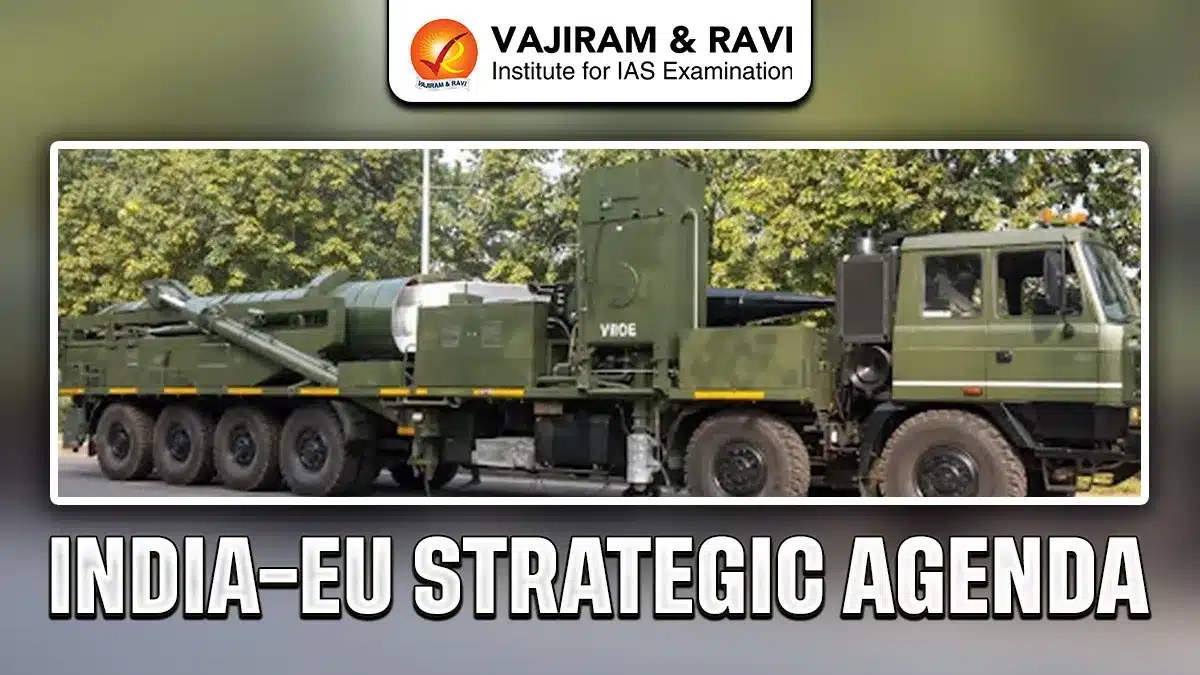
  • India and the European Union have agreed to deepen their partnership by adopting the “Towards 2030: India–EU Joint Comprehensive Strategic Agenda.” 
  • The agenda was adopted during talks between Prime Minister Narendra Modi and visiting European leaders Ursula von der Leyen and Antonio Costa.

India–EU Joint Comprehensive Strategic Agenda (Towards 2030): Key Takeaways

  • This Joint India-EU Comprehensive Strategic Agenda was endorsed at the 16th India-EU Summit.
  • It aims to further reinforce the strategic partnership by broadening, deepening and better coordinating EU-India cooperation to deliver mutually beneficial, concrete and transformative outcomes for both partners and for the wider world.
  • This agenda is being described as a more ambitious and holistic roadmap for the next five years, aimed at providing clear direction in a complex global environment.
  • Five Key Pillars of Cooperation
    • The Joint Comprehensive Strategic Agenda seeks to accelerate progress across five pillars:
      • Prosperity and sustainability
      • Technology and innovation
      • Security and defence
      • Connectivity and global challenges
      • Enablers, including skills, mobility, business cooperation, and people-to-people ties
  • Trade, Investment, and Economic Cooperation
    • Reaffirmation of trade and economic ties as the foundation of the partnership.
    • Timely implementation of the India–EU Free Trade Agreement (FTA).
    • Conclusion of Investment Protection Agreement and Geographical Indications (GI) Agreement.
    • Enhanced financial services regulatory cooperation, customs cooperation, and macroeconomic dialogue.
    • Scaling up Global Gateway investments with EIB participation.
  • Supply Chains and Economic Security
    • Cooperation on strategic value chains and economic security under the Trade and Technology Council (TTC).
    • Implementation of EU–India Semiconductor MoU; collaboration on R&D, chip design, and manufacturing.
    • Cooperation on critical minerals, APIs, agrifood supply chains, and biotechnology.
  • Clean Transition and Resilience
    • Strengthening Clean Energy and Climate Partnership.
    • Cooperation on renewables (wind, hydrogen), sustainable mobility, railways, ship recycling, smart cities.
    • Collaboration on carbon markets (CCTS–ETS), industrial decarbonisation, circular economy, water security.
    • Enhanced cooperation on health systems, disaster risk management, and climate adaptation.
  • Critical and Emerging Technologies
    • Joint research in AI, quantum, semiconductors, clean tech, biotech.
    • Establishment of India–EU Innovation Hubs and Startup Partnership.
    • Cooperation on trustworthy, human-centric AI, HPC, space technologies, and critical technology protection.
  • Digital Cooperation
    • Building a secure, interoperable digital ecosystem.
    • Cooperation on data protection, digital public infrastructure (DPI), telecom (6G), e-commerce.
    • Exploring interoperability of digital wallets and electronic signatures.
  • Research Collaboration
    • Deepening engagement under Horizon Europe; exploring India’s association.
    • Cooperation in peaceful nuclear research, semiconductors, advanced materials, and ITER.
  • Security and Defence Partnership
    • Implementation of India–EU Security and Defence Partnership (SDP).
    • Annual Security and Defence Dialogue; agreement on Security of Information.
  • Defence Industrial Cooperation
    • Industry-led India–EU Defence Industry Forum.
    • Exploring cooperation under relevant EU defence initiatives.
  • Regional and Global Security
    • Cooperation for a free, open, and rules-based Indo-Pacific.
    • Engagement through IPOI, IORA, IOC, and consultations on the Indo-Pacific.
    • Dialogue on global issues, including Ukraine.
  • Countering Threats
    • Cooperation against terrorism, hybrid threats, cyber risks, drug trafficking.
    • Strengthened law enforcement cooperation (CBI–Europol, SIENA).
  • Connectivity
    • Implementation of EU–India Connectivity Partnership (Global Gateway, MAHASAGAR).
    • Deepening collaboration under IMEC, digital corridors, green shipping, aviation dialogue.
  • Cooperation in Third Countries
    • Trilateral projects in energy, climate resilience, green mobility, digitalisation.
    • Cooperation through International Solar Alliance and CDRI.
  • Global Governance
    • Coordination in UN, G20, and reform of multilateral institutions (UN, WTO).
    • Cooperation on Paris Agreement, biodiversity, plastic pollution, maritime decarbonisation.
    • Engagement on AI governance, human rights, global health architecture.
  • Skills, Mobility, and People-to-People Ties
    • Skills and talent mobility, European Legal Gateway Office in India.
    • Easier visas, student and researcher mobility (Erasmus+, MSCA, SPARC).
    • Recognition of qualifications and gender balance.
  • Mutual Understanding
    • Academic, think-tank, cultural, and diplomatic exchanges.
    • Dedicated Jean Monnet network for India.
  • Business and Institutional Mechanisms
    • EU–India Business Forum; stronger role for business in TTC.
    • Annual summits, strengthened dialogues, and monitoring via TTC and Strategic Dialogue.

Source: IE | MEA

India–EU Strategic Agenda FAQs

Q1: What is the India–EU strategic agenda?

Ans: The India–EU strategic agenda is a joint roadmap adopted in 2026 to deepen cooperation across prosperity, technology, security, connectivity and people-to-people ties.

Q2: Why was the India–EU strategic agenda adopted?

Ans: The India–EU strategic agenda was adopted to provide clear direction for partnership in a complex geopolitical environment and deliver mutually beneficial outcomes.

Q3: What are the main pillars of the India–EU strategic agenda?

Ans: The India–EU strategic agenda rests on prosperity and sustainability, technology and innovation, security and defence, connectivity and global challenges, supported by enablers.

Q4: How does the India–EU strategic agenda address technology cooperation?

Ans: The India–EU strategic agenda promotes collaboration in AI, semiconductors, quantum, digital public infrastructure, clean tech and secure digital ecosystems.

Q5: Why is the India–EU strategic agenda important globally?

Ans: The India–EU strategic agenda strengthens coordination on global governance, supply chains, climate action and multilateral reforms, reflecting shared strategic interests.
India-EU Free Trade Agreement – The ‘Mother of All Deals’

Trade Agreement

Trade Agreement Latest  News

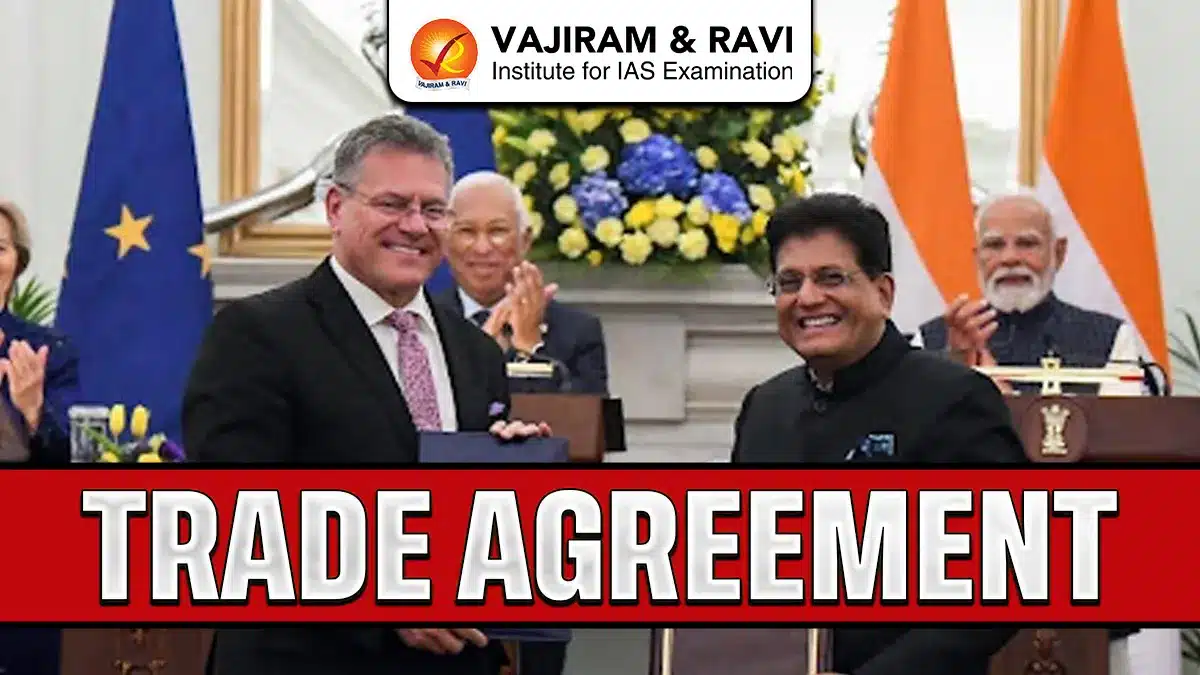
  • India and the European Union have concluded negotiations on a long-pending Free Trade Agreement (FTA), described by leaders as the “mother of all deals”.

Background of India-EU Trade Relations

  • India and the European Union are among the world’s largest economies and long-standing trading partners. 
  • The EU is India’s largest trading partner in goods, while India is a key market for EU exports and investments. 
  • Negotiations for a comprehensive trade agreement began in 2007 but faced repeated pauses due to differences over market access, regulatory standards, agriculture, automobiles, and services. 
  • Talks were revived in 2022 with a more pragmatic approach, leading to the conclusion of the FTA in January 2026 after nearly two decades.

Key Features of the India-EU Free Trade Agreement

  • The India-EU FTA is one of the most ambitious trade agreements signed by India to date, covering goods, services, and investment-related issues.
  • Tariff Liberalisation Commitments
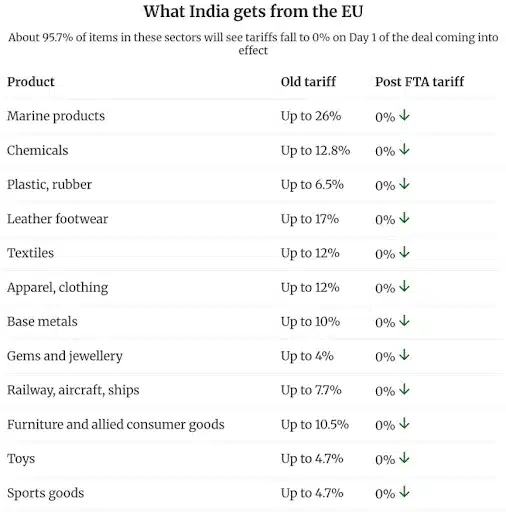
    • The EU has agreed to remove tariffs on 99.5% of the items India exports to the region, with most duties falling to zero immediately upon the agreement coming into force. 
    • On India’s side, tariff concessions have been offered on 97.5% of the traded value of EU exports, though with phased reductions for sensitive sectors. 
    • This asymmetrical liberalisation reflects India’s developmental concerns while ensuring substantial market access gains.

What India Gains from the Agreement

India’s Gains

  • India secures tariff reductions across 97% of tariff lines, covering 99.5% of trade value. 
  • About 90.7% of India’s exports will enjoy zero-duty access to the EU market from day one. 
  • Key beneficiaries include labour-intensive sectors such as textiles, apparel, leather and footwear, gems and jewellery, marine products, toys, sports goods, tea, coffee, and spices. 
  • These sectors are critical for employment generation and export-led growth.
  • The EU has also made commitments across 144 services subsectors, including IT and IT-enabled services, professional services, education, and business services. 
  • This enhances opportunities for Indian professionals and firms in a high-income market and strengthens India’s position in global value chains.

What India Has Conceded

EU’s Gains

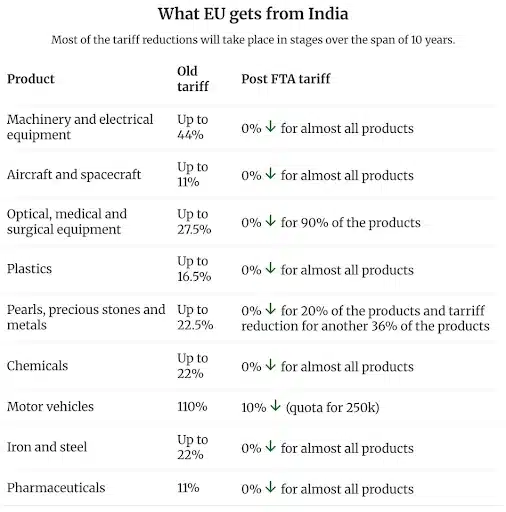
  • India has agreed to duty elimination or reduction on 92.1% of tariff lines, covering 97.5% of EU exports. 
  • Nearly half of these tariff lines will see immediate duty elimination, while others will be phased out over 5, 7, or 10 years. 
  • High-technology imports from the EU, such as machinery, electrical equipment, medical devices, pharmaceuticals, aircraft components, and precision instruments, are expected to reduce input costs for Indian industry and support manufacturing competitiveness.
  • Sensitive sectors like dairy and certain agricultural products have been excluded from full liberalisation to protect farmers’ livelihoods. 
  • Similarly, the EU has retained protections for products such as beef, sugar, rice, poultry, and milk powder.

Handling Sensitive and Contested Sectors

  • Automobiles and wine were among the most contentious issues. A compromise was reached through quota-based systems. 
  • India agreed to lower import duties on European cars priced above Rs. 25 lakh from 110% to as low as 10%, subject to quotas and price-based categories. 
  • For wines, tariffs will be reduced from 150% to 20-30%, again under a quota mechanism. 
  • This approach balances consumer access and domestic industry protection.

Strategic and Geopolitical Significance

  • For the EU, it reduces over-dependence on a limited set of global suppliers and strengthens supply chain resilience amid geopolitical uncertainties. 
  • For India, the agreement reinforces its image as a reliable economic partner and complements initiatives such as ‘Make in India’ and ‘Atmanirbhar Bharat’ by integrating domestic manufacturing with global markets.

Ratification and Implementation Process

  • The concluded text will undergo legal scrubbing and translation before being sent to all 27 EU member states. 
  • Ratification by the European Parliament is required before the agreement enters into force. This process underscores the institutional complexity of EU trade governance.

Conclusion

  • The India-EU Free Trade Agreement marks a watershed moment in India’s trade diplomacy. 
  • By opening markets while safeguarding sensitive sectors, the pact promises to boost exports, attract investment, generate employment, and deepen strategic ties between the two major economic blocs. 
  • Its successful implementation could serve as a template for India’s future trade agreements in an increasingly fragmented global trade environment.

Source: TH | ET

Trade Agreement FAQs

Q1: What is the India-EU Free Trade Agreement?

Ans: It is a comprehensive trade pact liberalising goods and services trade between India and the European Union.

Q2: Why is the India-EU FTA called the ‘mother of all deals’?

Ans: It is India’s largest and most ambitious FTA, covering nearly all traded goods and many services sectors.

Q3: Which Indian sectors benefit the most from the agreement?

Ans: Labour-intensive sectors such as textiles, leather, footwear, gems and jewellery, and marine products gain maximum benefits.

Q4: How are sensitive sectors protected under the FTA?

Ans: Sensitive areas like dairy, agriculture, automobiles, and wine are managed through exclusions or quota-based tariff reductions.

Q5: What is the strategic importance of the India-EU FTA?

Ans: It strengthens supply chain resilience, reduces strategic dependencies, and deepens India–EU economic and geopolitical cooperation.

UGC Equity Regulations 2026: Caste Discrimination Rules Explained

UGC Equity Regulations

UGC Equity Regulations Latest News

  • The University Grants Commission (UGC) recently notified new regulations to address discrimination, including caste-based bias, in higher education institutions. 
  • The move followed intervention by the Supreme Court of India after petitions filed by the mothers of Rohith Vemula and Payal Tadvi, who died by suicide in 2016 and 2019 amid allegations of caste-based discrimination.
  • These rules are an updated version of the UGC’s earlier “equity” regulations issued in 2012. 
  • However, they have triggered opposition from some quarters, who argue that the provisions could lead to harassment of general category students.

UGC Notifies New Promotion of Equity Regulations, 2026

  • The UGC has notified the University Grants Commission (Promotion of Equity in Higher Education Institutions) Regulations, 2026. 
  • The regulations aim to eradicate discrimination in higher education on grounds such as religion, race, gender, place of birth, caste, or disability.
  • The particular focus is on protecting Scheduled Castes, Scheduled Tribes, socially and educationally backward classes, economically weaker sections, and persons with disabilities, while promoting equity and inclusion.
  • These rules replace the earlier 2012 Promotion of Equity Regulations and apply to all higher education institutions. 
  • They establish a defined structure and procedure for filing and addressing complaints related to discrimination within campuses.

How Will the New UGC Regulations Be Implemented

  • To operationalise the Promotion of Equity Regulations, 2026, the University Grants Commission has mandated a three-tier institutional mechanism in all higher education institutions.

Equal Opportunity Centre (EOC)

  • Every institution must establish an Equal Opportunity Centre to oversee policies for disadvantaged groups.
  • The EOC will coordinate with district administration and police and facilitate legal aid when required.
  • It will comprise five faculty members, with no category-wise reservation mandated.
  • If a college lacks five faculty members, the university-level EOC of its affiliating university will perform these functions.

Equity Committee

  • The EOC will be supported by a 10-member Equity Committee, chaired by the head of the institution.
  • Five members must belong to reserved categories—OBCs, Scheduled Castes, Scheduled Tribes, Persons with Disabilities, and women.
  • The committee must meet within 24 hours of receiving a complaint and submit its report within 15 days.
  • The head of the institution is required to initiate action within seven days of receiving the report.

Equity Squads and Helpline

  • Institutions must constitute Equity Squads to maintain vigilance and prevent discrimination on campus.
  • These squads are expected to remain mobile and regularly visit vulnerable spots.
  • A 24-hour Equity Helpline must be set up to report discrimination.
  • Institutions are also required to appoint Equity Ambassadors, tasked with promoting awareness and acting as “torch bearers” of equity.

How Do the 2026 UGC Regulations Differ from the 2012 Rules

  • Nature of the Regulations
    • 2012 Regulations: Largely advisory, stating that punishment should be proportionate to the discrimination or harassment, without clearly defined enforcement mechanisms.
    • 2026 Regulations: Mandatory and enforceable, with clear structures, procedures, and penalties for non-compliance.
  • Enforcement and Penalties
    • 2012: No provision for action against institutions that failed to comply with the regulations.
    • 2026: The UGC can monitor implementation through a national-level monitoring committee and take punitive action against defaulting institutions, including:
      • Debarring them from UGC schemes
      • Restricting them from offering degree or online programmes
      • Removing eligibility for central grants
  • Institutional Mechanisms
    • 2012: Provided for Equal Opportunity Cells but did not specify their composition or detailed procedures for handling discrimination cases. Mandated an Anti-Discrimination Officer, with an appeal to the head of the institution.
    • 2026: Introduces a detailed, multi-tier mechanism—Equal Opportunity Centres, Equity Committees, and Equity Squads—with clearly defined roles, composition, and time-bound procedures.
  • Complaint Handling and Procedures
    • 2012: Lacked clarity on complaint registration, timelines, and disposal mechanisms.
    • 2026: Lays down elaborate procedures for filing, examining, and resolving complaints, with fixed timelines at each stage.
  • Coverage of Social Groups
    • 2012: Focused mainly on Scheduled Castes and Scheduled Tribes, with no explicit mention of Other Backward Classes (OBCs).
    • 2026: Explicitly covers OBCs, along with SCs, STs, persons with disabilities, women, and other disadvantaged groups, reflecting a broader and more inclusive approach.

Controversy Over the New UGC Regulation

  • Critics argue that the rules could lead to harassment of students from the general category and deepen caste-based divisions within campuses.
  • One of the main objections is the absence of penalties for “false complaints of discrimination”
    • Critics claim that without such a provision, the regulations could be misused, while institutions may face punitive action for non-compliance.
  • They allege that the regulations are unfair to general category students and that they promote caste-based divisions, particularly within the OBC community, for political purposes.

Source: IE | FP

UGC Equity Regulations FAQs

Q1: What are the UGC equity regulations 2026?

Ans: UGC equity regulations 2026 are new rules to prevent discrimination in higher education, focusing on caste, disability, gender and other forms of exclusion.

Q2: How do UGC equity regulations differ from 2012 rules?

Ans: Unlike advisory 2012 rules, UGC equity regulations are mandatory, enforceable and allow punitive action against institutions for non-compliance.

Q3: How are UGC equity regulations implemented on campuses?

Ans: UGC equity regulations mandate Equal Opportunity Centres, Equity Committees and Equity Squads with defined roles and strict timelines for complaint redressal.

Q4: Why did UGC equity regulations include OBCs?

Ans: UGC equity regulations explicitly include OBCs following objections to the draft and recommendations by parliamentary committees and student organisations.

Q5: What is the controversy over UGC equity regulations?

Ans: Critics argue UGC equity regulations may enable harassment of general category students, lack penalties for false complaints, and could deepen caste-based divisions.

India–EU Free Trade Agreement (FTA) – A Strategic Milestone in a Fragmenting Global Trade Order

India-EU Free Trade Agreement (FTA)

India-EU Free Trade Agreement (FTA) Latest  News

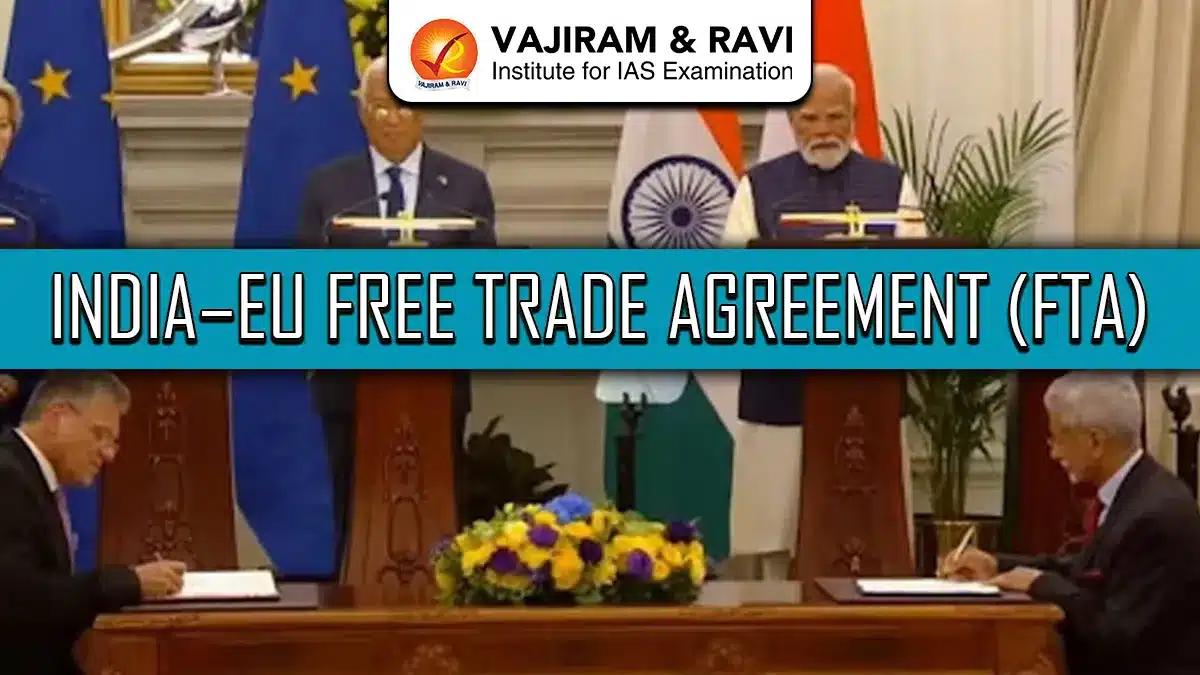
  • At the India–EU Leaders’ Summit, the Indian PM, European Council President António Luís Santos da Costa, and European Commission President Ursula von der Leyen announced the successful conclusion of negotiations of the India–EU Free Trade Agreement (FTA).
  • The agreement marks a major breakthrough in the India–EU Strategic Partnership, especially at a time of global trade uncertainty, tariff wars, and supply chain disruptions.

Significance of the India-EU FTA

  • India and the EU together account for approximately 25% of global GDP and over one-third of global trade.
  • The EU is India’s second-largest export destination after the US.
  • The FTA complements India’s recent trade agreements with the UK and European Free Trade Agreement (EFTA).

Key Components and Takeaways of the Agreement

  • Trusted strategic partnership:
    • Based on shared democratic values, rule of law, and human rights, highlighting India’s soft power, and diaspora diplomacy.
    • Strengthened by people-to-people ties, including 1.7 million Indian diaspora in the EU, and 1.21 lakh Indian students.
  • Economic complementarity, scale and diversity:
    • India (4th largest economy) and EU (2nd largest economy) are complementary rather than competitive.
    • Market integration opens unprecedented trade and investment opportunities.
  • Trade diversification, supply chain resilience, and de-risking: This will reduce excessive dependence on China-centric supply chains. It is critical amid US–China trade tensions and rising weaponisation of trade.
  • Commercially meaningful ‘Win–Win’ deal:
    • For India, major gains in labour-intensive sectors such as textiles & clothing, gems & jewellery, and leather & footwear. These sectors face high EU tariffs, making the FTA economically significant.
    • For the EU, India is a large, fast-growing market with relatively higher tariffs, giving the EU a significant advantage vis-a-vis its competitors (with India-EU FTA).
  • Safeguarding sensitive agriculture, food security: Core agriculture sectors excluded dairy, cereals, meat, select fruits and vegetables. This addresses concerns of farmers, a key political and electoral constituency.
  • Calibrated opening of the auto sector:
    • EU automakers allowed entry primarily in higher price segments, encouraging Make in India, future exports from India.
    • Auto sector liberalisation will benefit Indian consumers from technology transfer and competition.
  • Carbon Border Adjustment Mechanism (CBAM), green protectionism: Despite CBAM being a very sensitive and complex regulation, FTA provides most favoured treatment, dedicated technical dialogue, and EU support to India for climate transition.
  • Services as the future growth driver:
    • Services are expected to dominate bilateral trade growth, promoting services trade, digital economy, and mobility of professionals.
    • Key gains for India are certainty of market access, non-discriminatory treatment, boost to digitally delivered services, ease of mobility and social security coordination, and greater penetration of Indian talent and students.
  • Living agreement with review mechanisms:
    • Agreement designed as a “living document” includes periodic review clauses, consultation mechanisms for emerging technologies and regulations.
    • It relies on mutual trust and strong institutional stewardship.
  • Signal to global business and the US:
    • Projects India as a supporter of open, fair, stable, rule-based trading order.
    • Sends a strong message amid tariff wars, protectionism, unilateral trade actions (including by the US), promoting multilateralism, and trade certainty.

Challenges and Way Forward

  • Managing adjustment costs: In sensitive domestic sectors. Leveraging the FTA to boost manufacturing, services, and exports.
  • Aligning regulatory standards and compliance mechanisms: Effective implementation with capacity-building support.
  • Addressing CBAM-related competitiveness concerns: Using review mechanisms to adapt to technological and climate transitions.
  • Ensuring gains for MSMEs and small farmers: Strengthening domestic competitiveness through reforms.

Conclusion

  • The India–EU FTA is not merely a trade agreement but a strategic economic compact that reinforces India’s commitment to openness, diversification, and rule-based global trade. 
  • By balancing market access with protection of sensitivities, and embedding flexibility through a living framework, the agreement positions India as a reliable global economic partner in an era of uncertainty—making it a landmark step in India’s evolving trade diplomacy.

Source: IE

[youtube url="https://www.youtube.com/watch?v=naqsu4LXhbY" width="560" height="315"]

India-EU Free Trade Agreement (FTA) FAQs

Q1: How does the India-EU FTA strengthen India’s trade diversification strategy?

Ans: It reduces over-dependence on the US and China by expanding market access in the EU.

Q2: Why is the India–EU FTA described as a “commercially meaningful” agreement for India?

Ans: It offers substantial gains in labour-intensive sectors like textiles, leather, gems and jewellery by lowering high EU tariffs.

Q3: What is the significance of excluding core agricultural sectors from the India–EU FTA?

Ans: It safeguards farmer livelihoods and food security by respecting domestic sensitivities in sectors like dairy and cereals.

Q4: How does the India–EU FTA address concerns related to the CBAM?

Ans: It provides preferential treatment, institutionalised technical dialogue, and EU support to help India manage climate-related trade barriers.

Q5: In what ways does the India–EU FTA reinforce India’s position in the evolving global trade order?

Ans: It signals India’s commitment to an open, fair, and rule-based trading system amid rising protectionism and tariff wars.

Enquire Now