Enforcement Directorate (ED) – Can it File Writ Petitions Before Courts

Enforcement Directorate (ED)

Enforcement Directorate (ED) Latest News

  • Recently, the Supreme Court agreed to examine a significant constitutional question: Does the Enforcement Directorate (ED) have the locus standi to file writ petitions under Article 226 of the Constitution?
  • The issue arises from a long-running legal battle between the Union agency (ED) and State governments (Kerala and Tamil Nadu), with implications for Centre–State relations, federal balance, and the autonomy of investigative agencies.

Background of the Case

  • The controversy originates from the Kerala gold smuggling case (2020) involving diplomatic baggage from the UAE at Thiruvananthapuram airport.
  • The ED registered a case under the Foreign Exchange Management Act (FEMA), 1999, and the Prevention of Money Laundering Act (PMLA), 2002.
  • Allegations surfaced against senior Kerala officials, including the then CM. The ED approached the Kerala High Court seeking a writ of mandamus to access records, and a writ of certiorari to quash a State notification citing lack of jurisdiction.

What are Writ Petitions?

  • Meaning:
    • A writ petition is a formal request to a higher court (like Supreme Court under Article 32 of the Indian Constitution or High Courts under Article 226) for a court order (a "writ") to enforce fundamental rights or correct legal wrongs.
    • It provides an urgent remedy when standard legal avenues fail, typically compelling public authorities or lower courts to act lawfully or cease unlawful actions. 
  • Specific directives under writ petition:
    • Habeas Corpus (release from unlawful detention), 
    • Mandamus (commanding duty), 
    • Prohibition (stopping excess jurisdiction), 
    • Certiorari (quashing decisions), or 
    • Quo Warranto (challenging public office holding). 
  • Exemptions: 
    • Under Article 361 of the Constitution, a writ of mandamus cannot be issued against the President or the Governor of a State with respect to the exercise and performance of the powers and duties of their office. 
    • A writ also does not ordinarily lie against private individuals or bodies, except in cases where the state is alleged to have acted in collusion with a private party in violation of constitutional or statutory provisions.

Core Constitutional Question

  • Can the ED invoke writ jurisdiction under Article 226?
    • Article 226 empowers High Courts to issue writs for enforcement of fundamental rights and “any other purpose”.
    • Traditionally, it's being used by citizens, juristic persons, and bodies with enforceable legal rights.
    • The dispute is whether the ED qualifies as such an entity.
  • High Courts’ stand (Kerala & Madras HC):
    • Kerala HC (2021) and later the Madras HC held that the ED is a statutory body with independent powers, and its officers exercise quasi-judicial authority.
    • Therefore, the ED cannot be treated as a mere department of the Union. It has statutory capacity to approach courts.

Arguments by Kerala and Tamil Nadu Governments (Before Supreme Court)

  • The ED is not a juristic person, and is merely a department of the Union Government. Neither FEMA nor PMLA explicitly grant ED the power to sue.
  • Allowing ED to file writs undermines Article 131 (exclusive original jurisdiction of the Supreme Court in Centre–State disputes), and allows the Centre to bypass constitutional safeguards.
  • The Kerala government objected to the HC’s characterisation of its challenge to the maintainability of ED’s writ petition as a ‘trivial defect’.
  • It pointed out that the SC in the State of Andhra Pradesh vs Union of India (2012), and the Chief Conservator of Forests v. Collector (2003), held that only juristic persons can sue the governments.

Union Government or ED’s Defence

  • Writ petitions were filed by the Deputy Director (ED) in official capacity.
  • ED officers are not mere civil servants, they are statutorily empowered (under the PMLA and FEMA) to function as independent authority.
  • Hence, denying writ access would hamper effective enforcement, and create procedural roadblocks.

Supreme Court’s Observations

  • The issue (Whether ED can invoke Article 226) is substantial, not merely technical, and involves an important constitutional question of federal importance.
  • Hence, the matter has been referred for detailed hearing.

Challenges and Possible Implications

  • Challenges:
    • Blurring of federal boundaries between Centre and States.
    • Expansion of ED’s powers without explicit legislative backing.
    • Risk of executive overreach through constitutional remedies.
    • Potential dilution of Article 131’s exclusivity.
  • Possible implications:
    • If ED is allowed to file writs it may be placed on par with constitutional/statutory bodies like RBI, and enhances central investigative dominance.
    • If disallowed, Centre–State disputes may be confined strictly to Article 131, resulting in greater protection of State autonomy.

Way Forward

  • Legislative clarity: In FEMA/PMLA on ED’s legal personality.
  • Judicially evolved clear standards: On locus standi of Union agencies.
  • Reinforce: Cooperative federalism.
  • Ensuring investigative efficiency: Without constitutional overreach.

Conclusion

  • The Supreme Court’s decision will have far-reaching consequences for the scope of writ jurisdiction, and the institutional status of central investigative agencies.
  • This case is not merely about procedure, but about constitutional discipline, federalism, and limits on executive power.

Source: TH

Enforcement Directorate (ED) FAQs

Q1: What is the core constitutional issue in the dispute over the ED’s power to file writ petitions?

Ans: Whether the ED, being a statutory body and not a juristic person, has locus standi to invoke Article 226 of the Constitution.

Q2: Why do Kerala and Tamil Nadu argue that ED’s writ petitions violate the federal scheme of the Constitution?

Ans: Because allowing the ED to file writs enables the Union to bypass Article 131, thereby undermining the exclusive original jurisdiction of the SC.

Q3: How have HCs justified the maintainability of writ petitions filed by the ED?

Ans: HCs have held that the ED exercises statutory and quasi-judicial powers and is not merely a department of the Union government.

Q4: What is the difference between Articles 226 and 131?

Ans: Article 226 allows enforcement of legal rights before HCs, whereas Article 131 exclusively governs original jurisdiction disputes between the Union and States.

Q5: Why is the SC’s decision in this case significant for India’s federal structure?

Ans: The verdict will determine the constitutional limits of central investigative agencies and recalibrate the balance of power between the Centre and States.
New Solid Waste Management Framework – Explained

Solid Waste Management

Solid Waste Management Latest News

  • The Union government has notified the Solid Waste Management (SWM) Rules, 2026, making source-level processing of waste mandatory for bulk generators and local bodies across India.

Solid Waste Management in India: Status and Challenges

  • Solid waste management is a critical urban governance challenge in India, driven by rapid urbanisation, changing consumption patterns, and population growth. 
  • According to recent estimates, India generates about 1.85 lakh tonnes of solid waste per day, of which nearly 30-40% comes from bulk waste generators such as residential societies, commercial complexes, institutions, and government buildings.
  • Despite improvements in door-to-door collection and segregation under flagship initiatives like Swachh Bharat Mission (Urban), waste processing has lagged behind waste generation. 
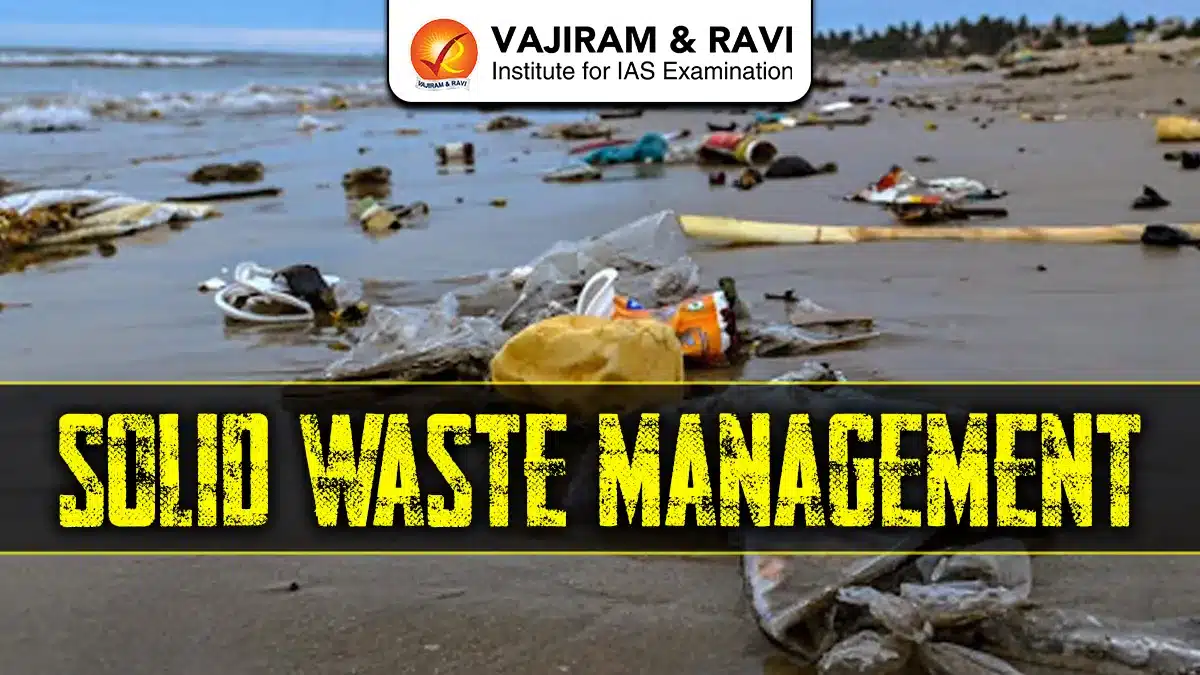
  • A significant share of collected waste continues to be dumped in landfills, leading to land degradation, groundwater contamination, air pollution, and public health risks. 
  • Poor segregation at source has been one of the most persistent bottlenecks, increasing the cost and inefficiency of downstream processing.

Regulatory Framework for Solid Waste Management

  • India’s solid waste governance is primarily guided by rules framed under the Environment (Protection) Act, 1986
  • The Solid Waste Management Rules, 2016 marked a shift from landfill-centric disposal to scientific waste management, emphasising segregation, decentralised processing, and waste-to-resource approaches.
  • Key features of the earlier framework included:
    • Mandatory segregation of waste at source
    • Responsibilities assigned to urban local bodies (ULBs) for collection and processing
    • Inclusion of bulk waste generators within regulatory oversight
    • Promotion of composting, biomethanation, and recycling
  • However, weak enforcement, limited institutional capacity of ULBs, and the absence of clear accountability mechanisms diluted the impact of these provisions. 
  • This regulatory gap has been addressed through the newly notified SWM Rules, 2026, which replace the decade-old regime.

News Summary

  • The Solid Waste Management Rules, 2026, notified by the Ministry of Environment, Forest and Climate Change, introduce a stricter compliance framework applicable from April 1
  • The most significant change is the mandatory processing of waste at source by bulk generators, who account for nearly one-third of India’s total solid waste.

Core Principles of the New SWM Framework

  • The revised framework is anchored in the concept of waste hierarchy, which prioritises:
    • Waste prevention and reduction, Reuse, Recycling, Recovery of energy and Disposal as a last resort
  • Landfills are to be used only for non-recyclable, non-recoverable, and inert waste, reinforcing the transition towards a circular economy. 
  • Higher landfill fees have been prescribed for unsegregated waste to discourage dumping and incentivise source-level processing.

Expanded Scope of Bulk Waste Generators

  • Entities qualifying as bulk waste generators include:
    • Buildings with a floor area of 20,000 sq. m. or more
    • Facilities consuming 40,000 litres of water per day or more
    • Entities generating 100 kg or more of waste per day
  • This covers residential societies, universities, hostels, commercial establishments, and central and state government institutions.

Mandatory Segregation Norms

  • The Rules prescribe four mandatory waste streams:
    • Wet waste, Dry waste, Sanitary waste and Special care waste (such as batteries, tube lights, and e-waste)
  • This detailed categorisation aims to improve recycling efficiency and reduce contamination.

Extended Bulk Waste Generator Responsibility

  • Bulk generators are required to:
    • Process wet waste on-site wherever feasible
    • Obtain an Extended Bulk Waste Generator Responsibility (EBWGR) certificate if on-site processing is not possible
    • Ensure environmentally sound collection, transport, and processing
  • A centralised online monitoring portal will enable real-time tracking and enforcement.
  • New Powers for Local Bodies
    • Local authorities in hilly and island regions have been empowered to levy user fees on tourists for waste management and regulate visitor numbers based on waste-handling capacity, recognising ecological fragility.

Significance of the New Rules

  • The 2026 Rules shift the burden of waste management away from urban local bodies towards waste generators themselves, improving accountability and reducing fiscal stress on municipalities. 
  • By directly targeting the largest contributors to urban waste, the framework is expected to significantly enhance processing rates and reduce landfill dependence.

Source : IE

Solid Waste Management FAQs

Q1: What is the main objective of the Solid Waste Management Rules, 2026?

Ans: To ensure segregation and processing of waste at source, especially by bulk waste generators.

Q2: Who qualifies as a bulk waste generator under the new rules?

Ans: Entities generating 100 kg/day of waste, or meeting specified building size or water-use criteria.

Q3: How many waste streams must be segregated at source?

Ans: Four streams: wet, dry, sanitary, and special care waste.

Q4: What is Extended Bulk Waste Generator Responsibility (EBWGR)?

Ans: A mechanism making bulk generators accountable for processing their waste, even off-site if required.

Q5: How do the new rules promote a circular economy?

Ans: By prioritising waste reduction, reuse, recycling, and energy recovery over landfilling.

India’s Consumption Puzzle: Wage Growth Problem Explained

Wage Growth Problem

Wage Growth Problem Latest News

  • With the Union Budget 2026–27 approaching, attention is shifting from consumer-focused measures to other growth drivers. 
  • This makes it timely to assess whether household consumption—after tax and GST support—has truly strengthened.

Policy Push to Support Consumption

  • In 2025–26, the government took multiple steps to boost household consumption. 
  • Income tax rates under the new regime were cut, followed by long-awaited GST rate rationalisation in September, aimed at lowering prices and stimulating demand.
  • Following GST cuts, demand for consumer durables rose, especially vehicle sales. 
    • Data from TransUnion CIBIL showed consumer durable loan demand during the Dussehra–Diwali period rose about 1.5 times year-on-year, suggesting renewed consumer confidence.
  • Lower taxes contributed to a sharp fall in headline retail inflation to a record 0.25% in October. However, the full benefit of tax cuts may not have been passed on to consumers
  • Some of the rise in demand may only be temporary, as many households postponed their purchases earlier and then bought everything at once after-tax cuts reduced prices.

Consumer Confidence Tells a Mixed Story

  • The RBI’s Consumer Confidence Survey (November 1–10) showed improvement in overall sentiment for both rural and urban households. 
  • Yet, a closer look reveals stress:
    • Rural households reported worsening perceptions of current income and spending.
    • Urban households saw a slight improvement in income perceptions but reported weaker current spending.

The Underlying Concern

  • Despite supportive policy measures and headline indicators, income and spending perceptions remain fragile, particularly in rural areas
  • This suggests that India’s consumption recovery may be uneven and vulnerable, with wage and income growth emerging as key constraints.

Inflation-Led Wage Gains Mask Underlying Weakness

  • While rural demand is widely seen as improving, recent data show that the rebound in real rural wage growth has been driven mainly by falling inflation rather than strong income gains. 
  • Real rural wages rose to 4.1% in the first quarter of 2025–26 after stagnating for three years, largely because rural CPI inflation dropped sharply to 2.4%. 
  • Nominal rural wage growth stood at 6.5%, the highest since mid-2023, highlighting that sustaining consumption will depend on continued wage growth, not just low inflation.

India’s Wage Growth: Inflation Is Doing the Heavy Lifting

  • According to experts, nominal wages must keep pace with inflation, which bottomed out in late 2025 and is now expected to rise. 
  • If wages do not increase—especially relative to core inflation—any prolonged fall in food prices could hurt rural incomes and weaken future demand.

Urban Wages: Growth Limited by Flat Pay Increases

  • Urban wage trends are often gauged through staff costs of listed companies. 
  • RBI data on over 3,000 non-financial firms shows real urban wage growth rose to 5.7% in July–September 2025, the highest in more than two years. 
  • However, this improvement was mainly due to low inflation of 2.1%. 
  • In nominal terms, urban wage growth stood at 7.8%, a level that has largely remained unchanged since mid-2023.

The Core Issue

  • In both rural and urban areas, recent gains in real wages are driven more by low inflation than strong pay hikes. 
  • To sustain consumption as inflation rises, nominal wages will need to increase, not just rely on price softness.

Borrow to Spend: Rising Household Debt Clouds Demand Outlook

  • While personal loan growth has picked up, it follows the RBI’s November 2023 move to rein in retail lending, especially unsecured loans. 
  • This highlights concerns over the sustainability of credit-led consumption.

Household Balance Sheets Under Stress

  • Indian households’ financial health weakened after the pandemic as savings were used to cope with income shocks. 
  • As a result, household borrowing rose sharply:
    • Financial liabilities increased from 3.9% of GDP in 2019–20 to 6.2% in 2023–24, before easing to 4.7% in 2024–25.
    • Net financial assets fell to a multi-decade low of 4.9% of GDP in 2022–23, recovering only modestly to 6% in 2024–25.

Debt Rising Faster Than Income

  • According to economists, between FY09 and FY23, industrial wages grew 1.9 times, while real personal bank debt rose 2.9 times, reaching 3.6 times by FY25. 
  • This points to a rising household debt burden relative to income.
  • With households increasingly borrowing to sustain spending and future demand looking uncertain, private investment remains subdued
  • Businesses are hesitant to expand capacity when the strength of long-term consumption growth is unclear.

Limited Budget Room to Boost Consumption

  • Economists believe the Union Budget offers little fiscal space for direct measures to drive consumption. 
  • According to them, existing support will continue as the RBI’s 125 basis points of rate cuts in 2025 are still working through the economy. 
  • With inflation expected to remain benign, the Budget is likely to stay focused on capital expenditure and supporting labour-intensive export sectors affected by US tariffs, while maintaining fiscal discipline to preserve buffers for any future need to stimulate consumption.

Source: IE

Wage Growth Problem FAQs

Q1: What is India’s wage growth problem?

Ans: India’s wage growth problem is that real wage gains are driven by falling inflation rather than strong pay increases, making consumption vulnerable as inflation starts rising again.

Q2: How does inflation affect the wage growth problem in rural India?

Ans: The wage growth problem in rural areas eased temporarily because rural inflation fell sharply, not because nominal wages rose strongly or sustainably

Q3: Why does urban India also face a wage growth problem?

Ans: Urban wage growth problem persists because nominal wage growth has remained flat since mid-2023, with real gains coming mainly from low inflation, not higher salaries.

Q4: How does household debt worsen the wage growth problem?

Ans: The wage growth problem deepens as households borrow more to sustain spending, with debt rising faster than income and weakening long-term consumption capacity.

Q5: Can the Budget solve India’s wage growth problem?

Ans: Economists say the wage growth problem cannot be easily solved through the Budget due to limited fiscal space, with reliance instead on rate cuts and capex-led growth.

Baramati Plane Crash: Aviation Safety Gaps Explained

Aviation Safety Gaps

Aviation Safety Gaps Latest News

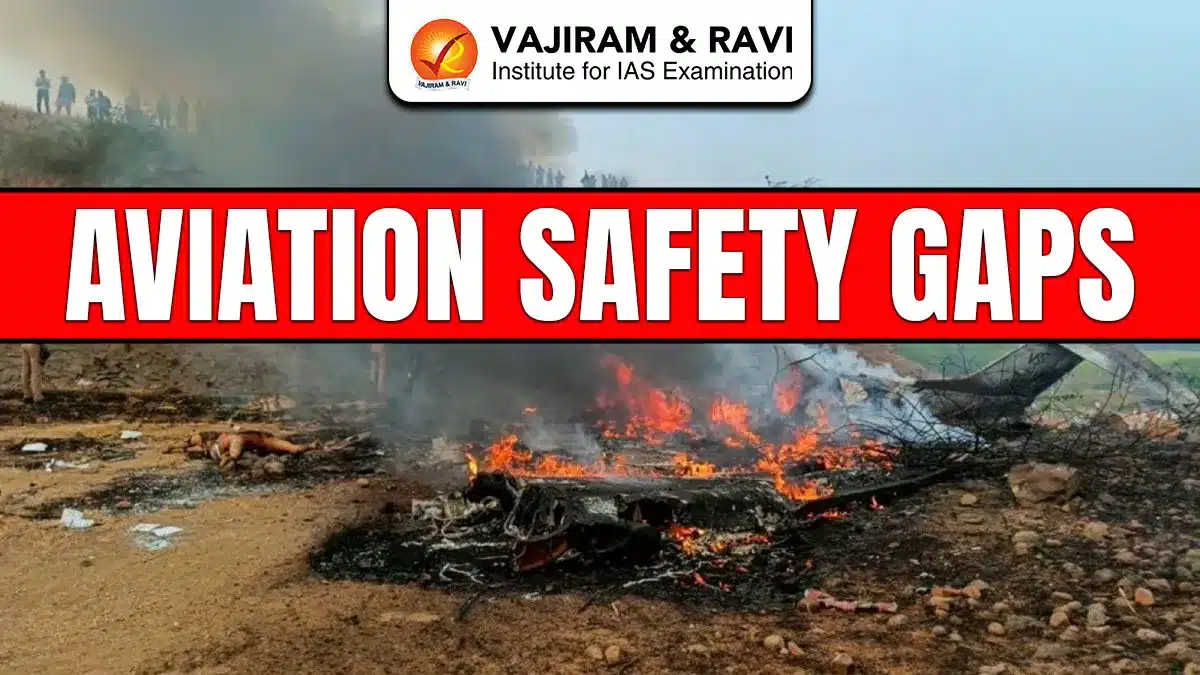
  • A plane crash in Baramati that killed Maharashtra Deputy Chief Minister Ajit Pawar has drawn attention to earlier warnings by a Parliamentary Standing Committee about gaps in India’s civil aviation safety framework.
  • Months before the accident, a Parliamentary Standing Committee had flagged serious concerns in a report tabled in Parliament in August 2025. The panel cautioned that India’s rapid aviation growth was outpacing regulatory oversight.
  • The committee highlighted specific vulnerabilities in the non-scheduled aviation sector, including private jets and charter aircraft. It noted that while this segment has expanded quickly, safety oversight and enforcement mechanisms have not kept pace.
  • Drawing a contrast with scheduled commercial airlines, the report observed that airlines operate under highly standardised and tightly regulated systems, whereas private and charter operations show uneven compliance, increasing safety risks.

Private and Charter Aircraft Safety Under Scrutiny

  • Concerns Over Maintenance and Safety Practices - The Parliamentary Committee raised concerns about maintenance standards, documentation, and operational controls among non-scheduled operators. It noted that some charter firms operate with small technical and safety teams, which can weaken maintenance planning and oversight.
  • Need for Stronger DGCA Oversight - The panel urged the DGCA to step up surveillance of private and charter aircraft through surprise inspections and more frequent, stricter audits to ensure compliance with safety norms.
  • Gaps in Operational Support Systems - Unlike scheduled airlines, smaller operators often lack layered operational control centres to support pilots, especially during bad weather or diversions. This absence was flagged as a key safety vulnerability.
  • Mandatory Safety Management Systems - The committee called for mandatory and fully functional Safety Management Systems (SMS) across all private operators, stressing that safety processes in the charter segment must be on par with scheduled airlines.
  • Flight Planning and Risk Assessment - The report highlighted weaknesses in flight planning, weather assessment, and pre-departure risk evaluation in private operations. It stressed that alternate planning and real-time operational oversight should not be compromised simply because flights are non-scheduled.

Aviation Regulator Under Strain

  • The Parliamentary Committee flagged that the DGCA is overburdened, facing manpower shortages and expanding responsibilities that often force it into a reactive approach to safety oversight. 
  • It recommended strengthening technical staffing, improving training, and adopting data-driven, predictive risk assessment tools. 
  • The report warned that rapid fleet expansion, new airports, and rising aircraft movements require parallel enhancement of safety surveillance, or else the margin for error in civil aviation will continue to shrink.

ATC Capacity and Fatigue Risks

  • Controllers Under Rising Workload - The Parliamentary Committee described Air Traffic Control (ATC) as the backbone of aviation safety and warned that controllers at busy airports are managing dense traffic without matching increases in manpower.
  • Fatigue and Human Error Concerns - High workload, especially during peak hours and adverse weather, was flagged as a key risk. The panel noted that fatigue and stress among controllers can significantly raise the chances of human error.
  • Need for Staffing and System Upgrades - The committee recommended faster recruitment of ATC personnel, better rostering to limit fatigue, and quicker modernisation of communication, navigation, and surveillance systems.
  • Redundancy and Airspace Coordination - It also stressed the importance of system redundancy and smoother civil–defence airspace coordination to ensure safer and more resilient air traffic management.

Learning from Past Aviation Accidents

  • Human Factors and Training Gaps - The Parliamentary Committee noted that investigations into past crashes repeatedly highlight human error, training quality, and decision-making under pressure as key factors affecting aviation safety.
  • Implementing Safety Recommendations - It stressed that findings and safety advisories from accident probe reports must be systematically tracked and implemented, not merely recorded. A centralised mechanism to monitor compliance with safety recommendations was recommended.
  • Upgrading Infrastructure at Smaller Airports - The report also flagged the need to upgrade infrastructure at smaller airports, as operations expand under regional connectivity schemes. Improvements are needed in runway safety areas, navigational aids, and emergency response systems to match rising traffic levels.

Growth Must Not Outpace Aviation Safety

  • The Parliamentary panel cautioned that India’s rapid aviation growth must be matched by equal, if not greater, emphasis on safety. 
  • It warned that expansion without strengthening oversight, ATC capacity, and operator discipline—particularly in private aviation—could heighten systemic risks.

Source: IE | IE

Aviation Safety Gaps FAQs

Q1: What aviation safety gaps were flagged after the Ajit Pawar plane crash?

Ans: The aviation safety gaps flagged include weak oversight of private aircraft, uneven compliance in charter operations, DGCA manpower shortages, ATC fatigue risks, and delayed safety implementation.

Q2: Why are aviation safety gaps larger in private and charter aircraft?

Ans: Aviation safety gaps are larger in private aviation because many operators lack robust maintenance systems, operational control centres, and safety management processes seen in scheduled airlines.

Q3: How does DGCA capacity contribute to aviation safety gaps?

Ans: Aviation safety gaps widen as the DGCA faces staff shortages and rising responsibilities, forcing reactive oversight instead of predictive, risk-based aviation safety supervision.

Q4: What ATC-related aviation safety gaps were identified?

Ans: The committee identified aviation safety gaps in ATC staffing, fatigue management, system redundancy, and slow modernisation of communication, navigation, and surveillance infrastructure.

Q5: Why did the panel warn against growth-driven aviation safety gaps?

Ans: The panel warned that aviation safety gaps grow when rapid fleet expansion, new airports, and private flying outpace safety oversight, increasing systemic risks across India’s aviation sector.

Enquire Now