Economic Survey 2025-26 Latest News
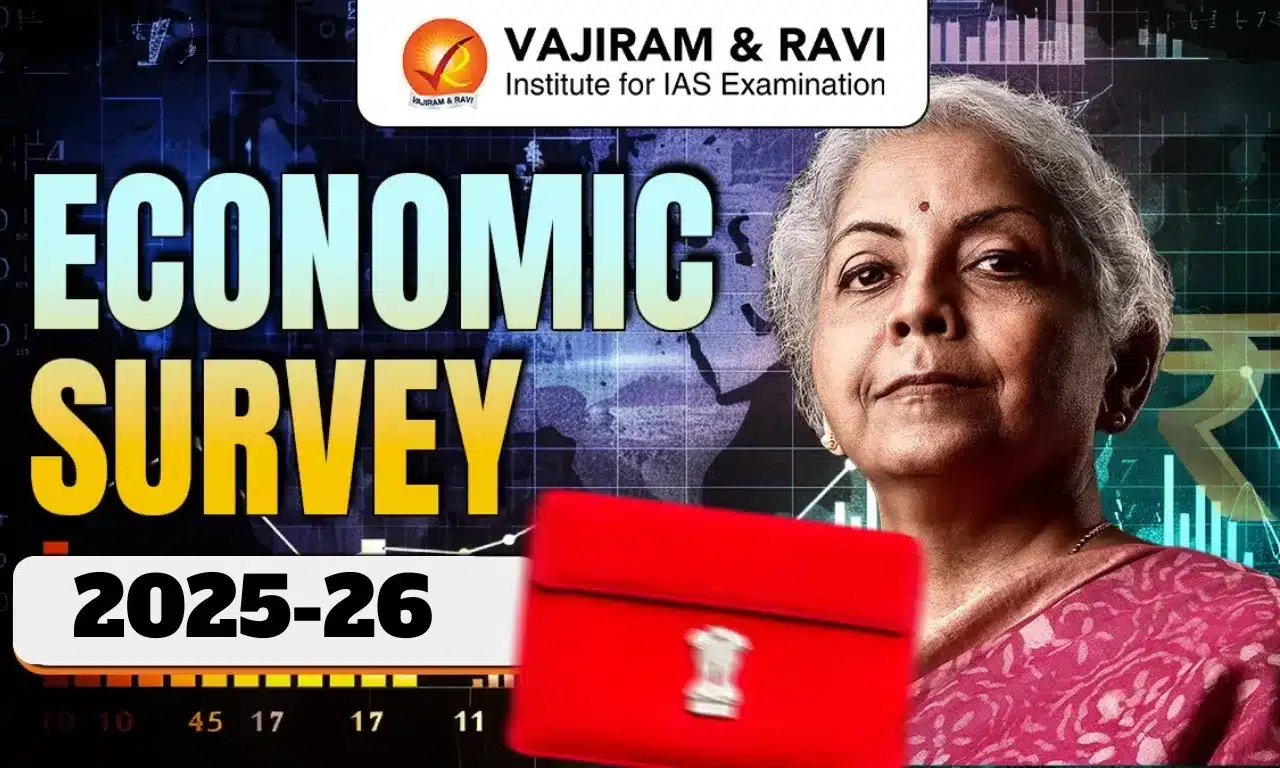
- The Economic Survey 2025–26, tabled in Parliament by the Union Minister for Finance and Corporate Affairs, Smt. Nirmala Sitharaman, reflects on India’s post-Covid economic resilience amid rising global geopolitical and economic uncertainties.
- The Preface departs from conventional macroeconomic commentary and makes a strong normative case for transforming India into an “entrepreneurial state” capable of navigating uncertainty while pursuing the goal of Viksit Bharat.
Reconfigured Economic Survey
- Structural changes:
- The Economic Survey 2025-26 expanded to 17 chapters - indicating greater depth and breadth.
- Chapters are rearranged based on national priority and relevance, not convention.
- Special essays on:
- Evolution of Artificial Intelligence
- Quality of life in Indian cities
- State capacity, private sector and households in achieving strategic resilience and strategic indispensability.
Core Theme - Entrepreneurial Policy Making under Uncertainty
- Fundamental shift in the role of the State: From risk-averse, compliance-driven governance to risk-structuring, capability-driven and adaptive governance.
- Key features of an ‘Entrepreneurial State’:
- It acts before certainty emerges, structures and manages risk, rather than avoiding it.
- It will learn from systematic experimentation, and correct course without policy paralysis.
- Significance: This vision is presented as practical and already unfolding, not merely aspirational.
Early Signals of the Entrepreneurial State
- The Survey highlights ongoing initiatives as evidence of this shift. For example,
- Mission-mode platforms (e.g., Semiconductors, Green Hydrogen).
- Public procurement reforms enabling first-of-a-kind domestic innovation.
- State-level deregulation compacts, replacing inspection-based controls with trust-based compliance.
- These initiatives mark a transition from regulation to capability building.
India’s Macroeconomic Resilience in a Turbulent World
- Despite the Covid-19 shock, US tariffs imposed (in April 2025), rising global fragmentation, India has demonstrated strong macroeconomic fundamentals.
- For example, expected real GDP growth of over 7% in 2025–26, with momentum continuing into the next year.
- However, the Survey identifies a “Paradox of 2025”:
- India’s strongest macroeconomic performance in decades coincides with a global system that no longer rewards macroeconomic prudence with currency stability, capital inflows, or insulation from shocks.
Global Headwinds vs India’s Aspirations
- India, with 145 crore people, aims to become a high-income country within a generation, within a democratic framework—a path with no ready-made global template.
- The Survey notes:
- Retreat of the global dominant power from earlier commitments.
- Rising trade frictions, geopolitical rivalries, and economic nationalism.
- These headwinds can become tailwinds only if the State, private sector, and households align and commit to sustained effort.
Three Possible Global Scenarios for 2026
- Managed disorder:
- Less coordinated world
- Higher risk aversion
- Integrated yet distrustful global system
- Narrower margin of safety
- Disorderly multipolar breakdown:
- Intensified strategic rivalry
- Coercive trade, sanctions, supply chain realignments
- Greater trade-offs between autonomy, growth, and stability
- Systemic shock cascade (low probability, high impact): Financial, technological, and geopolitical shocks amplify each other - potentially worse than the 2008 Global Financial Crisis.
India’s Relative Strengths
- India is better placed than many countries due to:
- Large domestic market
- Less financialised growth model
- Strong foreign exchange reserves
- Credible strategic autonomy
- Large domestic market
- Yet, a common risk across all scenarios remains:
- Disruption of capital flows
- Sustained pressure on the rupee
Running a Marathon and Sprint Simultaneously
- External sector imperative: Rising incomes will inevitably lead to rising imports. Therefore, India must generate export earnings, and foreign investor confidence.
- Policy stance for 2026:
- Focus on supply stability, resource buffers, diversification of routes and payment systems.
- Adopt strategic sobriety, not defensive pessimism.
- India must “India must run a marathon and sprint simultaneously, or run a marathon as if it were a sprint”—maximising growth while absorbing shocks.
Challenges
- India’s central challenge - Policy and process reforms:
- The Survey underlines that policy reforms are necessary, and process reforms are even more critical.
- Why? Processes govern state–citizen interaction. They determine whether policy intent succeeds or fails.
- Positive signals: State-led deregulation and smart regulation, and shift from control to enabling governance.
- Other challenges:
- Global geopolitical fragmentation and economic coercion
- Capital flow volatility and exchange rate pressures
- Need for rapid institutional adaptation
- Balancing growth with resilience and stability
Way Forward
- Integrating 3 pillars for Viksit Bharat:
- The Survey integrates three pillars: state capacity, societal participation, and deregulation.
- In a democracy, the State remains the principal development agent, but must upskill and reskill, be mentally prepared for a hostile and uncertain global terrain, and adapt to the reality that old rules no longer apply.
- Strategic opportunity amid global crises:
- Potential global crises may open space for India to shape the emerging global order, and enhance strategic influence and indispensability.
- This demands the most agile, flexible and purposeful governance since Independence.
- Delayed gratification over short-term fixes:
- The Survey advocates resilience over quick wins, innovation and persistence over short-term pressure management.
- This will help India to stay committed to Viksit Bharat amid prolonged global churn.
- Other suggestions:
- Deepen entrepreneurial governance.
- Strengthen process reforms and deregulation.
- Build buffers, redundancy, and liquidity.
- Align state, market, and society towards long-term national goals.
- Invest in state capacity and institutional learning.
Conclusion
- The Economic Survey 2025–26 Preface redefines India’s economic strategy for an era of uncertainty.
- It calls for an entrepreneurial, adaptive and resilient State that can sustain high growth while absorbing shocks.
- In a volatile global order, India’s path to Viksit Bharat lies not in quick fixes, but in patient resilience, relentless innovation, and strategic sobriety—running the marathon of development at the pace of a sprint.
Source: PIB
[youtube url="https://www.youtube.com/watch?v=Wu66P3clSAU" width="560" height="315"]
Economic Survey 2025–26 FAQs
Q1: What does the Economic Survey 2025–26 mean by an “entrepreneurial state”?
Ans: It is one that acts before certainty emerges, structures risk instead of avoiding it, learns through experimentation.
Q2: What is the “Paradox of 2025”?
Ans: India achieved its strongest macroeconomic performance while operating in a global system that no longer rewards such success.
Q3: What are the common macroeconomic risks for India?
Ans: Disruption of capital flows leading to sustained pressure on the rupee.
Q4: Why does the Economic Survey emphasise process reforms over policy reforms?
Ans: Because administrative processes shape state–citizen interaction and determine whether policy intent translates into effective outcomes.
Q5: What is meant by the metaphor of “running a marathon and sprint simultaneously”?
Ans: It signifies India’s need to maximise domestic growth while simultaneously building buffers, liquidity, and shock-absorption capacity.