India-U.S. Trade Deal 2026 – Strategic Significance

Trade Deal 2026

Trade Deal 2026 Latest News

  • India has committed to importing goods worth $100 billion annually from the U.S. for five years as part of a broader trade understanding that also involves significant tariff reductions. 

Background: India-U.S. Trade Relations

  • India and the United States share a rapidly expanding trade relationship, shaped by strategic convergence, supply chain realignments, and geopolitical considerations. 
  • The U.S. is India’s largest trading partner, accounting for a substantial share of India’s exports in services, pharmaceuticals, engineering goods, and IT.
  • However, trade ties have also witnessed friction, particularly over tariffs, market access, digital trade, and agriculture. 
  • In August 2025, the U.S. raised tariffs on Indian goods to 50%, citing trade imbalances. 
  • This escalation set the stage for renewed negotiations aimed at stabilising bilateral trade while protecting domestic interests.

Key Features of the India-U.S. Trade Deal

  • Large-Scale Import Commitment
    • India has committed to importing $100 billion worth of U.S. goods annually for five years, more than double the $45.62 billion imported in FY25. The imports will primarily include:
      • Energy products (oil, gas, coal), Aircraft and aircraft parts, Technology and high-value manufactured goods, Precious metals, Nuclear-related equipment and Selected agricultural products 
  • Tariff Reduction by the United States
    • As part of the understanding, the U.S. agreed to reduce tariffs on Indian goods to 18%, down from the earlier 50%. 
    • This rollback improves market access for Indian exporters and restores competitiveness in sectors such as engineering goods, textiles, and auto components.
  • Protection of Sensitive Sectors
    • Despite opening its market to a wide range of U.S. products, India has maintained explicit protection for sensitive sectors, including:
      • Genetically modified agricultural products, the dairy sector, Poultry, maize, cereals, and corn
    • This calibrated approach reflects India’s long-standing policy of shielding small farmers and food security from external shocks.

Agriculture and Market Access Framework

  • India has allowed quota-based or limited access for select agricultural commodities such as cotton, pulses, chestnuts, and onions. 
  • Market access has also been extended to apples, wine, spirits, and beer, products already permitted under trade agreements with other partners like the EU and New Zealand.
  • The government has consistently reiterated that no compromise has been made on farmer welfare

Strategic and Economic Rationale

  • Addressing Trade Imbalances
    • The deal aims to reduce persistent U.S. trade deficits in goods, particularly in agriculture. 
    • For India, the arrangement helps ease tariff pressure while ensuring continuity of access to the U.S. market.
  • Energy Security and Diversification
    • Large-scale energy imports from the U.S. support India’s energy diversification strategy, reducing overdependence on volatile regions and strengthening long-term supply stability.
  • Geopolitical Significance
    • Beyond economics, the deal reinforces India-U.S. strategic alignment amid shifting global trade patterns, decoupling pressures, and competition with China. 
    • Trade is increasingly being used as a tool of diplomacy and strategic reassurance.

Concerns and Criticisms

  • Fiscal and Trade Deficit Risks
    • Committing to fixed import values may constrain India’s trade flexibility and widen the merchandise trade deficit if exports do not grow proportionately.
  • Farmer and MSME Concerns
    • Farmer groups have expressed apprehensions that surplus U.S. agricultural produce could eventually seek deeper access to Indian markets, affecting domestic prices and livelihoods.
  • Absence of a Formal FTA
    • Despite its scale, the arrangement stops short of a full-fledged Free Trade Agreement (FTA), leaving uncertainties about dispute resolution mechanisms and long-term enforceability.

Way Forward

  • India will need to closely monitor implementation, ensure safeguard mechanisms remain robust, and simultaneously push for export expansion in services, manufacturing, and technology. 
  • Strengthening domestic competitiveness and productivity will be critical to maximising gains from the deal.

Source: TH | IE

Trade Deal 2026 FAQs

Q1: What is the core commitment under the India–U.S. Trade Deal?

Ans: India will import $100 billion worth of U.S. goods annually for five years.

Q2: Which sectors dominate India’s planned imports from the U.S.?

Ans: Energy, aircraft parts, technology goods, precious metals, and select agricultural products.

Q3: How did the U.S. respond to tariffs under the deal?

Ans: The U.S. reduced tariffs on Indian goods from 50% to 18%.

Q4: Are Indian farmers protected under the agreement?

Ans: Yes, sensitive sectors like dairy, GM crops, and staples remain protected.

Q5: Is this deal a formal Free Trade Agreement?

Ans: No, it is a large trade understanding, not a comprehensive FTA.

Solid Waste Management Rules 2026: Key Changes Explained

Solid Waste Management Rules 2026

Solid Waste Management Rules 2026 Latest News

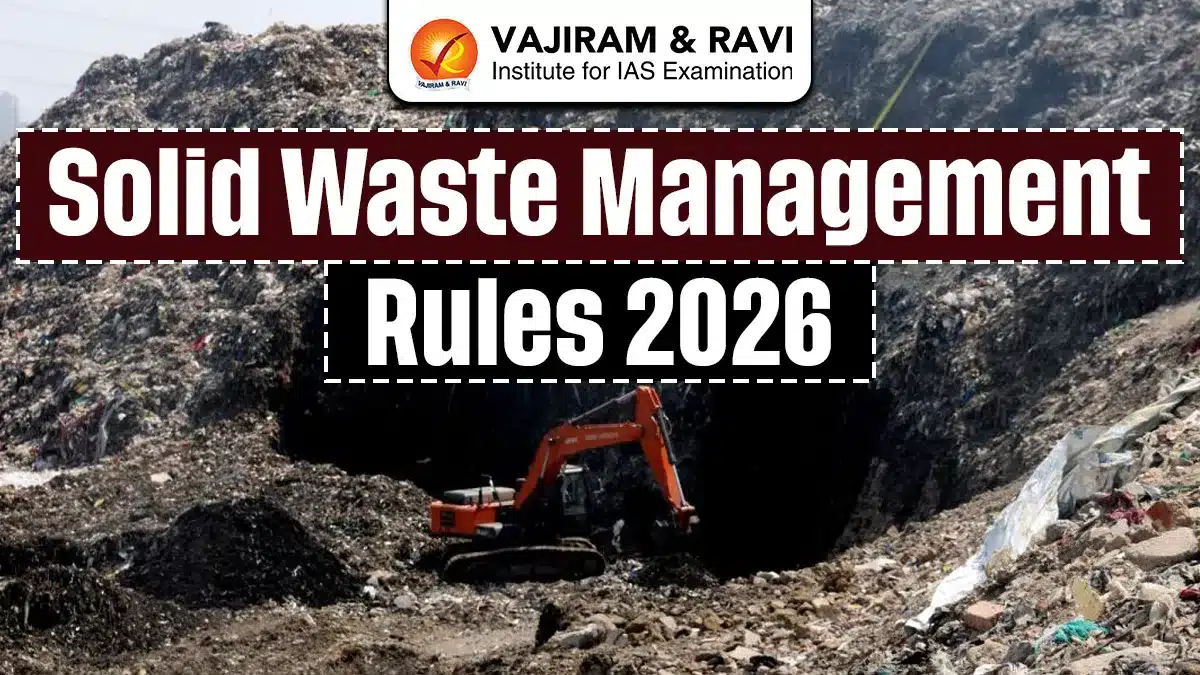
  • The Solid Waste Management Rules, 2026, notified by the Union Ministry of Environment, Forest and Climate Change, will come into force on April 1, 2026, replacing the 2016 framework. 
  • The new rules comprehensively overhaul waste management by urban and rural local bodies, emphasising waste reduction, reuse, segregation, and at-source processing. 
  • By discouraging dependence on large landfills and dumping yards, the rules aim to promote decentralised, sustainable, and circular approaches to managing India’s growing solid waste challenge.

Rationale Behind the Introduction of New Rules

  • As per Central Pollution Control Board’s 2023-24 data, India is facing a severe solid waste management crisis:
    • Annual waste generation: over 620 lakh tonnes
    • Daily waste generation: around 1.85 lakh tonnes
    • Daily collection: 1.79 lakh tonnes
    • Daily processing/treatment: 1.14 lakh tonnes
    • Daily landfilling: 39,629 tonnes
  • Despite the Solid Waste Management Rules, 2016, large quantities of waste continue to be poorly segregated and dumped in landfills, leading to environmental and public health risks.
  • To address this, the 2026 Rules aim to:
    • Reduce dependence on landfills
    • Improve segregation and accountability
    • Shift towards a circular economy, where waste is treated as a resource
    • Strengthen compliance through penalties and digital monitoring

How Are the 2026 Rules Different from the 2016 Rules

  • While retaining the core principles of segregation, recycling, and scientific disposal introduced in 2016, the 2026 Rules introduce stricter obligations, expanded segregation, and stronger enforcement mechanisms.

Waste Hierarchy Introduced

  • The Solid Waste Management Rules, 2026 lay down a clear waste hierarchy that prioritises prevention and minimisation of waste over disposal. 
  • The hierarchy follows the sequence of prevention, reduction, reuse, recycling, recovery, with disposal permitted only as a last resort, signalling a move away from landfill-dependent waste management.

Four-Way Waste Segregation

  • To operationalise this hierarchy, the rules introduce a four-way segregation system, expanding the earlier wet–dry classification.
    • Wet waste: biodegradable household waste
    • Dry waste: recyclable materials such as paper, plastic, metal, and glass
    • Sanitary waste: items like sanitary napkins, tampons, and condoms
    • Special-care waste: hazardous or sensitive items including medicines, paint cans, bulbs, and tube lights
  • Urban local bodies are mandated to support segregation through appropriate infrastructure. 
  • This includes green bins for wet waste, blue bins for dry waste, and red bins for sanitary waste, particularly in public toilets where such waste is generated.

Enhanced Responsibilities of Bulk Waste Generators

  • Definition of Bulk waste Generators - Entities meeting any one of the following:
    • Built-up area of 20,000 sq m or more
    • Water consumption of 40,000 litres/day or more
    • Waste generation of 100 kg/day or more
  • Covered entities include:
    • Residential societies and gated communities
    • Malls, hotels, restaurants
    • Colleges, universities, hostels
    • Government departments and large townships
  • New obligations:
    • Mandatory segregation at source
    • Hand over recyclable waste to authorised entities
    • All gated communities, RWAs, hotels and restaurants, and institutions with over 5,000 sq m area must comply within one year
  • The 2016 Rules had weaker enforcement for bulk generators.

Polluter Pays Principle and Environmental Compensation

  • Environmental compensation for:
    • Failure to register on the centralised portal
    • False reporting or forged documents
    • Improper waste handling and segregation
  • Higher landfill fees for mixed or unsegregated waste
  • Landfilling made financially disincentivising
  • Role of CPCB: To frame detailed guidelines on compensation and penalties.
    • This marks a shift from advisory compliance to deterrence-based regulation.

Centralised Tracking and Digital Monitoring System

  • Introduction of a centralised online portal to track: Waste generation; Collection; Transportation; Processing; Disposal.
  • Mandatory registration for:
    • Bulk waste generators
    • Urban and rural local bodies
    • Waste transporters and processors
    • Waste pickers
    • Railways, airports, SEZs and large authorities
  • This addresses data gaps and weak monitoring seen under the 2016 Rules.

Impact on Bulk Generators Including Housing Societies

  • Under the new rules, bulk waste generators are brought under an extended responsibility regime, similar to the Extended Producer Responsibility (EPR) applicable to manufacturers of electronic and plastic products.
  • This framework will become operational once urban local bodies (ULBs) notify by-laws by March 2027 incorporating provisions of the new rules.

Mandatory Registration and Certification-Based Compliance

  • Bulk generators—such as housing societies, colleges, large townships, commercial complexes and institutions—will be required to:
    • Register on a centralised online portal
    • Submit mandatory waste accounting data
    • Follow certification-based compliance, replacing the earlier self-declaration model
  • This system introduces verifiable accountability for waste generation and handling.

Segregation and On-Site Waste Processing Obligations

  • Mandatory four-way segregation of waste (wet, dry, sanitary and special-care)
  • Strong emphasis on at-source processing of wet waste, preferably through:
    • On-site composting, or
    • Other approved decentralised alternatives

Alternative Compliance through Certification

  • Where on-site processing is not feasible, bulk generators may procure compliance certificates from Urban local bodies, or Authorised waste processing facilities.
  • These certificates will serve as proof that waste has been scientifically processed.

Annual Reporting and Penalties

  • Annual returns to be filed by June 30 each year
  • Returns must detail: Quantity of waste generated; Mode of processing; Certificates procured.
  • Non-compliance will attract environmental compensation

Implications of SWM Rules, 2026 for Landfills

  • The Solid Waste Management Rules, 2026 seek to end India’s long-standing dependence on landfills. 
  • Under the new framework, landfills are to be used only as a last option, and exclusively for non-usable, non-recyclable, and non-energy-recoverable waste
  • This marks a decisive shift away from dumping mixed waste, which has historically led to large landfill mounds and severe environmental contamination.

Mapping and Remediation of Legacy Landfills

  • All urban local bodies (ULBs) are mandated to:
    • Map existing legacy landfills and dumpsites by October 31, 2026
    • Prepare time-bound action plans for their remediation
  • Remediation methods include:
    • Bioremediation: use of bacteria and microbes to reduce waste volume and odour
    • Biomining: scientific excavation of old waste to recover usable materials and reduce landfill mass
  • These measures aim to reclaim land, reduce pollution, and eliminate long-standing garbage mountains.

Energy Recovery from High-Calorific Waste

  • The new rules mandate that waste with a calorific value of 1,500 kcal/kg or more must be diverted for energy recovery
  • Methods include:
    • Refuse-Derived Fuel (RDF) production
    • Co-processing in cement kilns and thermal power plants
  • High-calorific waste includes plastic waste, agricultural residues, and kitchen waste, which can substitute conventional fossil fuels.
  • Industries have been assigned progressive targets for replacing solid fossil fuels with RDF:
    • 6% substitution initially
    • Scaling up to 15% substitution within six years
  • This creates assured demand for waste-derived fuels and strengthens the waste-to-energy ecosystem.

Source: IE | PIB

Solid Waste Management Rules 2026 FAQs

Q1: What are the Solid Waste Management Rules 2026?

Ans: The Solid Waste Management Rules 2026 replace the 2016 framework, focusing on waste reduction, segregation, decentralised processing, and reduced landfill dependence.

Q2: Why were the Solid Waste Management Rules 2026 introduced?

Ans: The Solid Waste Management Rules 2026 address poor segregation, landfill overload, and environmental risks amid India’s rapidly rising urban waste generation.

Q3: How are the Solid Waste Management Rules 2026 different from 2016 rules?

Ans: The Solid Waste Management Rules 2026 introduce four-way segregation, digital monitoring, polluter-pays penalties, and stricter obligations for bulk waste generators.

Q4: What do the Solid Waste Management Rules 2026 mean for housing societies?

Ans: Under the Solid Waste Management Rules 2026, housing societies must segregate waste, register on a central portal, process wet waste on-site, and file annual returns.

Q5: How do the Solid Waste Management Rules 2026 impact landfills?

Ans: The Solid Waste Management Rules 2026 restrict landfills to last-resort use, mandate remediation of legacy dumps, and promote waste-to-energy solutions.

Frozen Embryo Donation Case: ART Act Rules Under Court Review

Frozen Embryo Donation

Frozen Embryo Donation Latest News

  • The Delhi High Court has issued notice on a PIL questioning whether the law can mandate the destruction of viable frozen embryos instead of allowing their donation to infertile couples, even when all parties consent.
  • The plea challenges provisions of the Assisted Reproductive Technology (Regulation) Act, 2021 and its Rules, which allow embryos to be created using donor sperm and eggs but prohibit donating unused frozen embryos to another couple for reproductive use.
  • Under the existing framework, unused frozen embryos can be stored for up to 10 years. After that, they must either be donated for research or be “allowed to perish”, but cannot be transferred to another infertile couple. 
  • The plea argues that forcing viable embryos to perish is ethically irrational when willing recipient couples exist.
  • The petition questions why the law permits some forms of non-genetic parenthood, such as donor sperm or eggs, while blocking embryo donation, calling this inconsistency a possible legislative oversight.

What the Law Allows

  • The Assisted Reproductive Technology (ART) Act, 2021 permits altruistic donation of sperm and eggs under regulated conditions. 
  • It also allows donor-assisted IVF, including double-donor IVF, where embryos created from donor sperm and donor eggs are implanted in a commissioning couple.
  • In donor-assisted and double-donor IVF, the child has no genetic link with either parent. The law explicitly recognises and permits this form of non-genetic parenthood.
  • What the law prohibits - Despite allowing donor-based embryo creation, the law does not permit the donation of surplus frozen embryos to another infertile couple for reproductive use.
  • Why surplus embryos exist - IVF procedures typically create multiple embryos to improve pregnancy success rates. Not all embryos are implanted, and many remain cryopreserved when couples decide not to pursue further pregnancies.
  • Where the restriction applies - It is at this post-IVF stage — when embryos remain unused but viable — that the law restricts their transfer to other couples, limiting their fate to storage, research use, or eventual destruction.

How the prohibition works

  • The law does not expressly ban “embryo adoption”, but the restriction arises from how multiple provisions of the ART Act and its Rules operate together.
  • Embryos tied to the original couple - Clinics are required to preserve unused embryos only for the commissioning couple. They are prohibited from transferring these embryos to any other person or couple.
  • Limited scope for embryo transfer - Embryo transfer is allowed only when the same couple seeks to use its own embryos for personal reproductive purposes, and that too with regulatory approval. Any third-party use is barred.
  • Mandatory end-point after 10 years - Under Section 28(2), embryos can be stored for a maximum of 10 years. After this period, embryos must either be:
    • allowed to perish, or
    • donated to registered research institutions, with consent.
      • There is no legal pathway for donating embryos to another infertile couple for pregnancy.
  • Consent forms reinforce the restriction - The prescribed consent forms ask couples to choose the fate of embryos in situations like death or separation. However, donation to another couple is not listed as an option, effectively closing that route.

Fresh vs frozen embryos: the core contradiction

  • The petition highlights a key inconsistency in how the law treats fresh and frozen embryos.
  • What the law allows with fresh embryos - The ART Act permits embryos created using donor sperm and donor eggs to be transferred to a commissioning couple. In such cases, the child has no genetic link to the parents, which the law explicitly accepts.
  • Biological equivalence of frozen embryos - Frozen embryos, once thawed, are biologically identical to fresh embryos and are routinely used in IVF treatments with similar success rates.
  • Different legal treatment - Despite this equivalence, frozen embryos are barred from being transferred to another couple for reproductive use. They are treated as non-transferable once cryopreserved.
  • Alleged ‘double standard’ - The plea argues that while the law accepts genetic non-linearity in fresh donor embryos, it rejects the same principle for existing frozen embryos — creating what the petitioner calls a legal and ethical inconsistency.

The constitutional challenge to the ART law

  • The petition questions the validity of the embryo donation ban on constitutional grounds, invoking Articles 14 and 21.

Article 14: equality before law

  • The plea argues that the law makes an arbitrary distinction between couples allowed to receive fresh donor embryos and those barred from receiving frozen embryos. 
  • In both cases, the child has no genetic link to the parents.
  • It contends that this classification lacks an intelligible differentia and has no rational link to the objective of the law, thereby violating Article 14.

Article 21: reproductive autonomy

  • The petition places reproductive choice within the right to life, dignity and privacy. 
  • Decisions on whether and how to have a child through assisted reproduction, it argues, are part of individual decisional autonomy. 
  • Blocking embryo donation intrudes into this freedom.

Compulsory destruction as a core concern

  • A central objection is the law’s requirement that unused embryos be “allowed to perish” after 10 years if not used by the original couple.
  • The plea calls this a “legislative absurdity”, since viable embryos must be destroyed even when willing and consenting recipient couples exist.

Why the case matters

  • The petition highlights the broader social and ethical stakes of the embryo donation debate.
  • Scale of infertility in India - Infertility affects an estimated 27–30 million couples in India, making access to assisted reproductive options a significant public health issue.
  • Limits of existing options - IVF is costly and often requires multiple cycles, while traditional adoption is marked by long waiting periods and procedural hurdles. This leaves many couples with few viable choices.
  • Embryo donation as an alternative - The plea argues that regulated embryo donation could offer a middle path—allowing pregnancy and childbirth for couples who cannot conceive through other means.
  • Equity and access concerns - It also flags inequality: wealthier couples can seek embryo donation abroad, while others cannot. This, the petition argues, turns reproductive choice into a function of economic privilege rather than medical need.

Source: IE

Frozen Embryo Donation FAQs

Q1: What is the frozen embryo donation case before the Delhi High Court?

Ans: The frozen embryo donation case challenges ART Act provisions that require unused frozen embryos to perish or be donated for research instead of being donated to infertile couples.

Q2: Why does the ART Act restrict frozen embryo donation?

Ans: The ART Act allows storage of embryos for 10 years but does not provide a legal framework for frozen embryo donation to another couple for reproductive use.

Q3: How does the law treat fresh versus frozen embryos differently?

Ans: Fresh donor embryos can be transferred to commissioning couples, but frozen embryo donation is prohibited despite biological equivalence, creating a legal inconsistency.

Q4: What constitutional rights are raised in the frozen embryo donation challenge?

Ans: The plea invokes Articles 14 and 21, arguing that banning frozen embryo donation violates equality, reproductive autonomy, dignity, and decisional privacy.

Q5: Why does frozen embryo donation matter for infertile couples in India?

Ans: Frozen embryo donation could provide a regulated, affordable option for infertile couples, reducing dependence on costly IVF cycles and lengthy adoption processes.

Death Penalty in India – Appellate Courts Correcting Trial Court Errors, but Structural Faultlines Persist

Death Penalty in India

Death Penalty in India Latest News

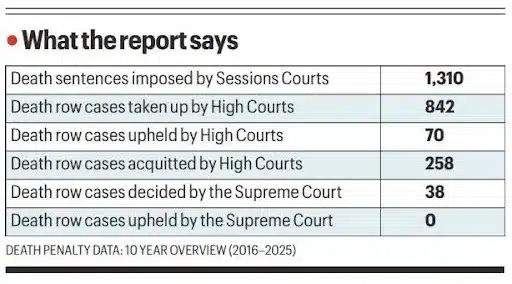
  • A decade-long study (2016–2025) by the Square Circle Clinic, a criminal laws advocacy group with the NALSAR University of Law (Hyderabad), highlights systemic flaws in death penalty sentencing in India. 
  • Despite a high number of death sentences awarded by trial courts, appellate courts—High Courts and the Supreme Court—have overturned, commuted, or acquitted the overwhelming majority, pointing to erroneous and unjustified convictions at the trial stage. 
  • The report is significant for debates on criminal justice reform, due process, Article 21 of the Indian constitution, and capital punishment jurisprudence.

Death Penalty in India

  • Meaning: It is a legal punishment for heinous crimes (such as murder, gang rape of minors under 18, terrorism-related offenses), restricted to the "rarest of rare" cases under the IPC and CrPC. 
  • Confirmation and appellate review: A death sentence passed by a Sessions Court must be confirmed by the High Court. Convicts have a right to appeal to the Supreme Court. 
  • Exceptions: Death penalties cannot be imposed on individuals who were under 18 at the time of the offense. Executions are generally avoided for pregnant women. 
  • The Bharatiya Nyaya Sanhita (BNS), 2023: It retains the death penalty for heinous crimes, and is restricted to the "rarest of rare" cases.
  • Constitutional aspects:
    • Article 21: The death penalty is not inherently unconstitutional, provided the procedure is fair, just, and reasonable (the Supreme Court interpretation).
    • Articles 14 and 19: While challenged under these articles, the courts have upheld the constitutionality of capital punishment.
    • Clemency powers: Article 72 empowers the President to grant pardons or commute sentences, including death sentences. 
  • Judicial aspects (Key cases):
    • Jagmohan Singh v. State of UP (1973): Upheld constitutionality.
    • Bachan Singh v. State of Punjab (1980): Established the "rarest of rare" doctrine.
    • Machhi Singh v. State of Punjab (1983): Further refined the guidelines for applying the "rarest of rare" rule.
    • Mandatory penalty struck down: The Supreme Court in Mithu v. State of Punjab (1983) declared mandatory death penalties (like Section 303 of the IPC) unconstitutional. 
    • Judicial discretion: Courts must consider mitigating factors (e.g., age, mental state, potential for rehabilitation) against aggravating factors (e.g., brutality, premeditation).

Key Findings of the Report

  • Stark disparity between trial courts and appellate courts:

  • In 2025 alone: Sessions courts awarded 128 death sentences in 94 cases. High Courts overturned death sentences in almost 90% of cases. Supreme Court acquitted the accused in over 50% of cases (10 out of 19).
  • This indicates a pattern, not an aberration, of wrongful or unjustified convictions.
  • Growing death row population despite fewer confirmations:
    • For example: 574 persons on death row as of December 31, 2025 — the highest since 2016.
    • Paradox: Appellate courts increasingly cautious, yet trial courts continue to impose death sentences at scale.
  • Supreme Court’s evolving jurisprudence on due process:
    • 2022 guidelines: Before imposing a death sentence, trial courts must consider psychological evaluation report, probation officer’s report, and prison conduct records.
  • Vasanta Sampat Dupare v. Union of India (2025):
    • Death penalty sentencing hearings recognised as an essential component of a fair trial.
    • Non-compliance with 2022 guidelines amounts to violation of Articles 14 and 21.
    • Enabled reopening of sentencing hearings even after exhaustion of appeals.
    • This reflects a constitutional shift towards procedural fairness and mitigation-centric sentencing.
  • Persistent non-compliance at Sessions Court level:
    • In 2025, trial courts failed to comply with Supreme Court guidelines in 79 of 83 cases (95.18% non-compliance).
    • For example, sentencing is often conducted on the same day as conviction (18 cases). Within five days in over two-thirds of cases.
    • Such haste prevents collection of mental health and prison records, and effective presentation of mitigating circumstances by the defence.
  • Legislative expansion vs judicial retrenchment:
    • While the higher judiciary shows restraint, Parliament and state legislatures have expanded the scope of capital punishment over the past decade.
    • Reflects a disconnect between legislative intent and judicial application.
  • Rise of life imprisonment without remission:
    • Appellate courts increasingly commute death sentences to fixed-term or whole-life imprisonment without remission.
    • The report flags this as a poorly regulated and arbitrary sentencing category.
    • Such sentences remove the possibility of remission, and deprive prisoners of hope, an essential element of human dignity under Article 21.
  • Geographical and offence-wise trends:
    • States with highest death row population: Uttar Pradesh (highest), followed by Gujarat, Haryana, Maharashtra, Kerala, Karnataka.
    • Women: Constituted 4.18% of death row inmates in 2025.
    • Major offences: Murder simpliciter, and murder involving sexual offences.

Challenges Highlighted and Way Forward

  • Systemic failure of trial courts: To follow constitutional safeguards. Mandatory enforcement of Supreme Court’s 2022 sentencing guidelines.
  • High risk of wrongful convictions: Capacity-building and sensitisation of trial court judges on mitigation and sentencing hearings.
  • Arbitrary use: Of life imprisonment without remission. Development of a clear statutory framework governing life imprisonment without remission.
  • Gap: Between evolving constitutional jurisprudence and ground-level judicial practice. Strengthening legal aid and defence representation in capital cases.
  • Legislative push: Towards harsher punishment amid judicial caution. Aligning legislative policy with constitutional values of fair trial, proportionality, and human dignity.

Conclusion

  • The report underscores that wrongful convictions in death penalty cases are systemic, not incidental, revealing deep structural flaws in India’s criminal justice system. 
  • While higher courts have emerged as corrective institutions safeguarding Articles 14 and 21, the persistence of procedural lapses at the trial level and the unregulated rise of harsh alternative sentences demand urgent reform
  • For a constitutional democracy, the legitimacy of capital punishment hinges not merely on legality, but on scrupulous adherence to due process and fairness.

Source: IE

Death Penalty in India FAQs

Q1: What does the high acquittal rate of death row prisoners by appellate courts indicate?

Ans: It reveals systemic errors and unjustified convictions at the trial court level, especially in capital sentencing.

Q2: How has the SC strengthened due process in death penalty sentencing in recent years?

Ans: By mandating mitigation-based sentencing hearings and recognising non-compliance as a violation of Articles 14 and 21.

Q3: Why is the judgment in Vasanta Sampat Dupare v. Union of India (2025) considered a landmark?

Ans: It constitutionalised sentencing hearings in death penalty cases as an essential part of the right to a fair trial.

Q4: What are the key concerns associated with the increasing use of life imprisonment without remission?

Ans: It is an unregulated and potentially arbitrary sentencing practice that extinguishes the prisoner’s right to hope and dignity.

Q5: What institutional contradiction does the report highlight regarding capital punishment in India?

Ans: While higher courts are increasingly reluctant to confirm death sentences, legislatures continue to expand the scope of capital punishment.

Enquire Now