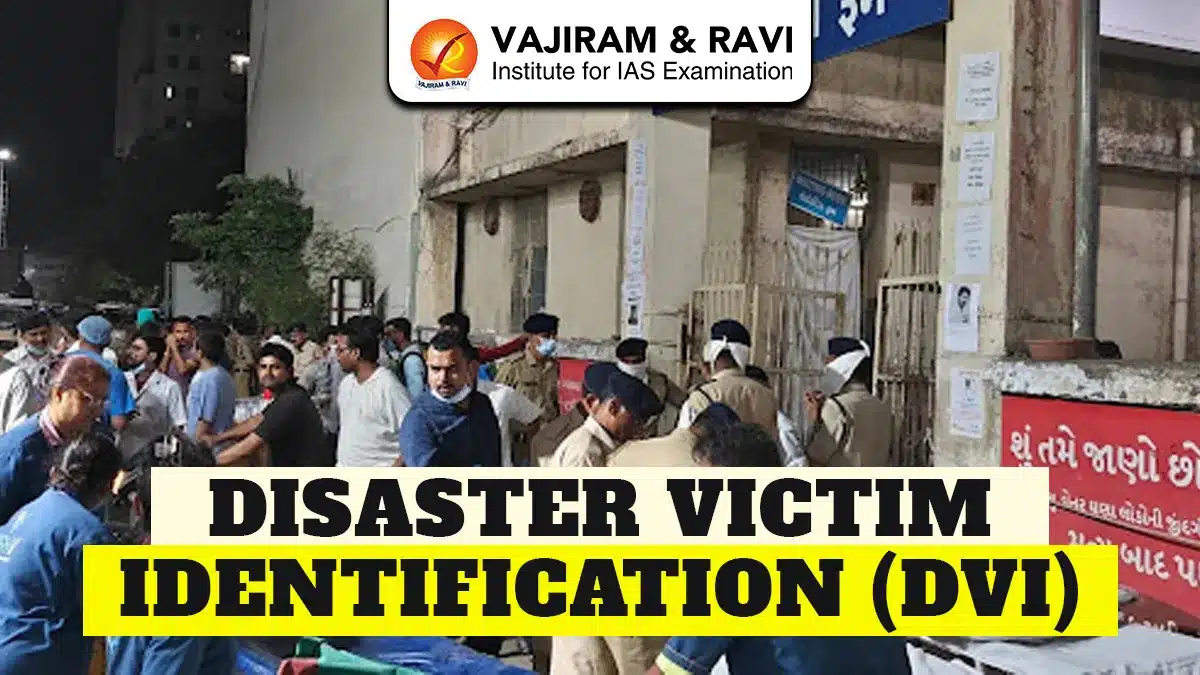
Disaster Victim Identification (DVI) Latest News
- A series of major disasters struck India in 2025, exposing serious gaps in the identification and management of disaster victims.
- In response to this, the National Disaster Management Authority (NDMA) has released India’s first comprehensive Standard Operating Procedure (SOP) for handling Mass Fatality Incidents (MFIs).
- The guidelines, titled “National Disaster Management Guidelines on Comprehensive Disaster Victim Identification and Management”, were released on Republic Day by the Ministry of Home Affairs, marking 25 years since the 2001 Gujarat earthquake.
Need for these Guidelines
- India witnessed at least five major mass fatality events in 2025, including -
- Air India crash, Ahmedabad (June)
- Chemical factory explosion, Sangareddy, Telangana (June)
- Gambhira bridge collapse, Vadodara (July)
- Flash floods, Dharali, Uttarakhand (August)
- Delhi car bomb blast (November)
- Several victims in such incidents remained unidentified or were identified after significant delays, causing prolonged distress to families and administrative challenges.
Key Objectives of the Guidelines
- Ensure: Scientific, coordinated and humane identification of disaster victims.
- Enable: Dignified handling and handover of human remains.
- Address: Institutional, logistical and forensic gaps.
- Standardise: Roles of multiple stakeholders across local, State and Central levels.
Salient Features of the SOP
- Four-stage victim identification process: The guidelines lay down a globally accepted, structured approach -
- Systematic recovery of human remains
- Collection of post-mortem data (physical, dental, forensic details)
- Collection of ante-mortem data from families (medical records, dental records, personal identifiers)
- Reconciliation and identification, followed by release of remains to families
- National Dental Data Registry:
- One of the most notable and innovative recommendations.
- As teeth and jaws often survive fire, explosions and decomposition, dental records can serve as reliable identifiers.
- Aligns with Interpol Disaster Victim Identification (DVI) standards.
- Use of advanced forensic disciplines:
- For example,
- Forensic odontology: Dental identification.
- Forensic archaeology: Identification of remains months or years after disasters, especially in landslides or buried sites.
- Brings together multiple forensic branches under one coordinated framework.
- For example,
- Humanitarian forensics approach: Recognises that mass autopsies may not always be feasible, emphasising -
- Sensitivity to community customs and religious practices
- Emotional support and counselling for families
- Focus on dignity, not merely procedural compliance
Institutional and Operational Framework
- The expansive document details the role of all stakeholders in the aftermath of a disaster.
- For example,
- Composition of identification teams.
- Coordination among police, medical, forensic, administrative and disaster response agencies.
- It acknowledges the reality of multi-agency presence and overlapping jurisdictions at disaster sites.
Challenges Highlighted in the Document
- Operational challenges:
- Fragmentation and commingling of remains.
- Rapid decomposition in hot and humid climates.
- Charring in fires and displacement during floods.
- Logistical gaps:
- Inadequate mortuary capacity.
- Lack of cold chain transport and storage.
- Absence of reliable manifests or records in many disaster scenarios.
- Institutional lacunae:
- Shortage of trained forensic manpower.
- Weak inter-agency coordination.
- Leadership and command challenges during large-scale disasters.
Way Forward Suggested by NDMA
- Creating: Organisational structures for Disaster Victim Identification (DVI) across India.
- Training: Experts from all relevant forensic fields.
- Forming: Specialised DVI teams, ideally in each State.
- Fast-tracking: Implementation on a “war footing”.
- Adaptation: Interpol best practices, contextualised for Indian conditions.
- Others:
- Strengthen Disaster Risk Reduction (DRR) and post-disaster governance.
- Integrate science, technology and humanitarian values.
- Reinforce India’s compliance with international forensic standards.
Conclusion
- The NDMA’s first-ever SOP on Disaster Victim Identification (DVI) marks a critical shift from ad hoc responses to an institutionalised, humane and scientific framework for managing mass fatalities.
- By combining global best practices with indigenous realities, and by placing dignity of victims and emotional well-being of families at the centre, the guidelines represent a mature evolution of India’s disaster management architecture.
- Effective implementation and sustained capacity-building will determine whether this landmark initiative translates into real relief on the ground during future disasters.
Source: IE
Disaster Victim Identification (DVI) FAQs
Q1: Why did the NDMA introduce the first-ever National SOP on Disaster Victim Identification (DVI)?
Ans: To address persistent gaps in identification, coordination and dignified handling of victims in mass fatality incidents.
Q2: How does the proposed National Dental Data Registry enhance disaster victim identification in India?
Ans: Dental records, being resilient to fire and decomposition, provide a reliable scientific tool for victim identification.
Q3: What are the four stages of DVI prescribed by the NDMA guidelines?
Ans: Systematic recovery of remains, collection of post-mortem data, collection of ante-mortem data, and reconciliation for identification and handover.
Q4: What is meant by ‘humanitarian forensics’ in the context of NDMA’s mass fatality guidelines?
Ans: It refers to a victim-centric forensic process that balances scientific identification with cultural sensitivity, dignity, etc.
Q5: What are the key operational and institutional challenges highlighted by NDMA in managing mass fatality incidents?
Ans: Fragmented remains, climatic decomposition, logistical shortages, lack of trained manpower, and weak inter-agency coordination.