
Bharat Taxi Explained: How Bharat Taxi’s Cooperative Model Is Challenging Uber

Bharat Taxi

Bharat Taxi Latest News

  • Union Cooperation Minister Amit Shah has launched Bharat Taxi, India’s first cooperative-based ride-hailing platform, positioning it as an alternative to private cab aggregators. 
  • The initiative is aimed at strengthening the cooperative movement while improving access to affordable and people-centric urban transport.
  • According to the Ministry of Cooperation, Bharat Taxi places drivers—called Sarathis—at the centre of the platform. 
  • Unlike aggregator-led models, drivers will have ownership, operational control, and greater say over earnings, reducing dependence on commission-heavy digital platforms. 
  • The model seeks to enhance driver autonomy and ensure fairer income distribution through a cooperative structure.

What is Bharat Taxi

  • A cooperative-based ride-hailing platform - Bharat Taxi is a ride-hailing app built on a cooperative model, aimed at offering an alternative to privately owned cab aggregators.
  • Drivers at the core - According to the Ministry of Cooperation, the platform places drivers at the centre of ownership, operations, and value creation, allowing them greater control over earnings and day-to-day functioning.
  • Reducing dependence on private aggregators - The model is intended to help drivers move away from exploitative practices often associated with aggregator-led platforms that limit income and autonomy.
  • Not a direct government initiative - While government-backed, Bharat Taxi is not run by the Government of India. It is operated by Sahakar Taxi Cooperative Limited, an independent cooperative entity.
  • Cooperative expertise behind the project - The initiative is supported by individuals who have previously worked with Amul, drawing on experience from one of the world’s most successful cooperative movements.

Bharat Taxi’s Cooperative Business Model

  • Driver-owned structure - Under Bharat Taxi, every driver—called a Sarathi—is a member of the cooperative and holds five shares, giving them a stake in ownership and decision-making.
  • Zero-commission pricing - Unlike private aggregators, Bharat Taxi does not deduct commission per ride. Drivers instead pay a fixed daily fee of ₹30 (₹18/day for auto-rickshaws) to use the platform, addressing long-standing concerns over high commissions and limited autonomy.
  • Lower fares for passengers - With no per-ride commission, cost savings are passed on to riders. Officials estimate fares to be up to 30% cheaper than those charged by platforms like Uber and Ola.
  • Large driver base - Bharat Taxi has stated that it already has over four lakh registered drivers, indicating significant early adoption of the cooperative model.
  • Safety and verification measures - The platform includes in-built safety features, a dedicated helpline, and driver verification. In partnership with Delhi Police, 35 special booths have been set up to quickly address passenger complaints and concerns.
  • Pricing Philosophy - Bharat Taxi aims to offer fair, transparent pricing, avoiding opaque surge pricing. The goal is not to be the cheapest, but the most reasonable and predictable.

Pilot Cities and Expansion

  • Bharat Taxi pilots began in Delhi-NCR and Rajkot in late 2025.
  • The service has since expanded to cities like Ahmedabad, where adoption has been rapid.
  • As per government data:
    • Around 4 lakh drivers are registered.
    • Over 10,000 rides daily are being completed.
  • The aim is nationwide operations by 2029, making it the largest ride-hailing platform in India.

Early Adopters: Hope Mixed with Caution

  • The early adopters have welcomed the zero-commission model but report initially lower earnings due to fewer bookings.
  • Despite this, both drivers remain hopeful that demand will rise as awareness grows.
  • Many drivers say they prefer a driver-owned, cooperative platform over private aggregators that take high commissions.
  • Some passengers report teething troubles, such as:
    • Staff unfamiliar with software at booths.
    • Longer queues.
  • Higher fares at certain locations compared to earlier prepaid services.
  • Officials acknowledge early challenges and say pricing algorithms and operations will improve as more data is gathered.

The Road Ahead

  • Bharat Taxi’s early phase reflects strong government backing, rapid driver onboarding, and high expectations, but also the realities of building scale in a competitive market.
  • Its success will depend on increasing ride volumes, refining pricing, and delivering consistent user experience, while staying true to its cooperative promise.

Source: IE | FE | HT

Bharat Taxi FAQs

Q1: What is Bharat Taxi and how does Bharat Taxi work?

Ans: Bharat Taxi is a cooperative ride-hailing platform where drivers own shares, pay a small daily fee, and keep full earnings, unlike commission-based private cab aggregators.

Q2: How is Bharat Taxi different from Uber and Rapido?

Ans: Bharat Taxi follows a zero-commission cooperative model, while Uber and Rapido deduct per-ride commissions, reducing driver income and limiting driver control.

Q3: Who owns Bharat Taxi and is Bharat Taxi a government app?

Ans: Bharat Taxi is owned by drivers through Sahakar Taxi Cooperative Limited. It is government-backed but not operated directly by the Government of India.

Q4: Why is Bharat Taxi important for Indian drivers?

Ans: Bharat Taxi improves driver autonomy, ensures fair income, reduces dependency on private platforms, and allows drivers to earn dividends through cooperative ownership.

Q5: What challenges does Bharat Taxi face going forward?

Ans: Bharat Taxi faces early adoption issues like lower bookings, pricing consistency, and customer awareness, but aims to scale nationwide by 2029.
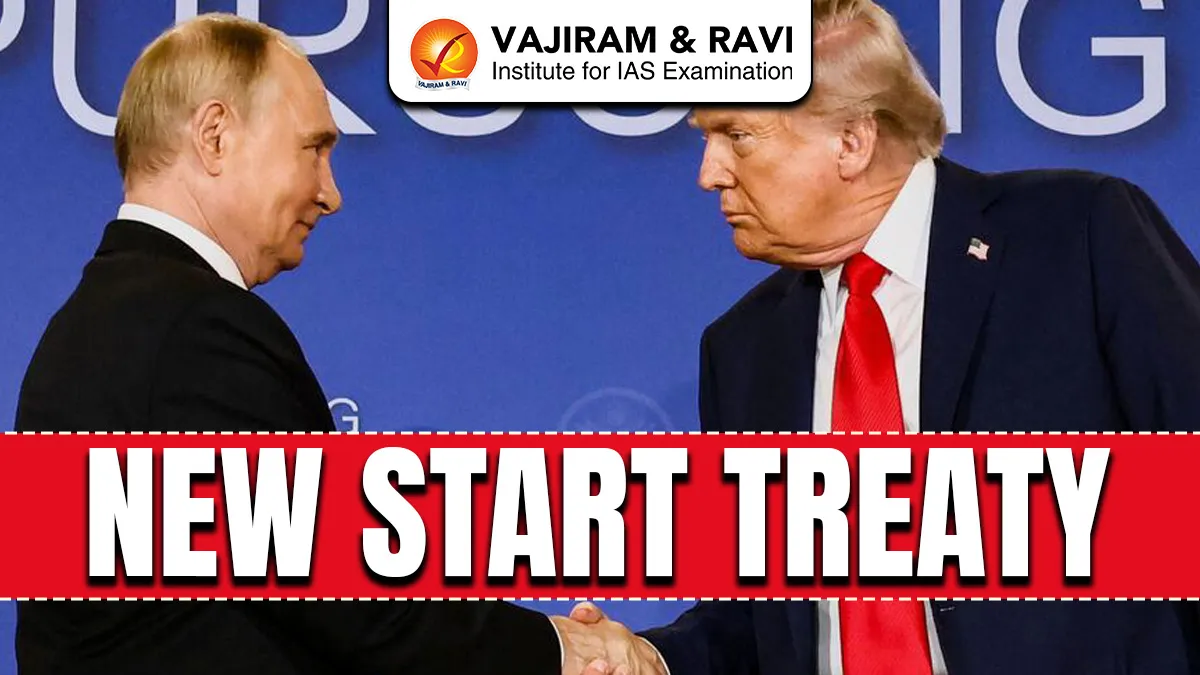
End of New START Treaty Explained: US–Russia Nuclear Arms Control Collapse

New START Treaty

New START Treaty Latest News

  • The expiry of the New START Treaty marks the end of five decades of binding nuclear limits between the US and Russia, raising global concerns about strategic stability and the risk of a renewed nuclear arms race.

Cold War Arms Control Efforts

  • In the late 1960s, at the peak of the Cold War, the Soviet Union began expanding its intercontinental ballistic missile (ICBM) arsenal to match the United States. 
  • In January 1967, US President Lyndon B. Johnson warned that Moscow was developing an anti-ballistic missile (ABM) system around its capital, raising fears of a destabilising first-strike capability.

SALT Talks and Early Treaties

  • To curb the escalating arms race, Washington and Moscow launched the Strategic Arms Limitation Talks (SALT) in November 1969. 
  • These negotiations produced two key agreements:
    • The Anti-Ballistic Missile (ABM) Treaty, which capped missile defence systems at 200 (later reduced to 100) per side.
    • An interim SALT accord under which both sides agreed not to expand their ICBM capabilities.

SALT II and Its Collapse

  • Negotiations for a follow-up pact, SALT II, began in 1972 and culminated in a 1979 agreement limiting nuclear delivery vehicles—such as ICBMs, submarine-launched missiles, and strategic bombers—to 2,250 each. 
  • However, after the Soviet invasion of Afghanistan in December 1979, US President Jimmy Carter withdrew the treaty from Senate consideration, and it was never ratified.

Unravelling of Controls

  • Years later, the US unilaterally exited the ABM Treaty in 2002, arguing it constrained defences against terrorist and rogue-state missile threats.
  • This marked an early step in the gradual erosion of Cold War-era arms control frameworks.

Post–Cold War Nuclear Arms Reduction

  • After the Cold War, the US and Russia signed the Strategic Arms Reduction Treaty (START I) in 1991. 
  • It required both sides to cap deployed strategic delivery systems at 1,600 and reduce nuclear warheads to 6,000.
  • Crucially, START I mandated the destruction of excess missiles and bombers, backed by an intrusive verification regime that included on-site inspections, data exchanges, and satellite monitoring. 
  • Because of the Soviet Union’s collapse and efforts to denuclearise former Soviet states, implementation took longer than expected. 
  • The reductions were completed only in December 2001, and the treaty expired in 2009.

START II: An Unfulfilled Follow-on

  • A second agreement, START II, was signed in January 1993. It aimed to cut strategic warheads further, to 3,000–3,500 by 2003. 
  • However, the treaty never entered into force due to delays in ratification in both countries. 
  • After the US withdrew from the Anti-Ballistic Missile Treaty in 2002, Russia formally withdrew from START II, and plans for a START III agreement collapsed.

SORT: A Temporary Bridge

  • In May 2002, the two countries adopted the Strategic Offensive Reductions Treaty (SORT), committing to reduce operationally deployed warheads to 1,700–2,200. 
  • SORT came into force in 2003 after legislative approval in both countries. 
  • It was conceived as an interim arrangement and was later superseded by the New START treaty in 2011.

A New Phase in US–Russia Arms Control

  • In 2010, US President Barack Obama and Russian President Dmitry Medvedev signed the New Strategic Arms Reduction Treaty (New START). 
  • The agreement came into force on February 5, 2011, marking a renewed commitment to nuclear arms control after earlier treaties expired.
  • Key Limits and Reductions
    • Under New START, both countries agreed to cap their strategic nuclear warheads at 1,550 and limit strategic delivery vehicles to 800, including both deployed and non-deployed systems. 
    • These cuts were substantial, requiring about a 30% reduction in warheads and a 50% reduction in delivery vehicles compared to the earlier SORT agreement.
  • Verification and Inspections
    • To ensure compliance, the treaty established a strong verification mechanism. 
    • Each side was permitted to conduct up to 18 on-site inspections per year of the other’s strategic nuclear facilities, along with regular data exchanges.
  • Extension and Expiry
    • The treaty allowed for a one-time extension. In 2021, after President Joe Biden took office, the US and Russia mutually agreed to extend New START by five years, setting its expiry date at February 5, 2026.

After New START: What Lies Ahead

  • End of Legal Limits on Nuclear Arsenals - With the treaty’s expiry, binding caps on US and Russian nuclear warheads cease to exist. As of 2025, the US holds about 5,277 warheads and Russia around 5,449, raising concerns over unchecked expansion.
  • Rising Risks and Loss of Transparency - Experts warn that the absence of arms control increases the danger of accidental or unintended escalation, especially amid regional conflicts involving Russia or China. Ending limits also reduces transparency over nuclear forces.
  • Erosion of Nuclear Deterrence - Analysts argue that traditional nuclear deterrence is weakening as a stabilising force. The breakdown of arms control norms signals a shift toward open-ended strategic competition among major powers.
  • Global Implications and Non-Proliferation Concerns - The lapse could undermine restraint worldwide, just ahead of the 2026 Nuclear Non-Proliferation Treaty review. While rethinking arms control is possible, experts caution that even limited mutual restraint is safer than unconstrained nuclear rivalry.

Source: IE | BBC

New START Treaty FAQs

Q1: What is the New START Treaty and why is it important?

Ans: The New START Treaty limited US and Russian nuclear warheads and delivery systems, ensuring transparency and stability in global nuclear arms control.

Q2: What happens after the New START Treaty expires?

Ans: With the New START Treaty ending, there are no legal caps on US–Russia nuclear arsenals, increasing risks of arms buildup and reduced transparency.

Q3: How many nuclear warheads do the US and Russia have after New START?

Ans: After the New START Treaty expiry, the US has about 5,277 warheads and Russia around 5,449, according to 2025 estimates.

Q4: Does the end of the New START Treaty increase arms race risks?

Ans: Yes. Experts warn that without the New START Treaty, accidental escalation, miscalculation, and open-ended nuclear competition become more likely.

Q5: Why does the New START Treaty expiry matter globally?

Ans: The New START Treaty lapse weakens global non-proliferation norms ahead of the 2026 NPT Review Conference and undermines arguments for nuclear restraint.

Distribution Companies in India – Performance Turnaround and Road Ahead

Distribution Companies

Distribution Companies Latest News

  • India’s electricity distribution companies (DISCOMs) have recorded a notable financial and operational turnaround, though concerns remain over their long-term sustainability. 

Understanding DISCOMs in India

  • Power Distribution Companies, commonly known as DISCOMs, are responsible for the final stage of electricity delivery, distributing power to households, industries, and agricultural consumers. 
  • India currently has 72 DISCOMs, comprising State-owned utilities, private-sector entities, and power departments. 
  • Historically, DISCOMs have been the weakest link in India’s power sector, plagued by inefficiencies, mounting losses, and rising debt.
  • Two indicators define their financial health:
    • Aggregate Technical and Commercial (AT&C) losses, which capture losses from theft, technical inefficiencies, and billing gaps.
    • ACS-ARR gap, the difference between the Average Cost of Supply (ACS) and Average Revenue Realised (ARR).
  • For decades, high AT&C losses and non-cost-reflective tariffs resulted in persistent deficits, forcing State governments to periodically bail out DISCOMs.

Legacy of Financial Stress

  • The roots of DISCOM losses lie in the functioning of earlier State Electricity Boards under the Electricity (Supply) Act, 1948
  • Although the law required utilities to earn modest profits, political interference, subsidised tariffs, and delayed subsidy payments weakened financial discipline.
  • Between 2020-21 and 2024-25, accumulated losses rose from Rs. 5.5 lakh crore to Rs. 6.47 lakh crore, while outstanding debt touched Rs. 7.26 lakh crore. 
  • Non-payment of dues by consumers, delayed State subsidies, and rising power procurement costs worsened the situation.

Signs of a Turnaround

  • Recent years have shown measurable improvement. According to official data, DISCOMs collectively recorded a Profit After Tax of Rs. 2,701 crore in 2024-25, a sharp contrast to losses exceeding Rs. 67,000 crore in 2013-14. 
  • AT&C losses declined from 22.62% to 15.04%, while the ACS-ARR gap narrowed drastically to 0.06 paise per unit, indicating near cost recovery.
  • This turnaround reflects better billing efficiency, improved collections, and stronger enforcement of financial discipline.

Role of Policy Reforms

  • The improvement has been driven by a series of reforms:
    • Revamped Distribution Sector Scheme (RDSS): Links financial assistance to measurable performance outcomes such as feeder metering, loss reduction, and system modernisation.
    • Electricity Rules and Late Payment Surcharge Rules: Enabled DISCOMs to clear legacy dues in instalments, preventing snowballing of unpaid liabilities.
    • Debt Discipline Measures: Since 2022, legacy dues of nearly Rs. 1.4 lakh crore have been substantially reduced through structured repayments.
  • These reforms restored confidence among power generators and fuel suppliers, stabilising the electricity supply chain.

Dependence on State Support

  • Despite improvements, financial sustainability remains fragile. Many DISCOMs have posted profits only after receiving tariff subsidies and loss takeovers from State governments. 
  • For instance, utilities in States like Tamil Nadu and Rajasthan reported profits largely due to direct fiscal support rather than operational surplus.
  • This dependence raises concerns about the durability of the turnaround, especially when future liabilities such as employee pay revisions arise.

Structural Challenges Ahead

  • Unmetered Agricultural Supply: Lack of accurate data on farm power consumption distorts cost recovery.
  • Free or Highly Subsidised Power: Universal free electricity benefits wealthier consumers disproportionately and weakens utility finances.
  • Operational Inefficiencies: Not all States have adopted feeder segregation or smart metering at scale.
  • Without addressing these structural issues, improvements may prove temporary.

Way Forward

  • Long-term sustainability requires deeper reforms. 
  • Expanding feeder segregation, promoting solar pumps in agriculture, improving metering, and ensuring cost-reflective tariffs are essential. 
  • Political commitment and professional management must align to transform DISCOMs into consumer-friendly and financially viable utilities.

Source: TH

Distribution Companies FAQs

Q1: What are DISCOMs?

Ans: DISCOMs are electricity distribution companies responsible for supplying power to end consumers.

Q2: What is AT&C loss?

Ans: AT&C loss measures technical losses, power theft, and inefficiencies in billing and collection.

Q3: What is the ACS–ARR gap?

Ans: It is the difference between the cost of supplying electricity and the revenue earned per unit.

Q4: Which scheme supports DISCOM reforms?

Ans: The Revamped Distribution Sector Scheme (RDSS) supports financial and operational reforms.

Q5: What is the key challenge for DISCOM sustainability?

Ans: Overdependence on State subsidies and non-cost-reflective tariffs remains the biggest challenge.

Enquire Now

