
AI Impact Summit 2026: India Eyes a Larger Role in the Global AI Economy

AI Impact Summit 2026

AI Impact Summit 2026 Latest News

  • India will host the AI Impact Summit 2026 from February 16 to 20, marking the first time this global AI governance forum is being held in the Global South.
  • The summit aims to generate actionable, long-term policy recommendations rather than impose immediate binding regulations. It seeks to align AI governance with inclusive growth, sustainability, and social impact.

Background: Evolution of Global AI Summits

  • The summit builds on a series of international meetings on AI governance.
  • The Bletchley Park AI Safety Summit (2023) focused on identifying catastrophic AI risks.
  • The Seoul Summit (2024) widened the agenda to include innovation and inclusivity.
  • The Paris AI Action Summit (2025) shifted attention to implementation and economic opportunities.
  • Each iteration has gradually expanded the scope beyond safety towards practical and developmental concerns.

India’s Distinct Approach

  • Unlike earlier summits centred on regulation and risk containment, India is steering the discussion towards “People, Planet, and Progress.” 
  • The focus is on developing AI solutions that address real-world challenges, especially in developing countries. 
  • This reflects India’s dual role as an emerging AI power and a representative voice of the Global South.
  • Through this summit, India is positioning itself to secure a larger role in shaping global AI governance and capturing greater economic and developmental benefits from the technology.

India AI Impact Summit 2026: What to Expect

  • Scale and Significance - The AI Impact Summit 2026 has been described by Union IT Minister Ashwini Vaishnaw as the largest such global gathering so far, with strong international interest and participation.
  • High-Level Global Participation - The summit is expected to host representatives from over 100 countries, including 15–20 heads of government, more than 50 ministers, and over 40 CEOs of leading global and Indian companies. 
    • Prime Minister Narendra Modi will inaugurate the event, host a dinner, and address a CEO roundtable.
  • Diverse Stakeholders - Participants will include governments, industry leaders, researchers, civil society organisations, and international institutions, highlighting the summit’s multi-stakeholder approach to AI governance and development.
  • Key Themes and Deliberations - The summit will feature working groups and discussions on major issues such as AI’s impact on jobs, trust and safety frameworks for AI systems, and the application of AI across key industries.
  • India’s AI Push and Model Launches - As part of the Rs 10,370 crore IndiaAI Mission, the government will launch several indigenous AI language models during the summit, including foundational and small language models.
  • Startup and Innovation Showcase - The event will showcase over 500 AI startups and host around 500 sessions alongside the main programme, making it one of the most comprehensive global forums focused on artificial intelligence.

Opening Up to China at the AI Impact Summit

  • Chinese Participation at the Summit - China is expected to send a delegation to the AI Impact Summit, following a formal invitation extended by India last year as both countries seek to strengthen domestic AI capabilities.
  • Summit Format and Invitations - The AI Summit is not a formal multilateral grouping. Participation is determined by the host country, giving India the discretion to invite China despite geopolitical sensitivities.
  • Precedents from Earlier Summits - When the UK hosted the first AI Safety Summit, it faced opposition from allies and domestic lawmakers over inviting China, but proceeded nonetheless. China also participated in the subsequent summits in Seoul and Paris.
  • Signal of Easing India–China Ties - India’s invitation to China reflects a gradual thaw in bilateral relations. Earlier this year, direct flights between the two countries resumed after a gap of more than five years.
  • Trade and Supply Chain Developments - China has also begun clearing applications from firms supplying rare earth components to Indian automobile manufacturers, easing earlier restrictions imposed amid global trade tensions.

Hardware and Energy: India’s Key AI Constraints

  • Dependence on Imported Computing Hardware - A major disadvantage for India in the AI race is the lack of domestically produced advanced hardware. Access to high-end GPUs, which power AI systems, depends largely on imports, limiting self-reliance.
  • Hopes from India–US Tech Trade - The proposed interim India–US trade deal offers some relief. It is expected to significantly expand trade in technology products, including GPUs and data centre equipment, and deepen joint technology cooperation.
  • Policy Push for Data Centres - India has announced a tax holiday until 2047 for foreign companies setting up data centres. This aims to attract global players and build domestic AI infrastructure, even as reliance on imported hardware continues.
  • Budget Signals and AI Mission - In the Union Budget 2026–27, the allocation for subsidising compute under the IndiaAI Mission was halved. This came alongside strong growth in electronics manufacturing and iPhone exports, indicating shifting priorities.
  • Energy Needs and Nuclear Power - Powering AI data centres is emerging as a critical challenge. The government is exploring nuclear energy as a long-term solution.

Source: IE

AI Impact Summit 2026 FAQs

Q1: Why is the AI Impact Summit 2026 significant for India?

Ans: The AI Impact Summit 2026 is significant because it is the first global AI governance summit in the Global South, positioning India as a leader in shaping inclusive AI norms.

Q2: How does the AI Impact Summit 2026 differ from earlier AI summits?

Ans: Unlike safety-focused meetings, the AI Impact Summit 2026 emphasises people-centric AI, development outcomes, jobs, sustainability, and practical governance aligned with emerging economies’ needs.

Q3: What outcomes does India seek from the AI Impact Summit 2026?

Ans: Through the AI Impact Summit 2026, India aims to influence global AI governance, attract investment, showcase startups, launch indigenous AI models, and gain economic benefits.

Q4: What challenges will be highlighted at the AI Impact Summit 2026?

Ans: The AI Impact Summit 2026 will address hardware dependence, GPU shortages, energy constraints, workforce disruption, and the need for trust and safety frameworks for AI systems.

Q5: Why is China’s participation important at the AI Impact Summit 2026?

Ans: China’s presence at the AI Impact Summit 2026 signals easing tensions, inclusivity in AI governance, and India’s intent to host balanced, geopolitically sensitive global technology dialogue.

Claude’s Cowork Plugins Trigger a SaaS Market Shock Across Global Tech

Claude’s Cowork Plugins

Claude’s Cowork Plugins Latest News

  • Recently, Anthropic released 11 open-source plugins for Claude Cowork, its AI workplace tool. Unlike regular chatbots, Cowork works like a digital colleague. It can read files, write documents, review contracts, and complete tasks across legal, finance, sales, and marketing with little human input.
  • A few days later, Anthropic launched Claude Opus 4.6. This new model can manage and coordinate multiple AI agents to carry out complex work such as financial research and due diligence.
  • This marked a major leap in autonomous AI capabilities, enabling AI agents to independently handle complex workplace tasks across sectors.
  • Markets reacted sharply. Global software stocks saw heavy losses, with major US SaaS firms and Indian IT companies witnessing steep declines. 
  • The sell-off reflected fears that autonomous AI could replace large teams, threatening traditional, headcount-driven business models—especially in India’s IT outsourcing industry.

About SaaS

  • Software as a Service (SaaS) is a cloud-based software delivery model where applications are hosted by a vendor and accessed by users over the internet, typically via a web browser. 
  • Instead of installing and maintaining software locally, users subscribe to the service, allowing for easier access, automatic updates, and flexible, pay-as-you-go pricing.

‘SaaSpocalypse’: Why AI Is Being Seen as an Existential Threat to SaaS

  • The term “SaaSpocalypse” reflects market fears that advanced AI is not just improving software but replacing it altogether
  • As AI agents perform tasks autonomously, the traditional per-user SaaS pricing model looks vulnerable.
  • This has triggered a sharp selloff in software stocks, with investors questioning whether businesses will still pay for large software licences when AI can deliver the same outcomes with fewer people and tools
  • While analysts warn that markets may be overreacting, the episode highlights a real structural shift in how software value is created and priced.

Real-World AI Disruption Across Professional Services

  • The direction of AI-driven disruption has been visible for years. In March 2023, Bloomberg launched BloombergGPT, a domain-specific financial model trained on an unprecedented volume of proprietary data. 
  • It outperformed general AI models on core financial tasks, proving that specialised AI could decisively augment — and eventually automate — expert work.

From tools to autonomous agents

  • BloombergGPT assisted professionals within a closed system. 
  • The newer shift, seen with Claude Cowork, takes this further by deploying AI as autonomous agents that operate across enterprises, executing workflows with minimal human input. 
  • This transition from “AI-assisted” to “AI-operated” systems has unsettled markets.

Legal services: automation shock

  • Claude’s legal plugins automate contract review, NDA screening, and compliance tracking — tasks that form the backbone of legal services. 
  • The impact was immediate: Thomson Reuters saw its steepest ever single-day stock fall, while LegalZoom, RELX, and Wolters Kluwer suffered sharp declines.

Financial services: AI runs the back office

  • Goldman Sachs’ partnership with Anthropic marks a turning point. 
  • Unlike earlier AI tools that supported analysts, Claude-based agents are being used to automate trade accounting, compliance, and client onboarding
  • This move triggered selloffs in firms like FactSet, S&P Global, and Moody’s.

Healthcare: agentic AI at scale

  • Cognizant’s collaboration with Palantir embeds AI agents into the TriZetto healthcare platform, which processes over half of US medical claims. 
  • These systems now handle routing, claims adjudication, and supply chains, with humans intervening only in exceptions.

Workforce implications

  • Industry leaders are openly acknowledging disruption. Anthropic’s CEO has warned that AI could displace half of entry-level white-collar jobs within five years. 
  • Salesforce’s CEO has said the company will not hire more engineers or lawyers due to AI efficiency gains.

Coding as a leading indicator

  • AI’s impact is already visible in software development. Experts report most of the coding are now done by AI agents, with humans editing the output. 
  • Research suggests AI may author 20% of public GitHub commits by year-end, signalling a broader shift in knowledge work.

India Inc’s AI Pivot: Incremental Moves in a Fast-Moving Disruption

  • Indian IT companies have begun responding to AI-driven disruption, but largely through cautious, incremental investments. 
  • The core challenge is speed. Autonomous AI agents are rapidly automating the very high-volume, repetitive tasks that underpin India’s outsourcing model. 
    • As global clients embed AI directly into operations — from banks deploying agentic workflows to defence agencies consolidating software under single platforms — the traditional argument of slow enterprise adoption is losing credibility.
  • To stay relevant, Indian IT firms must shift from labour-based delivery to AI deployment partnerships. 
  • Their competitive advantage lies in deep domain expertise across sectors like banking, insurance and healthcare. 
  • Combining this knowledge with leading AI platforms  offer a viable path forward in an era where AI is reshaping services at unprecedented speed.

Jobs at Risk, Roles Rewritten: How AI Is Reshaping Indian IT Employment

  • The near-term impact on Indian IT jobs is unsettling. 
  • Firms are cutting headcount, freezing fresher hiring, and automating entry-level roles in testing, maintenance and compliance — the traditional backbone of the outsourcing model. These trends signal genuine disruption, not just cyclical slowdown.
  • At the same time, a new layer of opportunity is emerging. 
  • Autonomous AI systems operating in regulated sectors still require Human-in-the-Loop (HITL) oversight — people to validate decisions, manage exceptions, ensure compliance, and uphold ethical and governance standards. 
  • These roles rely on domain expertise and judgment rather than routine coding.
  • The shift points to three growth avenues: AI deployment partnerships within enterprises, HITL operations centres for regulated industries, and large-scale reskilling to prepare engineers to design, supervise and govern AI systems. 
  • The employment challenge is real — but so is the chance to redefine the nature of tech work in India.

Source: TH | LM

Claude’s Cowork Plugins FAQs

Q1: Why have Claude’s Cowork plugins triggered a SaaS market shock?

Ans: Claude’s Cowork plugins triggered a SaaS market shock because autonomous AI agents can replace multiple software tools and teams, undermining traditional per-user SaaS business models.

Q2: How are Claude’s Cowork plugins different from earlier AI tools?

Ans: Claude’s Cowork plugins go beyond assistance by autonomously executing workflows across legal, finance, and sales functions, marking a shift from AI-assisted to AI-operated systems.

Q3: What sectors are most affected by Claude’s Cowork plugins?

Ans: Claude’s Cowork plugins are disrupting legal services, financial back offices, healthcare administration, and software development, leading to sharp selloffs in SaaS and IT stocks.

Q4: Why are Indian IT companies vulnerable to Claude’s Cowork plugins?

Ans: Claude’s Cowork plugins threaten India’s labour-intensive outsourcing model by automating repetitive, high-volume tasks that traditionally relied on large entry-level IT workforces.

Q5: What opportunities exist despite disruption from Claude’s Cowork plugins?

Ans: Despite disruption, Claude’s Cowork plugins create opportunities in AI deployment partnerships, Human-in-the-Loop oversight, AI governance roles, and large-scale reskilling in India’s IT sector.

India-Malaysia Relations – Expanding Cooperation

India-Malaysia Relations

India-Malaysia Relations Latest News

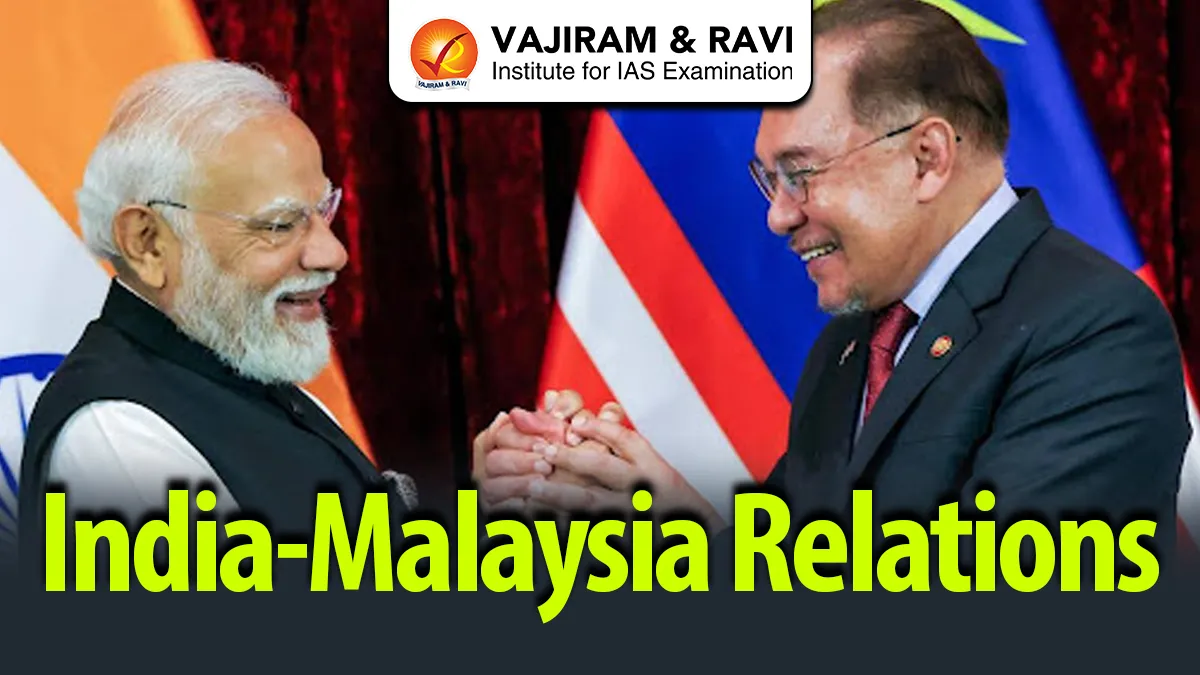
  • India and Malaysia signed multiple agreements during Prime Minister Narendra Modi’s visit to Kuala Lumpur in February 2026, marking a strategic deepening of bilateral ties.

India-Malaysia Bilateral Relationship

  • Historical and Civilisational Links
    • India and Malaysia share deep civilisational connections dating back over two millennia, shaped by trade, religion, language, and cultural exchanges across the Indian Ocean. 
    • Elements of Indian culture, including Sanskrit influences and Hindu-Buddhist traditions are visible in Malaysia’s historical evolution. 
    • Modern diplomatic relations were established soon after India’s independence, with consistent political engagement since then.
  • Political and Diplomatic Engagement
    • India and Malaysia elevated their relationship to a Comprehensive Strategic Partnership in 2024, reflecting growing political trust. 
    • High-level visits, regular foreign office consultations, and cooperation at multilateral forums such as the United Nations and ASEAN-led platforms form the backbone of diplomatic engagement. 
    • Malaysia has supported India’s demand for permanent membership of a reformed UN Security Council, reinforcing political convergence.
  • Trade and Economic Cooperation
    • Malaysia is India’s 3rd largest trading partner within ASEAN. Between April 2000 and March 2025, Malaysia invested about US$ 1.27 billion in India. 
    • Bilateral trade between the two countries stood at US$ 19.86 billion in 2024-25, comprising Indian exports worth US$ 7.32 billion and imports valued at US$ 12.54 billion
    • Owing to its strategic location along the Strait of Malacca and the South China Sea, Malaysia is a key pillar of India’s Act East Policy and an important partner in India’s maritime connectivity strategy. 
    • India’s major exports include petroleum products, engineering goods, meat and dairy products, and organic chemicals, while India’s major imports from Malaysia consist of vegetable oils, machinery, electrical equipment, and minerals.
  • Defence and Security Cooperation
    • Defence ties have expanded steadily through joint exercises, maritime cooperation, and capacity building. 
    • As maritime neighbours in the Indian Ocean and Indo-Pacific region, both countries share concerns over freedom of navigation, maritime security, and non-traditional threats such as piracy and terrorism. 
    • Intelligence sharing and counter-terrorism cooperation have gained prominence in recent years.
  • Diaspora and People-to-People Ties
    • The Indian diaspora in Malaysia, numbering over 2 million, plays a crucial role in strengthening bilateral ties. 
    • Persons of Indian Origin are active in Malaysia’s politics, business, education, and culture. 
    • Educational exchanges, tourism, and cultural diplomacy further enhance people-to-people relations.
  • Shared Regional and Global Platforms
    • Both countries actively engage through ASEAN, the East Asia Summit, and the Indian Ocean Rim Association (IORA)
    • India recognises ASEAN centrality in the Indo-Pacific, while Malaysia supports India’s Act East Policy, creating strategic alignment at the regional level.

News Summary

  • During Prime Minister Narendra Modi’s visit to Kuala Lumpur, India and Malaysia agreed to significantly broaden cooperation across multiple high-priority sectors. 
  • The two sides signed 11 agreements and MoUs, covering areas such as defence cooperation, semiconductors, digital technologies, health, and energy 
  • A major highlight was the framework agreement on semiconductor collaboration, reflecting both countries’ intent to integrate into global supply chains for advanced manufacturing. 
  • India invited Malaysian investment in electronics, AI, renewable energy, and healthcare, while showcasing domestic reforms aimed at improving ease of doing business.
  • Both leaders strongly reaffirmed a zero-tolerance approach to terrorism, explicitly condemning cross-border terrorism and calling for global cooperation against terror financing, radicalisation, and misuse of emerging technologies. 
  • Prime Minister Modi stressed that there would be “no double standards, no compromise” on terrorism.
  • Defence cooperation is set to expand further, particularly in maritime security, intelligence sharing, and joint capacity-building initiatives. 
  • The two sides also agreed to enhance cooperation in multilateral fora, including the UN and the Financial Action Task Force (FATF).
  • Another notable development was the decision to promote trade settlement in local currencies, the Indian Rupee and Malaysian Ringgit, to reduce transaction costs and dependence on third-country currencies. 
  • Malaysia reiterated its support for India’s permanent membership in a reformed UNSC.
  • India also announced the establishment of a new Indian Consulate General in Malaysia, aimed at improving consular services and strengthening diaspora engagement. 
  • The visit underscored the strategic convergence between the two countries on Indo-Pacific stability, ASEAN centrality, and reform of global governance institutions.

Source: TH | DH

India-Malaysia Relations FAQs

Q1: What is the current status of India-Malaysia relations?

Ans: India and Malaysia share a Comprehensive Strategic Partnership with expanding cooperation in trade, defence, and technology.

Q2: Why is semiconductor cooperation significant between India and Malaysia?

Ans: It helps both countries integrate into global value chains for advanced manufacturing and reduce supply-chain vulnerabilities.

Q3: How does Malaysia support India at global forums?

Ans: Malaysia backs India’s permanent membership in a reformed UN Security Council.

Q4: What role does the Indian diaspora play in Malaysia?

Ans: The Indian diaspora strengthens political, economic, and cultural ties between the two countries.

Q5: Why is local currency trade settlement important?

Ans: It reduces dependence on foreign currencies and lowers transaction costs in bilateral trade.

Enquire Now

