The SHANTI Act and Nuclear Liability Reform in India

SHANTI Act

SHANTI Act Latest News

  • The SHANTI Act, recently passed in Parliament, has opened India’s nuclear power sector to private players and significantly altered the nuclear liability framework. 

Background of Nuclear Liability in India

  • India’s nuclear liability regime was primarily governed by the Civil Liability for Nuclear Damage Act (CLNDA), 2010
  • The Act was enacted after India signed the Convention on Supplementary Compensation (CSC) for Nuclear Damage. 
  • Its key objective was to ensure prompt compensation to victims in case of a nuclear accident while also holding responsible parties accountable.
  • A distinctive feature of India’s framework was the “right of recourse”, which allowed the nuclear operator to seek compensation from suppliers if an accident occurred due to defective equipment or services. 
  • Additionally, Section 46 of the CLNDA permitted victims to pursue remedies under other laws, including criminal law. 
  • This structure was seen as strengthening accountability but was criticised by international suppliers who feared unlimited liability exposure.
  • Nuclear energy currently contributes only around 3% of India’s electricity generation. 
  • Despite ambitious targets, 10 GW by 2000 and 20 GW by 2020, actual capacity reached only 2.86 GW in 2000 and 6.78 GW in 2020. 
  • High capital costs, safety concerns, and liability issues have been key constraints.

Key Features of the SHANTI Act

  • Opening the Sector to Private Entities
    • The Act allows private companies to operate nuclear power plants, ending the Union government’s exclusive control over the sector. 
    • This marks a structural shift in India’s atomic energy governance model.
  • Supplier Indemnity and Removal of Right of Recourse
    • The Act channels liability entirely to the operator and removes the operator’s “right of recourse” against suppliers. 
    • This means suppliers cannot be sued for defects in equipment, even if such defects contribute to an accident. 
  • Liability Caps and Changes to CLNDA
    • The operator’s liability is capped between Rs. 100 crore (for small plants) and Rs. 3,000 crore (for large plants). 
    • The total liability for a nuclear accident, including the Centre’s contribution, is capped at 300 million Special Drawing Rights (approximately Rs. 3,900 crore). 
    • The Act also omits Clause 46 of the CLNDA, thereby limiting victims’ ability to seek remedies under other laws. 
    • Additionally, it provides a legislative framework for the Atomic Energy Regulatory Board (AERB), but its independence is limited as members are selected by a committee constituted by the Atomic Energy Commission. 

Rationale Behind Supplier Indemnity

  • Major nuclear accidents such as Three Mile Island (1979), Chornobyl (1986), and Fukushima (2011) involved design flaws and equipment vulnerabilities. 
  • Reports highlighted issues such as reactor design weaknesses, deficient emergency systems, and communication failures by suppliers.
  • Despite this historical evidence, multinational suppliers, particularly from the U.S., have consistently argued that India’s liability framework discouraged investment. 
  • International nuclear liability conventions generally channel liability exclusively to operators and shield suppliers.
  • The SHANTI Act aligns India’s domestic framework with these international norms by indemnifying suppliers from civil and criminal consequences.

Comparison of Liability Caps with Potential Damages

  • The liability caps under the SHANTI Act are significantly lower than the economic costs of past nuclear disasters.
    • The Fukushima accident’s total cost has been estimated at around Rs. 46 lakh crore.
    • Belarus alone estimated losses from Chornobyl at approximately Rs. 21 lakh crore.
  • In contrast, India’s total liability cap of around Rs. 3,900 crore is nearly a thousand times smaller than these figures. 
  • Even with additional funds from the CSC mechanism, compensation would likely cover only a fraction of actual damages in the event of a major disaster. 
  • This raises concerns that victims may bear a substantial share of losses beyond the statutory cap.

Safety and Moral Hazard Concerns

  • The Act introduces the concept of indemnifying operators for accidents caused by “grave natural disasters.” 
  • This departs from India’s earlier “absolute liability” principle for hazardous industries.
  • Such liability caps and indemnities may create a moral hazard. When operators and suppliers are insulated from full financial consequences, they may have weaker incentives to invest in maximum safety and resilience measures.
  • Given that Fukushima was triggered by a tsunami, critics argue that natural disasters cannot be treated as unforeseeable risks in nuclear plant design.

Economic and Strategic Implications

  • Despite contributing only a small share of electricity, nuclear energy projects involve enormous capital investments. 
  • For example, two Westinghouse AP1000 reactors in the U.S. cost about $18 billion each.
  • The SHANTI Act potentially facilitates greater private and foreign participation in India’s nuclear sector, including plans for 100 GW capacity by 2047. However, small modular reactors, often presented as the future of nuclear energy, remain largely untested and may have higher per-unit capital costs.
  • Thus, while the Act may unlock commercial opportunities and attract foreign suppliers, it simultaneously raises questions about regulatory independence, financial risk distribution, and long-term energy viability.

Source: TH

SHANTI Act FAQs

Q1: What is the SHANTI Act?

Ans: It is a law that opens India’s nuclear sector to private players and modifies the nuclear liability framework.

Q2: What major change does the Act make to supplier liability?

Ans: It removes the operator’s right of recourse against suppliers for defective equipment.

Q3: What is the total liability cap under the Act?

Ans: The total cap is 300 million SDRs, roughly Rs. 3,900 crore.

Q4: How much electricity does nuclear energy contribute in India?

Ans: Nuclear energy accounts for about 3% of India’s electricity generation.

Q5: Why has the Act raised safety concerns?

Ans: Because liability caps and supplier indemnity may create moral hazard and weaken safety incentives.

India’s New CPI Series – A Structural Reset of Retail Inflation Measurement

New CPI Series

New CPI Series Latest News

  • On February 12, 2026, the Ministry of Statistics and Programme Implementation (MoSPI) released India’s first retail inflation data under the new Consumer Price Index (CPI) series (Base Year: 2024=100).
  • Retail inflation for January 2026 stood at 2.75% (provisional) — the first official reading under the revised framework.
  • This revision replaces the earlier 2012 base year, reflecting changes in consumption behaviour, market structures, and household expenditure patterns, as captured by the Household Consumption Expenditure Survey (HCES) 2023–24.

Why a New CPI Series?

  • India’s economy has undergone structural transformation over the past decade.
  • For example,
    • Rising share of services
    • Growth of digital consumption
    • Shift toward cleaner fuels
    • Changing food patterns
    • Expansion of online marketplaces
  • The new CPI aligns inflation measurement with current consumption realities, thereby improving its relevance for monetary policy (RBI), fiscal policy calibration, wage indexation, welfare schemes, GDP deflation and national accounts.
  • Significance for monetary and fiscal policy:
    • The CPI is the primary inflation measure for RBI’s Monetary Policy Committee (MPC), linked to the inflation targeting framework (4% ± 2%), and is used for DA revisions, poverty estimation, real income calculation, welfare transfers.
    • Lower weight of volatile food items may reduce short-term fluctuations, and provide clearer inflation signals.

Key Structural Changes in the New CPI

  • Updated base year: Changed from 2012 to 2024, ensuring contemporary relevance.
  • Adoption of international classification: 
    • The new series adopts 12 consumption divisions in line with the COICOP 2018 (Classification of Individual Consumption According to Purpose) framework.
    • 12 divisions (more granular) from earlier structure (6 groups) enhances comparability with global inflation standards.
  • Expanded coverage of items: Total items increased from 299 to 358 (goods increased to 308 from 259, and services from 40 to 50). This reflects growth of the services economy, and modern consumption patterns.
  • New items added:
    • Rural house rent (introduced for the first time)
    • Online media and streaming services
    • Value-added dairy products
    • Barley and related products
    • Pen drives, external hard disks
    • Attendant and babysitter services
    • Exercise equipment
    • Cleaner fuels (CNG/PNG)
  • Removed items: VCR/VCD/DVD players, tape recorders, radios, CD/DVD cassettes, second-hand clothing, coir/rope, reflecting technological obsolescence and lifestyle shift.
  • Wider data collection:
    • The new series collects data from more sources across the country. For example, data is collected from 1,465 rural markets (up from 1,181) and 1,395 urban markets (up from 1,114). 
    • The new series also collects data from 12 online marketplaces. Inclusion of online platforms is a major methodological advancement.

Revised Weight Structure - Changing Consumption Patterns

  • Food and beverages:
    • Weight reduced to 36.75% (from 45.86%).
    • Implication: Headline inflation may become less volatile, as food prices are typically unstable. Food still remains the largest component.
  • Housing (expanded category):
    • Weight increased from 10.07% to 17.67%.
    • Now expanded to include water, electricity, gas, and other fuels. Also introduces rural house rent, improving representativeness.

Inflation Numbers (January 2026)

  • Headline CPI Inflation (2.75%): Rural: 2.73%, Urban: 2.77%
  • Food Inflation (CFPI): 2.13%
    • Rural: 1.96%
    • Urban: 2.44%
  • Housing Inflation: 2.05%
    • Rural: 2.39%
    • Urban: 1.92%
  • Historical comparison is limited since this is the first release under the new base. A linking factor has been provided to compute backward-compatible index values up to 2013.

Challenges and Way Forward

  • Comparability issues: Break in time series complicates long-term analysis. Integrate CPI data with big data analytics.
  • Data consistency: Linking factor may not perfectly replicate old series trends. Enhance transparency in linking methodology. 
  • Food weight reduction debate: India remains a lower-middle-income economy where food inflation impacts welfare significantly. Ensure regular revision cycles (every 5–10 years).
  • Rural representation concerns: Despite expansion, informal consumption may still be underreported. Strengthen rural data infrastructure. Increase public statistical literacy.
  • Online price volatility: Digital marketplace pricing can fluctuate dynamically. Improve real-time digital price collection systems.

Conclusion

  • The launch of the CPI Base 2024 series marks a crucial reform in India’s statistical architecture. 
  • By aligning inflation measurement with contemporary consumption patterns and international standards, the new series enhances the reliability of inflation signals for policymakers.
  • However, maintaining continuity, credibility, and transparency will be essential to ensure that the CPI remains a trusted macroeconomic anchor in India’s inflation-targeting regime.
  • In essence, this is not just a statistical update—it is a recalibration of how India measures the cost of living in a transforming economy.

Source: TH

New CPI Series FAQs

Q1: What is the base year of the newly launched CPI series released in February 2026?

Ans: The new CPI series has 2024 as the base year (2024=100).

Q2: Which survey forms the basis for revising the weights in the new CPI series?

Ans: The weights are based on the Household Consumption Expenditure Survey (HCES) 2023–24.

Q3: Under the new CPI series, how many consumption divisions are adopted and which international framework guides them?

Ans: The new series adopts 12 consumption divisions aligned with the COICOP 2018 framework.

Q4: How has the weight of the food and beverages category changed in the new CPI series?

Ans: The weight of food and beverages has been reduced from 45.86% to 36.75%.

Q5: What was the headline retail inflation rate (CPI) for January 2026 under the new series?

Ans: Retail inflation for January 2026 stood at 2.75% (provisional).

India AI Applications Stack: Competing Beyond Models with Social Impact

India AI Applications Stack

India AI Applications Stack Latest News

  • India’s AI success will hinge less on large GPU clusters and more on how AI applications improve everyday life. 
  • From enabling ASHA workers to detect high-risk pregnancies, helping farmers reduce pesticide use, to enhancing learning outcomes in government schools, AI’s real value lies in social impact.
  • The Economic Survey 2026 emphasises Human Primacy and Economic Purpose as core principles, calling for AI adoption to remain aligned with welfare and inclusion. 
  • A national AI strategy must reflect domestic realities and ensure benefits reach all sectors and citizens.
  • Encouragingly, Indian innovators are already building AI solutions in health, agriculture, education, urban governance, and disaster management. 
  • With sustained policy and ecosystem support, these solutions could scale nationwide and evolve into a cohesive India AI Applications Stack, with potential for global export.

AI in Healthcare: Expanding Access and Early Detection

  • Niramai: Early Breast Cancer Screening
    • Niramai has developed a non-invasive, AI-based thermal imaging tool for breast cancer screening. 
    • Unlike traditional mammography, it works effectively for women of all ages, including those with dense breast tissue. 
    • Portable and affordable, it enables large-scale screening in rural and semi-urban areas.
  • Qure.ai: Rapid Medical Imaging Analysis
    • Qure.ai uses AI to analyse X-rays and CT scans within seconds, detecting over 35 conditions such as tuberculosis, lung cancer, and heart failure. 
    • It is especially valuable in districts with limited radiologist availability, enabling faster triage and treatment.
  • AISteth: Remote Cardiac and Respiratory Diagnosis
    • AISteth is an AI-powered stethoscope that converts heart and lung sounds into visual waveforms. 
    • With around 93% accuracy, it supports frontline health workers in identifying cardiac and respiratory problems early, strengthening primary healthcare delivery.

AI in Agriculture: Smarter Farming, Lower Costs

  • Neoperk: Instant Soil Health Analysis
    • Neoperk uses near-infrared spectroscopy and machine learning to deliver lab-accurate soil health results in under five minutes. 
    • By analysing 12 key parameters without chemicals, it enables farmers to optimise fertiliser use, improve soil quality, and cut input costs.
  • CottonAce: Pest Management Through AI
    • Developed by the Wadhwani Institute for Artificial Intelligence, CottonAce allows farmers to upload pest images via a mobile app and receive instant, localised pesticide advice. 
    • It has helped thousands of cotton farmers manage threats like pink bollworm, boosting crop quality and profitability.
  • Niqo Robotics: Precision Spraying
    • Niqo Robotics deploys AI-powered robots with computer vision to detect pests and weeds in real time. 
    • This enables selective spraying, reducing pesticide use by up to 60–90%, lowering costs and minimising environmental damage.
  • Cropin: Digital Farming Ecosystem
    • Cropin offers an AI-enabled platform for farm monitoring, credit analytics, and farmer engagement. 
    • It supports climate-smart and predictive farming practices, transforming fragmented agricultural operations into scalable, data-driven systems.

AI in Education: Personalised and Inclusive Learning

  • PadhaiWithAI: Improving Math Outcomes
    • PadhaiWithAI offers an AI-powered personalised learning platform aimed at improving mathematics performance in government schools. 
    • Within six weeks, it significantly raised pass rates and boosted high-achiever performance, demonstrating scalable potential for rural education reform.
  • Rocket Learning’s Appu: Early Childhood Support
    • Rocket Learning’s AI companion, Appu, interacts with parents and children via WhatsApp. 
    • Through short, play-based activities, it strengthens foundational literacy and numeracy among children under six, making early learning accessible at scale.
  • Belagavi Smart City: Adaptive eBooks
    • Belagavi Smart City has introduced AI-enabled deep learning eBooks in public libraries. 
    • These books adapt storylines and difficulty levels in real time, leading to improved engagement and a 12% increase in reading speed within two weeks.

Government as Ecosystem Orchestrator for India’s AI Applications Stack

  • The government can play a catalytic role by acting as an ecosystem orchestrator for grassroots AI innovations. 
  • By enabling procurement of empanelled domestic AI solutions across departments, hospitals, and schools, it can create reliable demand and accelerate nationwide adoption.
  • By establishing clear benchmarks for AI use in health, agriculture, and education, the government can foster a trusted environment for citizens and institutions. 
  • Standard-setting would reduce uncertainty and encourage responsible deployment at scale.

Building the India AI Applications Stack

  • Once proven domestically, high-impact solutions can be integrated into an India AI Applications Stack—a unified suite of scalable, India-tested AI applications ready for global markets. 
  • Platforms such as the Global Partnership on AI can support international collaboration and outreach.
  • A robust national governance framework, harmonised with international standards like the European GDPR, can position the India AI Applications Stack as a plug-and-play solution for other countries, enhancing India’s global AI leadership.

Source: IE | PIB

India AI Applications Stack FAQs

Q1: What is the India AI Applications Stack?

Ans: The India AI Applications Stack refers to a unified ecosystem of scalable AI solutions built for India’s healthcare, agriculture and education sectors, designed for domestic impact and global deployment.

Q2: Why is the India AI Applications Stack important for India’s AI strategy?

Ans: The India AI Applications Stack shifts focus from GPU infrastructure to human-centric applications, ensuring AI improves public health, farm productivity and learning outcomes across diverse regions.

Q3: Which sectors are driving the India AI Applications Stack?

Ans: The India AI Applications Stack is powered by innovations in healthcare diagnostics, precision agriculture, personalised education, urban governance and disaster management applications.

Q4: What role can government play in the India AI Applications Stack?

Ans: The government can accelerate the India AI Applications Stack through procurement support, benchmarking standards, regulatory clarity and integrating proven solutions into public service delivery systems.

Q5: How can the India AI Applications Stack gain global relevance?

Ans: With strong governance aligned to frameworks like GDPR, the India AI Applications Stack can become a plug-and-play AI model exportable to developing nations facing similar social challenges.

Indian Inscriptions in Egypt: Tamil and Sanskrit Names in Pharaohs’ Tombs

Indian Inscriptions in Egypt

Indian Inscriptions in Egypt Latest News

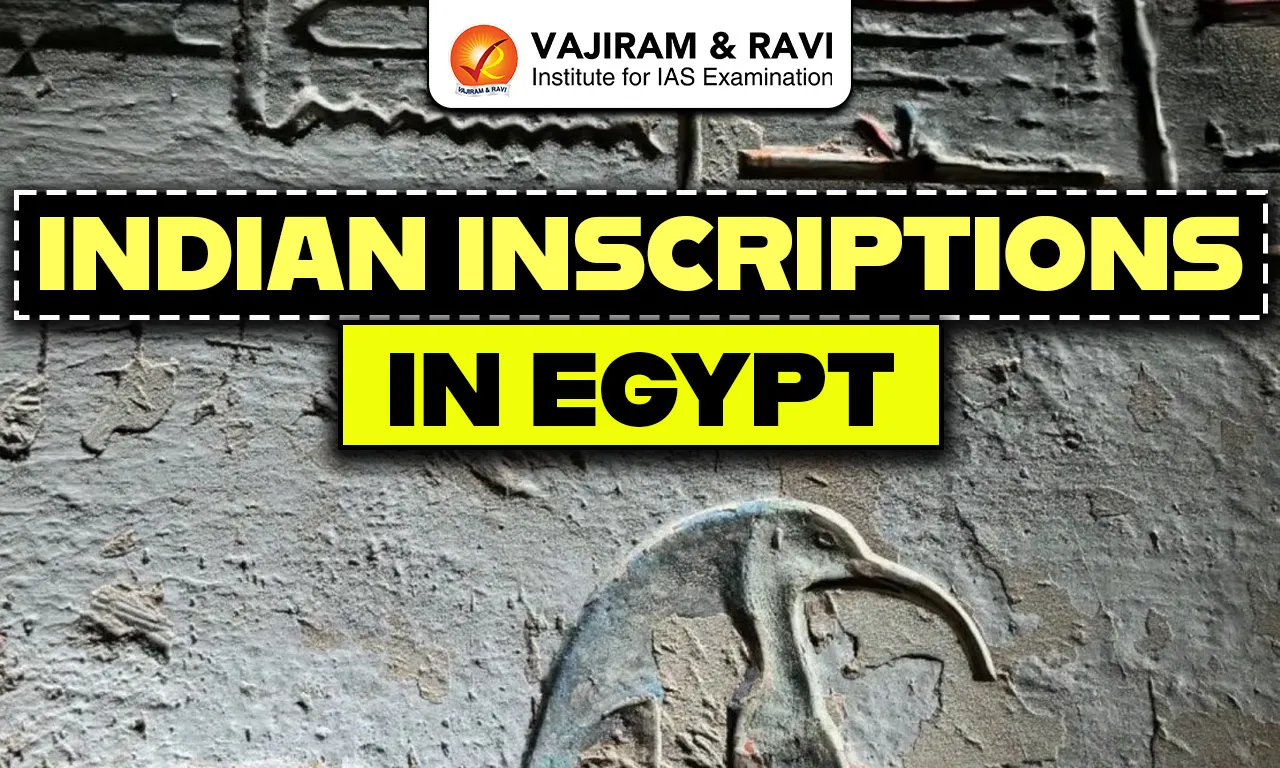
  • A recent study (2024–25) by scholars from the École Française d’Extrême-Orient (EFEO) and the University of Lausanne has documented nearly 30 inscriptions in Tamil-Brahmi, Sanskrit, and Prakrit inside six tombs in Egypt’s Valley of the Kings in the Theban Necropolis.
  • While Greek graffiti in these tombs had been catalogued as early as 1926, the Indian inscriptions — dating between the 1st and 3rd centuries CE — had largely gone unnoticed.
  • The discovery highlights deeper cultural and mobility links between South Asia and the Mediterranean world during antiquity.

The Repeated Name: Cikai Koṟṟaṉ in Egypt’s Tombs

  • Among the Indian graffiti found in Egypt’s Valley of the Kings, the Tamil name Cikai Koṟṟaṉ stands out. 
  • It was inscribed eight times across five tombs, including one placed prominently about four metres high near an entrance—suggesting deliberate visibility and assertion of presence.

Linguistic Blend: Sanskrit and Tamil Roots

  • The name reflects cultural hybridity:
    • “Cikai” may derive from the Sanskrit śikhā, meaning tuft or crown.
    • “Koṟṟaṉ” is distinctly Tamil, linked to roots meaning victory or slaying, and associated with Koṟṟavai, the Chera warrior goddess, and koṟṟavaṉ (king).
  • This fusion highlights the multilingual and cosmopolitan character of early historic Indian merchant communities.

Links to Tamilagam and Trade Networks

  • The name Koṟṟaṉ also appears in:
    • A pottery sherd from Berenike, a Red Sea port with Indian inscriptions.
    • The Sangam corpus, where the Chera ruler Piṭṭāṅkoṟṟaṉ is addressed as Koṟṟaṉ.
  • These parallels firmly connect the Egyptian graffiti to the literary and epigraphic traditions of ancient Tamilagam, reinforcing evidence of deep Indo-Mediterranean interactions.

“Kopāṉ Came and Saw”: Indian Voices in Egyptian Tombs

  • Another striking inscription discovered in Egypt’s Valley of the Kings reads: “Kopāṉ varata kantan” — “Kopāṉ came and saw.”
  • Scholars note that this phrasing closely mirrors common Greek graffiti formulae found in the same tombs. 
  • It suggests that Indian visitors were consciously adopting an existing Mediterranean tradition of marking presence at sacred sites.

Familiar Tamil Names in a Foreign Land

  • The name Kopāṉ has parallels in early Tamil inscriptions from Tamil Nadu, including Ammankovilpatti. Other names identified in the tombs include:
    • Cātaṉ
    • Kiraṉ
  • Both are well attested in Tamil-Brahmi inscriptions from South India, reinforcing the connection between these Egyptian markings and ancient Tamilagam.

Participation in a Cosmopolitan Travel Culture

  • The inscriptions appear alongside a large body of Greek graffiti inside the tombs. 
  • According to researchers, Indian visitors were not creating separate cultural spaces but participating in a shared Mediterranean practice — inscribing their names to record their visit.
  • This reflects a cosmopolitan network of mobility in the 1st–3rd centuries CE, where Indian travellers ventured far inland beyond Red Sea ports.

Beyond Tamil: Northern Indian Presence in Egyptian Tombs

  • Of the nearly 30 documented inscriptions, around 20 are in Tamil-Brahmi, while the remaining are in Sanskrit, Prakrit, and Gandhari-Kharosthi
  • This linguistic diversity indicates that visitors were not limited to southern India but came from multiple regions across the subcontinent.
  • One Sanskrit inscription mentions an envoy of a Kshaharata king who “came here.” 
    • The Kshaharata dynasty ruled parts of western India in the 1st century CE, suggesting that individuals linked to ruling elites, not just merchants, were part of these networks.
  • The range of languages confirms that Indo-Roman trade was not confined to Tamil merchants from the Malabar coast
  • Traders and travellers from northwestern and western India, including Gujarat and Maharashtra, also participated in transoceanic exchanges.
  • The Valley of the Kings graffiti captures a moment in history when the Indian Ocean world was deeply interconnected, with merchants, envoys, and travellers from different Indian regions leaving their mark far inland in Egypt.

From Berenike to Thebes: Expanding the Map of Indian Mobility

  • Beyond Port Trade - Earlier evidence of Indo-Roman contact centred on Berenike, the Red Sea port linking Roman Egypt with the Indian Ocean. Excavations there revealed Indian inscriptions and trade goods such as pepper, beads, and textiles.
  • Inland Presence in the Nile Valley - The discovery of Tamil-Brahmi, Sanskrit, and Prakrit inscriptions in the Valley of the Kings—far inland along the Nile—extends this narrative. It suggests Indian visitors travelled beyond coastal trade hubs, engaging in local commemorative practices and sightseeing.
  • Literacy and Cosmopolitanism - The inscriptions—mostly brief names and arrival statements—demonstrate: Literacy in Indian scripts; Mobility across long distances; Possible familiarity with Greek.
    • They reflect merchant communities confident enough to mark their presence thousands of miles from home.

Rethinking Tamil-Brahmi Evidence

  • With only around a hundred Tamil-Brahmi inscriptions known from India, the addition of about 20 in Egypt is significant. 
  • This raises questions about:
    • The survival of writing materials in Tamilagam
    • The social groups that practised stone inscription

Rethinking the Roman–Indian Exchange

  • Classical writers like Pliny and Ptolemy documented Roman trade with India, highlighting exports such as pepper, ivory, gemstones, and textiles. 
  • However, debates persisted over whether interaction was merely commercial or involved deeper reciprocal movement.
  • The newly documented inscriptions transform abstract trade into lived history. These names confirm that Indians were physically present in Roman Egypt, not just distant trading partners.

The Valley of the Kings as a Roman-Era Tourist Site

  • Originally built in the 16th century BCE, the Valley of the Kings became a site visited by Mediterranean travellers during the Roman period. 
  • Alongside Greek graffiti, Indian inscriptions now reveal participation in this shared commemorative culture.

Literary Echoes and Cultural Memory

  • The Tamil names resonate with the Sangam corpus, and linguistic elements linked to the goddess Koṟṟavai appear on Egyptian walls. 
  • This strengthens connections between epigraphic evidence and early South Indian literary traditions.

Preserved Across Two Millennia

  • Though modest and lightly scratched, the Tamil-Brahmi, Sanskrit, and Prakrit inscriptions survived due to Egypt’s dry climate and the protected interiors of rock-cut tombs. 
  • Their endurance provides rare, tangible proof of the Indian Ocean world’s interconnected past.

Source: IE | TH

Indian Inscriptions in Egypt FAQs

Q1: What are Indian Inscriptions in Egypt?

Ans: Indian Inscriptions in Egypt refer to Tamil-Brahmi, Sanskrit and Prakrit graffiti discovered inside the Valley of the Kings, dating between the 1st and 3rd centuries CE.

Q2: Why are Indian Inscriptions in Egypt important?

Ans: Indian Inscriptions in Egypt prove that Indians travelled inland to Thebes, showing direct physical presence in Roman Egypt beyond coastal trade exchanges.

Q3: Which languages appear in Indian Inscriptions in Egypt?

Ans: Indian Inscriptions in Egypt include Tamil-Brahmi, Sanskrit, Prakrit and Gandhari-Kharosthi, indicating participation from multiple Indian regions in Mediterranean networks.

Q4: Who was Cikai Koṟṟaṉ in Indian Inscriptions in Egypt?

Ans: Cikai Koṟṟaṉ, a Tamil name inscribed eight times, reflects linguistic hybridity and links with Sangam-era Tamilagam, strengthening evidence of Indian Inscriptions in Egypt.

Q5: How do Indian Inscriptions in Egypt change historical understanding?

Ans: Indian Inscriptions in Egypt reshape Indo-Roman trade history by showing literacy, cultural participation and mobility of Indian merchants within Roman-era commemorative traditions.

Enquire Now