
U.S.-India Interim Trade Deal – Explained

Interim Trade Deal

Interim Trade Deal Latest News

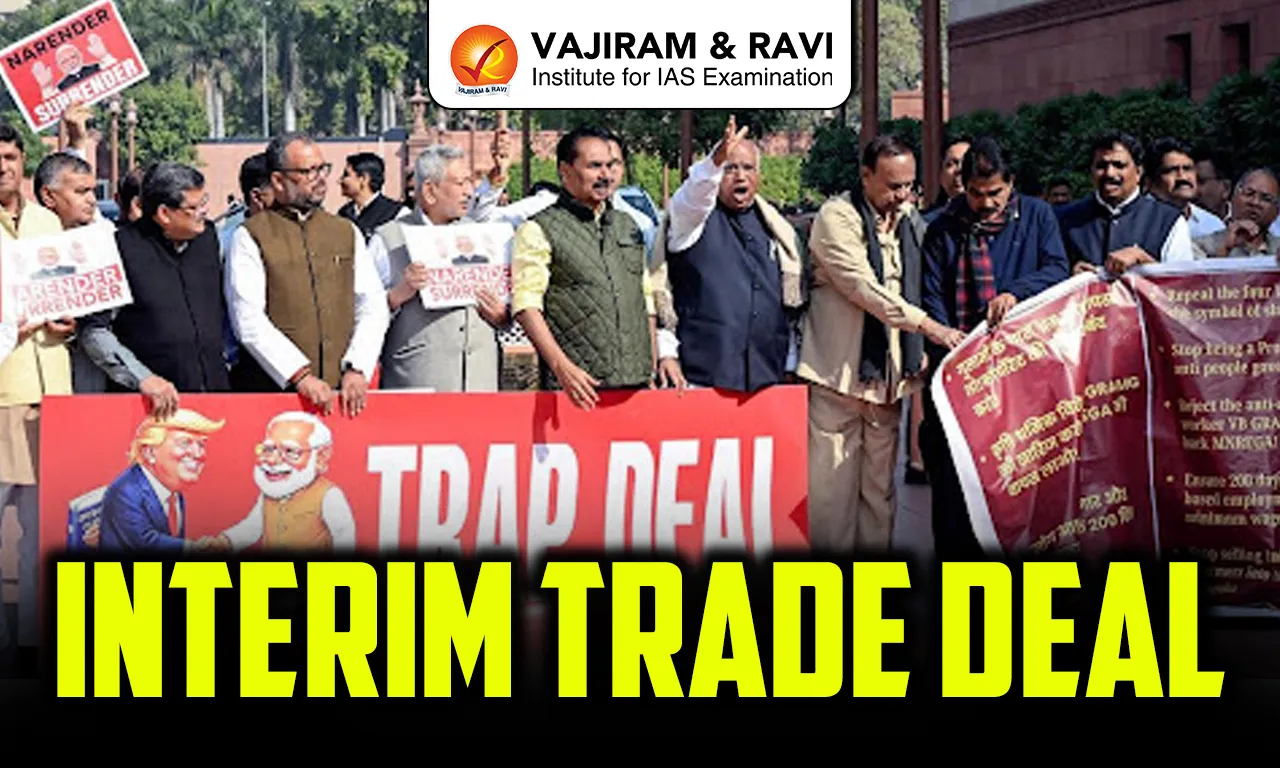
  • India and the United States have signed an interim trade agreement, triggering debates over its economic impact, agricultural implications, and sovereignty concerns.

Background of U.S.-India Trade Relations

  • India and the United States share a deep strategic and economic partnership. 
  • Bilateral trade in goods and services has grown significantly over the past decade, with the U.S. emerging as one of India’s largest trading partners. 
  • India has traditionally maintained a trade surplus with the U.S., exporting pharmaceuticals, textiles, engineering goods, and IT services, while importing energy, aircraft, and high-value technology products.
  • However, trade tensions escalated in August 2025 when U.S. President Donald Trump imposed 25% tariffs on Indian imports, along with an additional 25% penalty linked to India’s continued import of Russian crude oil. 
  • These measures strained bilateral ties and disrupted trade flows.
  • Nearly a year later, both countries agreed to an interim trade agreement as the first step towards a broader bilateral trade deal. 
  • While this agreement is being presented as a breakthrough in restoring ties, it has raised several policy and economic questions.

Key Provisions of the Interim Agreement

  • Tariff Reduction by the U.S.: The U.S. will reduce tariffs on Indian imports from 50% to 18%.
  • India’s Concessions on Market Access: India will eliminate or significantly reduce tariffs and non-tariff barriers on imports of industrial goods and a wide range of food and agricultural products from the U.S.
  • Energy and Strategic Commitments: India has expressed its intent to purchase $500 billion worth of U.S. energy products, aircraft, aircraft parts, precious metals, technology products, and coking coal over the next five years.
  • Russian Oil Imports: An Executive Order issued alongside the Joint Statement indicates that India would stop directly or indirectly importing Russian oil, although Indian officials have not formally confirmed this commitment.
  • Monitoring Mechanism: The U.S. administration has indicated that additional tariffs could be reimposed if India resumes Russian oil imports.

Potential Benefits of the Agreement

  • Supporters argue that lower U.S. tariffs could provide opportunities for Indian exporters, particularly in labour-intensive sectors such as textiles and clothing. 
  • A tariff reduction to 18% may offer some competitive advantage compared to countries facing higher duties.
  • However, this advantage may be limited. The U.S. has also concluded trade arrangements with countries like Bangladesh, offering preferential treatment to certain textile products. This reduces India’s relative edge in the American market.
  • Moreover, the agreement could strengthen strategic ties between the two countries and signal policy stability to global investors.

Concerns Regarding the Agricultural Sector

  • Impact on Farmers
    • The interim agreement does not explicitly state that tariff protection on sensitive agricultural products, especially cereals, will be maintained. 
    • Historically, India has safeguarded such products in all its Free Trade Agreements, including the recent EU-India FTA.
    • If tariff barriers on cereals and other agricultural commodities are reduced, Indian farmers may face competition from highly subsidised American agribusiness. This could undermine farm incomes and threaten food security.
  • Genetically Modified (GM) Products
    • The U.S. has long objected to India’s restrictions on genetically modified (GM) food imports, treating them as non-tariff barriers. 
    • The agreement’s reference to resolving “long-standing concerns” has raised fears that India may allow GM food imports in the future.
    • This has implications not only for farmers but also for public health, biosafety, and regulatory autonomy.

Unequal Tariff Structure

  • A critical concern is the asymmetry in tariff concessions.
  • While India is eliminating or reducing tariffs on U.S. imports, the U.S. is retaining an 18% tariff on Indian exports. 
  • Before the tariff dispute, average U.S. tariffs on Indian goods were around 2.5%. Thus, the new arrangement represents a significant increase in protection against Indian exports.
  • This raises questions about negotiating leverage and whether India has accepted an unequal arrangement under external pressure.

Sovereignty and Strategic Autonomy

  • The clause related to Russian oil imports and the potential reimposition of tariffs has broader geopolitical implications.
  • The possibility of U.S. surveillance over India’s oil imports and the conditionality attached to tariff relief could be viewed as constraining India’s strategic autonomy. 
  • For a country that has historically maintained an independent foreign policy, this aspect of the agreement has sparked intense debate.
  • Additionally, several countries, such as China and Brazil, have resisted similar tariff pressures. Critics question why India has chosen accommodation over resistance.

Broader Economic and Political Implications

  • The interim agreement must be seen as a precursor to a full-fledged U.S.-India Trade Agreement. Its final contours will determine:
    • The balance between export opportunities and domestic protection.
    • The future of India’s agricultural policy.
    • The degree of regulatory autonomy India retains.
    • The strategic alignment between the two democracies.
  • The government faces the challenge of ensuring that economic gains do not come at the cost of food security, farmer livelihoods, and sovereign decision-making.

Source: TH

Interim Trade Deal FAQs

Q1: What triggered the recent U.S.-India interim trade agreement?

Ans: The agreement followed U.S. tariff hikes in 2025 and aims to restore strained trade relations.

Q2: What is the new tariff rate imposed by the U.S. on Indian exports?

Ans: The U.S. has reduced tariffs to 18% under the interim agreement.

Q3: Why are Indian farmers concerned about the agreement?

Ans: There is uncertainty over tariff protection on cereals and the possible entry of U.S. agricultural products.

Q4: What is the controversy regarding Russian oil imports?

Ans: The U.S. may reimpose tariffs if India resumes importing Russian crude oil.

Q5: Why is the agreement termed unequal by critics?

Ans: India has reduced tariffs significantly, while the U.S. continues to maintain an 18% tariff on Indian exports.
Vande Mataram Row Explained

Vande Mataram Row

Vande Mataram Row Latest News

  • The Union government’s January 28 directive mandating the singing of all six stanzas of the National Song Vande Mataram at official functions has triggered objections from several organisations. 
  • The notification requires the full 3-minute-10-second version to be played before Jana Gana Mana when both are included in state events, with the audience standing in attention.
  • Traditionally, only the first two stanzas have been sung at public functions. The later four stanzas contain explicit religious imagery, which has historically been a source of controversy and discomfort for some communities.
  • The directive comes amid the government’s commemoration of 150 years of Vande Mataram, during which references to the “dropped” stanzas have been repeatedly raised in Parliament.
  • The move aligns with this broader effort but has revived debates over the song’s composition and the objections surrounding its later verses.

Origins and Evolution of Vande Mataram

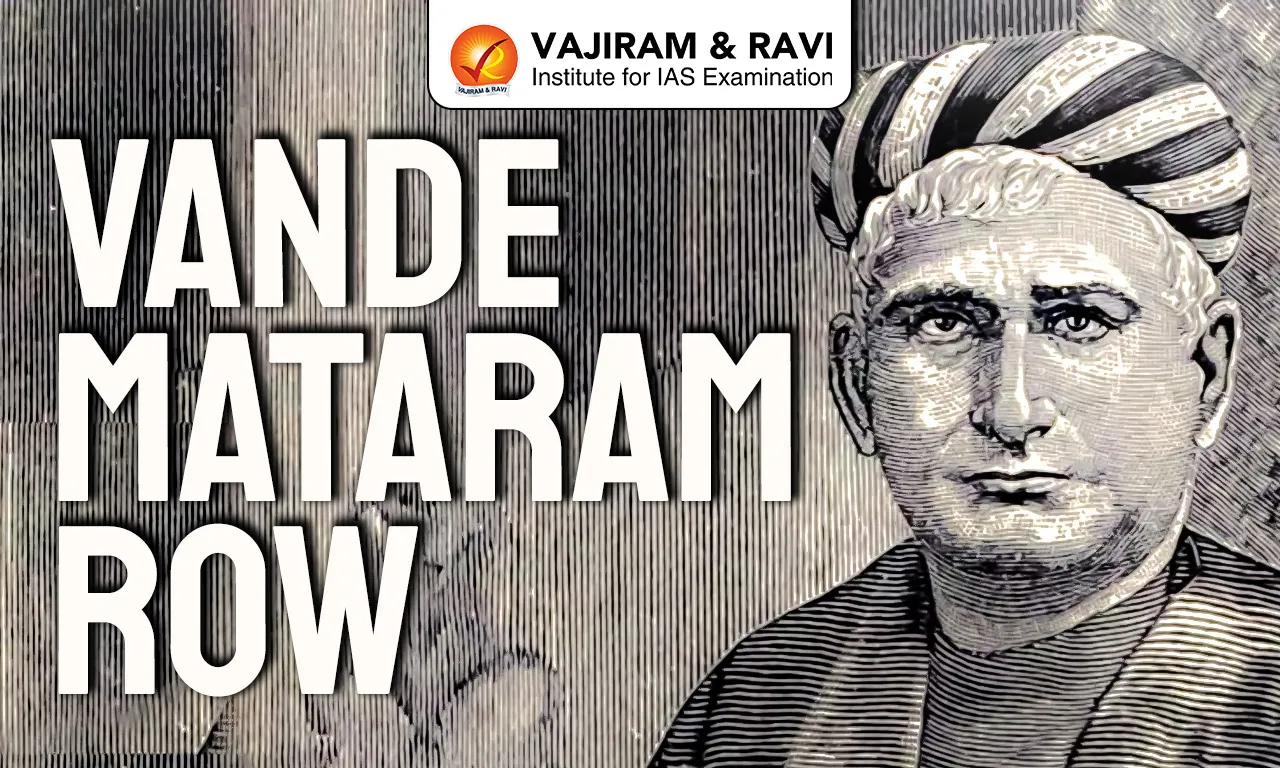
  • Vande Mataram (“Mother, I bow to thee”) was composed in 1875 by Bankim Chandra Chattopadhyay in Sanskritised Bengali. 
  • It was later included in his 1882 novel Anandamath, which depicted the late-18th century Sanyasi Rebellion against the rule of Mir Jafar and the East India Company.
  • The song became a powerful nationalist slogan during the Swadeshi movement (1905–08), symbolising resistance to British rule. 
  • However, concerns about its religious undertones emerged early on. 
  • In 1937, Jawaharlal Nehru wrote to Subhas Chandra Bose acknowledging apprehensions among Muslims, though he described the controversy as being amplified by communal elements.

Congress Compromise on Stanzas

  • In October 1937, the Congress Working Committee recommended that only the first two stanzas be sung at national gatherings. 
  • It observed that these verses, which celebrate the natural beauty and bounty of the motherland, were free of objectionable religious imagery, unlike the lesser-known later stanzas.

National Song Status and Protocol

  • In 1950, the first two stanzas were formally adopted as India’s National Song. 
  • The Constituent Assembly accorded it equal honour with the National Anthem but did not prescribe mandatory protocols regarding posture or recital. 
  • The recent government directive marks a shift toward formalising etiquette and performance requirements.

Religious and Constitutional Objections to Vande Mataram

  • Objections from Muslim scholars centre on the portrayal of “Mother India” as a goddess, which conflicts with Islam’s core principle of strict monotheism. 
  • Worship of any entity other than Allah is considered impermissible in Islamic belief.

Controversy Over the Later Stanzas

  • The latter four stanzas intensify the controversy.
    • The third stanza refers to “crores and crores” of arms ready for battle.
    • The fourth suggests the motherland’s image is present in shrines.
    • The fifth likens the nation to Hindu goddesses Durga, Lakshmi, and Saraswati.
  • Historians argue that in the context of Anandamath, these verses frame Muslims as adversaries and depict the motherland in explicitly Hindu religious imagery, alienating non-Hindu communities.
  • Various organizations have termed the move a “blatant attack” on religious freedom under Article 25 of the Constitution.
  • They clarified that Muslims do not object to others singing the song but oppose being compelled to recite verses that conflict with monotheistic beliefs.

Political Flashpoint Over Vande Mataram

  • In December 2025, Parliament marked 150 years of Vande Mataram, triggering sharp political exchanges over its historical interpretation and contemporary relevance.
  • In the Lok Sabha, PM Modi accused Jawaharlal Nehru of truncating the song in 1937 under pressure from the Muslim League. 
  • He cited Nehru’s correspondence with Subhas Chandra Bose, arguing that Nehru acknowledged Muslim League objections instead of firmly defending the song.
  • Opposition leaders responded by quoting additional portions of Nehru’s letter, where he described the opposition to Vande Mataram as largely “manufactured by communalists” and criticised what he termed the Muslim League’s “low type of communalism.”
  • Many contended that forcing citizens to sing the song violates constitutional principles. 
  • They maintained that portraying Bharat as a goddess turns nationalism into a religious expression, conflicting with secular values.

Source: IE

Vande Mataram Row FAQs

Q1: What triggered the Vande Mataram row?

Ans: The Vande Mataram row began after the government directed that all six stanzas be sung at official events, reviving debate over religious imagery in later verses.

Q2: Why are the later stanzas controversial?

Ans: In the Vande Mataram row, critics object to references portraying the motherland as Hindu goddesses, arguing this conflicts with monotheistic religious beliefs and secular constitutional principles.

Q3: What was the 1937 Congress decision regarding Vande Mataram?

Ans: During earlier controversy similar to the Vande Mataram row, Congress recommended singing only the first two stanzas, which celebrate the motherland without explicit religious imagery.

Q4: What constitutional concerns are raised in the Vande Mataram row?

Ans: The Vande Mataram row involves claims that compulsory singing violates Article 25, which guarantees freedom of religion, and challenges the secular framework of the Constitution.

Q5: Why is the Vande Mataram row politically significant?

Ans: The Vande Mataram row has reignited historical debates about nationalism, religious symbolism, and political interpretations of Nehru’s 1937 position on the song’s contested stanzas.

Refurbished Medical Devices in India: Policy Debate, Industry Divide & Regulatory Challenges

Refurbished Medical Devices

Refurbished Medical Devices Latest News

  • Recently, the Department of Pharmaceuticals informed the Rajya Sabha that the Ministry of Health and Family Welfare (MoHFW) has constituted a committee to draft a policy on the regulation of refurbished medical devices. 
  • The panel will define their scope, establish methods to assess safety, performance, and remaining useful life, and recommend guidelines for disposal and waste management.
  • The core debate now centres not on whether refurbished medical devices should be allowed, but on how they should be effectively regulated while balancing healthcare access and industrial policy considerations.

About Refurbished Medical Devices

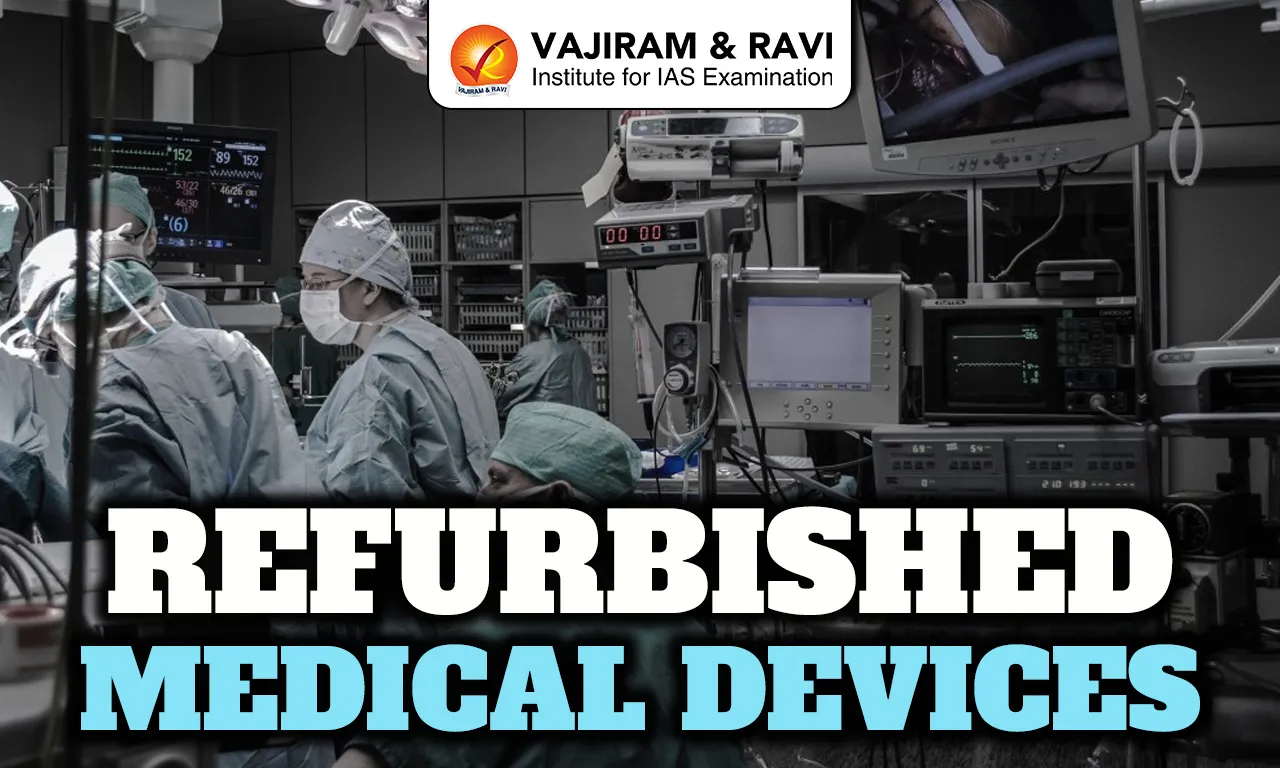
  • Refurbished medical devices are previously used equipment restored to original operating standards and resold at lower prices. 
  • These are typically capital-intensive technologies such as MRI machines, CT scanners, PET-CT systems, advanced endoscopy units, and robotic surgical systems.

Cost Advantage Over New Equipment

  • Refurbished systems offer significant cost savings:
    • 1.5T MRI machine: New: ₹4–8 crore | Refurbished: ₹1–3.5 crore
    • PET-CT system: New: ₹20 crore+ | Refurbished: ₹60 lakh–3.5 crore
    • CT scanner: New: ₹2–4 crore | Refurbished: ₹20 lakh–2.5 crore
  • These price differences make advanced diagnostics more accessible, particularly for hospitals in Tier-2 and Tier-3 cities.
  • For district hospitals, standalone diagnostic centres, and smaller private facilities, refurbished equipment reduces upfront capital costs. 
  • This supports decentralisation of healthcare and improves access to advanced diagnostics outside major urban centres.

Dependence on Imports

  • Despite growth in domestic manufacturing, India remains reliant on imports for advanced imaging and specialised devices due to technological complexity and global supply chain dominance. 
  • Refurbished equipment is commonly sourced from countries like the US, Germany, Japan, and the Netherlands, where hospitals upgrade systems before the end of their functional life.

Current Government Policy on Refurbished Medical Devices

  • India does not have a specific regulatory pathway for refurbished medical devices under the Medical Devices Rules, 2017
  • Although all medical devices were brought under phased regulation from 2017 and notified as “drugs” in 2020 under the Drugs and Cosmetics Act, no separate licensing mechanism exists for refurbished products.

Imports Governed by Waste Management Rules

  • At present, refurbished device imports are regulated primarily under the Hazardous and Other Wastes (Management and Transboundary Movement) Rules, 2016.
  • Imports are allowed only after obtaining:
    • No-objection certificates from an expert committee under the Ministry of Environment, Forest and Climate Change (MoEFCC)
    • Technical inputs from the Central Drugs Standard Control Organisation (CDSCO)
    • Import authorisation from the Directorate General of Foreign Trade
  • Earlier bans on used critical-care devices were relaxed in December 2022, permitting certain high-end equipment under strict scrutiny.

Recent Approvals and Regulatory Clash

  • In November 2025, a MoEFCC technical committee approved several refurbished devices for reuse.
  • However, in January 2025, CDSCO stated that refurbished devices cannot be imported for sale due to the absence of licensing provisions under the Medical Devices Rules. 
  • This contradiction created regulatory inconsistency between environmental approvals and medical device regulation.

Policy Ambiguity and Industry Concerns

  • India lacks a statutory definition distinguishing “used,” “refurbished,” “reconditioned,” or “remanufactured” devices. 
  • This creates uncertainty around classification, licensing, compliance, patient safety, and domestic manufacturing policy.
  • Industry estimates place the refurbished segment at around ₹1,500 crore, nearly 10% of India’s medical equipment market, highlighting the need for a coherent and unified regulatory framework.

Refurbished Medical Devices: Industry Divide and Policy Debate

  • The absence of a clear pathway under the Medical Devices Rules has created uncertainty for both industry and policymakers.
  • A key tension lies between promoting domestic manufacturing under Make in India and ensuring affordable access to advanced diagnostics, particularly in Tier-2 and Tier-3 cities.

International Manufacturers’ Perspective

  • The Medical Technology Association of India (MTAI), representing global manufacturers, argues against a blanket ban. 
  • It maintains that refurbished devices are regulated globally rather than prohibited.
  • It contends that regulated imports can improve affordability, expand access, support healthcare training goals, and complement industrial initiatives such as Electronics Repair Services Outsourcing.

Domestic Manufacturers’ Concerns

  • The Association of Indian Medical Device Industry (AiMeD) strongly opposes easing restrictions without robust regulatory standards aligned with global benchmarks.
  • Domestic players argue refurbished devices carry risks of unclear usage history, inconsistent performance, limited traceability, and shorter lifespan. 
  • They warn that legalising such imports could undermine indigenous manufacturing, weaken emergency preparedness, and turn India into a destination for end-of-life equipment.
  • Industry estimates suggest that unauthorised trade in pre-owned equipment is already significant, raising oversight and compliance concerns.

Impact on Innovation and Industrial Policy

  • Critics highlight that in developed countries, hospitals upgrade equipment after around 10 years, with older systems refurbished for resale. 
  • When such systems compete at similar price points with new Indian-made products, they may discourage domestic investment in advanced medical technologies.
  • This raises broader questions about balancing healthcare affordability with long-term industrial growth and innovation capacity.

Source: IE

Refurbished Medical Devices FAQs

Q1: What are refurbished medical devices?

Ans: Refurbished medical devices are previously used diagnostic or surgical machines restored to original specifications and resold at lower prices, improving affordability for smaller hospitals and diagnostic centres.

Q2: Why are refurbished medical devices controversial in India?

Ans: Refurbished medical devices raise concerns over safety, traceability, regulatory gaps, and their potential impact on domestic manufacturing under the Make in India initiative.

Q3: How are refurbished medical devices currently regulated?

Ans: Refurbished medical devices are governed mainly under waste management rules, requiring environmental clearance, but lack a dedicated licensing pathway under the Medical Devices Rules, 2017.

Q4: What is the industry divide on refurbished medical devices?

Ans: International manufacturers support regulated imports of refurbished medical devices for affordability, while domestic manufacturers fear they may undermine indigenous innovation and industrial growth.

Q5: Why is a new policy needed for refurbished medical devices?

Ans: A clear regulatory framework for refurbished medical devices would resolve policy inconsistencies, ensure patient safety, protect domestic industry, and improve affordable access to advanced healthcare technologies.

Enquire Now

