
India’s Vision for Artificial Intelligence – Global Good and Inclusive Growth

Artificial Intelligence

Artificial Intelligence Latest News

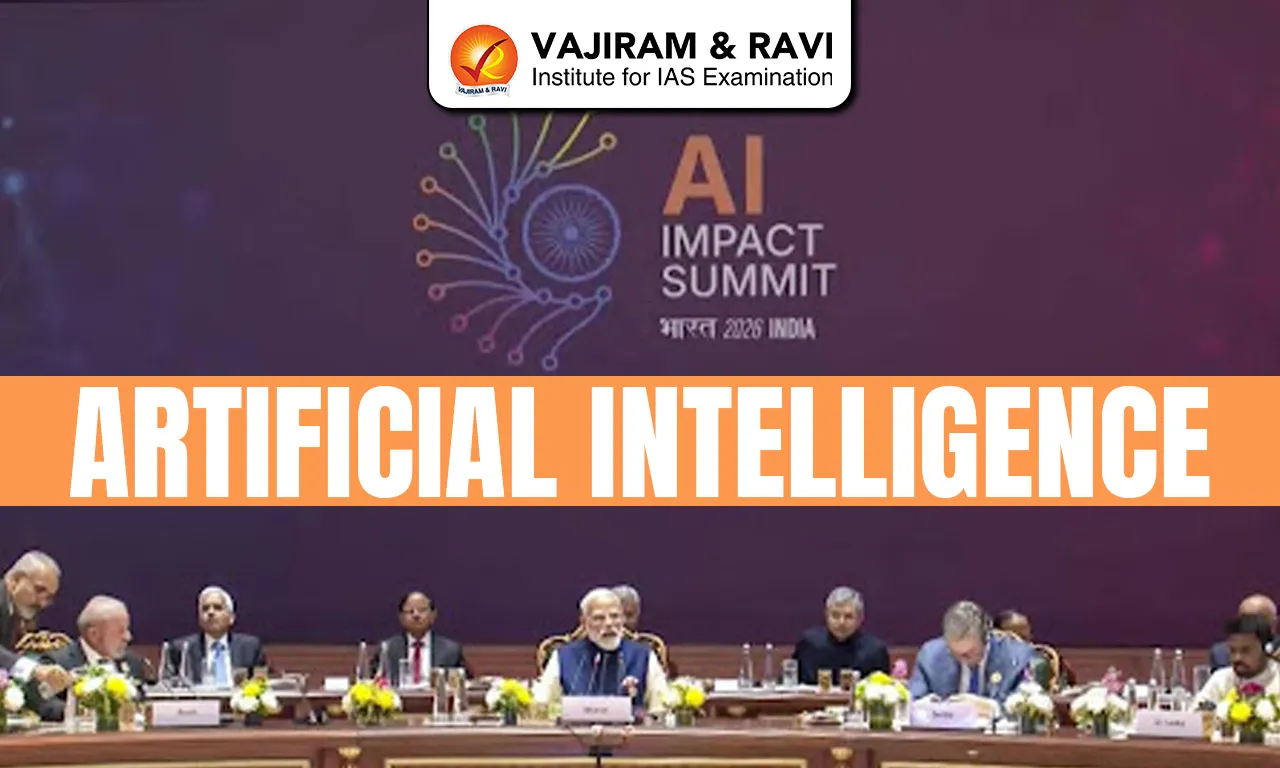
  • Prime Minister Narendra Modi articulated India’s Artificial Intelligence Vision at the AI Impact Summit 2026, emphasising AI as a global common good and announcing the New Delhi Frontier AI Impact Commitments.

India’s Approach to Artificial Intelligence

  • At the AI Impact Summit held in New Delhi, the Prime Minister stated that India does not view Artificial Intelligence (AI) with fear, but sees “fortune and the future” in it. 
  • Addressing global technology leaders and policymakers, he argued that AI represents a transformative moment in human history and must be shaped responsibly.
  • India’s approach differs from that of some countries and corporations that treat AI as a strategic and confidential asset. 
  • Instead, India has proposed that AI should be developed as a “global common good” benefitting humanity only when it is shared openly.
  • The Prime Minister emphasised that open-source development and collaborative innovation would allow millions of young innovators worldwide to make AI systems safer and more effective.

The MANAV Framework

  • Central to India’s Artificial Intelligence Vision is the “MANAV” framework, an acronym representing key governance principles:
    • Moral and Ethical Systems: AI must be grounded in ethical guidelines.
    • Accountable Governance: Transparent rules and strong oversight mechanisms are necessary.
    • National Sovereignty: Data ownership must remain with those who generate it.
    • Accessible and Inclusive: AI should not become a monopoly but act as a multiplier for society.
    • Valid and Legitimate: AI applications must be lawful, verifiable, and trustworthy.
  • This framework reflects India’s attempt to balance innovation with regulation, ensuring AI remains human-centric rather than machine-centric.

AI as a Tool for Inclusion and Global South Leadership

  • India positioned itself as a voice for the Global South in AI governance. The Prime Minister underlined that AI must be democratised and used for inclusion and empowerment, especially in developing countries.
  • The summit also saw the signing of the New Delhi Frontier AI Impact Commitments, a voluntary framework adopted by major global and Indian AI companies, including Google, OpenAI, Meta, Microsoft, Anthropic, and Indian firms.
  • These commitments focus on:
    • Evaluating AI systems for real-world contexts.
    • Strengthening multilingual and cross-cultural AI capabilities.
    • Enhancing analysis of AI’s impact on jobs, skills, and economic transformation.
  • Companies pledged to publish statistical insights from anonymised and aggregated usage data by the next summit. This is aimed at supporting evidence-based policymaking.

Multilingual AI and Digital Public Infrastructure

  • A notable development was the live-streaming of the Prime Minister’s speech in seven Indian languages using AI-powered translation tools. 
  • This reflects India’s push to leverage digital public infrastructure such as BHASHINI for language inclusion.
  • The emphasis on multilingual AI is critical for India, given its linguistic diversity. It also aligns with the broader goal of making AI accessible beyond English-dominant ecosystems.

AI Governance, Deepfakes and Authenticity Standards

  • The Prime Minister raised concerns about deepfakes and fabricated content destabilising open societies. Drawing an analogy with food nutrition labels, he suggested that digital content should carry authenticity labels to help users distinguish between real and AI-generated material.
  • The need for watermarking and source verification standards was highlighted as part of responsible AI governance. This aligns with global debates on regulating generative AI and combating misinformation.

Economic Transformation and Skilling

  • AI was described as a catalyst for higher-value and creative roles, fostering innovation and entrepreneurship. 
  • However, the Prime Minister emphasised the importance of skilling, reskilling, and upskilling to manage workforce transitions.
  • India is simultaneously building a resilient ecosystem that includes semiconductor manufacturing, quantum computing, secure data centres, and a robust IT backbone.
  • According to the Prime Minister, any AI model that succeeds in India’s diverse and large-scale environment can be deployed globally.
  • This positions India as a potential hub for affordable, scalable, and secure AI solutions.

Strategic Context and Global Debate

  • The summit took place amid global competition over AI dominance. 
  • While some countries advocate building AI systems within closed national stacks, India has emphasised openness and collaboration.
  • India’s Artificial Intelligence Vision thus seeks to balance:
    • Technological sovereignty,
    • Ethical governance,
    • Economic growth, and
    • Global cooperation.

Source: TH | IE

Artificial Intelligence FAQs

Q1: What is the core idea behind India’s Artificial Intelligence Vision?

Ans: India views AI as a global common good that must be ethical, inclusive, and shared for global benefit.

Q2: What does the MANAV framework stand for?

Ans: MANAV represents Moral systems, Accountable governance, National sovereignty, Accessible AI, and Valid uses.

Q3: What are the New Delhi Frontier AI Impact Commitments?

Ans: They are voluntary commitments by AI companies to ensure inclusive, multilingual, and responsible AI development.

Q4: Why is multilingual AI important for India?

Ans: It ensures inclusion across India’s linguistic diversity and supports democratisation of AI access.

Q5: How does India link AI with economic transformation?

Ans: India sees AI as creating higher-value jobs and innovation opportunities while emphasising skilling and digital infrastructure.

Graphics Processing Unit Explained: How GPU Power AI and Modern Computing

GPU

GPU Latest News

  • In 1999, Nvidia introduced the GeForce 256 as the world’s first GPU, designed primarily to enhance video game graphics and performance. 
  • Over the past 25 years, GPUs have evolved far beyond gaming, becoming essential components of the digital economy and powering core technologies such as artificial intelligence and large-scale computing.

GPU: Understanding the Basics

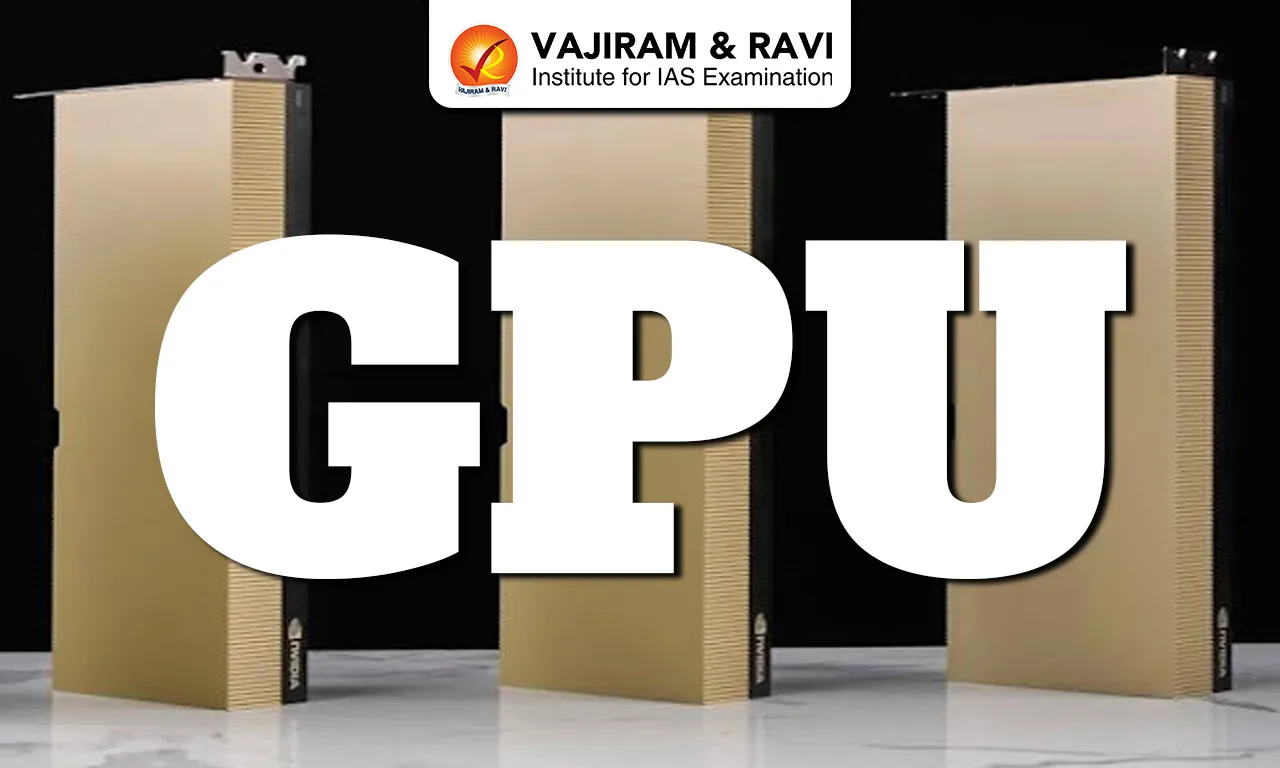
  • A Graphics Processing Unit (GPU) is a specialised processor designed to perform many simple calculations simultaneously. 
  • Unlike a Central Processing Unit (CPU), which handles fewer but more complex tasks quickly and efficiently, a GPU excels at parallel processing—handling large volumes of repetitive computations at once.

Why GPUs Are Ideal for Graphics

  • Rendering images on a screen requires updating millions of pixels multiple times per second. 
  • For example, a 1920×1080 display has over 2 million pixels per frame, and at 60 frames per second, more than 120 million pixel updates are required every second. 
  • Each pixel’s colour depends on lighting, texture, shadows, and object properties. 
  • Since the same calculations are repeated across pixels, GPUs are better suited than CPUs for this kind of workload.

Parallel Processing Made Simple

  • A GPU can be imagined as a large team of workers, each handling a small portion of a task simultaneously. 
  • While each GPU core is less powerful than a CPU core, the GPU contains hundreds or thousands of such cores. 
  • This allows it to process large, repetitive workloads far more quickly than a CPU working alone.

How a GPU Works: The Rendering Process Explained

  • When a video game displays a scene, it sends the GPU objects built from triangles. 
  • The GPU processes them through a four-step rendering pipeline to produce the final image.
  • Vertex Processing - The GPU calculates where each triangle should appear on the screen. Using mathematical operations with matrices, it rotates, moves, and adjusts objects according to the camera’s perspective.
  • Rasterisation - Once positioned, the GPU determines which screen pixels each triangle covers. This step converts geometric shapes into pixel-level data ready for colouring.
  • Fragment (Pixel) Shading - For each pixel fragment, the GPU calculates the final colour. It applies textures, lighting, shadows, reflections, and other visual effects using small programs called shaders.
  • Frame Buffer Output - The computed pixel colours are written to memory known as the frame buffer. The display system then reads this buffer to render the final image on the screen.

Parallel Processing and Memory Design

  • GPUs execute shader programs simultaneously across many vertices and pixels. 
  • To handle massive data flows—such as 3D models and textures—they use dedicated high-bandwidth memory called VRAM (video RAM). 
  • Smaller, faster caches and shared memory structures help prevent bottlenecks.
  • Because GPUs excel at repeating similar calculations across large datasets, they are widely used beyond graphics in machine learning, image processing, and scientific simulations.

Where Is the GPU Located

  • The GPU as a Silicon Chip - A GPU is built on a silicon die — a flat piece of semiconductor material measured in square millimetres. Like a CPU, it is a physical chip mounted inside a computing device.
  • Dedicated Graphics Card Setup - In systems with a separate graphics card, the GPU die sits beneath a metal heat sink at the centre of the card. It is surrounded by VRAM chips and connects to the motherboard through a high-speed interface.
  • Integrated Graphics in Modern Devices - In laptops and smartphones, the GPU is often integrated with the CPU on the same die. This design is common in modern systems-on-a-chip (SoCs), which combine multiple components that were previously separate into a single package.

GPUs Vs CPUs

  • GPUs are not fundamentally smaller than CPUs. Both use similar silicon transistors and advanced fabrication nodes (e.g., 3–5 nm). 
  • The difference lies in microarchitecture — how transistors are organised and used.
  • CPUs dedicate more die area to complex control logic, cache, and decision-making features. 
  • GPUs allocate more space to repeated compute units and wide data paths, enabling parallel processing.

How Much Energy Do GPUs Consume

  • Energy During Training - In a scenario using four Nvidia A100 GPUs (250 W each) for 12 hours of neural network training, total energy consumption would be about 12 kWh, as the GPUs run near full capacity.
  • Energy During Inference - Once deployed, if one GPU handles predictions, energy use drops to roughly 2 kWh for inference.
  • Total System Consumption - Including additional server components (CPU, RAM, storage, cooling), total daily power use can reach around 6 kWh when running continuously, accounting for 30–60% overhead.
  • Real-World Comparison - This is comparable to running an air conditioner for 4–6 hours, a water heater for 3 hours, or 60 LED bulbs for 10 hours daily.

Source: TH

GPU FAQs

Q1: What is a GPU?

Ans: A Graphics Processing Unit (GPU) is a specialised processor designed for parallel computing, handling many simple calculations simultaneously, making it ideal for graphics, AI, and simulations.

Q2: How does a Graphics Processing Unit (GPU) differ from a CPU?

Ans: A Graphics Processing Unit (GPU) focuses on parallel tasks with many cores, while a CPU handles fewer complex instructions with advanced control logic and decision-making capabilities.

Q3: How does a Graphics Processing Unit (GPU) render images?

Ans: A Graphics Processing Unit (GPU) uses a rendering pipeline—vertex processing, rasterisation, shading, and frame buffering—to transform 3D objects into coloured pixels displayed on screen.

Q4: Where is a Graphics Processing Unit (GPU) located in devices?

Ans: A Graphics Processing Unit (GPU) may sit on a dedicated graphics card with VRAM or be integrated with the CPU on a single system-on-chip in laptops and smartphones.

Q5: How much energy does a Graphics Processing Unit (GPU) consume?

Ans: A Graphics Processing Unit (GPU) can consume significant power during training workloads—around 12 kWh in intensive tasks—plus additional system overhead, depending on usage and configuration.

Gold ETF Inflows Surge: How India’s Precious Metal Craze Is Straining the Economy

Gold ETF

Gold ETF Latest News

  • Indian households are diversifying their savings, with investments in mutual funds and equities rising sharply — from 7% of financial assets in 2022–23 to 15% in 2024–25 — while bank deposits declined slightly. However, the long-standing preference for gold remains strong. 
  • Gold imports surged to $12.07 billion in January, nearly tripling from December. 
  • A growing channel for this investment is gold exchange-traded funds (ETFs), reflecting the increasing financialisation and formalisation of household savings, even as it adds to gold import pressures.

Gold ETFs: From Niche Product to Investment Wave

  • Gold ETFs function like mutual funds that invest in gold. They offer advantages over physical gold—no concerns about purity, storage, or security, and the flexibility to invest in small amounts. 
  • The fund handles gold purchases based on investor inflows.

Record Inflows in January

  • What began modestly in 2007 surged dramatically in January. According to the World Gold Council, Indian gold ETFs purchased a record 15.52 tonnes of gold in January—nearly equal to the previous three months combined.
  • Data from AMFI show net gold ETF inflows more than doubled to an all-time high of ₹24,040 crore, even as equity mutual fund inflows fell 14% to ₹24,029 crore. 
  • For the first time, gold ETFs attracted more investment than equity funds.
  • Gold ETF inflows accounted for 22% of total gold imports (₹1.1 lakh crore) in January. The share was even higher for silver—52% of silver imports were linked to ETF inflows.

Speculation and Economic Concerns

  • Analysts suggest the surge may reflect large-scale speculation in precious metals. 
  • While it may represent a shift from physical gold demand, concerns remain that heavy investment in gold—financial or physical—effectively amounts to capital moving out of the domestic economy.

Gold Rush Redux: Lessons from the Past

  • After the 2008 global financial crisis, high inflation, a weakening rupee, and slow growth drove Indian households toward gold. 
  • Imports surged, forcing the government and RBI to curb free imports and introduce measures to discourage physical gold purchases.

Sovereign Gold Bonds: A Policy Experiment

  • Launched in 2015, Sovereign Gold Bonds (SGBs) offered returns linked to gold prices plus 2.5% annual interest. 
  • Indians invested in bonds equivalent to 147 tonnes of gold worth ₹72,274 crore, reducing the need for physical imports.
  • Rising gold prices made the scheme costly, with annual payouts nearing ₹18,000 crore. The government discontinued SGBs in early 2024 due to mounting fiscal pressure.

Renewed Concerns Over Gold Investments

  • Although inflation is currently moderate, geopolitical tensions, policy uncertainty, and uneven global stock market gains have renewed interest in gold as a safe haven.
  • A January spike in gold ETF-driven imports pushed India’s goods trade deficit close to $35 billion, highlighting macroeconomic risks.
  • Given rising precious metal demand, a redesigned Sovereign Gold Bond scheme—possibly extended to silver and other metals—may help manage imports while offering households structured investment alternatives.

Source: IE

Gold ETF FAQs

Q1: Why are Gold ETF inflows rising sharply in India?

Ans: Gold ETF inflows surged as investors shifted from equity funds to gold amid rising prices, global uncertainty, and safe-haven demand, making Gold ETF inflows a key driver of imports.

Q2: How do Gold ETF inflows affect India’s trade deficit?

Ans: Gold ETF inflows require funds to purchase physical gold, increasing imports. In January, Gold ETF inflows accounted for 22% of total gold imports, widening the goods trade deficit.

Q3: What makes Gold ETF inflows attractive to households?

Ans: Gold ETF inflows offer exposure to gold prices without storage risks, purity concerns, or security issues, making them more convenient than buying physical gold.

Q4: How did Sovereign Gold Bonds impact Gold ETF inflows?

Ans: Sovereign Gold Bonds reduced physical imports by offering interest plus price exposure, but after discontinuation in 2024, Gold ETF inflows gained stronger momentum.

Q5: Why do analysts see risks in rising Gold ETF inflows?

Ans: Analysts warn that heavy Gold ETF inflows may reflect speculation or declining confidence in financial systems, effectively diverting domestic capital into non-productive assets.

Enquire Now

