
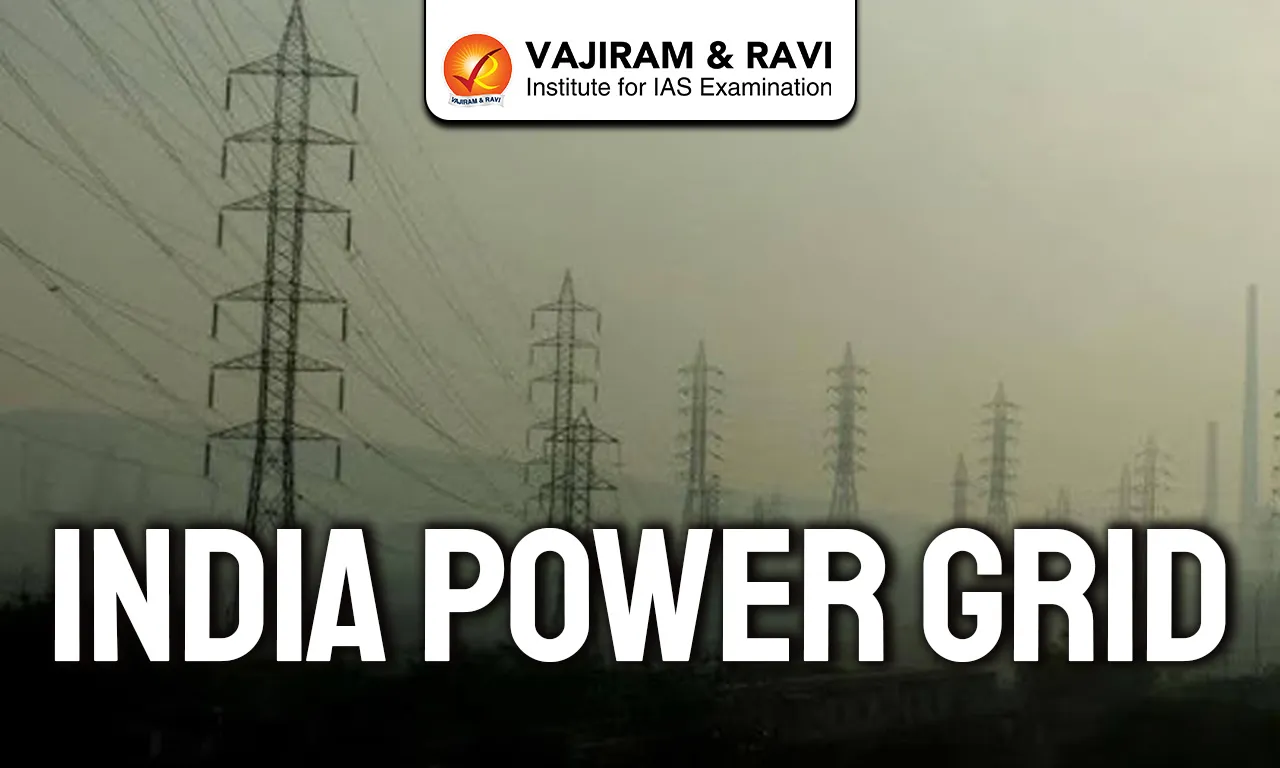
India Power Grid & Data Centre Boom: Can the Grid Handle AI Demand

India Power Grid

India Power Grid Latest News

  • India’s power system is set for a major transformation as AI-driven data centres expand rapidly, according to Grid India chief. 
  • While AI depends on algorithms, it also demands vast amounts of electricity. India’s current data centre capacity of about 1.2 GW is expected to quadruple by 2030 as AI-led computing surges. 
  • This growth will significantly reshape grid planning and operations, with data centres becoming large, complex, and dynamic loads on the power network.

Rising Grid Risks from Data Centre Expansion

  • AI-driven data centres represent intense electricity loads, often requiring direct transmission-level connectivity rather than traditional sub-transmission networks.
  • Their projected growth to 8–10 GW by 2030 will significantly strain grid infrastructure.
  • Unlike conventional industrial demand, data centres exhibit sharp variability, rapid load ramps, and “silent exits” from the grid. 
  • As inverter-based systems, sudden withdrawal of 1–2 GW could destabilise grid operations.

Planning and Resource Adequacy

  • Experts emphasise the need for proactive infrastructure planning, including robust transmission networks, strong connectivity, and compliance mechanisms. 
  • Data centres must also meet resource adequacy norms, covering primary energy, reserves, and balancing requirements.
  • Given AI’s unpredictable load patterns, especially during peak processing phases, forecasting becomes difficult. 
  • Grid authorities stress that risks cannot be fully absorbed by the grid and must be managed at the demand side.

Evolving Standards and Storage Integration

  • Globally, many jurisdictions require data centres to have dedicated generation capacity. 
  • India’s grid codes, standards, and energy storage integration must evolve to accommodate these emerging large-scale, dynamic loads.

Risk of Chaos Without Strategic Planning

  • Rapid expansion of hyperscale data centres — each requiring nearly 1 GW — could severely strain the grid if not carefully planned. 
  • Such demand necessitates high-voltage substations and coordinated planning by central and state transmission utilities.
  • Since hyperscale data centres have steady baseload demand, they require long-duration, stable generation sources. 
  • While the US increasingly relies on nuclear power, India may need a diversified supply approach.

Mixed Energy and Storage Solutions

  • Experts recommend combining grid supply with captive generation, renewable energy, and long-duration battery storage (6–9 hours) to manage reliability and reduce dependence on the grid alone.
  • To avoid chaotic infrastructure expansion and rising tariffs, authorities should identify and pre-plan dedicated data centre zones. 
  • Without coordinated planning, ad hoc grid expansion could lead to inefficiencies and higher costs for consumers.

Renewables and Efficiency in Data Centre Expansion

  • Renewable energy can power new data centres through the open access route, which allows large consumers (1 MW+) to buy electricity directly from suppliers or exchanges, bypassing DISCOMs.
  • Surplus generation capacity and upcoming pump hydro projects could support affordable round-the-clock green power.

Semiconductor-Level Efficiency Gains

  • Semiconductor firms are central to the AI-driven power challenge.
  • Under Intel’s 18A process, innovations such as RibbonFET, backside power delivery, and advanced packaging improve efficiency by about 15% and reduce energy use by limiting data movement.
  • Intel also promotes a “heterogeneous AI” approach, arguing that not all AI tasks require energy-intensive GPUs. 
  • Optimised workload allocation across processors can significantly reduce total power consumption.

Hyperscalers’ Key Requirements

  • AI scaling in India is still emerging, offering time to plan. 
  • For large investments, hyperscalers prioritise assured renewable power, grid reliability, regulatory clarity, long-term price certainty, and quick power availability.

Source: IE | NDTV

India Power Grid FAQs

Q1: Why is India power grid under pressure from data centres?

Ans: India power grid faces rising strain because AI-driven data centres demand intense, transmission-level electricity loads projected to reach 8–10 GW by 2030.

Q2: How do data centres affect India power grid stability?

Ans: Data centres create sharp load ramps and sudden withdrawals, which can destabilise India power grid operations without robust transmission planning and resource adequacy measures.

Q3: What planning reforms are needed for India power grid?

Ans: India power grid requires stronger transmission infrastructure, updated grid codes, storage integration, demand-side management, and dedicated data centre zoning to prevent operational chaos.

Q4: Can renewable energy support India power grid expansion?

Ans: Yes, renewable energy through open access, pump hydro, battery storage, and captive generation can reduce stress on India power grid while ensuring sustainable AI growth.

Q5: Why is storage critical for India power grid resilience?

Ans: Energy storage and hybrid power models help India power grid manage variability, baseload demand, and peak AI workloads from hyperscale data centres efficiently.
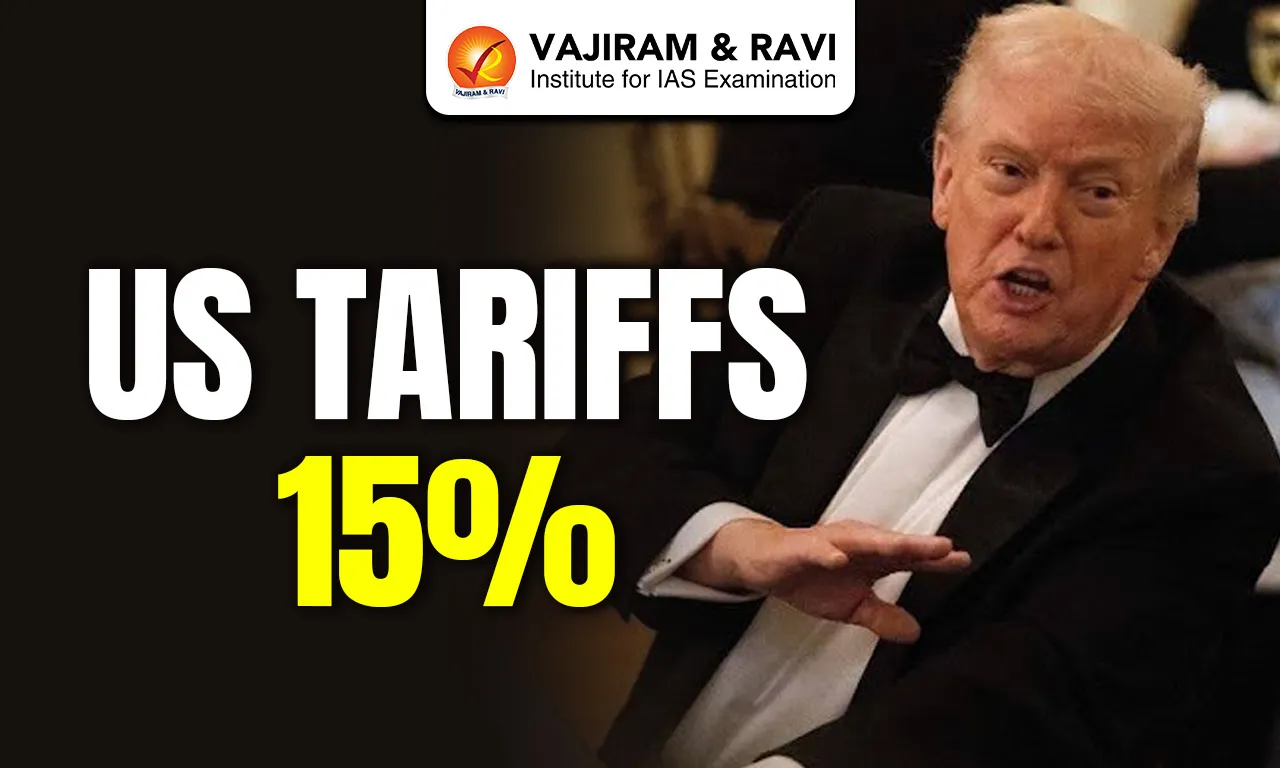

US Tariffs 15%: How the US Tariffs 15% Impact India and Global Trade?

US Tariffs 15%

US Tariffs 15% Latest News

  • After the US Supreme Court struck down tariffs imposed by the Trump administration, President Donald Trump invoked a different legal provision — Section 122 of the 1974 Trade Act — to reimpose trade levies. 
  • He first announced a 10% tariff on all imports, later raising it to 15%, the maximum allowed under this rarely used law. However, the measure is temporary and can remain in force for only about five months unless approved by the US Congress.

Impact of the New 15% US Tariff

  • Countries Better Off Under Flat Rate - With the temporary flat 15% tariff, several major economies — including India, China, Japan, South Korea, ASEAN nations, Brazil, Mexico, and Canada — now face lower duties compared to the earlier, higher differential tariffs.
  • Countries Facing Higher Tariffs - Conversely, countries such as Russia, Australia, the UK, Saudi Arabia, the UAE, Qatar, Argentina, Colombia, and many in North and Central Africa are now subject to higher tariff rates.
  • India’s Position - India had been facing cumulative tariffs of up to 50% since August 2025 due to reciprocal tariffs and penalties linked to Russian oil imports. 
    • After a recent trade deal framework and removal of the oil penalty, Indian goods are currently taxed at 25%, with expectations of falling to 18%.
  • China’s Position - China had been subject to cumulative tariffs of around 45%, including reciprocal and fentanyl-related levies under IEEPA. With IEEPA struck down, a flat 15% tariff could temporarily put India and China on similar footing — unless new measures are introduced.

Supreme Court Ruling Curtails Trump’s Tariff Powers

  • The US Supreme Court’s decision striking down the use of International Emergency Economic Powers Act (IEEPA) has significantly limited President Trump’s ability to impose tariffs unilaterally through executive orders. 
  • Future tariff actions now require detailed justifications from government agencies and face stricter legal constraints.
  • The ruling weakens Trump’s leverage in trade negotiations, as other countries may adopt a tougher stance knowing his tariff powers are curtailed. 
  • Additionally, the administration may have to refund previously collected tariff revenues, further diminishing its bargaining position.

Mounting Legal and Political Challenges for Trump

  • More Court Battles Ahead - The administration faces additional Supreme Court cases, including efforts to end birthright citizenship and remove a Federal Reserve Board member — both seen as difficult to win.
  • Limited Congressional Path - To restore broad tariff powers, Trump would need explicit Congressional approval. With slim Republican majorities and midterm elections approaching, securing such backing appears unlikely.
  • Political Risks and Party Divisions - Tariffs have contributed to inflationary pressures, potentially alienating voters.
  • Revenue Impact and Alternative Tools - The scrapping of IEEPA tariffs could halve America’s effective tariff rate. The administration plans to rely on Section 122, Section 232 (national security), and Section 301 (unfair trade practices) to offset losses, though these provisions come with tighter legal checks and procedural requirements.

Shifting Trade Dynamics After IEEPA Ruling

  • With IEEPA-based reciprocal tariffs struck down, around 55% of India’s exports to the US could revert to standard MFN rates, easing duty burdens. 
  • However, Section 232 tariffs — 50% on steel and aluminium and 25% on certain auto parts — remain in force, while about 40% of exports such as smartphones, petroleum products, and medicines continue to be exempt.

Trade Leverage Weakens

  • Experts argue that the removal of reciprocal tariffs erodes US leverage in ongoing trade negotiations. 
  • The ruling signals a shift from executive-driven tariff policy to one constrained by legal and legislative oversight.
  • Amid uncertainty, India has postponed a planned visit by its chief trade negotiator to Washington, allowing both sides time to assess the legal and policy implications before resuming discussions.
  • Despite the setback, New Delhi anticipates that the US administration may deploy other legal mechanisms to impose tariffs, as trade measures remain central to President Trump’s foreign policy strategy.

Source: IE

US Tariffs 15% FAQs

Q1: What are US tariffs 15% under Section 122?

Ans: US tariffs 15% are temporary flat import duties imposed under Section 122 of the 1974 Trade Act after the Supreme Court struck down IEEPA-based tariffs.

Q2: How do US tariffs 15% affect India?

Ans: US tariffs 15% temporarily reduce India’s earlier cumulative tariff burden, placing it closer to China in duty incidence after removal of Russian oil penalties.

Q3: Why did the Supreme Court weaken tariff powers?

Ans: The ruling blocked IEEPA-based levies, limiting executive authority and requiring legal justification and Congressional oversight for future US tariffs 15% expansions.

Q4: Which countries benefit from US tariffs 15%?

Ans: India, China, Japan, South Korea, ASEAN nations, Brazil, Mexico, and Canada now face relatively lower duties under US tariffs 15% compared to earlier differential rates.

Q5: What happens after the five-month US tariffs 15% period?

Ans: After five months, US tariffs 15% require Congressional approval; otherwise, the administration must seek alternative legal tools like Section 232 or 301 tariffs.

Apple Traders in J&K Are Worried About Recent Trade Deals

Apple Traders

Apple Traders Latest News

  • Apple traders and political leaders in Jammu & Kashmir have raised concerns over reduced import duties on U.S. and EU apples under recent trade agreements. 

Background of the Trade Decisions

  • The controversy arises from India’s decision to reduce the basic customs duty on apples imported from the United States from 50% to 25%, while setting a Minimum Import Price (MIP) of Rs. 80 per kilogram.
  • Under the India-European Union trade deal, import duty on fresh fruits has been reduced to 20% under a Tariff Rate Quota (TRQ) system
  • Initially, 50,000 tonnes of apples per year will be allowed at the reduced rate, with the quota set to increase to 1,00,000 tonnes over the next 10 years.
  • Political leaders in J&K, including the Chief Minister and opposition figures, have termed these decisions potentially harmful to the region’s horticulture sector.

Importance of Apple Production in J&K

  • Apple cultivation is central to Jammu & Kashmir’s economy. According to the J&K Economic Survey 2025-26:
    • Apple production constitutes 50% of total horticulture output in the region.
    • The horticulture sector generates roughly Rs. 10,000 crore in revenue.
    • Around 35 lakh individuals are directly or indirectly employed in the sector.
    • About seven lakh families depend on horticulture for livelihood.
  • In 2024, apple production in J&K stood at 21 lakh metric tonnes. The region contributes more than 70% of India’s total apple production, making it the backbone of the country’s apple supply.

Structural Challenges Faced by J&K Orchardists

  • Small Landholdings
    • One major disadvantage is fragmented landholdings. Orchardists in countries such as the U.S., New Zealand, and EU nations operate on average farms of over 50 hectares, while the average orchard size in J&K is just 0.40 hectares.
  • Lower Productivity
    • Productivity is another challenge. India produces only 7-8 tonnes of apples per hectare, compared to 40-70 tonnes per hectare in countries such as the U.S., Iran, New Zealand, and China.
    • Higher productivity abroad is driven by:
      • Mechanised farming
      • Advanced pruning and harvesting techniques
      • AI-based agricultural systems
      • Better climate conditions
    • Western countries have adopted AI-driven systems for pruning, pollination, harvesting, sorting, and bagging.
  • Variety and Quality Gap
    • Popular apple varieties such as Gala apples are well-established in Western markets. India introduced the Gala variety only recently, and it has not yet reached optimal quality in terms of yield, colour, taste, and shape.
    • This creates an uneven playing field in quality perception.

Impact on Cold Storage and Off-Season Prices

  • Kashmir has heavily invested in controlled-atmosphere cold storage infrastructure to stabilise prices during the off-season. 
  • Currently, 397.08 lakh metric tonnes of apples are stored in 92 cold storage units in J&K.
  • With reduced import duties, fresh apples from countries like New Zealand may enter Indian markets at lower prices. 
  • This could directly undercut apples stored in cold facilities, destabilising off-season pricing. Traders warn that cheaper imports could:
    • Reduce the profitability of stored apples
    • Make cold storage investments economically unviable
    • Lead to distress sales by farmers 
  • The concern is that price stability mechanisms built over the years could collapse if imports dominate the market.

Political and Policy Demands

  • Political parties and trade bodies in J&K are demanding safeguards. 
  • They have urged the Centre to re-evaluate the trade agreements and consider excluding apples from the deals. Key demands include:
    • Expansion of high-density apple cultivation (currently limited to 30,000 kanals out of 30 lakh kanals).
    • Interest-free loans under the Holistic Agriculture Development Programme (HADP) to enhance competitiveness.
    • Expansion of controlled-atmosphere storage infrastructure.
    • Activation of dry port projects to improve logistics.
  • Leaders argue that without improvements in productivity and quality, local producers will struggle against better-quality imports.

Broader Economic and Policy Implications

  • The issue reflects a classic trade-off in international trade policy:
    • Lower tariffs benefit consumers through lower prices.
    • However, domestic producers may face competitive pressure.
  • The debate also highlights the need for technological upgradation, farm consolidation, and value-chain modernisation in Indian agriculture.

Source: TH

Apple Traders FAQs

Q1: Why are apple traders in J&K concerned about recent trade deals?

Ans: Reduced import duties may allow cheaper foreign apples to undercut local produce.

Q2: How much does J&K contribute to India’s apple production?

Ans: J&K contributes over 70% of India’s total apple output.

Q3: What is the productivity gap between India and Western countries?

Ans: India produces 7–8 tonnes per hectare compared to 40–70 tonnes abroad.

Q4: What is a Tariff Rate Quota (TRQ)?

Ans: It allows a limited quantity of imports at reduced duty, after which higher tariffs apply.

Q5: What safeguards are J&K leaders demanding?

Ans: They seek exclusion of apples from trade deals, better storage infrastructure, and financial support for orchardists.

Enquire Now

