
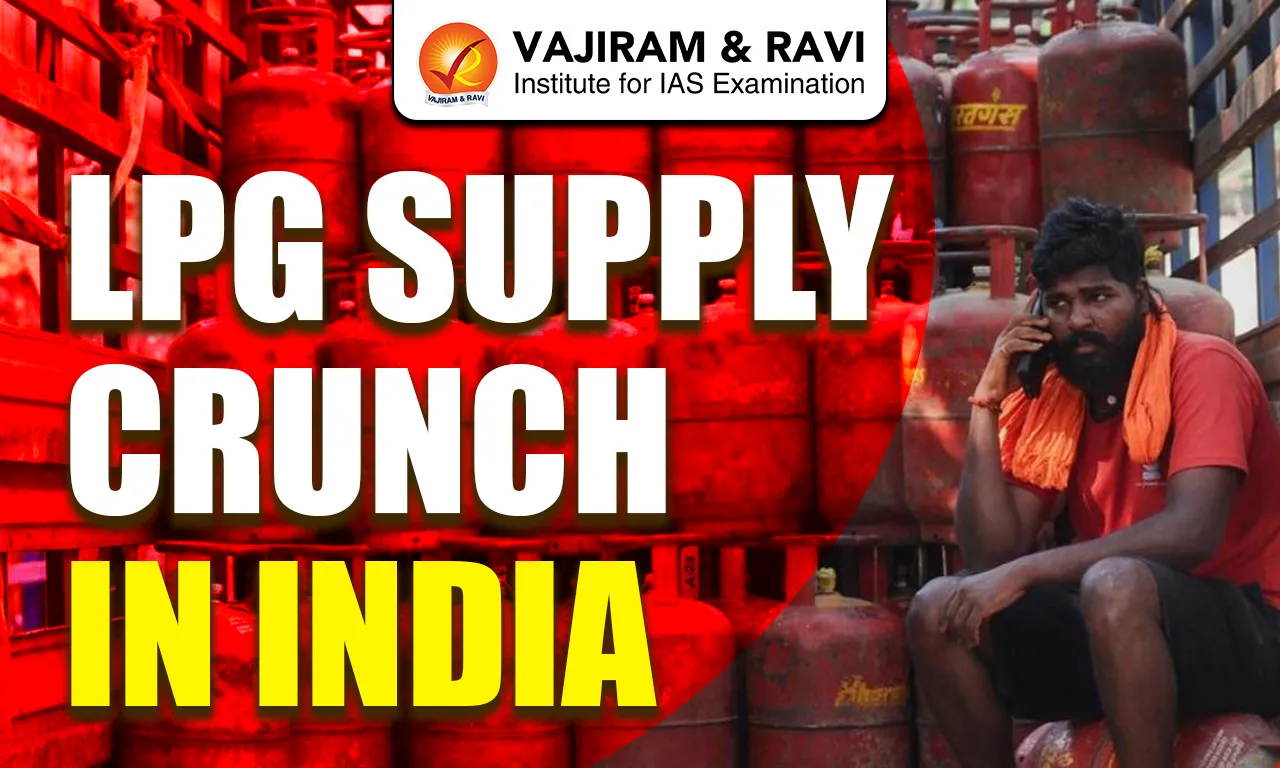
LPG Supply Crunch in India: Rising Imports and Weak Storage Threaten Energy Security

LPG Supply Crunch in India

LPG Supply Crunch in India Latest News

  • India is facing an LPG supply shortage as the country significantly expanded LPG consumption—especially among poorer households—primarily through increased imports without building adequate long-term storage reserves.
  • With over 85% of LPG imports passing through the Strait of Hormuz, disruptions have quickly affected supply due to limited backup storage. 
  • Unlike crude oil, where India maintains strategic reserves covering about two months of consumption, the LPG system is designed mainly for continuous operational flow rather than stockpiling, which the International Energy Agency (IEA) has identified as a major infrastructure weakness.

Rising LPG Imports in India

  • India’s LPG imports have increased threefold, rising to about 20 million tonnes between 2011–12 and 2024–25, with imports now meeting around 60% of domestic demand. 
  • Import dependency has increased from 47% in 2015 to current levels.
  • India consumes about 3 million tonnes of LPG per month, making it the second-largest LPG consumer globally. 
  • However, existing storage facilities can meet less than half of the monthly requirement, with most storage located in import terminal tanks such as Ennore.

Inadequate Strategic Reserves

  • India has only two underground LPG storage caverns at Mangaluru and Visakhapatnam, with a combined capacity of 1.4 lakh tonnes, equivalent to less than two days of national consumption. 
  • The Mangaluru cavern, with 80,000 tonnes capacity, equals roughly one day’s consumption.

Growth in Domestic LPG Consumption

  • India’s daily LPG consumption is about 80,000 tonnes, with over 85% used by households. 
  • The country has 33 crore domestic LPG connections, including around 10 crore added since 2017 under the Pradhan Mantri Ujjwala Yojana (PMUY).

Role of the Ujjwala Scheme

  • The PMUY scheme expanded LPG access to poor households by providing deposit-free connections and subsidies, helping shift from traditional fuels like firewood and kerosene. 
  • However, it also contributed to the rapid increase in LPG consumption and import dependence.

Import Diversification Efforts

  • India has signed an agreement with the United States to import 2.2 million tonnes of LPG annually. 
  • However, shipments from the U.S. take about 45 days to arrive, compared to much faster supplies from the Persian Gulf region.

Underground Caverns as a Storage Solution

  • Expanding underground gas storage caverns is considered a potential solution to India’s LPG supply vulnerability. 
  • Such facilities allow countries to store large volumes of gas and ensure supply security during disruptions.

Global Practices in Gas Storage

  • In Europe, underground gas storage plays a major role in energy security. 
  • The region can store about 25% of its annual gas consumption, and its underground storage capacity equals around 150% of annual LNG import volumes. 
  • Following the Ukraine war in 2022, the European Union mandated that storage facilities should reach 90% filling levels before winter to avoid supply shortages.

Geological Zones Suitable for Storage in India

  • The Peninsular Shield, covering much of southern India, is the most suitable geological zone for underground storage. 
  • It consists of stable granite and gneiss formations, which already host the LPG caverns at Visakhapatnam and Mangaluru. 
  • These caverns use proven engineering techniques and demonstrate that the rock formations are suitable for storage.

Deccan Traps

  • The Deccan Traps, a large basalt plateau across western and central India, present more engineering challenges for cavern construction. 
  • Projects designed by Engineers India Limited (EIL) have faced difficulties due to geological conditions.

Salt Caverns in Rajasthan

  • The Bikaner–Barmer salt formations in Rajasthan offer another promising option. Salt caverns are cheaper, quicker to build, naturally impermeable, and allow rapid gas injection and withdrawal. 
  • EIL has partnered with Germany’s DEEP to develop technology for such storage.

Depleted Gas Reservoirs

  • Another potential option under study is the use of depleted gas reservoirs in the Krishna–Godavari, Cambay, and Mumbai offshore basins for underground gas storage.

Conclusion

  • Developing underground storage caverns across suitable geological zones could significantly strengthen India’s LPG storage capacity and improve energy security against supply disruptions.

Source: TH

LPG Supply Crunch in India FAQs

Q1: Why is an LPG supply crunch in India becoming a concern?

Ans: The LPG supply crunch in India is emerging due to rising import dependence, growing household consumption, limited strategic storage capacity, and supply vulnerabilities linked to the Strait of Hormuz.

Q2: How dependent is India on LPG imports?

Ans: India meets around 60% of its LPG demand through imports, with annual imports rising sharply over the past decade due to expanded access to cooking gas among households.

Q3: Why is the Strait of Hormuz important for LPG supply to India?

Ans: More than 85% of India’s LPG imports pass through the Strait of Hormuz, making the country vulnerable to geopolitical tensions, shipping disruptions, or regional conflicts affecting energy supply.

Q4: What is the main infrastructure weakness in India’s LPG system?

Ans: India’s LPG system focuses on continuous supply rather than strategic stockpiling, leaving the country with limited storage reserves that can cover only a small fraction of national consumption.

Q5: What solutions can address the LPG supply crunch in India?

Ans: Developing underground storage caverns, expanding strategic reserves, diversifying import routes, and strengthening domestic infrastructure can help India mitigate risks associated with LPG supply disruptions.
Passive Euthanasia in India: Supreme Court Allows Withdrawal of Treatment for Harish Rana

Passive Euthanasia

Passive Euthanasia Latest News

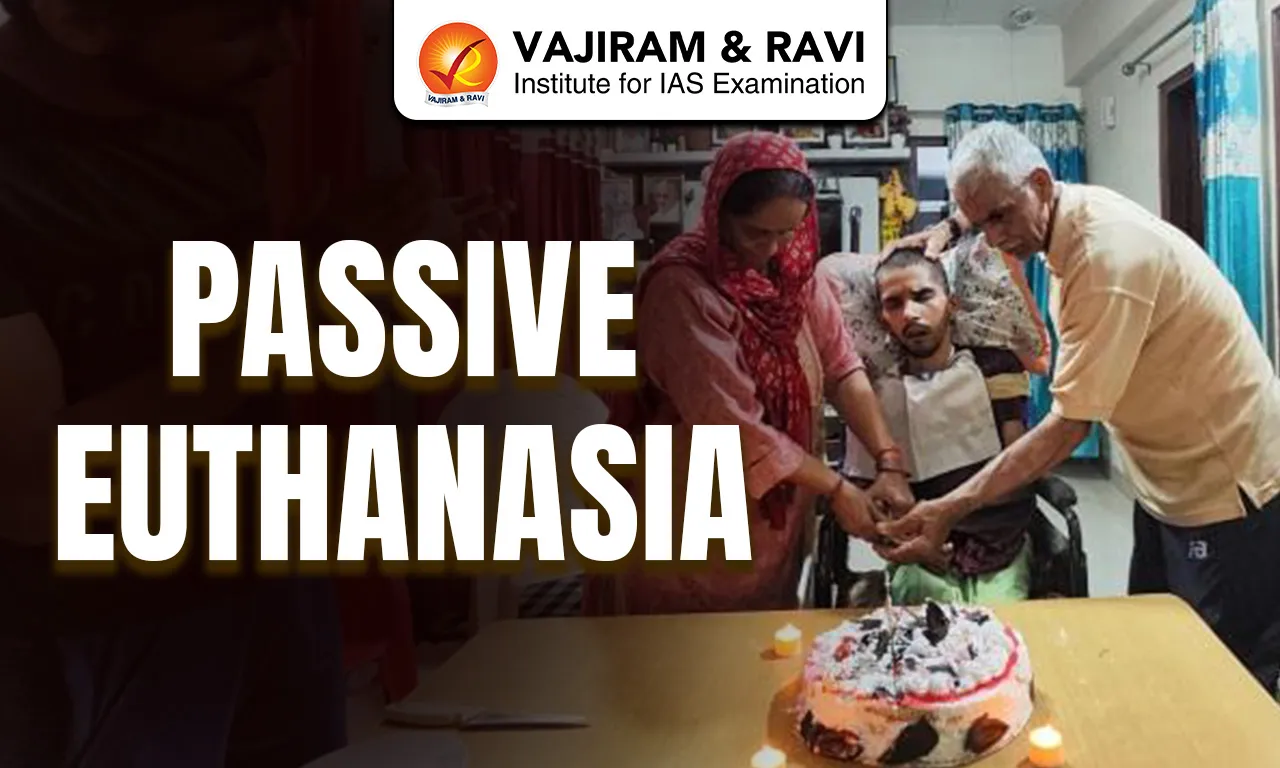
  • The Supreme Court permitted the withdrawal of life-sustaining treatment for Harish Rana, a 32-year-old man who has been in a vegetative state since 2013 after a severe head injury. 
  • This marks the first Indian court order approving passive euthanasia in such a case.
  • A bench of Justices J. B. Pardiwala and K. V. Vishwanathan allowed the withdrawal of medical treatment, including clinically assisted nutrition, being provided to Rana. The Court directed AIIMS to implement a palliative end-of-life care plan, ensuring that his final stage is managed with comfort and dignity.

Background of the Case

  • Harish Rana has been in a vegetative state since 2013 following a fall that caused severe head injuries.
  • In 2024, his father approached the Delhi High Court seeking permission to withdraw life-sustaining treatment.
  • The High Court rejected the plea, stating that Rana was not terminally ill.
  • The family subsequently approached the Supreme Court, which reconsidered the case based on medical assessments.
  • In 2025, the Supreme Court constituted primary and secondary medical boards to assess Rana’s condition. 
  • Both boards concluded that his condition was irreversible with negligible chances of recovery, supporting the decision to withdraw treatment.

Court’s Ethical Perspective

  • The Supreme Court emphasised that the decision was not about ending life but about avoiding the artificial prolongation of life without hope of recovery. 
  • It described the case as lying at the intersection of love, loss, medicine, and compassion, stressing that dignity must guide end-of-life decisions.

Legal Position on Euthanasia in India

  • India distinguishes between assisted dying (active euthanasia) and withdrawal of life-sustaining treatment (passive euthanasia), with different legal implications.

Assisted Dying and Criminal Liability

  • Assisted dying involves intentionally causing death through methods such as a lethal injection. 
  • In India, this is illegal and may amount to culpable homicide under the Bharatiya Nyaya Sanhita. 
  • If a doctor assists a patient in ending their life, it may also attract criminal liability for abetment to suicide. 
  • Attempted suicide remains an offence, although courts have emphasised the need for care and support rather than punishment.

Passive Euthanasia and the Right to Dignity

  • Passive euthanasia refers to withdrawing or withholding life-sustaining treatment, allowing the illness or injury to take its natural course. 
  • The Supreme Court has treated this differently because it does not actively cause death but ends medical intervention that artificially prolongs life.

Constitutional Basis

  • The legal framework stems from Article 21 of the Constitution, which guarantees the right to life. 
  • The Supreme Court has interpreted this right to include the right to live with dignity, which also extends to dignity in end-of-life decisions.
  • For terminally ill patients or those in a persistent vegetative state, the Court has recognised the right to refuse invasive or futile medical treatment, allowing them to avoid unnecessary suffering when recovery is unlikely.

Supreme Court’s Rulings on Euthanasia in India

  • The Supreme Court’s decision permitting the withdrawal of treatment for Harish Rana marks the first practical application of India’s passive euthanasia framework, which has largely evolved through judicial rulings on end-of-life decisions.

Aruna Shanbaug Case (2011): Foundation of Passive Euthanasia

  • In Aruna Ramchandra Shanbaug v. Union of India (2011), the Supreme Court laid down the initial framework for passive euthanasia.
  • The Court reaffirmed its earlier ruling in Gian Kaur v. State of Punjab (1996) that Article 21 does not recognise a general “right to die.”
  • Active euthanasia or assisted dying remained illegal.
  • However, the Court recognised that the right to live with dignity may, in certain situations, include the right to die with dignity, particularly for patients in a terminal condition or persistent vegetative state.

Distinction Between Active and Passive Euthanasia

  • The Court clarified an important distinction:
    • Active euthanasia (assisted dying): Actively causing death; remains illegal.
    • Passive euthanasia: Withdrawing or withholding life-sustaining treatment; may be permitted in limited circumstances.

Guidelines Laid Down in the Shanbaug Case

  • Since no law existed on euthanasia at the time, the Court created interim guidelines:
    • The request for withdrawal of treatment could be made by family members, doctors, or a “next friend” acting in the patient’s best interest.
    • Approval from the High Court was required.
    • A two-judge bench would decide the case after consulting a committee of three doctors.
  • Despite setting guidelines, the Court did not allow withdrawal of treatment in Shanbaug’s case, noting that she still showed signs of life and the hospital staff caring for her opposed the request.

Common Cause Case (2018): Recognition of Right to Die with Dignity

  • In Common Cause v. Union of India (2018), a Constitution Bench expanded the legal framework.
  • Key rulings included:
    • The right to die with dignity is part of Article 21 (Right to Life).
    • Withdrawal or withholding of life-sustaining treatment is permissible because it allows the natural process of death to occur.
    • The Court recognised Advance Medical Directives (living wills), allowing individuals to specify in advance whether they want life-prolonging treatment.

Practical Difficulties in Implementation

  • The 2018 framework had complex safeguards, including:
    • Advance directives signed by two witnesses and countersigned by a judicial magistrate.
    • Multiple approvals from medical boards and authorities.
  • These procedures made implementation difficult.

Simplification of the Process in 2023

  • In 2023, the Supreme Court simplified the process for passive euthanasia.
  • Key changes included:
    • Advance Directives can now be attested before a notary or gazetted officer.
    • They can be stored in digital health records.
    • Hospitals must form two medical boards (primary and secondary) with experienced doctors.
    • The Collector’s role and mandatory magistrate visits were removed, though hospitals must still inform the magistrate before withdrawing treatment.
  • As of March 2026, the Parliament of India has not enacted a comprehensive, dedicated law governing euthanasia or end-of-life care, relying instead on evolving guidelines established by the Supreme Court of India.

Source: IE | IE

Passive Euthanasia FAQs

Q1: What is passive euthanasia in India?

Ans: Passive euthanasia in India refers to withdrawing or withholding life-sustaining medical treatment for patients with no hope of recovery, allowing natural death while ensuring dignity and palliative care.

Q2: Why did the Supreme Court allow passive euthanasia for Harish Rana?

Ans: The Supreme Court allowed passive euthanasia after medical boards confirmed that Harish Rana’s vegetative condition was irreversible and recovery chances were negligible, making continued artificial support medically futile.

Q3: What ethical principle guided the Supreme Court’s decision?

Ans: The Court emphasized dignity in end-of-life care, stating that passive euthanasia is not about ending life but about avoiding artificial prolongation of suffering without realistic prospects of recovery.

Q4: What role do medical boards play in passive euthanasia cases?

Ans: Medical boards assess the patient’s condition and recovery prospects. Their expert opinion helps courts determine whether withdrawal of life-sustaining treatment is medically justified and legally permissible.

Q5: How has the legal framework on euthanasia evolved in India?

Ans: Passive euthanasia in India evolved through Supreme Court judgments that recognized the right to die with dignity, allowed living wills, and established safeguards involving medical boards and judicial oversight.

India’s New GDP Series – Revision and Economic Implications

GDP Series

GDP Series Latest News

  • India recently released a revised GDP series with 2022-23 as the base year, which shows a modest reduction in the estimated size of the economy and changes in sectoral composition. 

Understanding Gross Domestic Product (GDP)

  • Gross Domestic Product is the most widely used measure of the size and performance of an economy. 
  • It represents the total value of all final goods and services produced within a country during a given year, after accounting for intermediate inputs. 
  • GDP estimates are compiled using large datasets on production, prices, consumption, and investment. These calculations follow the global standards prescribed by the United Nations System of National Accounts (UNSNA)
  • In India, the National Statistical Office (NSO) prepares the National Accounts Statistics (NAS), which include GDP estimates, national income, savings, and investment indicators.
  • Since economies evolve over time, statistical methods and data sources also change. To reflect these changes accurately, the base year used for calculating GDP is revised periodically.

Importance of Revising the Base Year

  • The base year is the reference year used to measure economic growth and price changes.
  • Revising the base year is necessary for several reasons:
    • It incorporates new economic activities and sectors that may not have existed earlier.
    • It updates data sources and statistical methods used to estimate production.
    • It reflects changes in the structure of the economy, including shifts in sectoral contributions.
    • It improves the accuracy and reliability of economic statistics.
  • Typically, countries revise their GDP base year every five to ten years. In India, the previous revision took place in 2015 with 2011-12 as the base year. The latest revision introduces 2022-23 as the new base year, after a gap of more than a decade. 

Background to the GDP Revision

  • The earlier GDP series with base year 2011-12 had generated significant debate among economists and policymakers.
  • Several analysts argued that the growth rates reported under this series were unusually high and not fully consistent with other economic indicators.
  • For example, manufacturing growth in the 2011-12 series appeared stronger than suggested by alternative data sources. In addition, the estimated contribution of the private corporate sector to GDP was significantly larger than in previous estimates. 
  • These concerns led to questions about the reliability of India’s national accounts statistics.
  • The issue gained further attention when the International Monetary Fund (IMF) reviewed the quality of economic statistics across countries and assigned India a ‘C’ grade for the quality of its national accounts data. 
  • Against this background, the release of the new GDP series was widely anticipated.

Key Findings of the New GDP Series

  • The revised GDP series introduces several notable changes in India’s economic estimates.
  • Reduction in the Size of GDP
    • The new estimates show that the absolute size of India’s GDP is about 3-4% smaller compared with estimates based on the previous series. 
    • This result is somewhat surprising because base-year revisions usually increase GDP by capturing previously unrecorded activities.
    • However, economists argue that the reduction may reflect a correction of earlier overestimations in the 2011-12 series.
  • Similar Growth Rates
    • Despite the reduction in the overall size of the economy, the annual GDP growth rates under the new series remain broadly similar to those in the previous series, differing by roughly one percentage point. 
    • This suggests that while the level of GDP has changed, the overall growth trend of the economy remains largely unchanged.

Changes in the Structure of the Economy

  • Agriculture and Industry
    • The share of agriculture and industry in GDP has increased compared with the previous series.
    • This indicates that these sectors may have been underestimated earlier or that new datasets have improved their measurement.
  • Services Sector
    • At the same time, the share of the services sector has declined slightly under the revised estimates. 
    • Although services continue to dominate India’s economy, the revision suggests a somewhat more balanced sectoral structure.
  • Manufacturing Sector
    • The manufacturing sector’s share has increased slightly from 14.3% to 14.7% of GDP
    • However, the absolute size of manufacturing output has declined by about 1.5-1.6% compared with earlier estimates. 
    • This finding is significant because manufacturing performance has been a major subject of economic debate in India.

Changes in Institutional Sector Contributions

  • The revised GDP estimates also alter the distribution of economic activity among institutional sectors.
  • One important change concerns the non-financial private corporate sector (PCS).
  • The PCS share in GDP has declined from 35.4% to about 33.9% in 2022-23, with an even larger reduction in the following year. 
  • This is noteworthy because the size of the private corporate sector had increased sharply in the previous revision, which had raised questions among economists.
  • Meanwhile, the household or informal sector’s share has increased slightly, partly due to improved measurement of agricultural activity. 

Economic Implications of the Revision

  • Impact on Economic Targets
    • With the revised GDP level being slightly smaller, the timeline for achieving ambitious economic targets, such as becoming a $5 trillion economy, may be extended. 
  • Better Statistical Accuracy
    • If the revision corrects earlier overestimations, it may lead to a more realistic understanding of India’s economic performance.
  • Need for Greater Transparency
    • Economists emphasise that more detailed methodological explanations are needed to fully evaluate the reliability of the revised GDP series.
    • Without transparency in data sources and statistical methods, debates about GDP accuracy may continue.

Source: TH

GDP Series FAQs

Q1: What is GDP?

Ans: GDP is the total value of all final goods and services produced within a country during a specific period.

Q2: Why is the GDP base year revised?

Ans: The base year is revised to incorporate new data sources, improved methods, and changes in the structure of the economy.

Q3: What is the new base year for India’s GDP series?

Ans: The latest GDP series uses 2022-23 as the base year.

Q4: What change has the new GDP series introduced in the size of the economy?

Ans: The revised series estimates India’s GDP to be about 3–4% smaller than in the previous series.

Q5: How has the sectoral composition of GDP changed in the new series?

Ans: The shares of agriculture and industry have increased slightly, while the services sector’s share has declined.

Enquire Now

