
Global Energy Shock in India: How Global Energy Shock Threatens Goldilocks Growth

Global Energy Shock

Global Energy Shock Latest News

  • Rising global energy shocks, driven by geopolitical conflicts and disruptions like the closure of the Strait of Hormuz, are putting pressure on India’s rupee, inflation, and overall economic stability.
  • As a result, India’s Goldilocks phase (stable growth + low inflation) is under threat from external energy shocks, underscoring the need for energy diversification and macroeconomic resilience.

India’s Structural Energy Vulnerability

  • India remains heavily dependent on imported energy, making it highly exposed to global price shocks.
  • Recent crises — Russia–Ukraine war and West Asia conflict — highlight that not just financial markets, but the entire economy is vulnerable.

Pressure on the Rupee

  • The rupee is weakening due to:
    • Weak FDI inflows
    • Portfolio outflows: $11.8 billion (2025); $4 billion (2026 so far).
  • Exchange rate trends:
    • Fell below ₹90–91 per dollar (Dec)
    • Breached ₹92 per dollar recently
  • If crude prices stay high, the rupee may approach ₹100 per dollar.
  • At $120+/barrel:
    • Oil trade deficit could reach $220 billion
    • Current Account Deficit (CAD) may exceed 3.1% of GDP
  • High deficits may trigger:
    • Sharp rupee depreciation (10%+ historically)
    • Rising inflation
    • Liquidity crunch in the economy

India’s Goldilocks Growth–Inflation Balance Under Threat

  • India has recently enjoyed a “Goldilocks” phase of strong growth and low inflation:
    • GDP growth rose from 6.7% (Q1 2025–26) to 8.4% (Q2), then 7.8% (Q3)
    • Inflation dropped to 2.75% (Jan, new CPI series), below RBI’s 4% target
  • However, this favourable macroeconomic balance is now at risk due to rising crude oil prices and fuel supply disruptions, which could disrupt both growth and inflation stability.

Rising Oil Prices Threaten Growth and Inflation Stability

  • Crude oil prices, after briefly crossing $100/barrel, remain volatile and above $90/barrel despite efforts like potential IEA reserve releases.
  • Iran has warned of further escalation, even suggesting prices could reach $200/barrel.
  • India received a 30-day waiver to import Russian oil, but its impact is limited.

Domestic Impact: Fuel Shortages and Policy Response

  • Gas shortages have forced the government to:
    • Prioritise key sectors for supply
    • Increase LPG prices by ₹60 per cylinder
    • Extend refill waiting period from 21 to 25 days
  • Though petrol/diesel prices remain unchanged, household inflation pressures are rising.

Inflation Risks Intensifying

  • Nomura raised CPI inflation forecast (2026–27) to 4.5% (+70 bps).
  • UBS estimates inflation could cross 5% if crude hits $100/barrel with full pass-through.
  • Rising fuel costs are expected to push up overall price levels.

Growth Outlook Weakening

  • RBI projects GDP growth at 6.9–7% in early 2026–27.
  • Economists see downside risks emerging:
    • Nomura cut forecast to 7%
    • UBS & DBS estimate 40 bps reduction if oil stays at $100/barrel

Who Bears the Cost of Rising Fuel Prices

  • If retail fuel prices are not increased, the burden shifts to:
    • Government finances
    • Oil Marketing Companies (OMCs)
  • Political considerations (elections in early 2026) may delay price hikes, with OMCs initially absorbing the shock.
  • Government may also cut excise duties instead of raising fuel prices.
  • However, both options lead to revenue losses or financial stress.

Fiscal Targets Under Pressure

  • Budget targets for 2026–27 at risk:
    • Fiscal deficit: 4.3% of GDP
    • Debt-to-GDP ratio: 55.6%
  • Revised GDP estimates (3–4% lower) already made targets harder to achieve.
  • Elevated oil prices could increase fiscal deficit by ~30 basis points (bps).
  • A ₹2 excise cut may cost ₹32,000 crore annually.
  • Additional pressures: Fertiliser subsidy increase (₹19,230 crore extra in 2025–26).

Government Response Measures

  • Creation of an Economic Stabilisation Fund (₹1 lakh crore) to manage shocks from global volatility.
  • The situation remains highly fluid. If the conflict ends and supply stabilises, the economic impact may be limited.

Source: IE | FT

Global Energy Shock FAQs

Q1: What is the global energy shock in India?

Ans: Global energy shock in India refers to rising oil prices and supply disruptions impacting inflation, rupee stability, and economic growth due to heavy import dependence.

Q2: Why is India vulnerable to energy shocks?

Ans: India depends heavily on imported oil and gas, making it highly exposed to global price fluctuations, geopolitical tensions, and supply disruptions affecting macroeconomic stability.

Q3: How does global energy shock affect inflation?

Ans: Global energy shock raises fuel costs, increasing transportation and production expenses, which pushes up overall inflation and reduces household purchasing power.

Q4: What is India’s Goldilocks phase?

Ans: India’s Goldilocks phase refers to a period of strong GDP growth combined with low inflation, creating a balanced and stable macroeconomic environment.

Q5: Who bears the cost of rising fuel prices?

Ans: Costs are shared between consumers, government finances, and oil companies, especially when political considerations delay fuel price hikes or reduce excise duties.
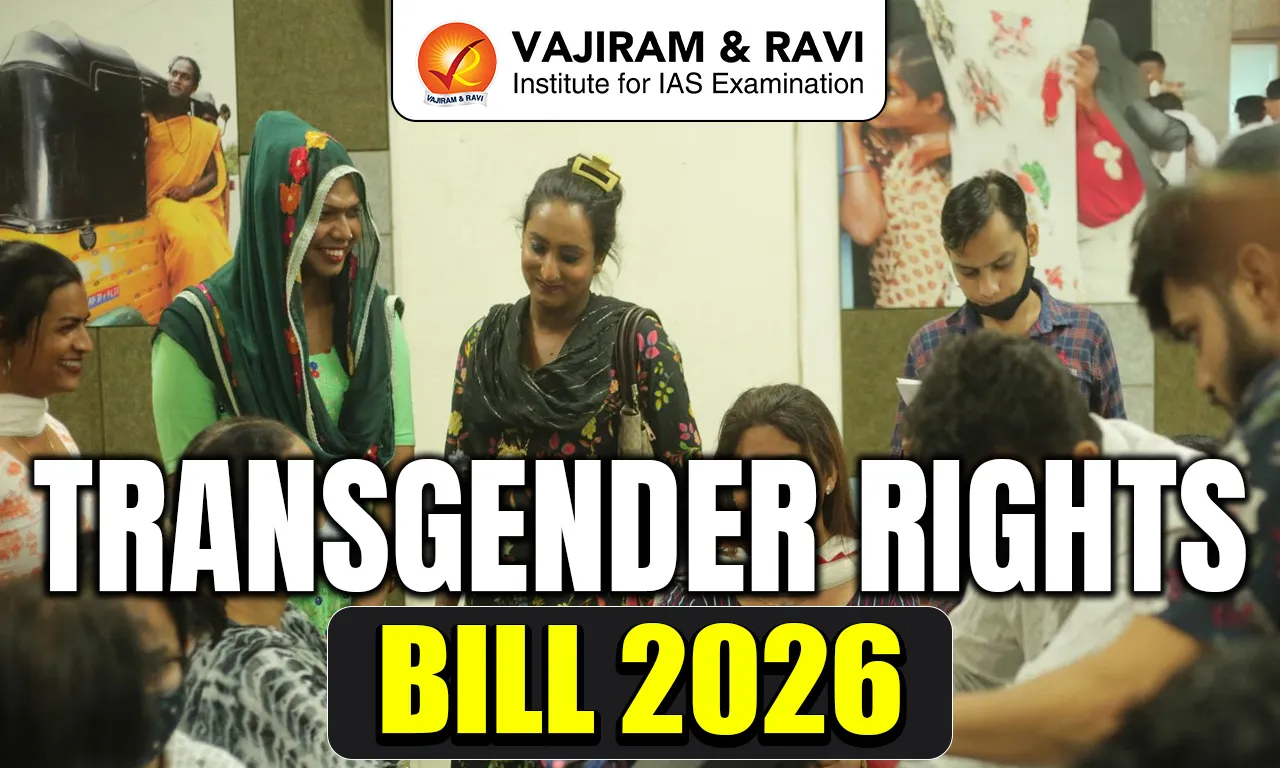
Transgender Rights Bill 2026: Key Changes in Transgender Rights Bill Explained

Transgender Rights Bill 2026

Transgender Rights Bill 2026 Latest News

  • The Transgender Persons (Protection of Rights) Amendment Bill, 2026, introduced in Parliament, proposes significant changes to the 2019 law governing transgender rights.
  • The most contentious provision is the removal of the right to self-identify one’s gender, which was recognised by the Supreme Court in the landmark NALSA v. Union of India (2014) judgment. Instead, the Bill introduces a requirement for medical certification for legal gender recognition.
  • This shift has triggered widespread criticism from transgender and LGBTQ+ groups, who argue that it undermines dignity, autonomy, and hard-won legal rights, marking a rollback of progressive jurisprudence in India.

Definitions of Sex, Gender, and Transgender

  • The Transgender Persons (Protection of Rights) Act, 2019 defines a transgender person as someone whose gender does not match the gender assigned at birth
  • It includes a wide range of identities such as:
    • Trans men and trans women (irrespective of medical procedures)
    • Persons with intersex variations
    • Genderqueer and non-binary individuals
    • Sociocultural identities like kinner, hijra, aravani, and jogta
  • The Act’s definition aligns with the United Nations’ view, which treats transgender as an umbrella term for individuals whose gender identity differs from their assigned sex at birth.
  • The framework highlights that biological sex and social gender are distinct, and recognizing this distinction is central to understanding transgender identities.

Distinction Between Sex and Gender

  • Sex: Refers to biological characteristics; Determined by anatomy, chromosomes, and hormones; Categorised as male or female.
  • Gender: A social and cultural construct; Defines roles, behaviours, and expectations; Varies across societies and time.

Concept of Gender Identity

  • Gender identity is a person’s internal sense of self and gender.
  • It may or may not align with the sex assigned at birth.
  • Forms the basis of transgender identity.

NALSA Judgment (2014) and Its Impact on Transgender Rights

  • The Supreme Court in NALSA v. Union of India (2014) delivered a landmark ruling that transformed transgender rights in India. 
  • It recognised transgender persons as a “third gender” and affirmed that they are entitled to all fundamental rights under the Constitution.
  • A key aspect of the judgment was the right to self-identification of gender, allowing individuals to identify as male, female, or third gender without mandatory medical intervention.
  • The Court also directed the government to create laws and welfare measures for the transgender community. 
  • This led to the enactment of the Transgender Persons (Protection of Rights) Act, 2019, which institutionalised legal recognition through:
    • Inclusion of “third gender” in official documents
    • Issuance of transgender identity cards
    • Creation of welfare mechanisms, including Transgender Welfare Boards
  • These identity cards enabled access to government schemes, with over 32,000 cards issued so far, improving legal recognition and social inclusion of transgender persons.

Key Changes Proposed in the Transgender Rights Amendment Bill, 2026

  • Shift in Approach: From Identity to Biology
    • The Bill focuses on protecting only those facing biological-based exclusion.
    • It marks a shift back to a pre-2014 understanding, prioritising biological traits over self-identified gender.
  • Narrower Definition of Transgender
    • Restricts recognition to:
      • Sociocultural identities (kinner, hijra, aravani, jogta, eunuch)
      • Persons with specific congenital biological variations
      • Replaces the broader 2019 definition with a medicalised and limited list (genitalia, chromosomes, hormones, etc.).
    • New Category Introduced: Includes persons forced into transgender identity through coercion, surgery, or manipulation.
  • Removal of Self-Identification
    • Deletes the provision allowing self-identification of gender.
    • Argues earlier definition was “vague” and made it difficult to identify genuine beneficiaries.
    • Excludes gender-fluid and self-perceived identities from legal recognition.
  • Medical Board for Certification
    • Replaces the earlier administrative process with a medical evaluation system.
    • A Medical Board (headed by CMO/DCMO) will assess applicants and advise the District Magistrate.
    • Introduces clinical gatekeeping in identity recognition.
    • Institutional Change: Members representing states/UTs must now be senior officials (Director rank or above).
  • Stricter Penal Provisions
    • Expands punishments for crimes against transgender persons.
    • New Offences & Penalties:
      • Forcing transgender identity (adult): 10 years to life imprisonment + ₹2 lakh fine
      • Forcing transgender identity (child): Life imprisonment + ₹5 lakh fine
      • Forced begging/servitude (adult): 5–10 years imprisonment + ₹1 lakh fine
      • Forced begging/servitude (child): 10–14 years imprisonment + ₹3 lakh fine
    • The Bill introduces a restrictive, medicalised framework, reduces autonomy, and strengthens punitive measures, significantly altering the rights-based approach of the 2019 Act.

Criticism of the Transgender Rights Amendment Bill, 2026

  • Violation of Self-Determination
    • Activists argue the Bill removes the fundamental right to self-identify gender.
    • Seen as a serious human rights violation, undermining dignity and autonomy.
    • Critics emphasise that gender identity is personal and lived, not subject to external approval.
  • Burden of Proof on Individuals
    • The amendment requires individuals to prove their identity through medical certification.
    • Activists argue identity should not require validation by authorities.
    • Raises concerns about institutional barriers and discrimination.
  • Challenges Due to Social Stigma
    • Requirement of medical documentation may be difficult due to prevailing transphobia in healthcare systems.
    • Trans persons may face bias, exclusion, and lack of access in hospitals and institutions.
  • Exclusionary Definition of Transgender Identity
    • Recognition limited to certain socio-cultural groups.
    • Excludes individuals who identify as transgender outside traditional community structures.
    • Critics say this ignores the diversity of transgender experiences.
  • Concerns Over Socio-Cultural Gatekeeping
    • The focus on traditional systems (like guru-chela networks) may:
      • Reinforce power hierarchies and exploitation
      • Marginalise those who transition independently

Source: IE

Transgender Rights Bill 2026 FAQs

Q1: What is the Transgender Rights Bill 2026?

Ans: Transgender Rights Bill 2026 is a proposed amendment to the 2019 law introducing medical certification, narrowing definitions, and removing the right to self-identification.

Q2: What change does the bill make to self-identification?

Ans: The bill removes the right to self-identify gender, replacing it with a medical certification process, which critics say undermines autonomy and dignity of transgender persons.

Q3: How does the bill redefine transgender identity?

Ans: It narrows the definition to biological traits and certain socio-cultural groups, excluding broader gender identities like non-binary and gender-fluid individuals.

Q4: What is the role of the medical board?

Ans: The medical board will assess individuals and recommend certification for transgender identity, introducing clinical gatekeeping instead of the earlier administrative process.

Q5: Why is the bill being criticised?

Ans: Critics argue the Transgender Rights Bill 2026 violates self-determination, imposes proof burdens, excludes many identities, and reverses progressive rights established by the Supreme Court.

Parliamentary Panel Flags Poor Financial Planning by NITI Aayog

Financial Planning

Financial Planning Latest News

  • A Parliamentary Standing Committee has criticised financial planning by NITI Aayog and the Ministry of Planning for persistent underutilisation of budgetary allocations. 

Role of NITI Aayog in India’s Governance

  • NITI Aayog (National Institution for Transforming India) serves as the government’s premier policy think tank. 
  • Established in 2015, it replaced the Planning Commission with the objective of promoting cooperative federalism and evidence-based policymaking.
  • Its key functions include:
    • Designing long-term policy frameworks
    • Monitoring and evaluating government schemes
    • Providing strategic and technical advice to the Centre and States
    • Facilitating innovation and development initiatives
  • Although NITI Aayog does not directly allocate funds like the erstwhile Planning Commission, it plays a crucial role in shaping development priorities and ensuring efficient utilisation of public resources.

Parliamentary Committee’s Observations

  • The Parliamentary Standing Committee on Finance has raised serious concerns regarding financial management by the Ministry of Planning and NITI Aayog.
  • The Committee found that the Ministry consistently spent significantly less than the budget allocated to it. Key findings include:
    • In 2023-24, actual expenditure was about Rs. 290.81 crore against a Budget Estimate (BE) of Rs. 824.39 crore (around 35%).
    • In 2024-25, expenditure stood at Rs. 282.61 crore against a BE of Rs. 837.26 crore (around 34%). 
  • This pattern indicates a structural issue in planning and execution, where funds remain idle instead of being effectively utilised.
  • Rising Budget Allocations Despite Low Spending
    • Despite the low utilisation rates, the Ministry continued to seek higher allocations.
    • The Ministry requested Rs. 1,203.38 crore for 2026-27, which is about 22% higher than the previous year’s allocation. 
  • The Committee questioned this trend, noting that increasing allocations without proper utilisation reflects poor fiscal discipline.

Weak Implementation and Planning Gaps

  • The Committee highlighted that the problem is not merely financial but also administrative.
    • There is dismal implementation of planned activities on the ground.
    • The Quarterly Expenditure Plan (QEP) shows persistent gaps between planned and actual spending.
  • This indicates that schemes and initiatives are either delayed or inadequately executed.

Issues in Expenditure Management

  • One major concern raised by the Committee is the tendency to spend large amounts in the final quarter of the financial year.
  • In 2025-26, a significant portion of spending was projected in the fourth quarter.
  • This creates a “rush to exhaust funds,” which can compromise the quality of expenditure. 
  • Such practices may also violate government norms that aim to distribute spending evenly throughout the year.

Violation of Fiscal Discipline Norms

  • The Central government has guidelines to ensure balanced expenditure patterns, including limits on monthly spending.
  • The Committee warned that excessive spending in the last quarter may breach these norms, leading to:
    • Inefficient allocation of resources
    • Reduced accountability
    • Poor outcomes from public expenditure

Recommendations by the Committee

  • The Parliamentary panel has made several recommendations to improve financial management.
  • Realistic Budgeting
    • Accurate estimation of expenditure
    • Avoiding inflated budget demands
    • Aligning allocations with actual requirements
  • Strengthening Monitoring Mechanisms
    • Conduct regular internal reviews
    • Ensure timely administrative approvals
    • Synchronise planning with expenditure targets
  • Better Utilisation of Funds
    • Avoid idle funds and resource blocking
    • Ensure the timely implementation of schemes
    • Improve coordination between planning and execution

Broader Implications for Governance

  • The issue of underutilisation of funds reflects deeper challenges in public financial management in India.
  • Impact on Development Outcomes - Inefficient use of funds can delay development projects and reduce the effectiveness of government programmes. This ultimately affects service delivery and economic growth.
  • Fiscal Responsibility and Accountability - Proper financial planning is essential for maintaining fiscal discipline. Persistent underutilisation, coupled with rising allocations, undermines accountability in public spending.

Source : TH

Financial Planning FAQs

Q1: What is NITI Aayog’s role in financial planning?

Ans: NITI Aayog provides policy guidance and monitors development programmes but does not directly allocate funds.

Q2: What issue did the Parliamentary Committee highlight?

Ans: It flagged persistent underutilisation of funds by the Ministry of Planning and NITI Aayog.

Q3: What is the problem with last-quarter spending?

Ans: It leads to rushed expenditure, inefficiency, and possible violation of fiscal norms.

Q4: Why is underutilisation of funds a concern?

Ans: It indicates poor planning and delays in implementation of development programmes.

Q5: What reforms were suggested by the Committee?

Ans: The Committee recommended realistic budgeting, better monitoring, and efficient utilisation of funds.

Maternity Leave for Adoptive Mothers – Supreme Court Redefining Parenthood Rights

Maternity Leave for Adoptive Mothers

Maternity Leaves for Adoptive Mothers Latest News

  • The Supreme Court of India has read down provisions of the Code on Social Security, 2020 to extend 12 weeks of maternity leave to all adoptive mothers irrespective of the child’s age. 
  • Simultaneously, it has urged the Union Government to recognise paternity leave as a social security benefit.
  • The judgment also intersects with an ongoing constitutional challenge to Section 5(4) of the Maternity Benefit Act, 1961, which restricts maternity benefits for adoptive mothers based on the age of the child.

Key Highlights of the Judgment

  • Removal of age restriction for adoptive mothers:
    • The Court read down Section 60(4) of the Code on Social Security, 2020.
    • It held that all adoptive mothers are entitled to 12 weeks of maternity leave, regardless of whether the child is above or below 3 months.
    • It declared the earlier restriction violative of Articles 14 (Right to Equality) and 21 (Right to Life and Personal Liberty).
  • Motherhood beyond biological childbirth:
    • The Court clarified maternity benefit is linked to motherhood, not childbirth.
    • Adoptive mothers have similar caregiving responsibilities as biological mothers.
    • Adoption recognised as part of reproductive and decisional autonomy under Article 21.
  • Maternity leave as a human right: The judgment termed maternity protection as a “basic human right”, ensuring economic security, workplace inclusion of women, and freedom to exercise reproductive choices without employment penalty.
  • Emphasis on role of fathers:
    • The Court highlighted early childhood care requires both parents.
    • Absence of paternity leave reinforces gender stereotypes, limits father’s participation in caregiving, and urges the government to frame a paternity leave policy as part of social security.

Legal and Policy Background

  • Maternity Benefit Act, 1961:
    • It aims to regulate employment of women before and after childbirth.
    • Key provisions are paid maternity leave (the period of such leave could not exceed twelve weeks), protection from dismissal, etc.
  • 2017 Amendment:
    • Increased paid maternity leave to 26 weeks for biological mothers.
    • Introduced, 12 weeks leave for adoptive mothers (only if child < 3 months), work-from-home provision, mandatory crèche facilities (in establishments having 50 or more employees).
  • Code on Social Security, 2020: It consolidates labour laws, and retains similar restrictive provision for adoptive mothers (which is now read down by SC).

Pending Constitutional Challenge

  • A PIL challenges Section 5(4) of the Maternity Benefit Act, 1961 as discriminatory and arbitrary, and violative of Part III (Fundamental Rights) of the Indian Constitution.
  • Key issues:
    • Denial of benefits to adoptive mothers of older children.
    • Discrimination against orphaned and abandoned children.
    • Conflict with the Juvenile Justice Act, 2015, and the adoption procedures that delay early adoption.

Key Issues and Challenges

  • Discrimination in existing framework: Unequal treatment between biological and adoptive mothers, adoptive mothers based on child’s age.
  • Structural barriers in adoption: Lengthy procedures make adoption of infants (<3 months) rare, legal requirements (e.g., declaration of child as “legally free”) cause delays.
  • Lack of paternity leave: India lacks a comprehensive statutory paternity leave policy, leading to gender imbalance in caregiving, and reinforcement of traditional roles.
  • Limited impact on women’s workforce participation: Evidence suggests that decline in women’s participation in several sectors post-2017 amendment, as a result of employer bias due to increased costs and lack of childcare support.
  • Implementation gaps: Weak enforcement in the unorganised sector. Limited access to crèche facilities, work-from-home flexibility.

Way Forward

  • Gender-neutral parental leave policy: Introduce statutory paternity leave, and move towards shared parental leave framework.
  • Harmonisation of laws: Align the Maternity Benefit Act, Code on Social Security, and the Juvenile Justice Act. Remove inconsistencies affecting adoptive parents.
  • Strengthening adoption ecosystem: Simplify procedures, reduce delays in declaring children legally free for adoption.
  • Incentivising employers: Government support/subsidies to offset maternity costs, promote women-friendly workplace policies.
  • Focus on unorganised sector: Expand social security schemes, ensure portability and accessibility of benefits.

Conclusion

  • The SC’s intervention marks a progressive shift from a biology-centric to a care-centric understanding of parenthood. 
  • By recognising adoptive motherhood as equal to biological motherhood and advocating for paternity leave, the judgment advances substantive equality and gender justice.
  • However, meaningful transformation will depend on legislative action, policy coherence, and effective implementation, ensuring that parental rights translate into real social security for all families.

Source: IE | IE

Maternity Leave for Adoptive Mothers FAQs

Q1: How did the SC reinterpret maternity benefits for adoptive mothers under the Code on Social Security, 2020?

Ans: The Court read down Section 60(4) to grant 12 weeks of maternity leave to all adoptive mothers.

Q2: Why did the SC hold the age-based classification in maternity benefits for adoptive mothers as unconstitutional?

Ans: Because it lacked a rational nexus with the objective of maternity protection, violating Article 14 (equality).

Q3: How does the judgment expand the scope of reproductive rights under Article 21?

Ans: It recognises adoption as an integral part of reproductive and decisional autonomy, not limited to biological childbirth.

Q4: What concerns has the SC raised regarding the absence of paternity leave in India?

Ans: It leads to reinforcement of gender stereotypes and restricts fathers’ participation in early childcare, undermining child development.

Q5: Why is Section 5(4) of the Maternity Benefit Act, 1961 being challenged constitutionally?

Ans: Because it denies benefits to adoptive mothers of children above three months, violating Fundamental Rights.

Enquire Now