
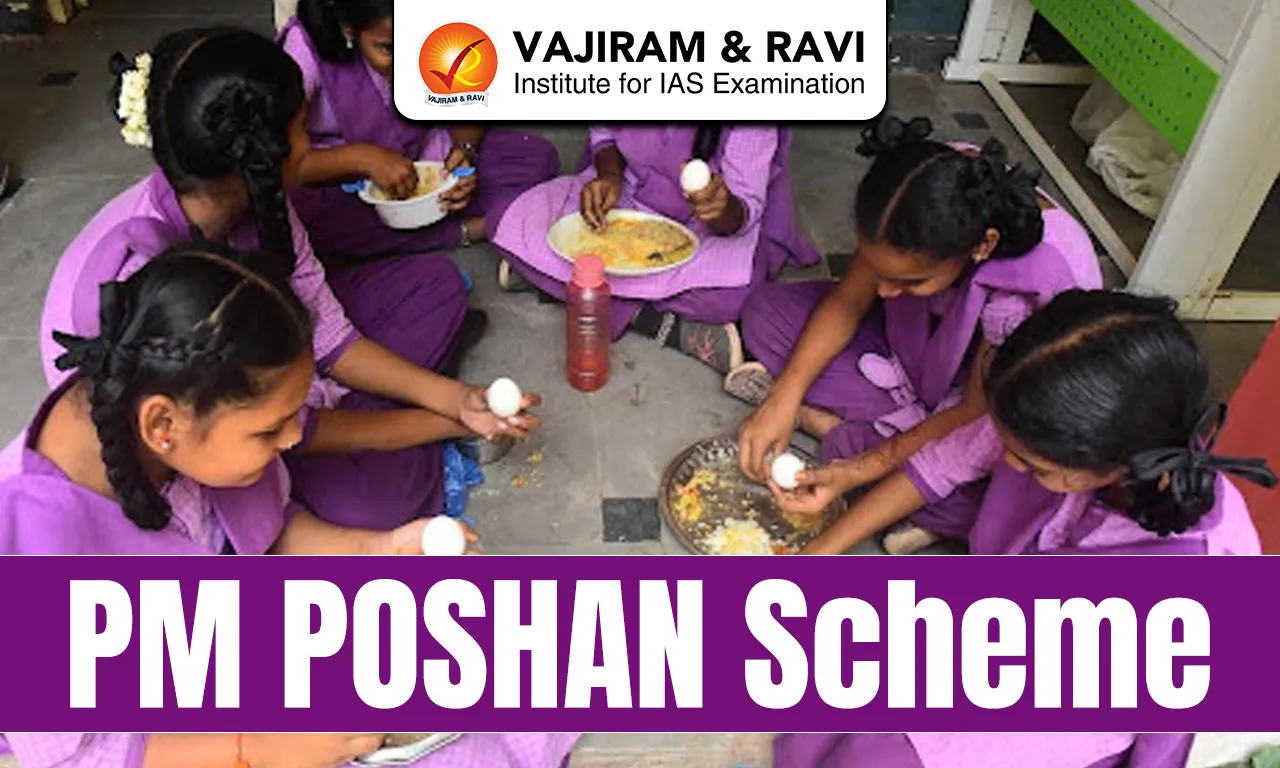
PM POSHAN Scheme and Proposal for Breakfast & Expansion

PM POSHAN Scheme

PM POSHAN Scheme Latest News

  • A Parliamentary Standing Committee has recommended expanding the PM POSHAN Scheme to include breakfast and extending coverage up to Class 12.

PM POSHAN Scheme

  • The PM POSHAN Scheme (Pradhan Mantri Poshan Shakti Nirman) is the restructured version of the Mid-Day Meal Scheme, launched in 2021. 
  • It is one of the world’s largest school nutrition programmes aimed at improving the nutritional status of children and enhancing school participation.
  • Objectives
    • Improving nutritional levels among school children
    • Increasing enrolment, retention, and attendance in schools
    • Reducing dropout rates, especially among disadvantaged groups
    • Promoting social equity by encouraging children from different backgrounds to eat together
  • Coverage and Beneficiaries
    • The scheme currently provides one cooked meal per day to:
      • Students of government and government-aided schools
      • Students studying from Class 1 to Class 8
  • Components of the Scheme
    • Hot Cooked Meals: Nutritious meals prepared as per prescribed calorific and protein norms
    • Nutritional Standards: Meals designed to meet daily energy and protein requirements
    • Supplementary Nutrition: Inclusion of local and seasonal foods
    • School Nutrition Gardens: Promotion of locally grown vegetables and fruits
    • Monitoring Mechanisms: Use of technology for real-time monitoring and quality checks
  • Budget and Funding Pattern
    • The scheme is centrally sponsored, with funding shared between the Centre and States.
    • The overall budget for PM POSHAN (2021-26) is over Rs. 1.3 lakh crore
    • The Centre bears a major share of the cost, while States contribute the remaining portion
  • Key Achievements
    • ~11.80 crore children are covered under the scheme
    • Around 100+ crore meals served per month Nutritional Standards Achieved
    • Primary (Classes 1-5): 450 calories, 12 grams of protein
    • Upper Primary (Classes 6-8): 700 calories, 20 grams of protein

News Summary

  • The Parliamentary Standing Committee on Education has recommended significant reforms to strengthen the PM POSHAN Scheme.
  • Proposal to Introduce Breakfast
    • The Committee has suggested that schools should provide at least a light breakfast along with the existing midday meal.
    • Morning nutrition is expected to improve concentration and cognitive performance
  • Expansion of Coverage
    • The Committee recommended expanding the scheme in a phased manner:
      • Immediate extension up to Class 10
      • Gradual expansion up to Class 12 within five years 
  • Focus on Adolescent Nutrition
    • The Committee highlighted that adolescence is a critical stage of growth.
    • Stopping nutritional support after Class 8 leaves a gap during an important developmental phase
    • Adequate nutrition during this stage can prevent long-term health issues
    • It can also reduce dropout rates, particularly among girls 
  • Link Between Nutrition and Education
    • The Committee emphasised that nutrition and education are closely linked.
    • Students in Classes 10 and 12 face academic pressure due to board exams
    • Proper nutrition can improve focus, memory, and overall academic performance
  • Other Recommendations
    • Extending the benefits of PM-SHRI schools to more government schools
    • Ensuring the timely release of funds under Samagra Shiksha
    • Addressing resource concentration in select institutions

Significance of the Proposed Changes

  • The proposed reforms have wider implications for India’s education and health systems.
  • Addressing Malnutrition: Expanding the scheme will help tackle malnutrition among adolescents, which remains a major public health issue in India.
  • Improving Learning Outcomes: Better nutrition directly contributes to improved cognitive abilities and academic performance.
  • Promoting Gender Equity: Nutritional support for older students, especially girls, can reduce dropout rates and encourage continued education.
  • Strengthening Human Capital: Investing in nutrition and education simultaneously enhances human capital development, which is crucial for long-term economic growth.

Source: TH

PM POSHAN Scheme FAQs

Q1: What is the PM POSHAN Scheme?

Ans: It is a government scheme that provides cooked meals to school children to improve nutrition and education outcomes.

Q2: Who are the beneficiaries under the scheme?

Ans: Students from Class 1 to Class 8 in government and aided schools.

Q3: What new recommendation has the Parliamentary Committee made?

Ans: It has suggested providing breakfast and extending the scheme up to Class 12.

Q4: Why is extending the scheme beyond Class 8 important?

Ans: It ensures proper nutrition during adolescence, a critical growth phase.

Q5: How does the scheme impact education?

Ans: It improves attendance, reduces dropouts, and enhances learning outcomes through better nutrition.
Iran Attacks US Assets: Why NATO Obligations Do Not Apply in Iran Conflict

NATO

NATO Latest News

  • US President Donald Trump has urged NATO allies to support the ongoing US-Israel war against Iran, particularly in securing the Strait of Hormuz, warning of consequences if they refuse. 
  • However, several NATO members, including Germany, have rejected this call, stating the conflict is not a NATO matter. 
  • The war, now in its third week, has escalated tensions across West Asia, including the closure of the Strait of Hormuz, a critical route for nearly 20% of global oil shipments.

NATO: Structure and Core Principle of Collective Defence

  • NATO, established in 1949 after World War II, is an intergovernmental military alliance comprising 32 member countries, mainly from Europe, along with the US and Canada.
  • Its defining feature is collective defence under Article 5, which states that an attack on one member is considered an attack on all, ensuring mutual security against external threats.

Why NATO Is Not Fighting as an Alliance

  • Violation of NATO’s Peace Principles - Article 1 requires members to resolve disputes peacefully and avoid force inconsistent with UN principles. The current conflict does not align with these norms, limiting NATO’s collective involvement.
  • Article 5 Applies Only to Defensive Situations - Article 5 mandates action only in case of an armed attack on a member state. Even after 9/11, allies were not obligated to join US military action, choosing voluntary participation instead.
  • Flexibility in Support - NATO members can choose non-military support, such as financial or humanitarian aid, instead of direct military involvement.
  • Geographical Limitations - Article 6 restricts NATO’s defence obligations to Europe, North America, Turkey, and parts of the North Atlantic. The Iran-related conflict lies outside NATO’s operational zone.
  • High Threshold for Collective Action - NATO maintains a strict threshold for invoking collective defence. Attacks on member assets do not automatically trigger Article 5 unless conditions are clearly met.

Current NATO Position in the Iran Conflict

  • Limited Role: “Enabling Support” - NATO has confined itself to logistics and missile defence support, avoiding direct military involvement. The alliance has not invoked Article 5, maintaining a cautious stance.
  • Official Stand: No Collective Military Action - NATO leadership has clarified there are no plans for formal involvement. Any participation is through individual member actions, not as a unified alliance.
  • European Resistance to US Call - Several European nations, including Germany, have rejected calls for escalation. Preference is for diplomatic solutions, with leaders stressing “this is not our war.”

Individual Allies Acting Independently 

  • Some members are supporting operations at their own discretion:
    • UK: Allowing use of bases in Cyprus and deploying forces
    • Greece: Sending frigates and F-16s
    • France: Deploying naval assets
  • NATO forces have also intercepted Iranian drones and missiles in key locations.
  • The alliance’s eastern flank is handling conflict spillovers, especially near Turkey.
  • Despite rising tensions, NATO continues to avoid formal entry into the war.

Trump’s Grievances Against NATO

  • Burden-Sharing Concerns - Donald Trump has long argued that NATO allies underfund defence, placing a disproportionate burden on the US. Members are expected to spend at least 2% of GDP on defence.
  • Misleading Claims and Reality - Trump claimed many countries were “not paying anything,” which is inaccurate. Rising defence spending among allies has been driven largely by security concerns like the Russia-Ukraine war.
  • NATO’s Support to the US - Article 5 has been invoked only once, after the 9/11 attacks, in support of the US. NATO allies actively participated in Afghanistan and Iraq wars, contributing troops and resources.
  • Diverging Perspectives on US Wars - Some European leaders view interventions like the 2003 Iraq War as costly and misguided. This has shaped reluctance toward future US-led military engagements.

Overall Position

  • While Trump highlights funding imbalances, data shows growing contributions by allies, alongside a history of shared military commitments and sacrifices.
  • US defence spending accounted for 63% of NATO’s total in 2024 (down from 72% in 2016).
  • However, the US ranks sixth in defence spending as a percentage of GDP.
  • Non-US allies increased spending significantly from $292 billion (2016) to $482 billion (2024).
  • 18 of 31 members met the 2% target in 2024, up from just 4 in 2016.

Source: IE | BBC

NATO FAQs

Q1: Why are NATO obligations not triggered in the Iran conflict?

Ans: NATO obligations Iran conflict are not triggered because Article 5 applies only to defensive responses against attacks on member territories, which does not apply here.

Q2: What does Article 5 of NATO state?

Ans: Article 5 states that an attack on one NATO member is considered an attack on all, requiring collective defence, but only under clearly defined defensive circumstances.

Q3: How is NATO involved in the current Iran conflict?

Ans: NATO is providing limited logistical and defensive support, while individual members act independently, avoiding formal alliance involvement under NATO obligations Iran conflict.

Q4: What role does geography play in NATO obligations?

Ans: NATO obligations apply only within defined regions like Europe and North America. The Iran conflict lies outside this area, limiting NATO’s legal responsibility to intervene.

Q5: Why have European allies resisted US calls for support?

Ans: European allies prefer diplomatic solutions and view the conflict as outside NATO’s mandate, reflecting strategic caution and differing perspectives on US-led military interventions.

India Tightens Solar Sourcing Norms: How Solar Sourcing Norms Reduce Chinese Imports

Solar Sourcing Norm

Solar Sourcing Norm Latest News

  • The government has expanded its domestic sourcing mandate for solar equipment to include wafers and ingots, effective from June 2028. 
  • This requirement will apply mainly to government-backed, utility-scale, and commercial projects, including schemes like PM Surya Ghar.
  • Currently, the mandate covers mainly solar PV modules, while other components can still be imported. 
  • However, a separate rule mandating domestic solar cells will come into effect from June this year, indicating a gradual push toward full supply chain localisation.

Reducing Import Dependence in Solar Manufacturing

  • The extension of domestic sourcing norms to wafers and ingots aims to cut import dependence and strengthen local manufacturing in India’s solar sector.
  • While India has built strong capacity in solar modules (172 GW) and cells (27.2 GW), upstream segments like polysilicon, ingots, and wafers remain underdeveloped, with wafer and ingot capacity at only about 2 GW.
  • Wafers are an important step in making solar panels. First, raw material (polysilicon) is turned into ingots, then cut into thin wafers. 
  • These wafers are used to make solar cells, which are finally assembled into solar panels. That’s why producing wafers in India is important for reducing dependence on imports.

Domestic Wafer Rollout Norms in Solar Sector

  • According to a memorandum by the Ministry of New and Renewable Energy (MNRE), a list of domestic wafer manufacturers will be announced only when: 
    • At least three independent units exist (no common ownership)
    • Combined capacity reaches 15 GW.
  • A new Approved List of Models and Manufacturers (ALMM) i.e. ALMM List-III will be created specifically for wafers.
  • Manufacturers must also have matching ingot production capacity to qualify.
  • The framework ensures end-to-end domestic sourcing, strengthening India’s solar manufacturing ecosystem and reducing reliance on imports.

ALMM Framework for Solar Supply Chain

  • MNRE’s Approved List of Models and Manufacturers (ALMM) ensures domestic sourcing:
    • List-I: Solar modules
    • List-II: Solar cells
    • List-III (new): Solar wafers
  • Cascading Requirement
    • Modules must come from List-I manufacturers
    • Cells must come from List-II manufacturers
    • Wafers used in cells must come from List-III manufacturers

Transitional Exemptions

  • Projects are exempt from domestic wafer sourcing if:
    • Bid submission is on or before the cut-off date
    • Cut-off = 7 days after first wafer ALMM list is issued
  • Projects with bids or PPAs before the cut-off remain exempt, even if later procurement occurs.

Mandatory Compliance After Cut-Off

  • Projects with bids after the cut-off date must ensure:
  • Modules, cells, and wafers are sourced strictly from ALMM List-I, II, and III
  • Tender documents must explicitly include these requirements.

Upstream Challenges in India’s Solar Manufacturing

  • Despite growth in solar module manufacturing, upstream segments like polysilicon, ingots, and wafers face challenges.
  • Key issues include high capital requirements and price competition from cheaper Chinese imports.

Performance of the PLI Scheme

  • The Production Linked Incentive (PLI) scheme covers both:
    • Upstream: Polysilicon, ingots, wafers
    • Downstream: Cells and modules
  • Launched in 2021 to build 65 GW annual capacity, with total outlay of ₹24,000 crore.
  • However, progress has been uneven, with upstream segments lagging behind.

Implementation Gaps and Capacity Achievement

  • Overall operational capacity reached only 29% of awarded capacity (as of June 2025).
  • Performance across segments:
    • Modules: 59% (strong progress)
    • Cells: 22%
    • Wafers/Ingot: 10%
    • Polysilicon: 14%
  • Indicates significant execution gaps, especially in upstream manufacturing.

Continued Import Dependence

  • India still relies heavily on imports:
    • Solar cells: $1,641 million
    • Wafers: $156 million
      • Polysilicon: $0.03 million (FY25)
  • Highlights vulnerability in critical supply chain components.

Policy Response and Way Forward

  • Government is exploring new capital subsidy schemes for wafers and ingots.
  • Aim is to boost domestic capacity and reduce reliance on imports in upstream segments.
  • While downstream manufacturing is advancing, upstream bottlenecks remain a key hurdle, requiring targeted policy support and investment for full solar supply chain self-reliance.

Source: IE | FE

Solar Sourcing Norm FAQs

Q1: What are solar sourcing norms in India?

Ans: Solar sourcing norms in India mandate use of domestically manufactured components like modules, cells, wafers, and ingots to reduce import dependence and boost local solar manufacturing capacity.

Q2: Why is India expanding solar sourcing norms?

Ans: India is expanding solar sourcing norms to reduce dependence on Chinese imports, strengthen domestic supply chains, and achieve self-reliance in renewable energy manufacturing.

Q3: What is the ALMM framework in solar sourcing norms India?

Ans: The ALMM framework lists approved domestic manufacturers for modules, cells, and wafers, ensuring cascading sourcing requirements across the solar value chain under solar sourcing norms India.

Q4: What challenges exist in upstream solar manufacturing?

Ans: Upstream segments like wafers and polysilicon face high capital costs, low capacity, and competition from cheaper Chinese imports, slowing progress despite policy support like the PLI scheme.

Q5: How will solar sourcing norms impact imports?

Ans: Solar sourcing norms India will gradually reduce imports by mandating domestic production of key components, strengthening energy security and boosting local manufacturing ecosystems.

Enquire Now

