Iran Long-Range Strike Latest News
- Iran launched two intermediate-range ballistic missiles targeting the US-UK military base at Diego Garcia — located approximately 4,000 km from Iran's coastline in the Indian Ocean.
- This marks one of Tehran's longest-range strike attempts ever, sharply escalating the West Asia conflict beyond its regional boundaries and raising alarms in Washington and allied capitals worldwide.
Background: What Exactly Happened
- Iran fired two ballistic missiles at Diego Garcia. Neither hit its target:
- One failed mid-flight;
- The second was intercepted by a US Navy destroyer using an SM-3 missile interceptor — though whether the interception was fully successful remains unclear.
- Despite causing no physical damage, the attempt itself has triggered serious concern — it signals that Iran may now possess, or is willing to demonstrate, strike capabilities far beyond previously declared limits.
Why the Distance Matters
- Diego Garcia lies ~3,800–4,000 km from Iran.
- Iran had long claimed its missile programme had a maximum range of ~2,000 km.
- This strike attempt effectively doubles that claimed range, suggesting Iran has significantly advanced its missile capabilities.
- If confirmed, it would be the first operational indication that Iran can strike targets at such distances.
- A 4,000 km strike radius from Iran would theoretically place within reach:
- Large parts of Europe, including cities like Paris and London
- This fundamentally changes the threat perception for NATO countries that had so far viewed the West Asia conflict as a regionally contained crisis
The Missile Used: Khorramshahr-4
- The Khorramshahr-4 itself is a liquid-fuelled missile capable of carrying a warhead exceeding one tonne, with the option of deploying cluster munitions.
- Its design, derived in part from earlier North Korean and Soviet systems, combines relatively simple architecture with high payload capacity.
- The missile is also believed to feature manoeuvrable re-entry capabilities, making interception more difficult.
- Assessed range - Potentially exceeds 4,000 km (previously undemonstrated).
Diego Garcia and its Significance
[caption id="attachment_94247" align="alignnone" width="532"]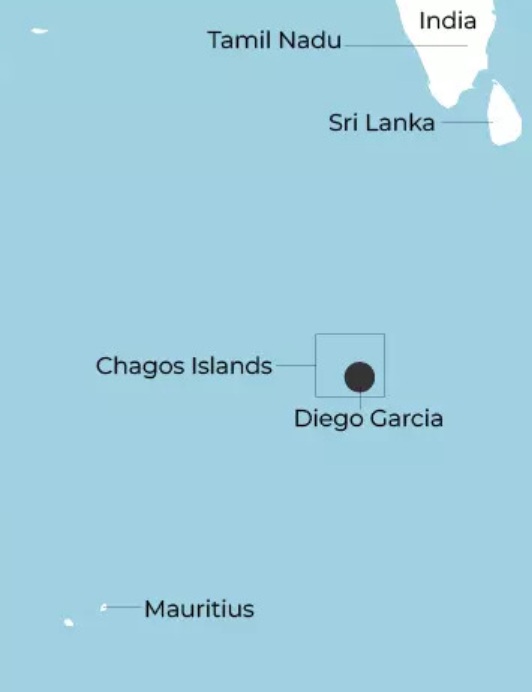 Location of Diego Garcia[/caption]
- Diego Garcia, located in the central Indian Ocean in the Chagos Archipelago, is a key US military base and one of only two major bomber bases in the Indo-Pacific, along with Guam.
- It is operated jointly by the United States and the United Kingdom.
- Diego Garcia sits approximately 3,000 km from both the Bab-el-Mandeb Strait at the mouth of the Red Sea and the Malacca Strait near the South China Sea.
Strategic Importance
- Serves as a critical logistics and operations hub for long-range military missions.
- Has historically supported US bombing campaigns in Afghanistan, Iraq, and recent Middle East operations.
- Its airfield can host:
- Heavy bombers
- Surveillance aircraft
- Pre-positioned military equipment
- Enables rapid military deployment across Asia, Africa, and the Gulf.
- Additionally, it plays an important role in US Space Force tracking systems, enhancing its strategic significance.
Ownership and Control of Diego Garcia
- Historical Control and Lease to the US - Diego Garcia is part of the Chagos Archipelago, originally controlled by the UK. In 1966, the UK leased the island to the US for a military base for 50 years. The lease was extended in 2016 for 20 more years, initially up to 2036.
- International Legal Dispute - In 2019, the International Court of Justice (ICJ) ruled that the UK’s separation of the Chagos Islands from Mauritius was illegal. It recommended that sovereignty should be returned to Mauritius.
Current Status
- In May 2025, the UK formally transferred sovereignty of the Chagos Islands to Mauritius.
- However, Diego Garcia was leased back to the UK for 99 years at £101 million annually.
- The move was partly driven by strategic concerns, including preventing rival powers like China from gaining access.
Missile Defence: The SM-3 System
- The attempted interception was carried out using the SM-3 interceptor, deployed on US Navy warships.
- The SM-3 uses a "hit-to-kill" approach — it destroys incoming missiles through kinetic force (physical impact), not explosives.
- It is well-established against short and medium-range threats, but the uncertainty around this interception highlights the challenges posed by advanced manoeuvrable ballistic missiles.
Iran's Broader Escalation Strategy
- The Diego Garcia strike is not an isolated event — it fits into a wider pattern of Iranian escalation:
- Stepped-up attacks on energy infrastructure across the Gulf, including drone strikes on Kuwait's Mina Al-Ahmadi refinery.
- Warnings issued to countries hosting US forces.
- Iranian officials signalling that targets could extend beyond traditional battlefields.
- This points to a strategy combining conventional missile strikes with the threat of asymmetric warfare.
Iran Long-Range Strike FAQs
Q1: What is the Iran long-range strike on Diego Garcia?
Ans: Iran long-range strike refers to missile attacks targeting Diego Garcia, demonstrating extended missile capability and escalating tensions beyond the West Asia region.
Q2: Why is Diego Garcia strategically important?
Ans: Diego Garcia is a key US-UK military base enabling long-range operations, monitoring key sea routes, and supporting global military deployments across Asia, Africa, and the Middle East.
Q3: What missile was used in the Iran long-range strike?
Ans: Iran used the Khorramshahr-4 missile, capable of carrying heavy payloads and potentially exceeding 4,000 km range, indicating significant advancement in missile technology.
Q4: What are the implications of the Iran long-range strike?
Ans: The Iran long-range strike expands conflict beyond West Asia, increases risks for NATO countries, and signals a shift toward broader geopolitical escalation and deterrence dynamics.
Q5: How was the Iran long-range strike countered?
Ans: The attack was intercepted using the SM-3 missile defence system, which uses a hit-to-kill approach, though challenges remain against advanced manoeuvrable ballistic missiles.