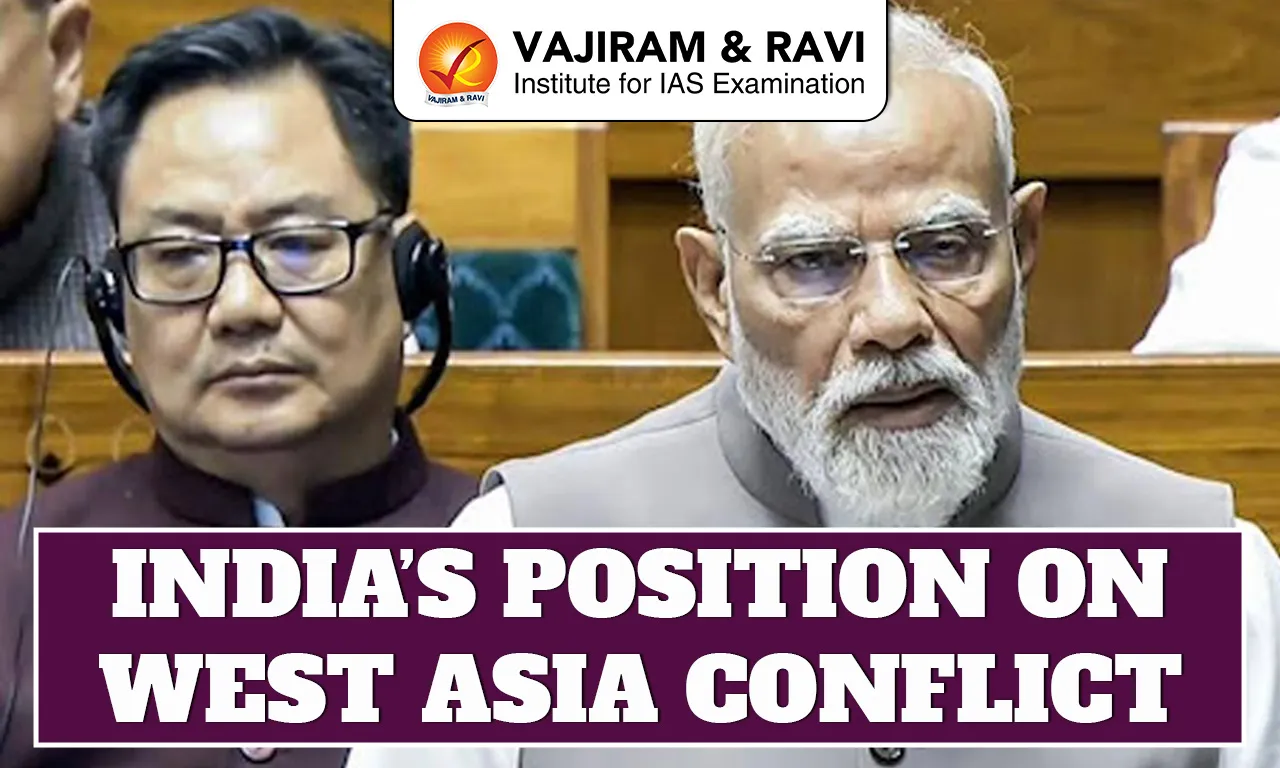
India’s Position on West Asia Conflict: Key Signals from PM Modi’s Statement

India’s Position on West Asia Conflict

India’s Position on West Asia Conflict Latest News

  • PM Modi addressed the Lok Sabha during the Budget Session of Parliament, outlining India's position on the escalating West Asia conflict, now in its fourth week. 
  • His statement carried five key diplomatic signals and touched upon energy security, the Indian diaspora, and India's foreign policy approach.

Key Takeaways From PM Modi’s Lok Sabha Speech on West Asia Conflict

  • Acknowledging the Crisis: Why Parliament Was Chosen
    • PM Modi described the situation in West Asia as "concerning" and noted that the conflict has been ongoing for "more than three weeks". 
    • Choosing Parliament as the platform to address the crisis is itself significant — it reflects the gravity of the situation and its direct impact on ordinary citizens' lives, including supply chain disruptions affecting everyday goods.
  • Economic Impact on India
    • PM highlighted that India has extensive trade relations with countries both directly at war and those affected by the war in West Asia and the Gulf region.
    • The Strait of Hormuz: A Critical Chokepoint
      • The Strait of Hormuz is a narrow but strategically vital waterway through which approximately one-fifth of the world's energy supply passes.
      • PM Modi described any closure of the strait as "unacceptable", underlining its importance to India's trade and energy needs.
      • Several Indian commercial ships and seafarers are directly affected in this region.
    • Energy Security and LPG
      • India imports 60% of its LPG requirements, and uncertain supply due to the conflict has prompted the government to prioritise domestic LPG production.
      • Government is ensuring smooth supply of petrol and diesel across the country.
      • Active monitoring of Gulf shipping routes to ensure safe passage; several stuck ships have since arrived in India.
      • India currently holds a Strategic Petroleum Reserve of 53+ lakh metric tonnes.
      • Work underway to expand this to 65+ lakh metric tonnes, in addition to reserves held by oil companies.
      • Over the past 11 years, India has expanded its energy import sources from 27 to 41 countries, reducing dependence on any single region — a strategy that has proven its value in the current crisis.
  • Indians Affected by the Conflict
    • The Indian Diaspora in the Gulf
      • Approximately one crore (10 million) Indians live and work in Gulf countries.
      • They are primarily breadwinners from states like Kerala, Uttar Pradesh, Bihar, and West Bengal.
      • Any prolonged conflict threatens their livelihoods, remittances, and safety — making this a deeply personal issue for millions of Indian families.
    • Stranded Indian Seafarers
      • Around 700 Indian seafarers aboard approximately 22 ships are currently stuck in the Strait of Hormuz.
      • Indians make up a significant portion of crew members on commercial ships sailing these waters, amplifying India's stakes in the crisis.
    • Evacuation
      • More than 3,75,000 Indians have safely returned to India since the war began.
      • Approximately 1,000 Indians evacuated from Iran, including over 700 young medical students.
      • CBSE has cancelled Class 10 and 12 board exams in Gulf countries and is working to ensure educational continuity.
    • Consular Mechanisms Activated
      • All Indian missions in affected countries are providing continuous help and issuing regular advisories.
      • 24/7 control rooms and emergency helplines established both in India and in affected countries.
  • India's Diplomatic Position: Dialogue Over Conflict
    • PM Modi stated that he has personally spoken twice to all major leaders in the region — including those from Iran, Saudi Arabia, UAE, Qatar, Oman, Kuwait, and Bahrain.
    • He reiterated that "dialogue and diplomacy are the only solutions", echoing a position India had also taken during the Russia-Ukraine war.
    • India has consistently positioned itself as a voice for peace in the interest of humanity, urging all parties to pursue a swift and peaceful resolution.
  • India's Strategic Silence: Reading the Diplomatic Signals
    • One of the most notable aspects of PM Modi's statement was what he did not say:
      • He made no condemnation of US or Israeli actions in the conflict.
      • He also expressed no condolences for the Iranian supreme leader — a silence that has been noted in Tehran.
    • This deliberate ambiguity reflects India's pragmatic foreign policy — a careful balancing act to protect its national interests without alienating any of the major players. 
    • This approach is often described as "strategic autonomy" — India avoids taking sides while actively engaging all parties diplomatically.

Source: IE | PMINDIA

India’s Position on West Asia Conflict FAQs

Q1: What is India’s position on West Asia conflict?

Ans: India’s position on West Asia conflict emphasises diplomacy, dialogue, and neutrality, avoiding taking sides while protecting national interests like energy security and diaspora safety.

Q2: Why is the Strait of Hormuz important for India?

Ans: India’s position on West Asia conflict highlights the Strait of Hormuz as critical since nearly one-fifth of global energy flows pass through it, impacting India’s imports.

Q3: How is the conflict affecting India’s economy?

Ans: India’s position on West Asia conflict reflects concerns over supply disruptions, rising oil prices, and trade impacts, which can affect inflation and economic stability.

Q4: How is India protecting its citizens abroad?

Ans: India’s position on West Asia conflict includes evacuations, consular support, helplines, and monitoring of Indian seafarers and diaspora in Gulf countries.

Q5: What is India’s foreign policy approach in this conflict?

Ans: India’s position on West Asia conflict reflects strategic autonomy, balancing relations with all sides while advocating peaceful resolution through dialogue and diplomacy.
Corporate Laws (Amendment) Bill 2026 – Balancing Ease of Doing Business with Regulatory Oversight

Corporate Law (Amendment) Bill 2026

Corporate Law (Amendment) Bill 2026 Latest News

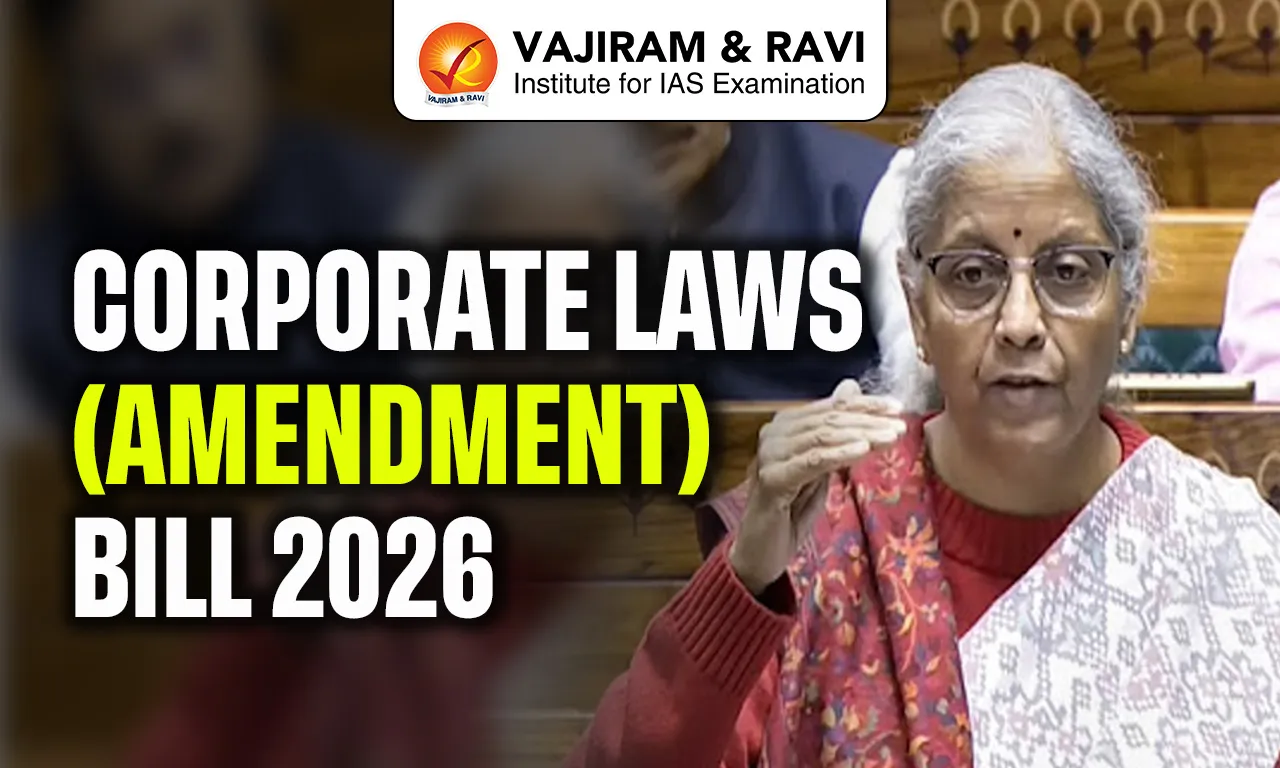
  • The Corporate Laws (Amendment) Bill 2026, introduced by the Union Finance Minister in the Lok Sabha, seeks to amend the Limited Liability Partnership Act, 2008 and the Companies Act, 2013
  • The Bill has been referred to a 31-member Joint Parliamentary Committee (JPC) for detailed scrutiny, reflecting both its significance and the concerns raised by the Opposition.
  • The 31 members JPC [21 from Lok Sabha (nominated by Om Birla), and 10 from Rajya Sabha (selected by C. P. Radhakrishnan)], will submit its report by the first week of the Monsoon Session.

Objectives of the Bill

  • Ease of Doing Business: Simplify compliance requirements and reduce regulatory burden.
  • Decriminalisation: Shift minor corporate offences from criminal penalties to monetary fines.
  • Modernisation: Align India’s corporate regulatory framework with global best practices.
  • Governance reforms: Strengthen institutions like National Financial Reporting Authority (NFRA) and Regional Directors (RDs).

Key Provisions of the Bill

  • Decriminalisation of corporate offences: It seeks to convert minor offences into civil violations with monetary penalties, to reduce litigation and improve business sentiment.
  • Changes in Corporate Social Responsibility (CSR): 
    • It increases CSR applicability threshold from ₹5 crore to ₹10 crore profits.
    • However, mandatory CSR spending remains at 2% of average net profits (last 3 years).
    • Relaxations: Exemption for small companies. Extension of deadline for transferring unspent CSR funds (from 30 to 90 days).
  • Corporate governance and compliance reforms:
    • Reduced compliance burden for small companies.
    • For example, relaxed auditor appointment norms, lower additional fees for filings, and enhanced role of NFRA and RDs.
  • Hybrid meetings and digital governance: 
    • Companies are allowed to hold Annual General Meetings (AGMs)/Extraordinary General Meetings (EGMs) via videoconferencing. 
    • However, at least one physical AGM is mandatory every three years. 
    • This reflects post-pandemic digital governance trends.
  • Capital structure flexibility: Rationalisation of provisions related to share buybacks. Increased flexibility in capital structuring while retaining safeguards.
  • New framework for trust conversion: It enables conversion of specified trusts (registered under SEBI/IFSC) into LLPs. Expands flexibility for financial entities and investment structures.

Concerns and Criticisms

  • Delegation of legislative powers: Critics argue excessive delegation to executive bodies like NFRA. In Hamdard Dawakhana vs Union of India, the apex court held that Parliament should not enact “skeletal legislation”.
  • Dilution of parliamentary oversight: Opposition fears reduced role of legislature in rule-making. Concerns over arbitrariness and accountability.
  • Weakening of CSR framework: Raising the CSR threshold may exclude many companies, and could dilute social responsibility obligations.
  • Governance vs deregulation debate: Decriminalisation may reduce fear of non-compliance. Risk of weakening corporate accountability mechanisms.

Significance for the Economy

  • Positive signals for investors: Reduced compliance burden improves business climate.
  • Alignment with global practices: Enhances India’s attractiveness as an investment destination.
  • Digital corporate ecosystem: Promotes efficiency through virtual meetings and governance.

Challenges and Way Ahead

  • Striking a balance: Between ease of doing business and corporate accountability.
    • Stakeholder consultation - Incorporate industry, civil society, and expert inputs.
    • Balanced decriminalisation - Retain strict penalties for serious corporate misconduct.
  • Ensuring effective oversight: Despite increased delegation.
    • Strengthen parliamentary scrutiny - Ensure JPC thoroughly evaluates delegation clauses.
  • Maintaining CSR effectiveness: Amid relaxed norms.
    • CSR reforms with safeguards - Monitor impact of increased thresholds on social spending.
  • Preventing misuse: Of decriminalisation provisions.
    • Robust regulatory framework - Empower NFRA with accountability safeguards.

Conclusion

  • The Corporate Laws (Amendment) Bill 2026 represents a significant step toward modernising India’s corporate regulatory landscape. 
  • The success of the reform will ultimately depend on maintaining a fine balance between liberalisation and accountability, ensuring that economic growth does not come at the cost of governance standards.

Source: IE

Corporate Laws (Amendment) Bill 2026 FAQs

Q1: What is the significance of the Corporate Laws (Amendment) Bill 2026?

Ans: It aims to improve ease of doing business by replacing criminal penalties with monetary fines, reducing litigation and compliance burden.

Q2: How does the Bill propose to reform CSR in India?

Ans: It raises the CSR applicability threshold to ₹10 crore profit and relaxes compliance norms.

Q3: What are the concerns regarding delegation of legislative powers in the Bill?

Ans: Critics argue it leads to excessive executive control and weakens parliamentary oversight, risking arbitrariness.

Q4: What is the role of digital governance reforms proposed in the Bill?

Ans: Provisions for virtual AGMs/EGMs enhance efficiency, transparency, and adaptability in corporate functioning.

Q5: Will the Bill disturb the balance between ease of doing business and corporate accountability?

Ans: While reforms promote business flexibility and investment, they risk diluting accountability if oversight mechanisms are weakened.

India’s Strategic Petroleum Reserves: Hidden Vulnerability in Energy Security

India’s Strategic Petroleum Reserves

India’s Strategic Petroleum Reserves Latest News

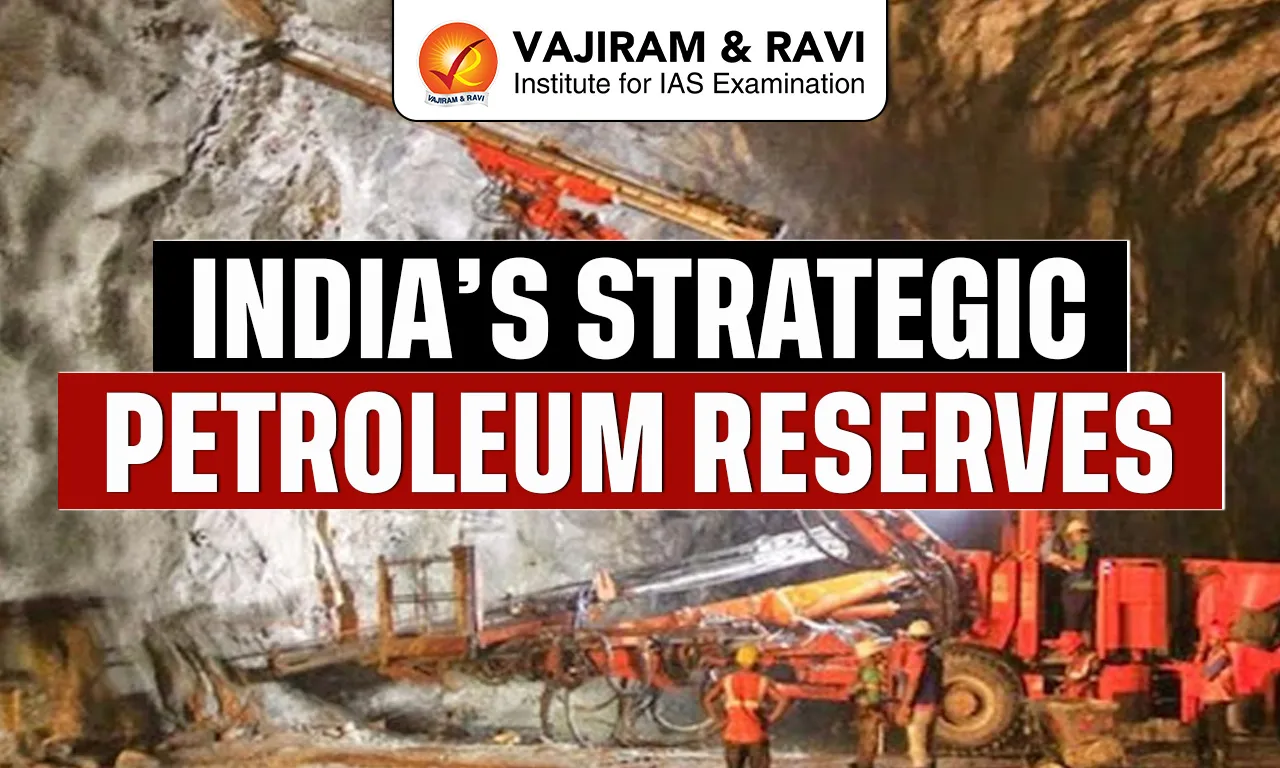
  • India's Strategic Petroleum Reserves (SPRs), with a total storage capacity of 5.33 million tonnes, are currently holding 3.37 million tonnes of crude oil — just 64% of total capacity, as revealed by Minister of State for Petroleum in a written reply to the Rajya Sabha.
  • The SPRs are spread across three underground cavern facilities in Andhra Pradesh and Karnataka, managed by the Indian Strategic Petroleum Reserve Limited (ISPRL). At full capacity, they can cover approximately 9.5 days of India's crude oil requirements.
  • With one-third of storage capacity lying vacant, India's buffer against short-term supply shocks is not at its strongest at a time when it is needed most. The government noted that the reserve figure is dynamic, not static — it fluctuates depending on market conditions, incoming stocks, and actual consumption. So the 64% figure represents a snapshot, not a fixed position.

About Strategic Petroleum Reserves (SPRs)

  • Strategic Petroleum Reserves are dedicated stockpiles of crude oil maintained by countries as a buffer against sudden supply disruptions and price shocks. 
  • They are distinct from the routine operational reserves held by oil companies.

Historical Background

  • The concept of SPRs was first proposed after the Oil Crisis of 1973, when Arab nations imposed an oil embargo on Western countries. 
  • Since then, SPRs have been tapped during major global emergencies.
  • Countries like the US, China, and Japan maintain massive SPRs, reflecting the strategic importance of energy stockpiling for large oil-importing economies.

India's SPR Infrastructure: Current Status

  • In India, SPRs are managed by ISPRL (Indian Strategic Petroleum Reserve Limited) — a special purpose vehicle and a wholly-owned subsidiary of the Oil Industry Development Board (OIDB). 
  • India currently has three underground cavern facilities:
    • Visakhapatnam (Andhra Pradesh) – 1.33 million tonnes
    • Mangaluru (Karnataka) -1.50 million tonnes
    • Padur (Karnataka) - 2.50 million tonnes
    • Total - 5.33 million tonnes
  • At full capacity, these reserves cover approximately 9.5 days of India's crude oil needs.

Planned Expansion: Future SPR Sites

  • In July 2021, the government approved two additional commercial-cum-strategic petroleum reserves with a combined capacity of 6.5 million tonnes:
    • Chandikhol, Odisha — 4 million tonnes
    • Padur, Karnataka (expansion) — 2.5 million tonnes
  • Further proposals exist for reserves at Bikaner (Rajasthan) and Rajkot (Gujarat), which would add another 6 million tonnes to India's total SPR capacity. 
  • However, decisions on these are yet to be taken.

Key Gaps and Concerns

  • Current reserves cover only ~9.5 days of crude needs — far below the 90-day benchmark recommended for IEA members.
  • Reserves are presently at only 64% capacity (3.37 million tonnes out of 5.33 million tonnes).
  • Planned expansion projects remain incomplete or undecided, leaving India exposed during prolonged supply disruptions like the current West Asia conflict.

India's Oil Stockpiles: Where We Stand and Why It Matters

  • India is the world's third-largest consumer of crude oil.
  • Over 88% of its crude oil requirement is met through imports.
  • This high import dependency makes India acutely vulnerable to global supply disruptions.

The IEA Benchmark: How Does India Compare

  • The IEA (International Energy Agency) recommends that countries maintain oil stocks equivalent to at least 90 days of net oil imports. 
  • This includes both strategic reserves and commercial inventories held by refiners.
  • India is an Associate Member of the IEA (not a full member), so it is not legally obligated to meet this benchmark.
  • India's current total national storage capacity — including commercial stocks with refiners — stands at 74 days, still short of the 90-day IEA standard.

Why India Urgently Needs to Expand Its SPRs

  • The ongoing West Asia conflict has effectively closed the Strait of Hormuz, a critical maritime chokepoint. 
  • Experts argue that expanding dedicated strategic reserves is long overdue, given:
    • India's massive and growing consumption levels.
    • Its over 88% import dependency.
    • The risk of extended supply disruptions from geopolitical conflicts like the current West Asia war.
  • The current SPR covers only ~9.5 days of crude needs — a dangerously thin buffer.

The Commercial Case for Expanding SPRs

  • Beyond energy security, there is a strong commercial rationale for building more storage capacity:
    • Market leverage — Even limited additional storage would allow ISPRL to release inventory when prices surge and recharge reserves when prices are low, making it a serious player in international oil markets.
    • Leasing to foreign refiners — Storage can be leased to West Asian refiners, who benefit from reduced freight costs when supplying to Southeast Asian markets.

The ADNOC Example

  • In July 2021, the government approved the commercialisation of Phase-I SPRs. 
  • Under this, an agreement was signed between ADNOC (Abu Dhabi National Oil Company, UAE) and ISPRL.
  • It allows ADNOC to use 7,50,000 tonnes of capacity at the Mangaluru SPR — a model that can be replicated to generate revenue while keeping reserves available for emergencies.

Source: IE

India’s Strategic Petroleum Reserves FAQs

Q1: What are India’s strategic petroleum reserves?

Ans: India’s strategic petroleum reserves are emergency crude oil stockpiles stored in underground facilities to protect against supply disruptions and stabilise energy availability during crises.

Q2: Why are India’s strategic petroleum reserves important?

Ans: India’s strategic petroleum reserves act as a buffer against supply shocks, especially given India’s high dependence on imported crude oil and vulnerability to geopolitical disruptions.

Q3: What is the current status of India’s strategic petroleum reserves?

Ans: India’s strategic petroleum reserves are at about 64% capacity, covering roughly 9.5 days of crude demand, which is relatively low compared to global standards.

Q4: How does India compare with global oil reserve standards?

Ans: India’s strategic petroleum reserves fall short of the IEA’s 90-day benchmark, with total reserves (including commercial stocks) covering around 74 days of imports.

Q5: What challenges affect India’s strategic petroleum reserves?

Ans: India’s strategic petroleum reserves face challenges like limited capacity, incomplete expansion plans, high import dependency, and exposure to global conflicts like the West Asia crisis.

Women’s Reservation Act and Delimitation – Explained

Women’s Reservation

Women’s Reservation Latest News

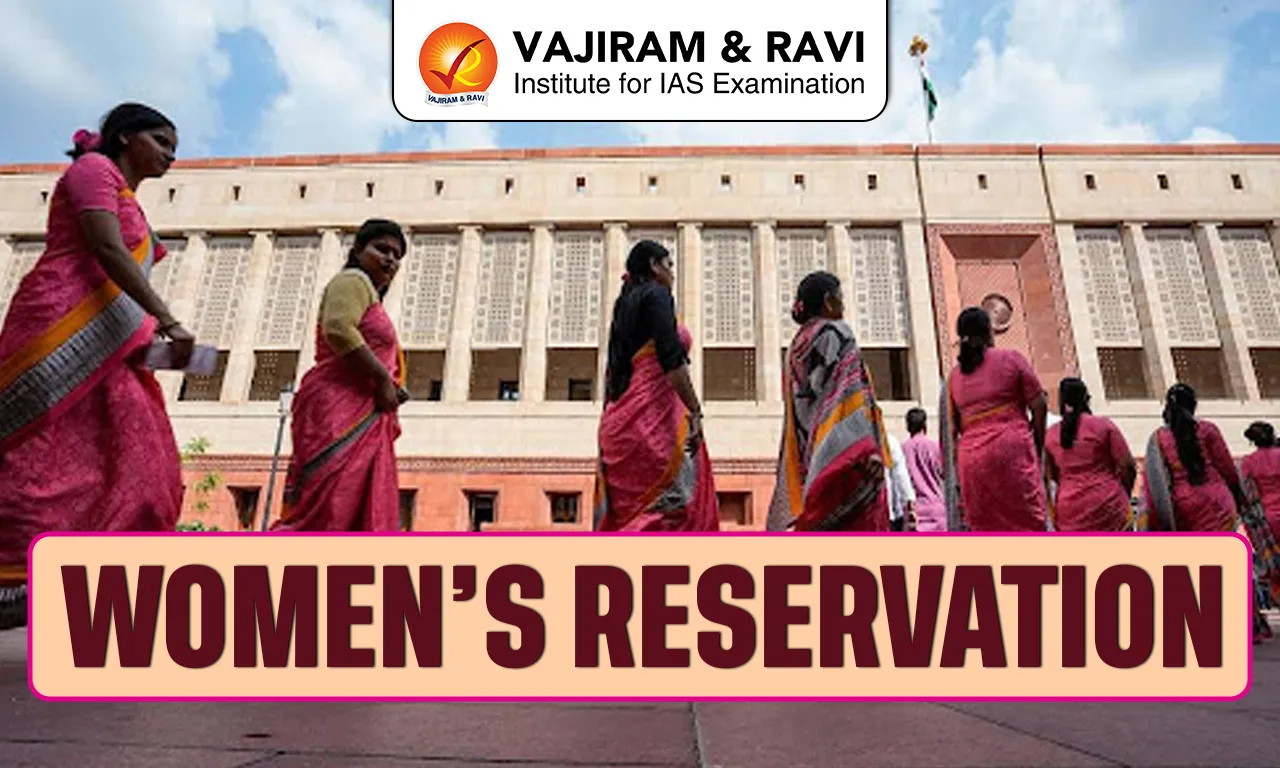
  • The government is considering implementing the Women’s Reservation Act through delimitation based on the 2011 Census to fast-track its rollout. 

Women’s Reservation Act

  • The Women’s Reservation Act, officially known as the Constitution (106th Amendment) Act, 2023, aims to provide 33% reservation for women in the Lok Sabha and State Legislative Assemblies.
  • Key Features
    • Reserves one-third of seats for women in Parliament and State Assemblies. 
    • Includes reservation within the Scheduled Castes (SC) and Scheduled Tribes (ST) quotas. 
    • Reservation is expected to be implemented after delimitation based on Census data. 
  • Significance
    • The Act is a major step toward enhancing women’s political participation and representation in governance.
    • It aims to address historical underrepresentation and promote inclusive policymaking.

Delimitation and Its Role

  • Delimitation refers to the process of redrawing the boundaries of electoral constituencies based on population data.
  • It is conducted under Article 82 (for Parliament) and Article 170 (for State Assemblies). 
  • The objective is to ensure equal representation by adjusting seats according to population changes. 
  • Under the existing framework, delimitation is to be carried out after the first Census conducted post-2026.
  • This requirement has delayed the implementation of the Women’s Reservation Act.

Issues with Current Framework

  • The linkage between the Census and delimitation has created delays.
    • The 2021 Census has been delayed, pushing the timeline further. 
    • As a result, the implementation of women’s reservation could be postponed beyond 2030. 
  • This has led to policy discussions on alternative mechanisms to expedite implementation.

News Summary

  • The government is exploring a proposal to delink the Women’s Reservation Act from the ongoing Census and delimitation process and implement it earlier.
  • Increase in Lok Sabha Seats
    • The number of Lok Sabha seats may increase from 543 to 816
    • Out of these, 273 seats could be reserved for women
    • This expansion may involve a 50% increase in seats across states, while maintaining the current proportion of representation. 
  • Maintaining Federal Balance
    • To address concerns of southern states, the proposal suggests:
    • Keeping the proportion of seats across states unchanged
    • Avoiding the penalisation of states that have controlled population growth. 
    • This ensures political balance and reduces regional opposition.
  • Legislative and Constitutional Changes
    • Implementation would require amendments to key provisions, i.e. Article 81 (Lok Sabha composition) and Article 170 (State Assemblies composition). 
    • These constitutional caps currently limit the number of seats, necessitating amendments. 
  • Possible Implementation Mechanism
    • A lottery system may be used to determine reserved constituencies. 
    • Every third seat is likely to be reserved for women. 
    • However, clarity is still awaited on whether the reservation will be rotational.

Implications of the Proposal

  • Faster Implementation
    • Using 2011 Census data can enable implementation before the 2029 Lok Sabha elections.
  • Political Impact
    • An increase in seats may alter electoral dynamics. 
    • Larger states like Uttar Pradesh could see significant seat increases. 
  • Federal Concerns
    • Balancing representation without disadvantaging certain states is a critical challenge.
  • Administrative Challenges
    • Delimitation and seat expansion require extensive administrative and legal processes.

Source: TH | IE

Women's Reservation FAQs

Q1: What does the Women’s Reservation Act provide?

Ans: It provides 33% reservation for women in the Lok Sabha and State Assemblies.

Q2: Why has its implementation been delayed?

Ans: It is linked to delimitation based on Census data, which has been delayed.

Q3: What is the proposed solution by the government?

Ans: To conduct delimitation based on the 2011 Census to fast-track implementation.

Q4: How many seats are proposed in the Lok Sabha after expansion?

Ans: The number may increase to 816 seats, with 273 reserved for women.

Q5: What major constitutional changes are required?

Ans: Amendments to Articles 81 and 170 are required to increase seat limits.

Enquire Now