
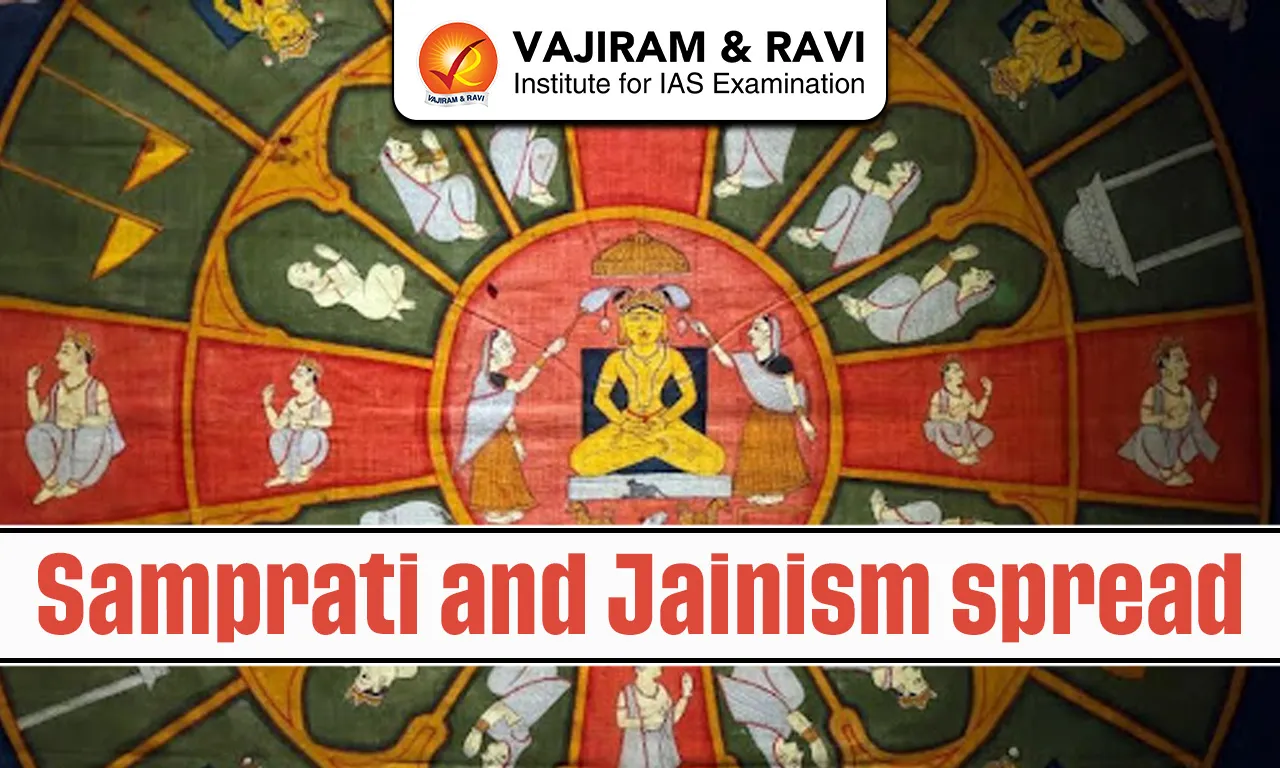
Samprati and Jainism Spread: How Samprati Took Jainism Across India After Ashoka

Samprati and Jainism Spread

Samprati and Jainism Spread Latest News

  • On Mahavir Jayanti (March 31), PM Modi inaugurated the Samrat Samprati Museum in Koba, Gandhinagar, dedicated to Jain history and Samrat Samprati, grandson of Emperor Ashoka.
  • While Ashoka is known for spreading Buddhism, Samprati is remembered for promoting Jainism across India and beyond, playing a key role in expanding the faith’s influence.

Mauryan Legacy Beyond Ashoka

  • The Mauryan Empire (3rd century BCE) is best known for Emperor Ashoka (c. 269–232 BCE), who expanded the empire and promoted a moral order based on Buddhist principles. 
  • His model of ethical kingship influenced regions beyond India, especially Buddhist Southeast Asia.

Jainism Within the Mauryan Era

  • Despite Buddhism’s prominence, Jainism also remained significant during this period. 
  • Ashoka’s first wife, Padmavati, is believed to have been a Jain, and his grandfather, Chandragupta Maurya, is said in Jain traditions to have embraced Jainism, migrated south during a famine, and died in meditation at Shravanabelagola.
  • While Chandragupta is central to the Digambara tradition, Shvetambara texts highlight Ashoka’s grandson, Samprati, as a key figure. 
  • After Ashoka’s death (in 232 BCE), the empire may have been divided between his grandsons Dasharatha and Samprati.
  • Samprati, son of Kunala, is portrayed in Jain texts as a devoted follower who played a major role in spreading Jainism, particularly by promoting and distributing images of the Jinas across the subcontinent.

Samprati: The Jain Counterpart to Ashoka

  • Samprati, believed to have ruled between 230 and 220 BCE, emerges in Shvetambara Jain texts as a key royal patron of Jainism. 
  • Over time, his legacy expanded through medieval works like Samprati Nripa Charitra, portraying him as a central figure in Jain religious history.

Conversion and Religious Commitment

  • While some traditions claim he was Jain from birth, most accounts highlight his conversion under the monk Suhastin in Ujjain. 
  • He adopted Jain lay practices, including daily icon worship, and developed a deep personal commitment to Jain dharma, rather than acting out of political motives.

Expansion of Jainism Across Regions

  • After his conversion, Samprati is credited with actively spreading Jainism by sending monks to distant regions, building and renovating temples, and installing numerous Jain icons. 
  • His efforts helped consolidate Jainism across regions like Andhra, Tamil Nadu, Karnataka, Maharashtra, Gujarat, Malwa, and Rajputana.
  • Some traditions even extend his influence to China, Myanmar, Afghanistan, Nepal, Bhutan, and parts of Central and West Asia.

Temple Building and Religious Infrastructure

  • Samprati’s contribution went beyond missionary activity. 
  • Like Ashoka with Buddhist stupas, he is said to have institutionalised Jain religious culture through large-scale temple construction and icon installation. 
  • Traditions credit him with building 125,000 temples, renovating 36,000, consecrating millions of icons, and establishing 700 charitable centres.

Legacy in Jain Tradition

  • In western India, many ancient temples and icons without clear historical records are often attributed to Samprati. 
  • His role in Jain history is seen as parallel to Ashoka’s in Buddhism, symbolising a ruler who not only spread teachings but also embedded religious practices across regions.

Historical Sources and Death

  • Samprati’s life is documented in texts like Sampratikatha, Parishistaparva, and Prabhavakcharita. 
  • He is believed to have ruled for about 50 years and died around 190 BCE, leaving behind a lasting legacy as a champion of Jainism.

Conclusion

  • The story of Samprati and Jainism spread highlights how Ashoka’s grandson played a crucial role in expanding Jainism. 
  • The Samprati and Jainism spread effort involved sending monks, building temples, and installing Jain icons across regions. 
  • Through these actions, Samprati and Jainism spread became a defining chapter in ancient Indian religious history.

Source: IE | JS

Samprati and Jainism Spread FAQs

Q1: Who was Samprati in Jain history?

Ans: Samprati was Ashoka’s grandson and a Mauryan ruler known for promoting Jainism extensively through temple building, missionary work, and spreading Jain practices across India and beyond.

Q2: How did Samprati and Jainism spread across India?

Ans: Samprati and Jainism spread through sending monks, constructing thousands of temples, and installing Jain icons across regions like Gujarat, Karnataka, Tamil Nadu, and Maharashtra.

Q3: Did Samprati spread Jainism outside India?

Ans: Some traditions suggest Samprati and Jainism spread to regions like Myanmar, Afghanistan, Nepal, and Central Asia, similar to Ashoka’s spread of Buddhism.

Q4: What role did religion play in Samprati’s rule?

Ans: Samprati’s rule was deeply influenced by Jainism, focusing on non-violence, temple construction, and welfare activities rather than political expansion.

Q5: Why is Samprati compared to Ashoka?

Ans: Samprati is compared to Ashoka because both rulers promoted religions—Ashoka spread Buddhism, while Samprati and Jainism spread became central to Jain history.

India’s Push for Piped Natural Gas – Reducing LPG Dependence

Piped Natural Gas

Piped Natural Gas Latest News

  • India is accelerating the shift towards piped natural gas (PNG) to reduce LPG import dependence and improve energy security. 

Types of Cooking and Transport Fuels

  • India uses multiple forms of gaseous fuels for domestic and industrial purposes.
    • Liquefied Petroleum Gas (LPG) is a mixture of propane and butane obtained during oil refining and natural gas processing. 
    • Liquefied Natural Gas (LNG) is natural gas cooled to extremely low temperatures to convert it into liquid form for transport. 
    • Piped Natural Gas (PNG) is natural gas supplied directly to households through pipelines. 
    • Compressed Natural Gas (CNG) is natural gas compressed for use as a vehicular fuel. 
  • Each of these fuels differs in storage, transport, and usage. LPG is cylinder-based, while PNG is pipeline-based, making it more continuous and convenient. 

Transport and Distribution Mechanisms

  • The logistics of fuel distribution differ significantly across fuel types.
    • LPG is transported in cylinders after being liquefied and pressurised, and delivered physically to households. 
    • LNG is transported through specialised carriers at extremely low temperatures and later regasified. 
    • PNG is delivered through underground pipelines directly to consumers. 
  • Pipeline-based delivery reduces handling and storage risks while ensuring an uninterrupted supply. 

Why LPG Became Dominant in India

  • India adopted LPG as the primary cooking fuel due to logistical convenience.
  • Cylinder-based delivery is easier to implement compared to building an extensive pipeline network.
  • This made LPG suitable for rapid expansion, especially under schemes like PM Ujjwala Yojana.
  • However, LPG supply chains are vulnerable to disruptions, especially due to import dependence.

News Summary

  • The Union Govt is actively promoting piped natural gas as an alternative to LPG, driven by concerns over import dependence and global disruptions. 
  • India currently has around 33 crore LPG connections. Officials estimate that domestic natural gas production could potentially support up to 30 crore connections if households transition to PNG. 
  • One of the key reasons behind this push is India’s heavy reliance on LPG imports. 
    • Nearly three-fifths of LPG demand is met through imports, with about 90% routed through the Strait of Hormuz, which has been affected by geopolitical tensions. 
  • In contrast, LNG imports are more diversified globally, making natural gas a more secure option.
  • The government is also taking policy measures to accelerate PNG adoption. It is expected that around 15 lakh new PNG connections will be added in the near term. 
  • A major policy shift includes discouraging dual connections. Households may be required to transition fully to PNG where available, leading to an increase in PNG adoption. 
  • Currently, PNG connections have crossed 1.5 crore and are expected to reach 2 crore soon. The government aims to expand this to 12 crore connections by 2034. 
  • To support this expansion, India is rapidly developing pipeline infrastructure. The existing pipeline network spans about 25,000 km, with an additional 10,500 km under construction. 

Advantages of PNG

  • Energy Security. Reduces dependence on LPG imports and vulnerable supply routes. 
  • Convenience. Provides an uninterrupted supply without cylinder replacement. 
  • Cost Efficiency. Lower logistics and handling costs in the long run. 
  • Environmental Benefits. Natural gas burns cleaner than LPG and reduces emissions. 
  • These advantages align with India’s broader goals of energy transition and sustainability.

Challenges in PNG Expansion

  • High initial investment in pipeline infrastructure. 
  • Difficulties in land acquisition and approvals. 
  • Uneven geographical coverage. 
  • Limited awareness and technical readiness among industrial users. 
  • Additionally, India’s LNG system operates on a “just-in-time” model with limited storage, making it vulnerable to supply disruptions. 

Way Forward

  • India must adopt a balanced approach for gas-based energy transition.
    • Expand pipeline infrastructure to underserved regions. 
    • Increase domestic natural gas production. 
    • Strengthen LNG import and storage capacity. 
    • Improve regulatory coordination for faster approvals. 
    • Promote awareness and technical support for industries. 

Source: TH

Piped Natural Gas FAQs

Q1: What is piped natural gas (PNG)?

Ans: PNG is natural gas supplied directly to households through pipelines for cooking and heating.

Q2: Why is India promoting PNG over LPG?

Ans: To reduce import dependence and improve energy security.

Q3: What is the target for PNG connections in India?

Ans: India aims to achieve 12 crore PNG connections by 2034.

Q4: What is a major challenge in PNG expansion?

Ans: Lack of pipeline infrastructure and last-mile connectivity.

Q5: How does PNG benefit the environment?

Ans: It burns cleaner than LPG and reduces carbon emissions.

Enquire Now
