

CBSE AI Curriculum and Student Preparedness

CBSE AI Curriculum

CBSE AI Curriculum Latest News

  • On 1 April 2026, the government launched a CBSE curriculum on Computational Thinking (CT) and AI for Classes 3–8. 
  • The aim is to build skills like logical reasoning, problem-solving, and pattern recognition, and introduce students to AI in daily life. 
  • The programme will begin from the 2026–27 academic session and is seen as a step toward future-ready education. 
  • While the initiative is ambitious and welcome, its success depends on proper implementation and sequencing.

The Missing Foundation: LSRW Skills in AI Learning

  • Importance of LSRW Skills - Listening, Speaking, Reading, Writing (LSRW) form the core of meaningful learning. They are the cognitive foundation for understanding, processing, and expressing ideas across all subjects, including AI.
  • CT Curriculum Built on Language - Computational Thinking (CT) is integrated across subjects, not a standalone discipline. It is delivered through language, requiring students to read, interpret, and respond to text.
  • Learning Activities Depend on Comprehension - Curriculum includes puzzles, pattern exercises, and problem-solving tasks embedded in textbooks. Students must interpret texts and analyse information to complete these tasks.
  • Assessment Requirements - Evaluations involve: Written tests with CT questions; Group activities; Teacher observations. All require basic reading and comprehension skills.
  • Core Concern - The CT curriculum effectively functions as a literacy-based learning tool. Students who lack grade-level reading ability will face it as a reading challenge rather than a thinking exercise.

What the Data Reveals: Learning Deficit Across Schools

  • Evidence from ASER 2024 - The ASER 2024 report shows that over half of Class 5 students in government schools cannot read a Class 2-level text. This basic reading benchmark has remained unchanged since 2006.
  • Persistent Literacy Gap - Even after five years of schooling, many children fail to achieve foundational reading skills. This highlights a serious gap in basic learning outcomes.
  • Not Limited to Rural or Government Schools - The assumption that private or urban schools perform better is incorrect. Learning deficits exist across different school types.
  • Findings from PARAKH 2024 - The national assessment covering 23 lakh students found that:
    • Urban private school students performed worse than rural counterparts at Grade 3 level. 
    • Government school students scored higher in Language and Mathematics.
  • Implication for CBSE Students - Students entering CBSE classrooms are not insulated from the literacy crisis. They are directly affected by the same foundational learning challenges.

A Promise and a Deadline: Literacy Goals vs Reality

  • NIPUN Bharat Mission - Launched in 2021 to ensure foundational literacy and numeracy by Grade 3. Target year set as 2026–27.
  • Current Status of Learning Levels - ASER 2024 shows improvement since 2022. However, more than half of Class 5 students still cannot read a Class 2-level text.
  • Gap Between Target and Achievement - The literacy goal remains incomplete as of the latest data. Foundational learning levels are still below expectations.
  • Overlap with CT Curriculum Launch - The CT curriculum is introduced in the same year the literacy target was to be achieved. This creates a mismatch between policy goals and ground reality.

What the Curriculum Assumes: Dependence on Foundational Skills

  • Focus on Higher-Order Cognitive Skills - The CT curriculum aims to develop logical, critical, and analytical thinking. These are advanced skills that depend on basic comprehension.
  • Comprehension as a Prerequisite - Abstract reasoning cannot develop without the ability to understand written text and instructions. Weak reading skills hinder the development of computational thinking.
  • Increasing Complexity in Class 6 - From Class 6, assessments include: Project presentations; Reflective journals; Written assignments. AI concepts are also introduced at this stage.
  • Risk of Early Learning Breakdown - Students struggling with reading in earlier classes may fail to build foundational CT skills. The gap becomes visible later, indicating an early breakdown in the learning pipeline.
  • Assessment Challenges - Evaluation methods require strong written and oral skills (LSRW). Without these, assessments measure literacy gaps instead of computational thinking ability.

The Unfulfilled Parallel: LSRW and CT

  • Foundational Priority of LSRW - Foundational literacy and numeracy were identified as the highest priority under NEP 2020. NIPUN Bharat was launched to achieve this goal.
  • Gap Between Policy and Outcomes - Despite policy focus, LSRW has not been achieved at scale. Data shows that foundational learning gaps still persist.
  • CT as the New Priority - Computational Thinking (CT) is now being promoted as a key educational priority. The curriculum is:  Well-designed and ambitious; Developed by leading academic institutions; Based on activity-based and ethical approaches.

The Sequencing Question: Literacy Before AI

  • Global Experience - Countries like Finland, Singapore, and South Korea introduced AI education after achieving strong foundational literacy. Curriculum reforms followed literacy, not preceded it.
  • India’s Current Position - India has institutional momentum with initiatives like NIPUN Bharat. ASER 2024 shows improvement in reading levels, though gaps remain.
  • Need for Careful Sequencing - The issue is not whether to introduce CT and AI, but whether students are ready. Foundational literacy must support the rollout. 
  • Ground Reality in Classrooms - Students in Class 3 face CT tasks alongside existing reading gaps. The effectiveness of the curriculum depends on the child’s readiness.

Conclusion

  • A curriculum’s success depends on learning foundations. Addressing CT without fixing literacy gaps does not achieve true transformation.

Source: TH

CBSE AI Curriculum FAQs

Q1: What is the aim of CBSE AI Curriculum and Student Preparedness initiative?

Ans: CBSE AI Curriculum and Student Preparedness aims to build computational thinking skills like reasoning and problem-solving, preparing students for AI-driven learning from early classes.

Q2: Why is CBSE AI Curriculum and Student Preparedness linked to literacy?

Ans: CBSE AI Curriculum and Student Preparedness relies heavily on reading and comprehension, as students must interpret instructions, solve problems, and express ideas through language-based activities.

Q3: What do ASER and PARAKH data reveal about CBSE AI Curriculum and Student Preparedness?

Ans: Data shows many students lack basic reading skills, meaning CBSE AI Curriculum and Student Preparedness may face challenges as students struggle with foundational literacy requirements.

Q4: What is the main risk in CBSE AI Curriculum rollout?

Ans: The key risk is implementing advanced cognitive learning without strong literacy foundations, leading students to face reading barriers instead of developing computational thinking skills.

Q5: What is the importance of sequencing in CBSE AI Curriculum and Student Preparedness?

Ans: Sequencing ensures literacy is achieved before introducing AI learning, making CBSE AI Curriculum and Student Preparedness effective and preventing repetition of earlier foundational learning failures.
Understanding India’s Internet Censorship Regime: Laws, ISP Blocking, and Challenges in Internet Censorship Regime

Internet Censorship

Internet Censorship Law Latest News

  • Internet access in India depends on the Internet Service Provider (ISP), not just in terms of price and quality, but also which websites are accessible.
  • ISPs block websites based on government and court orders, but implementation differs, leading to varying blocklists across providers.
  • Under the Information Technology Act, 2000 (Sections 69A and 79), the government has the power to order such blocks.
  • ISP licensing agreements require providers to comply with blocking orders, which are confidential and binding.

Internet Censorship in India

  • Internet censorship refers to the control or suppression of what can be accessed, published, or viewed on the internet. 
  • In India, it sits at the intersection of free speech, national security, public order, and digital governance.

Constitutional Basis

  • Article 19(1)(a) guarantees freedom of speech and expression, which courts have extended to online speech.
  • Article 19(2) permits reasonable restrictions on grounds of sovereignty, security of state, public order, decency, and morality.
  • Internet shutdown or censorship must pass the test of reasonableness and proportionality.

Legal Framework

  • Information Technology Act, 2000
    • Section 69A — Empowers the Central Government to block websites/content in the interest of sovereignty, security, public order, etc.
    • Section 66A (now struck down) — Criminalised "offensive" online speech; declared unconstitutional in Shreya Singhal v. Union of India (2015).
    • Section 79 — Safe harbour provision for intermediaries.
  • IT (Intermediary Guidelines and Digital Media Ethics Code) Rules, 2021
    • Mandates traceability of message originators (threatens end-to-end encryption).
    • Requires significant social media intermediaries to appoint Grievance Officers.
    • Controversial for placing heavy compliance burdens on platforms.
  • Telecom Act, 2023
    • Replaces the Telegraph Act; consolidates powers related to telecom suspension, including internet services.

Types of Censorship Practiced in India

  • Website Blocking — Blocking of URLs/domains by ISPs on government orders (e.g., pornographic sites, piracy sites, separatist content).
  • Internet Shutdowns — Suspension of mobile/broadband internet in specific regions during unrest (e.g., Jammu & Kashmir, Manipur).
  • Social Media Takedowns — Government directives to platforms to remove specific posts, accounts, or content.
  • App Bans — Banning of Chinese apps (e.g., TikTok, PUBG Mobile) under Section 69A citing national security.

How ISPs Block Websites: DNS and Protocols

  • The Internet works through protocols like Hypertext Transfer Protocol (HTTP), Transport Layer Security (TLS), and Domain Name System (DNS) among others. ISPs can use any of these to block websites.
  • DNS (Domain Name System) is the first step when accessing a website, converting domain names into IP addresses.
  • ISPs often block websites at the DNS level using DNS poisoning, where incorrect addresses are returned instead of the real ones.
  • As a result, users are redirected away from the actual website.
  • Most Indian ISPs prefer DNS blocking because it is cheap and easy to implement without advanced inspection.

What the Data Shows: Inconsistent and Opaque Website Blocking

  • Scale of the Study - Analysis of 294 million domains across six ISPs in 2025 found 43,083 blocked domains.
  • Lack of Uniform Blocking - Only 1,414 domains were blocked by all six ISPs. ISPs do not block the same websites despite receiving similar orders. 
  • Variation by Content Type - Majority of blocked sites include: Piracy, peer-to-peer sharing, pornography, and gambling. Blocking is inconsistent across ISPs for these categories.
  • Higher Consistency in Sensitive Cases - Domains related to terrorism and militancy show higher blocking consistency. Some cases (e.g., Weibo, The Kashmir Walla) show uniform enforcement.
  • Arbitrary and Uneven Implementation - ISPs engage in arbitrary blocking practices. Lack of standard guidelines leads to a haphazard blocking system.
  • Issue of Opacity - The blocking system is non-transparent. There is a need for disclosure of blocked domains, except in sensitive cases.

Source: TH

Internet Censorship FAQs

Q1: What is India’s Internet Censorship Regime?

Ans: India’s Internet Censorship Regime involves controlling online content through legal provisions, ISP-level blocking, and government directives to restrict access to certain websites and platforms.

Q2: Which laws govern India’s Internet Censorship Regime?

Ans: India’s Internet Censorship Regime is governed mainly by the IT Act, 2000, especially Sections 69A and 79, along with intermediary rules and telecom regulations.

Q3: How do ISPs implement India’s Internet Censorship Regime?

Ans: ISPs implement India’s Internet Censorship Regime using methods like DNS blocking, where users are redirected away from websites based on government or court orders.

Q4: What does data reveal about India’s Internet Censorship Regime?

Ans: Data shows inconsistent blocking across ISPs, with only a small number of domains blocked uniformly, highlighting uneven enforcement within India’s Internet Censorship Regime.

Q5: What are the key issues in India’s Internet Censorship Regime?

Ans: Major issues include lack of transparency, inconsistent implementation, arbitrary blocking practices, and absence of standardised guidelines, making India’s Internet Censorship Regime opaque and unpredictable.

Fast Breeder Reactor and Criticality – Kalpakkam Nuclear Milestone

Fast Breeder Reactor

Fast Breeder Reactor Latest News

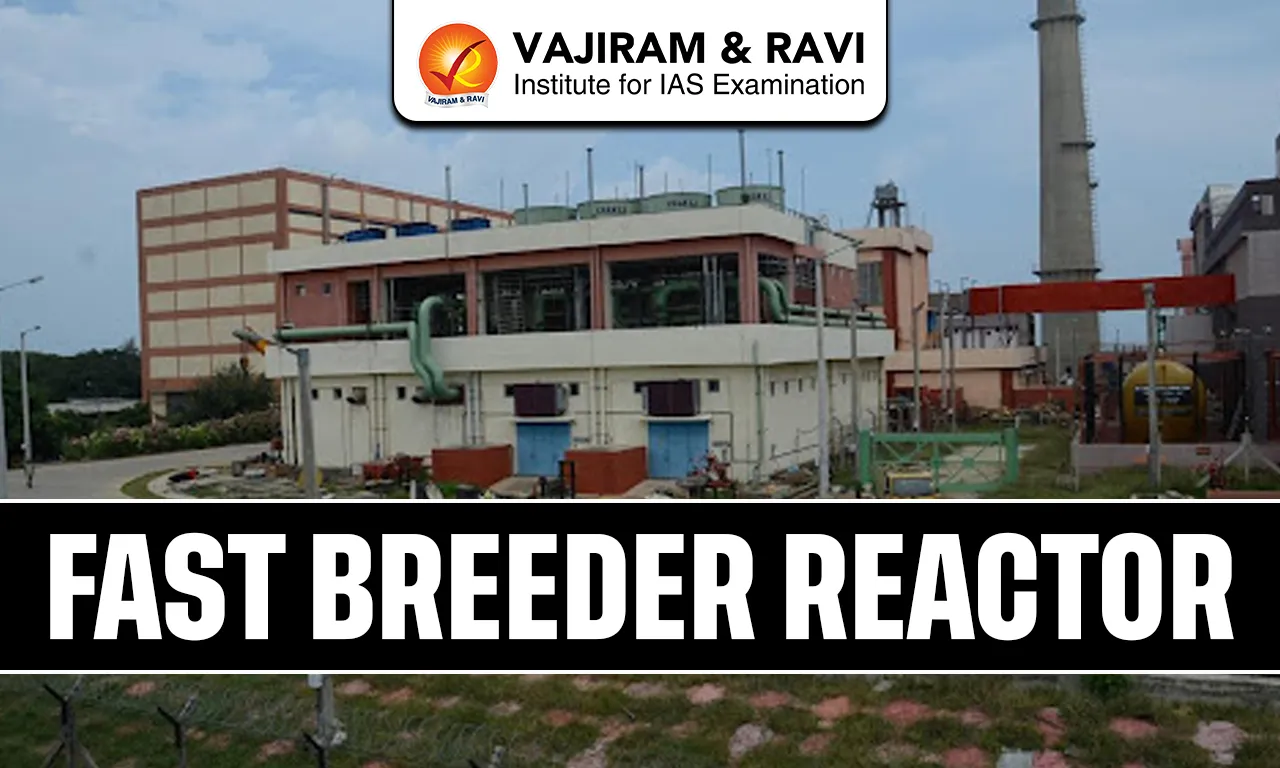
  • India’s Prototype Fast Breeder Reactor (PFBR) at Kalpakkam has achieved criticality, marking a key milestone in the nuclear programme. 

About Fast Breeder Reactor

  • A Fast Breeder Reactor (FBR) is a type of nuclear reactor that generates more fissile material than it consumes.
  • Unlike conventional reactors, which use thermal (slow) neutrons, FBRs use fast neutrons to sustain nuclear fission. This allows efficient utilisation of fuel and enhances energy output.
  • FBRs typically use plutonium-based fuel, often in the form of Mixed Oxide (MOX), along with fertile materials such as uranium-238. These fertile materials are converted into fissile material (like plutonium-239) during reactor operation.
  • A key feature of FBRs is the “breeding” process. In this process, non-fissile material is transformed into fissile material through neutron absorption, thereby creating additional fuel.
  • FBRs are crucial for countries like India that have limited uranium reserves but abundant thorium resources. 
  • They form the second stage of India’s three-stage nuclear programme, enabling the transition toward thorium-based energy systems.

Significance of Fast Breeder Reactors

  • Fast breeder reactors play a critical role in ensuring long-term energy security.
  • They significantly improve fuel efficiency by extracting more energy from available uranium resources.
  • They also reduce nuclear waste by utilising materials that would otherwise remain unused.
  • In India’s context, FBRs are essential for converting thorium into uranium-233, which is vital for the third stage of the nuclear programme. 

Criticality in Nuclear Reactors

  • Criticality refers to the state in which a nuclear reactor achieves a self-sustaining chain reaction.
  • At this stage, each fission event produces enough neutrons to sustain further fission reactions without external intervention.
  • Criticality is a crucial milestone in reactor commissioning. It indicates that the reactor core is functioning as designed and is ready to move toward power generation. 
  • There are three states associated with criticality:
    • Subcritical state, where the reaction dies out over time. 
    • Critical state, where the reaction is stable and self-sustaining. 
    • Supercritical state, where the reaction increases rapidly. 
  • Achieving controlled criticality is essential for the safe and efficient operation of nuclear reactors.

News Summary

  • India’s 500 MWe Prototype Fast Breeder Reactor (PFBR) at Kalpakkam in Tamil Nadu has attained criticality, marking a defining step in the country’s nuclear energy programme. 
  • The reactor is located at the Indira Gandhi Centre for Atomic Research and is operated by Bharatiya Nabhikiya Vidyut Nigam Limited (BHAVINI), a public sector enterprise under the Department of Atomic Energy. 
  • The PFBR is a sodium-cooled, pool-type fast breeder reactor that uses mixed oxide (MOX) fuel consisting of uranium-238 and plutonium-239. It is designed to generate more fissile material than it consumes, thereby enhancing fuel sustainability. 
  • Achieving criticality means that the reactor has initiated a self-sustaining nuclear fission chain reaction, indicating readiness for eventual power generation. 
  • The project is a key component of India’s three-stage nuclear programme
    • In the first stage, Pressurised Heavy Water Reactors (PHWRs) produce plutonium. 
    • In the second stage, fast breeder reactors like PFBR use this plutonium to generate additional fissile material. 
    • The third stage aims to use thorium to produce uranium-233 for long-term energy security. 
  • India is now among a select group of countries possessing advanced fast breeder reactor technology, with Russia being the only other nation operating commercial-scale FBRs. 
  • The reactor also incorporates important safety features such as a negative void coefficient, which reduces reaction rates in case of overheating, enhancing operational safety. 
  • Overall, the achievement of criticality at Kalpakkam marks a significant step toward India’s goal of developing a closed nuclear fuel cycle and reducing dependence on imported uranium.

Source: TH | IE

Fast Breeder Reactor FAQs

Q1: What is a Fast Breeder Reactor?

Ans: It is a nuclear reactor that produces more fissile material than it consumes.

Q2: What does criticality mean in nuclear terms?

Ans: It refers to a self-sustaining nuclear chain reaction within the reactor core.

Q3: Where is India’s PFBR located?

Ans: It is located at Kalpakkam in Tamil Nadu.

Q4: What fuel is used in the PFBR?

Ans: It uses mixed oxide (MOX) fuel comprising uranium and plutonium.

Q5: Why are FBRs important for India?

Ans: They enable efficient fuel use and support the transition to thorium-based nuclear energy.

Enquire Now

