Bauxite Distribution Latest News
- Clashes in Odisha over a proposed bauxite mining project have brought attention to resource distribution and tribal rights.
Bauxite Distribution in the World
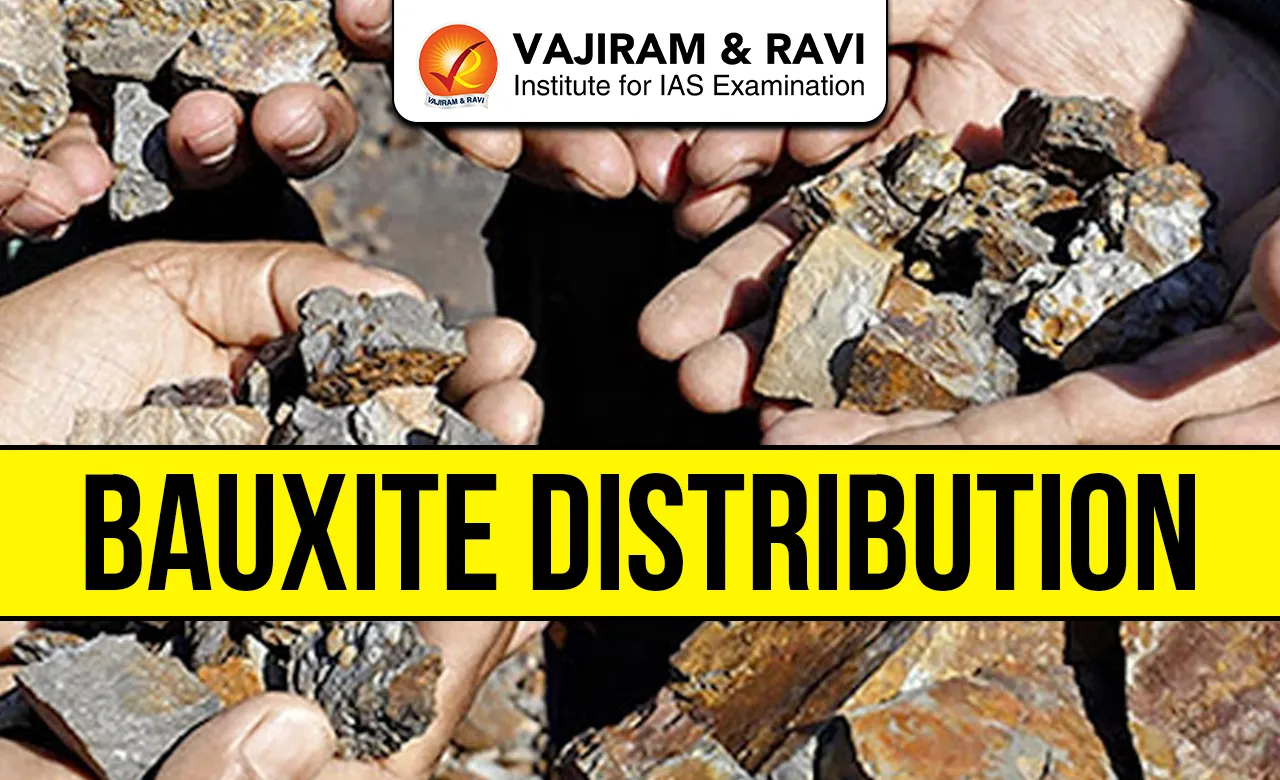
- Bauxite is the primary ore of aluminium and is widely distributed across tropical and subtropical regions.
- Globally, major bauxite reserves are concentrated in:
- Australia: The largest producer and exporter, with high-quality reserves.
- Guinea (West Africa): Holds some of the world’s largest reserves.
- Brazil: Significant producer with large deposits in the Amazon basin.
- China: Major producer, though with relatively lower-grade reserves.
- Indonesia and Jamaica: Important contributors to global supply.
- The distribution is influenced by climatic conditions, as bauxite forms through intense weathering of rocks in hot and humid environments.
Bauxite Distribution in India
- India is among the top producers of bauxite globally, with deposits mainly located in plateau and hill regions. Key features of distribution include:
- Odisha: The largest producer and holder of reserves, accounting for a major share of India’s total resources.
- Andhra Pradesh and Gujarat: Significant reserves and production centres.
- Jharkhand, Maharashtra, and Chhattisgarh: Important secondary producers.
- Bauxite deposits in India are largely found in the Eastern Ghats, Western Ghats, and the central plateau regions.
- The ore is crucial for aluminium production, which is widely used in transportation, construction, packaging, and electrical industries due to its lightweight and conductive properties.
Significance of Bauxite
- Bauxite plays a strategic role in industrial and economic development.
- It is the raw material for aluminium production.
- Aluminium is essential for infrastructure, aviation, electronics, and renewable energy sectors.
- It contributes to export earnings and industrial growth.
- However, mining activities often lead to environmental degradation and social conflicts, especially in tribal regions.
News Summary
- Clashes occurred between tribal villagers and police in Odisha’s Rayagada district over a bauxite mining project, leaving several injured.
- The conflict centres around the construction of a 3 km approach road to the Sijimali bauxite mine, which has been allotted to Vedanta Limited.
- Villagers alleged that police conducted raids and used force to suppress protests, while authorities stated that action was taken to maintain law and order.
- The tribals have opposed the project due to concerns over displacement, loss of livelihoods, and lack of proper consultation. They claim that Gram Sabha approvals were obtained fraudulently, whereas the administration maintains that due process under the Forest Rights Act was followed.
- The project has received Stage-1 forest clearance from the central government, which is a conditional approval requiring compliance with environmental safeguards such as compensatory afforestation.
- The Sijimali region in the Eastern Ghats contains an estimated 311 million tonnes of high-grade bauxite spread over 1,500 hectares across Rayagada and Kalahandi districts.
- The site is strategically located near Vedanta’s Lanjigarh alumina refinery, which has a production capacity of 5 million tonnes per annum.
Odisha’s Role in Bauxite Production
- The report highlights Odisha’s importance in India’s bauxite sector. According to the Indian Bureau of Mines (2022), Odisha accounts for 41% of India’s bauxite resources and about 73% of production in 2021-22.
- Bauxite is refined into alumina, which is then used to produce aluminium. Aluminium is widely used due to its strength, light weight, and conductivity, making it essential for industries ranging from packaging to aerospace.
- The current protests are not unprecedented. The earlier Niyamgiri mining project faced strong opposition from the Dongria Kondh tribal community, leading to the rejection of mining proposals after Gram Sabha consultations and a Supreme Court judgment in 2013.
Issues and Challenges
- The Odisha conflict reflects broader challenges in resource governance.
- Tribal Rights vs Development: Balancing economic development with indigenous rights remains difficult.
- Environmental Concerns: Mining in ecologically sensitive areas threatens biodiversity.
- Governance Gaps: Allegations of improper consultation weaken trust in institutions.
- Legal Framework: Implementation of the Forest Rights Act and environmental laws remains contested.
Source: IE
Bauxite Distribution FAQs
Q1: Which country has the largest bauxite reserves?
Ans: Guinea has the largest bauxite reserves globally.
Q2: Which state leads bauxite production in India?
Ans: Odisha is the leading producer of bauxite in India.
Q3: What is bauxite used for?
Ans: Bauxite is used to produce alumina and aluminium.
Q4: Why are tribals opposing bauxite mining in Odisha?
Ans: They fear displacement, livelihood loss, and environmental damage.
Q5: What was the Niyamgiri case about?
Ans: It involved the rejection of a bauxite mining project after Gram Sabha opposition and a Supreme Court ruling.