COP33 Latest News
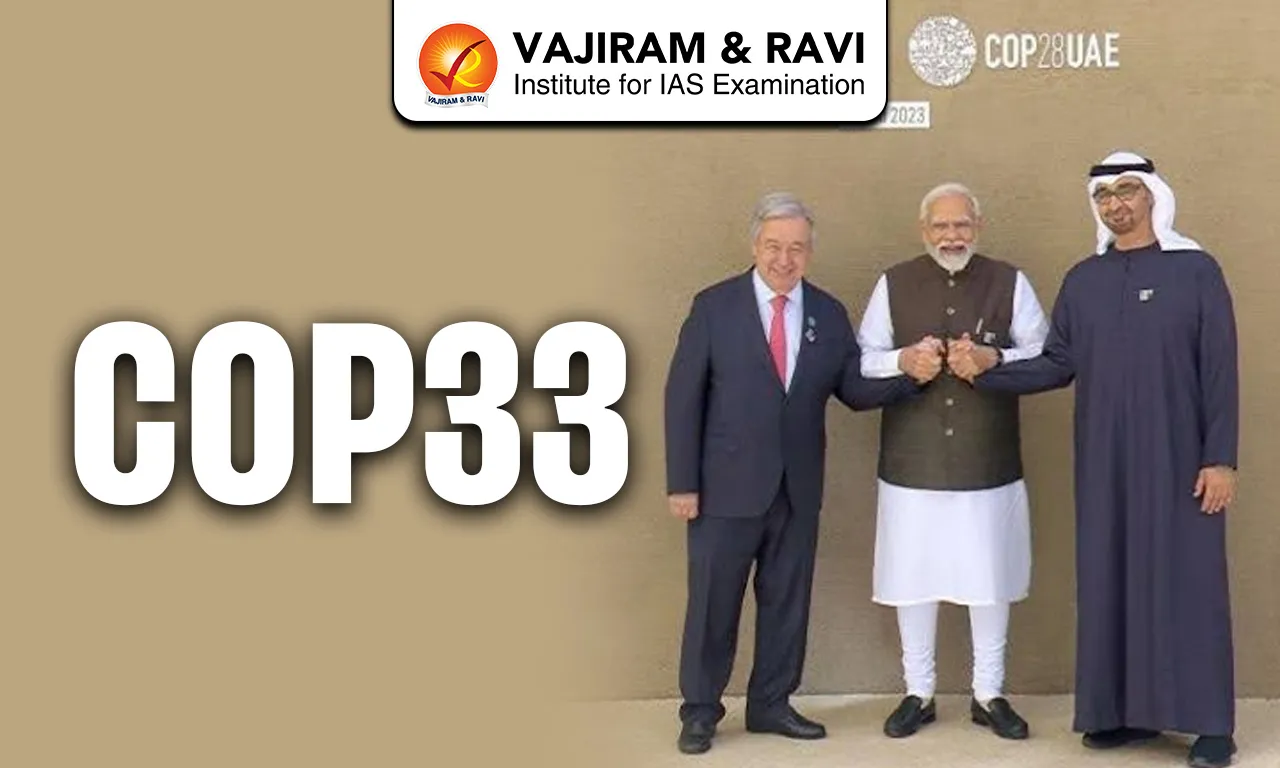
- India had offered to host the 2028 COP climate meeting during COP28 (December 2023) in Dubai, signalling its intent to take a leadership role in global climate governance, especially after the successful G20 summit.
- However, changing global and domestic circumstances led to a reassessment. India realised that hosting the summit would require it to advocate positions that might conflict with its evolving climate stance and national interests.
- Consequently, India has decided not to pursue hosting COP33 in 2028.
India’s Evolving Climate Stance: Prioritising National Interest
- Context of Policy Shift - India’s decision to reconsider hosting a future climate summit reflects a broader shift in its climate positioning, shaped by changing global negotiations and a reassessment of national priorities.
- Concerns with the Global Climate Framework - India has increasingly argued that the Paris Agreement remains skewed against developing countries, especially those like India that require greater carbon space for economic growth.
- Development-First Approach - India has moved towards a development-first strategy, emphasising that economic growth and improved living standards are essential for building long-term resilience against climate change.
- Questioning Temperature Targets and Mitigation Focus - India has challenged the focus on fixed temperature targets (1.5°C/2°C) and the mitigation-centric approach, arguing that adaptation needs equal or greater priority for developing nations.
- Divergence from Global Climate Narrative - This stance contrasts with the dominant global view that prioritises climate action above all else. India instead advocates a balanced approach, similar to development-led models followed by countries like China.
- Assertive Position on Climate Finance - India has taken a strong stand on climate finance, pushing for the implementation of Article 9.1 of the Paris Agreement, which obligates developed nations to provide financial resources to developing countries.
- Resistance to Fossil Fuel Transition Pressures - India’s position has also hardened on proposals for an early transition away from fossil fuels, resisting pressure from developed countries and emphasising its developmental needs.
- Increasingly Vocal Climate Diplomacy - In recent years, India has become more assertive and vocal in global climate negotiations, reflecting its recalibrated priorities and willingness to challenge prevailing international frameworks.
Global Climate Leadership vs National Interest: India’s COP33 Dilemma
- Conflict Between Leadership Role and National Position - India’s evolving climate stance made it difficult to lead COP33, as the host is expected to champion the Paris Agreement, whereas India has been questioning key aspects of the framework.
- Pressure to Deliver Higher Climate Ambition - COP33 would include the second Global Stocktake (GST), requiring stronger global commitments on emission cuts. As host, India would have been responsible for pushing ambitious outcomes despite its own reservations.
- Increased Scrutiny on India’s Policies - Hosting COP33 would have placed India under greater international scrutiny, especially as the third-largest emitter, potentially pressuring it to align with global expectations over domestic priorities.
- Limited Impact Without Global Consensus - With the United States stepping away from the Paris Agreement, India recognised that increased ambition by other countries alone may not significantly impact the climate crisis, reducing the effectiveness of leadership efforts.
- Deepening Global Divisions - Post-COP29, trust between developed and developing countries has declined, making consensus-building increasingly difficult. This challenge was evident at COP30 and would have been even more complex during a GST year.
- Strategic Decision to Avoid Role Conflict - Given these challenges, India chose not to pursue hosting COP33, avoiding a situation where it would have to prioritise global climate expectations over national interests.
IPCC AR7 and India’s Strategic Calculus on COP33
- AR7 Timeline and Link to Global Stocktake - The seventh assessment report (AR7) of the IPCC, expected in 2029, may be advanced to 2028 to inform the Global Stocktake, increasing its relevance for COP33 negotiations.
- Likely Findings and Implications - AR7 is expected to present a worsening climate scenario, with rising temperatures and insufficient global action, potentially triggering renewed pressure on countries to enhance climate commitments.
- India’s Opposition to Early Publication - India, along with countries like China, has opposed early release, citing limited capacity of developing nations to adequately review the report and concerns over imbalanced scientific representation.
- Concerns Over Increased Pressure - India’s resistance is also driven by fears that an early AR7 would intensify pressure on developing countries to raise climate ambition, constraining their policy flexibility.
- Host Nation Constraints at COP33 - As host of COP33, India would have been expected to support early publication and stronger climate action, making it difficult to oppose measures that conflict with its national interests.
- Preserving Policy Space and Energy Security - India aims to avoid binding international commitments under pressure, especially amid geopolitical uncertainties affecting energy security and supply chains.
- Balancing Leadership and Strategic Interests - Although stepping back may appear as a loss of leadership opportunity and a setback to Global South advocacy, India prioritised avoiding being cornered on critical climate issues.
- Decision to Opt Out - Weighing these challenges, India chose not to host COP33, opting to safeguard its strategic and developmental priorities over the demands of global climate leadership.
Source: IE
COP33 FAQs
Q1: Why did India refuse to host COP33?
Ans: India climate decision was driven by concerns that hosting COP33 would force India climate policy to prioritise global commitments over national development and energy security interests.
Q2: How has India climate policy evolved recently?
Ans: India climate policy now emphasises development-first strategy, adaptation focus, and equitable climate responsibility, challenging the mitigation-centric approach of global climate frameworks.
Q3: What role does the IPCC AR7 report play?
Ans: India climate concerns include early IPCC AR7 publication, which could increase pressure on developing countries to raise climate ambition and limit policy flexibility.
Q4: What is the Global Stocktake (GST)?
Ans: India climate negotiations include GST, a periodic review of global progress under the Paris Agreement, requiring countries to enhance commitments and accelerate emission reductions.
Q5: What challenges would India face as COP33 host?
Ans: India climate leadership at COP33 would involve balancing national interest with global expectations, managing geopolitical divisions, and pushing consensus on ambitious climate targets.