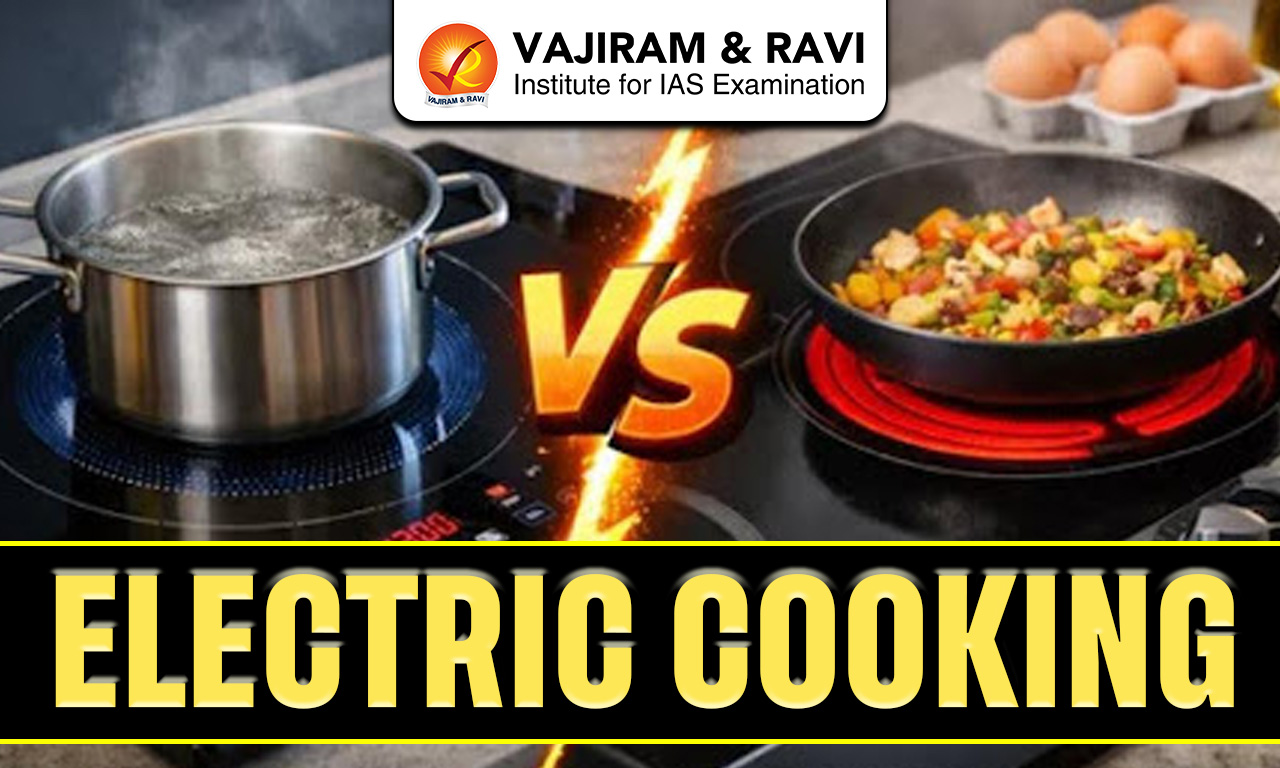
Electric Cooking in India: Electric Cooking Impact on Power Grid Explained

Electric Cooking

Electric cooking Latest News

  • The recent West Asia conflict and resulting fuel disruptions have highlighted India’s vulnerability as an import-dependent energy economy, leading to LPG shortages and rising prices. 
  • This has triggered a shift in households toward electric cooking options like induction and infrared cooktops, with sales surging significantly. The government is also exploring measures to boost production of such appliances. 
  • While this transition may reduce reliance on LPG, it is likely to increase electricity demand, potentially adding strain to an already stressed power grid during peak periods.

Induction Cooktops as an Alternative to LPG

  • A basic induction cooktop costs around ₹3,000–4,000, comparable to the price of an LPG cylinder in the black market.
  • This makes it an affordable entry point for households considering a shift to electric cooking.

Working Mechanism

  • Induction cooktops do not use an open flame. 
  • They generate a rapidly changing electromagnetic field, which heats the vessel directly. 
  • Heat is produced through electrical resistance, converting energy into thermal heat efficiently. 
  • Direct heating of the vessel ensures higher energy efficiency. Absence of flame makes induction cooktops safer and cleaner compared to gas stoves.

Compatibility Constraints

  • Induction cooktops require ferromagnetic cookware such as cast iron or magnetic stainless steel. 
  • Not all traditional utensils are compatible due to differences in electrical resistance.
  • Induction-compatible cookware is generally more expensive, making it less attractive for households planning only a temporary or partial transition from LPG.

Infrared Cooktops: Working Mechanism and Rising Adoption

  • Infrared cooktops are gaining popularity despite higher costs due to their versatility and compatibility with all types of cookware.

How Infrared Cooktops Work

  • Electricity heats a coil or halogen element beneath a ceramic glass surface. 
  • The element becomes red-hot, similar to a toaster coil. 
  • It emits infrared radiation, an invisible form of electromagnetic energy.
  • Infrared radiation passes through the glass surface and is absorbed by the cookware. 
  • This causes molecules in the vessel to vibrate and generate heat, cooking the food. 

Growing Market Demand

  • Unlike induction, infrared cooktops work with steel, aluminium, glass, and ceramic vessels. This eliminates the need for specialised cookware.
  • Demand has surged significantly, with sales increasing nearly fourfold on platforms like Amazon India.
  • The ease of use and flexibility are key factors behind this trend.

Challenges of Infrared Cooktops

  • Lower Energy Efficiency - Infrared cooktops operate at 70–80% efficiency, compared to 85–95% for induction cooktops. Heat is generated in stages—coil → glass → vessel—leading to greater energy loss.
  • Higher Electricity Consumption - Due to indirect heating, infrared cooktops consume more electricity than induction cooktops for the same cooking task.
  • Heat Control Limitations - Induction cooktops use advanced power electronics (like pulse-width modulation) to maintain efficiency even at low heat. Infrared cooktops rely on phase-angle control, switching the coil on and off to regulate heat.
  • Power Quality Issues - Phase-angle control distorts the electrical waveform and reduces the power factor. This causes extra current flow that does not contribute to useful heating, leading to inefficiencies.
  • Impact on Power Grid - Widespread use of infrared cooktops can increase losses in the distribution system. It may place additional stress on local electricity infrastructure, especially in high-demand areas.

Electric Cooking and Stress on Power Grid Infrastructure

  • Peak-Time Demand Pressure - Electric cooking demand is concentrated during morning and evening hours. Even a 3–5 GW increase during these periods can significantly strain local distribution networks. 
  • Localised Load Challenges - The impact is often highly localised, with clusters of households or businesses shifting to electric cooking. This can overload distribution transformers, causing outages and infrastructure stress.
  • Infrastructure Limitations - Existing grid infrastructure in many areas is not designed for sudden demand spikes. Managing these sharp increases poses a major operational challenge for utilities. 
  • Long-Term Demand Implications - A sustained shift away from LPG to electric cooking could lead to a persistent rise in electricity demand. This would require significant upgrades in infrastructure and power supply capacity.
  • Seasonal and Supply Pressures - With expectations of a hotter-than-normal summer, electricity demand is already rising. The government may rely more on coal-based power and emergency measures to meet peak demand.

Source: IE

Electric cooking FAQs

Q1: Why is electric cooking increasing in India?

Ans: Electric cooking is rising due to LPG shortages, high prices, and fuel insecurity, pushing households toward induction and infrared cooktops as affordable and accessible alternatives.

Q2: How do induction cooktops work in electric cooking?

Ans: Electric cooking with induction cooktops uses electromagnetic fields to heat vessels directly, ensuring higher efficiency, faster cooking, and improved safety compared to traditional LPG-based cooking methods.

Q3: How are infrared cooktops different in electric cooking?

Ans: Electric cooking with infrared cooktops uses radiant heat from heated coils, allowing compatibility with all cookware but resulting in lower efficiency and higher electricity consumption.

Q4: What challenges does electric cooking pose to the power grid?

Ans: Electric cooking increases peak-time demand, causing localised load spikes, transformer stress, and infrastructure strain, especially during morning and evening hours when cooking demand is highest.

Q5: What is the long-term impact of electric cooking in India?

Ans: Electric cooking may reduce LPG dependence but will require major grid upgrades, improved infrastructure, and efficient demand management to handle sustained increases in electricity consumption.

Iran US Talks Collapse: Why Iran US Talks Failed in Islamabad

Iran US talks

Iran US talks Latest News

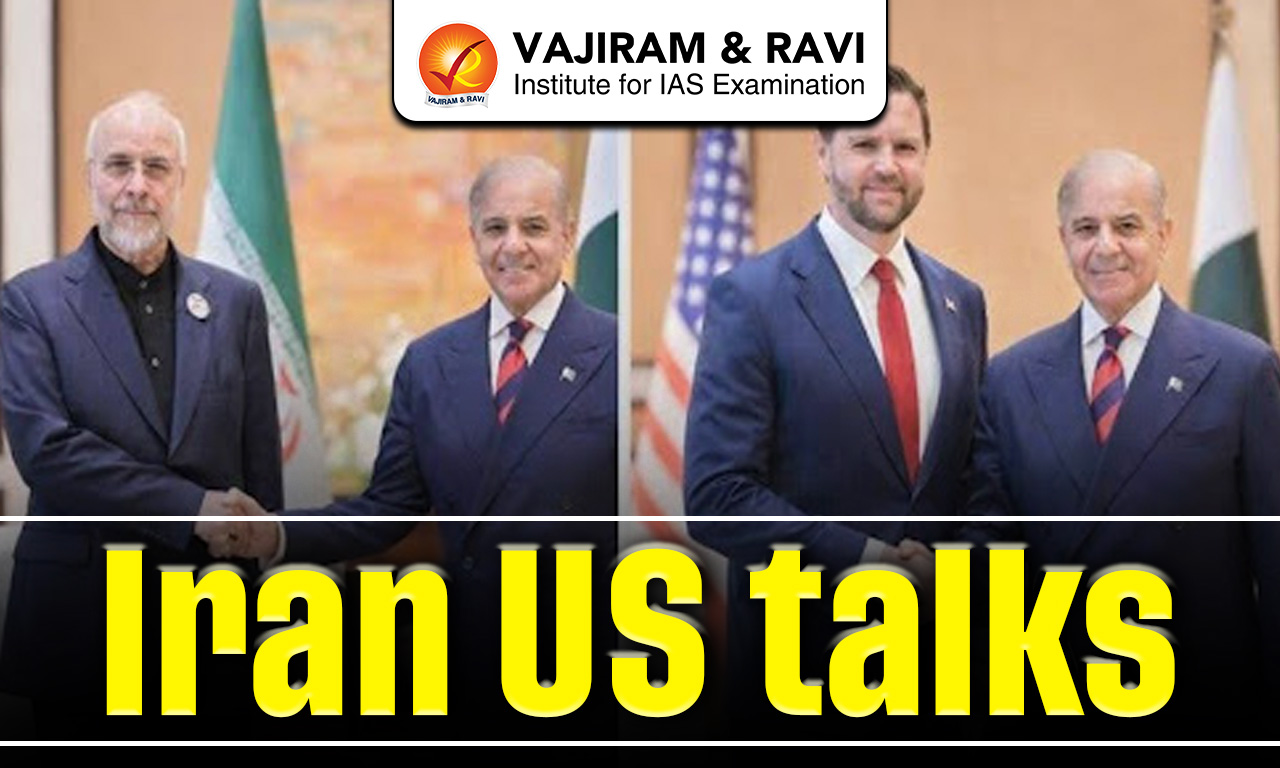
  • High-stakes negotiations between the United States and Iran aimed at securing a ceasefire and a broader diplomatic framework collapsed after nearly 21 hours of intense discussions in Islamabad. 
  • The talks, mediated by Pakistan, ended without an agreement, with US Vice President JD Vance confirming that American negotiators returned home empty-handed.
  • Despite the failure, the meeting itself was historically significant — marking the first high-level political contact between the US and Iran since the 1979 Islamic Revolution.

Core Issues That Led to the Breakdown

  • The Nuclear Question — The Central Sticking Point
    • The US demand for an unambiguous commitment from Iran to not pursue nuclear weapons — or the tools that would enable rapid acquisition of nuclear capability — remained the fundamental obstacle. 
    • Tehran insists that uranium enrichment is its sovereign right as a signatory of the Nuclear Non-Proliferation Treaty (NPT), which commits it to never building a nuclear weapon but does not prohibit civilian enrichment.
    • Before the war began, Iran had offered to suspend nuclear operations for a few years — but refused to surrender its stockpile of 440+ kg of highly enriched uranium or permanently give up enrichment capability.
    • The war has only hardened Iran's position.
  • Strait of Hormuz
    • The US has demanded that Iran immediately reopen the Strait of Hormuz to all international maritime traffic. 
    • Iran, after 39 days of conflict, has come to recognise that the Strait — through which one-fifth of the world's energy supply passes — is its single greatest strategic leverage, far more powerful than drones, missiles, or nuclear stockpiles.
    • It is deeply reluctant to surrender this leverage without substantial concessions in return.
  • Mutual Distrust
    • Iran's foreign ministry combined resolve with deep scepticism, stating that Iran has "not forgotten and will not forget the experiences of America's breaches of promise." 
    • This underlying trust deficit complicated even procedural progress.
  • Iran's Frozen Assets and Reparations
    • Iran has demanded the release of approximately $27 billion in frozen revenues held in Iraq, Luxembourg, Bahrain, Japan, Qatar, Turkey, and Germany for post-war reconstruction. 
    • Additionally, Tehran has sought war reparations for damage caused by six weeks of airstrikes. 
    • The Americans have refused both demands. This has been Iran's consistent position even from the pre-war negotiating period.

Positions of Each Side

  • United States
    • Immediate priority: Preventing Iran from acquiring nuclear weapons capability.
    • Unwilling to move forward without an affirmative Iranian commitment on the nuclear question.
    • Characterised the failure as "bad news for Iran more than for the USA."
  • Iran
    • Insists on recognition of its legitimate rights, including uranium enrichment.
    • Demands sanctions relief, war reparations, and a complete cessation of hostilities in the region.
    • Accuses the US of maximalist and unlawful demands.
    • Views diplomacy as a tool to secure national interests — alongside all other available means.

The Deadlock — and the Silver Lining

  • Despite the collapse, neither side has walked away entirely. 
  • Vance left the door ajar, indicating that the US proposal remains "a final and best offer" for Iran to consider. 
  • The fact that Iran's maximalist 10-point plan has been whittled down to three core sticking (Strait of Hormuz; Nuclear and Issue of Frozen Assets) points itself suggests some underlying progress. 
  • Iran has indicated it will consult with the IRGC, clergy, and the Supreme Leader before any further movement. 
  • Both sides retain a two-week ceasefire window to negotiate, and the willingness to talk — even without agreement — signals that diplomacy is still alive.

Pakistan's Mediating Role

  • Pakistan elevated its diplomatic profile significantly by hosting the talks. 
  • However, the lack of a breakthrough — and the apparent disconnect between the two sides — has raised questions about Pakistan's effectiveness as a message carrier, given that Vance and Iranian negotiators appeared to be working from fundamentally different frameworks.

Impact on India

  • India has been watching the negotiations with acute concern, given the severe economic impact of the conflict on its domestic economy. 
  • Key pressure points include gas shortages affecting LPG supply, potential petrol price hikes, disruption to sectors ranging from ceramics, plastics, and textiles to fertilisers, helium, agriculture, healthcare, and semiconductors. 
  • India has navigated the diplomatic space carefully — maintaining continuous engagement with Iran over six weeks and expressing concern over Israeli strikes on Lebanon without naming Israel. 
  • India has managed to secure passage for about eight to nine vessels through the Strait of Hormuz, highlighting just how dependent India is on the free flow of energy through this critical chokepoint.

Source: ToI | IE

Iran US talks FAQs

Q1: Why did Iran US talks collapse?

Ans: Iran US talks collapsed due to disagreements over nuclear programme limits, reopening the Strait of Hormuz, and Iran’s demand for release of frozen assets and reparations.

Q2: What was the main issue in Iran US talks?

Ans: Iran US talks were primarily stalled by the nuclear issue, with the US demanding termination and Iran insisting on its sovereign right to enrich uranium.

Q3: What role did the Strait of Hormuz play in Iran US talks?

Ans: Iran US talks faced deadlock over the Strait of Hormuz, as the US demanded reopening while Iran viewed it as a key strategic leverage.

Q4: What was Pakistan’s role in Iran US talks?

Ans: Iran US talks were hosted and mediated by Pakistan, which elevated its diplomatic profile but faced criticism due to the failure to achieve a breakthrough.

Q5: How do Iran US talks affect India?

Ans: Iran US talks impact India through energy supply disruptions, LPG shortages, rising fuel prices, and broader economic effects across industries dependent on stable oil and gas flows.

Balancing Forest Rights and Conservation – FRA vs Forest Conservation Act Debate

Forest Rights and Conservation

Forest Rights and Conservation Latest News

  • A legal dispute before the Supreme Court of India (SC) has brought into focus the tension between tribal housing rights and forest conservation laws. 
  • The case concerns construction of houses under the Pradhan Mantri Awas Yojana–Gramin (PMAY-G) on forest land for the Sahariya tribe in Shivpuri, Madhya Pradesh (MP).
  • This has raised critical questions about the interpretation of the Forest Rights Act (FRA), 2006 and the Forest (Conservation) Act, 1980.

Legal and Policy Framework

  • Forest Rights Act (FRA), 2006:
    • It recognises individual and community forest rights of Scheduled Tribes (ST) and forest dwellers.
    • It empowers Gram Sabhas as the primary authority for claims verification.
    • It also imposes duties on rights holders to conserve forests, biodiversity, and wildlife.
  • Forest (Conservation) Act, 1980: The law regulates diversion of forest land for non-forest purposes, and requires prior approval from the Centre for such activities.
  • Government’s stand:
    • The Centre argues that once forest rights are recognised under FRA, prior approval under the Forest Conservation Act is not required.
    • This emphasises harmonious interpretation of both laws to ensure social justice and ecological protection.

FRA Implementation

  • According to the Ministry of Tribal Affairs (monthly progress report for the period ending February 28, 2026), over 54 lakh claims have been filed under FRA across states, of which over 25.38 lakh titles have been distributed. 
  • Around 80.56% of all claims have been disposed of, while 18.12 lakh claims have been rejected.
  • This indicates -
    • Large-scale implementation.
    • Significant rejection rate raising concerns over procedural gaps and exclusion.

Key Issue Before the Court

  • Whether construction of houses under PMAY-G on forest land violates forest conservation norms.
  • Whether recognition of rights under FRA overrides procedural requirements under the Forest Conservation Act.
  • The apex court will also examine the National Green Tribunal’s (NGT) order, which held the PMAY-G constructions as violative of the Forest Conservation Act.
    • A contempt petition was filed alleging non-compliance with NGT orders.
    • The Supreme Court sought clarity on regulatory safeguards and convergence of both laws.

Safeguards under FRA

  • Multi-tier verification process: Three-tier system - Gram Sabha, Sub-divisional committee, and District-level committee, ensures checks and balances.
  • Role of Gram Sabha: Initiates and verifies claims. Requires 50% quorum for proceedings. Decisions based on deliberation and voting - ensures transparency.
  • Evidence-based claim process: Mandatory documentary and oral evidence - prevents fraudulent claims.
  • On-site physical verification: Conducted by forest and revenue officials, and mandated under Rule 12A(1) of the Act.
  • Oversight by forest department: Participation in verification, approval/rejection, and monitoring committees, ensures institutional accountability.
  • Non-transferability of land titles: Prevents commercialisation and misuse of forest land.
  • Duties of rights holders: Protect forests, wildlife, biodiversity, preventing ecological degradation.

Ground-Level Conflict - Binega Village Case

  • 63 families of the Sahariya tribe granted housing under PMAY-G.
  • Dispute over whether land is -
    • Individual forest land (eligible under FRA), or
    • Community Forest Resource (CFR) land (restricted use).
  • Allegations of encroachment and misuse, including by non-tribal actors.

Key Challenges

  • Legal ambiguity: Conflict between individual rights (FRA) and collective ecological safeguards (FCA).
  • Implementation deficits: Variations across states in claim verification and approval. Risks of erroneous recognition or rejection.
  • Environmental concerns: Potential fragmentation of forest ecosystems. Weak monitoring post-recognition of rights.
  • Institutional overlap: Multiple authorities result in coordination challenges. There are also Centre vs State jurisdiction issues.
  • Misuse and encroachment: Allegations of non-tribal encroachment on CFR lands. Weak enforcement against violations.

Way Forward

  • Harmonised legal framework: Clear judicial guidelines on FRA–FCA convergence. Codify principles of “development with conservation”.
  • Strengthening Gram Sabhas: Capacity building for evidence-based decision-making, ensuring genuine community participation.
  • Robust monitoring mechanisms: Use of GIS mapping and satellite imagery. Periodic audits of forest land use.
  • Safeguarding community forest resources: Clear demarcation of CFR vs individual rights land, preventing elite capture and misuse.
  • Inter-departmental coordination: Better synergy between the Tribal Affairs Ministry, Environment Ministry, and the State governments.

Conclusion

  • The ongoing case underscores a fundamental governance dilemma—how to reconcile tribal welfare with ecological sustainability. 
  • The Forest Rights Act represents a corrective justice framework for historically marginalised communities, while the Forest Conservation Act safeguards critical ecological assets. 
  • The solution lies not in prioritising one over the other, but in institutionalising a balanced, transparent, and accountable framework that ensures both livelihood security and environmental integrity.

Source: IE

Forest Rights and Conservation FAQs

Q1: What is the conflict between the FRA and the FCA?

Ans: The conflict arises from FRA enabling livelihood rights over forest land while the FCA prioritises regulatory approval to prevent ecological degradation.

Q2: What is the role of the Gram Sabha under the Forest Rights Act, 2006?

Ans: Gram Sabha acts as the primary authority for claim verification through quorum-based deliberation, etc.

Q3: How does the FRA incorporate safeguards against misuse of forest land?

Ans: FRA includes multi-tier verification, mandatory evidence, on-site inspection, etc.

Q4: What are the challenges in harmonising tribal welfare and environmental conservation in India?

Ans: Challenges include legal ambiguity, weak implementation, institutional overlap, and risks of ecological degradation.

Q5: What are the measures to improve convergence between forest rights recognition and conservation goals?

Ans: Clear legal guidelines, strengthened Gram Sabhas, technological monitoring, and better Centre-State coordination.

Death Penalty Jurisprudence in India – The Sriharan Vacuum Explained

Death Penalty

Death Penalty Latest News

  • A recent trial court judgment in the Sattankulam custodial death case has reignited debate on sentencing limitations under the Sriharan ruling

Death Penalty in India

  • The death penalty in India is governed by judicial principles evolved through constitutional interpretation.
  • The Supreme Court in the Bachan Singh v State of Punjab (1980) case laid down that capital punishment should be awarded only in the “rarest of rare” cases. 
  • This principle ensures that the death penalty is used sparingly and only when life imprisonment is considered inadequate.
  • Key features include:
    • The death penalty is constitutionally valid under Article 21
    • It is awarded only in exceptional cases involving extreme brutality. 
    • Courts must consider mitigating factors such as background, mental health, and the circumstances of the accused. 
  • Over time, the judiciary has attempted to balance deterrence with human rights concerns.

Intermediate Sentencing and the Sriharan Doctrine

  • The judiciary has developed an intermediate sentencing option to bridge the gap between life imprisonment and the death penalty.
  • In Swamy Shraddananda v State of Karnataka (2008), the Supreme Court introduced the concept of fixed-term life imprisonment without remission.
  • Later, in Union of India v V. Sriharan (2015), a Constitution Bench ruled that:
    • Only High Courts and the Supreme Court can impose such special sentences. 
    • Trial courts (Sessions Courts) cannot award life imprisonment beyond statutory remission limits. 
  • This created a structural limitation in sentencing powers at the trial level.

News Summary

  • The Madurai trial court sentenced nine policemen to death in the Sattankulam custodial death case involving the killing of a father and son in 2020. 
  • The judge invoked the “rarest of rare” doctrine, stating that life imprisonment was not an adequate punishment given the brutality of the crime. 
  • The trial court had only two options: life imprisonment or the death penalty. It could not impose a fixed-term sentence without remission, such as 20 or 30 years. 
  • This limitation arises from the Sriharan judgment, which restricts such intermediate sentencing powers to constitutional courts. 
  • The trial judge explicitly acknowledged this constraint. He noted that ordinary life imprisonment could allow the convicts to be released in about 14 years due to remission provisions under Section 433A of the Code of Criminal Procedure. 
  • The judge found this duration inadequate for the severity of the crime. However, since he could not impose a longer fixed-term sentence, he chose the death penalty. 
  • Legal experts describe this situation as the “Sriharan vacuum”, referring to the gap between a 14-year effective life sentence and capital punishment. 
  • The Supreme Court itself has acknowledged this gap. In cases like Kiran v State of Karnataka (2025), it noted that trial courts cannot bridge this sentencing gap. 
  • Higher courts frequently use the intermediate sentencing option. All commutations by the Supreme Court in 2025 resulted in life imprisonment without remission. 
  • Further, empirical studies show that trial courts often fail to adequately consider mitigating factors, despite Supreme Court guidelines in Manoj v State of Madhya Pradesh (2022). 
  • The Sattankulam case will now be reviewed by the Madras High Court, which has the authority to convert the death sentence into a fixed-term life sentence without remission. 

Issues in the Current Sentencing Framework

  • The Sriharan ruling has created structural and practical challenges.
    • Sentencing Gap: Trial courts face a binary choice between 14 years and death. 
    • Judicial Constraint: Inability to impose proportionate punishment at the trial stage. 
    • Inconsistency: Higher courts frequently use intermediate sentencing, creating disparity. 
    • Procedural Concerns: Lack of proper mitigation hearings affects fairness. 
  • These issues highlight the need for reform in sentencing jurisprudence.

Way Forward

  • A more coherent sentencing framework is required.
    • Extending powers of intermediate sentencing to trial courts. 
    • Strengthening compliance with mitigation guidelines. 
    • Ensuring uniformity through appellate review rather than restricting jurisdiction. 
    • Revisiting the post-Bachan Singh framework to reduce arbitrariness. 
  • Such reforms can ensure proportionality and fairness in criminal justice.

Source: TH

Death Penalty FAQs

Q1: What is the “rarest of rare” doctrine?

Ans: It allows the death penalty only in exceptional cases where life imprisonment is inadequate.

Q2: What is the Sriharan ruling?

Ans: It restricts the power to impose fixed-term life sentences without remission to higher courts.

Q3: What is the “Sriharan vacuum”?

Ans: It refers to the gap between 14-year life imprisonment and death penalty at the trial court level.

Q4: What is Section 433A of CrPC?

Ans: It mandates a minimum of 14 years of imprisonment for life convicts before remission.

Q5: Which court will review the Sattankulam case?

Ans: The Madras High Court will review the death sentence.

Enquire Now