
Biometric Verification in Mandis: Why Biometric Verification Triggered Haryana Farmers Protest

Biometric Verification in Mandis

Biometric Verification in Mandis Latest News

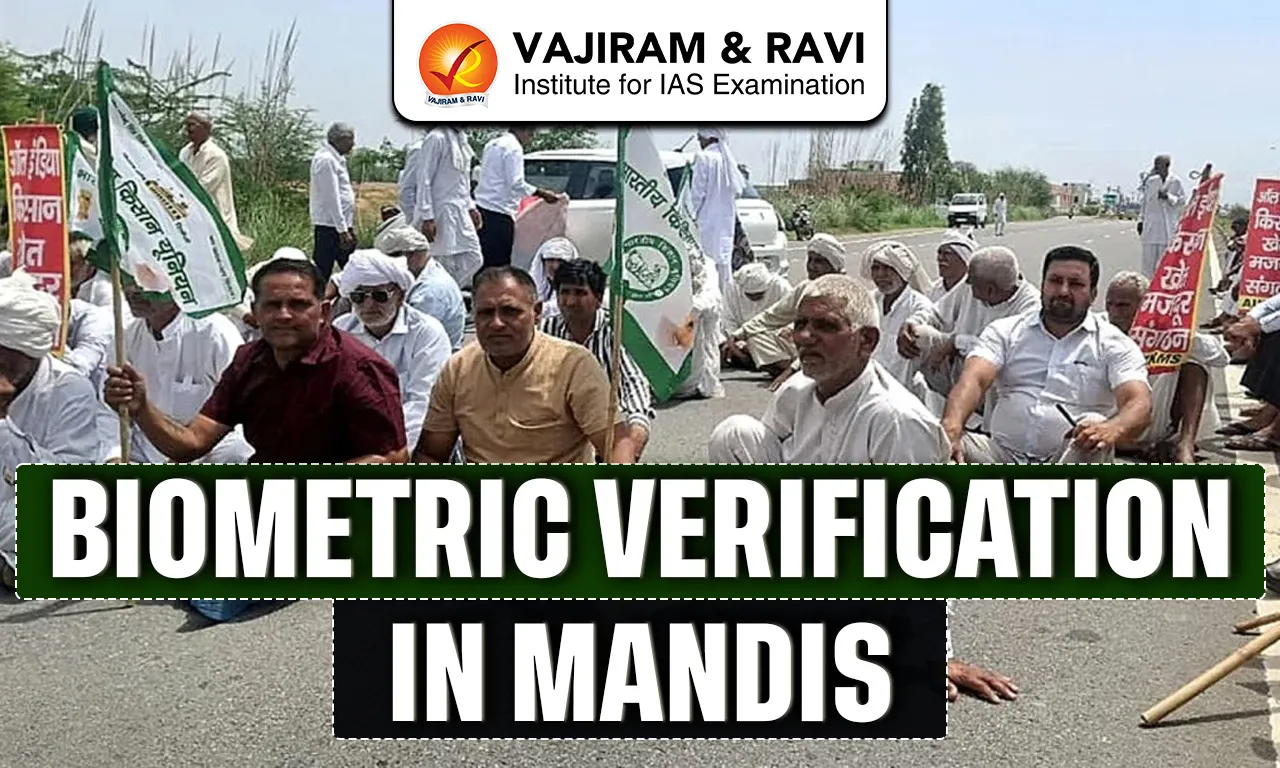
  • A section of farmers in Haryana protested against the mandatory biometric verification for selling crops in mandis, blocking highways and alleging it creates harassment and procedural hurdles.
  • The state government, however, defended the move as a step to enhance transparency and accountability in the procurement system.

Mandi System in India

  • The Mandi system is India's regulated agricultural marketplace framework where farmers bring their produce for sale through a structured auction process. 
  • These mandis (wholesale markets) are established under the Agricultural Produce Market Committee (APMC) Acts enacted by individual state governments
  • The APMC Act designates specific geographical areas as market yards, and all agricultural trade within that area must compulsorily pass through the regulated mandi. 
  • Middlemen called arhatiyas (commission agents) facilitate transactions between farmers and buyers, charging a commission on every sale.

Issues and Challenges 

  • Structural Problems
    • The mandi system has long been criticised for creating a monopoly of middlemen. 
    • The middlemen often advance loans to farmers, creating a cycle of debt bondage where farmers are compelled to sell exclusively through their creditor-agent regardless of price.
  • Fragmented Market and Multiple Levies
    • India's mandi system is highly fragmented — a trader operating across states must obtain separate licences in each state and pay multiple layers of taxes including market fees, commission charges, and various local levies. 
    • This fragmentation increases transaction costs and discourages private investment in agricultural marketing infrastructure.
  • Price Realisation Gap
    • Farmers typically receive only 30-40% of the final consumer price of their produce, with the remainder absorbed by the chain of intermediaries.
    • In the current setup, farmers are often price-takers rather than price-setters, leaving them vulnerable to exploitation especially during periods of surplus production.
  • Infrastructure Deficits
    • Many mandis suffer from inadequate storage, cold chain facilities, and processing infrastructure. 
    • Poor road connectivity to mandis, lack of weighing equipment, and absence of grading and sorting facilities result in significant post-harvest losses.
  • Information Asymmetry
    • Farmers — particularly small and marginal ones — lack access to real-time price information, making them heavily dependent on the arhatiya for price discovery.

Government Efforts at Reform and Integration

  • Electronic National Agriculture Market (e-NAM) - Launched in April 2016, e-NAM is an online trading portal that networks existing APMC mandis across the country into a unified national market.
  • Model APMC Act, 2003 - The central government circulated a Model APMC Act encouraging states to amend their legislations to allow direct purchase from farmers, establishment of private markets, and promotion of contract farming. 
    • However, adoption across states was uneven, with several states making only cosmetic changes.
  • Gramin Haats and Primary Agriculture Cooperative Societies (PACS) - The government has been upgrading 22,000 Gramin Haats (rural periodical markets) into Farmer-Consumer Markets to enable direct farm-to-consumer trade, bypassing intermediaries. 
    • Simultaneously, PACS are being strengthened to provide collective bargaining power to small farmers.

Haryana’s Biometric Procurement System in Mandis

  • Introduced in 2026, Haryana’s procurement system mandates Aadhaar-based fingerprint verification for farmers before selling crops in mandis, linked to the “Meri Fasal-Mera Byora” portal to ensure accurate registration and prevent discrepancies. 
  • The system also includes vehicle tracking, requiring tractor details and photos, and geofencing of procurement centres and storage points to enhance monitoring and prevent misuse. 
  • So far, hundreds of mandis and over a thousand storage locations have been brought under this digital oversight framework.

Reason Behind Biometric Verification in Haryana Mandis

  • The biometric verification system was introduced following the 2025 Karnal paddy scam, where fake gate passes were used to sell paddy from other states in Haryana mandis
  • This led to fraudulent procurement records and siphoning of government funds, involving officials, traders, and millers. 
  • The scam resulted in multiple FIRs and arrests, prompting the government to implement biometric verification to prevent such fraud and ensure transparency in procurement.

Farmers’ Concerns Over Biometric Verification

  • Farmers argue that procurement irregularities were due to collusion among officials and millers, not farmers themselves, yet the new system places the burden on them. 
  • They report long queues, slow verification, and procedural hassles, especially when the registered farmer cannot be physically present. 
  • Many see the process as excessive and humiliating, with union leaders calling it overly cumbersome and farmers feeling they are being treated with undue suspicion.

Government–Opposition Divide on Biometric Procurement

  • The Haryana government defends biometric verification as a tool to enhance transparency, accountability, and efficiency, noting significant adoption in wheat procurement. 
  • It has also introduced relaxations, such as allowing nominated individuals and flexible vehicle documentation.
  • However, opposition leaders criticise the system as bureaucratic and arbitrary, arguing it unfairly burdens farmers while ignoring the real issue of collusion among officials and traders.

Source: IE | DTE

Biometric Verification in Mandis FAQs

Q1: Why are farmers protesting biometric verification in mandis?

Ans: Farmers oppose biometric verification as it creates delays, long queues, and procedural hurdles, making crop sales difficult and increasing dependency on physical presence at mandis.

Q2: What is biometric verification in mandis?

Ans: Biometric verification in mandis requires Aadhaar-based fingerprint authentication before crop sales, linked to the Meri Fasal-Mera Byora portal to ensure transparency and prevent fraud.

Q3: Why was biometric verification in mandis introduced?

Ans: Biometric verification in madis was introduced after the 2025 Karnal paddy scam to prevent fake procurement, eliminate fraud, and improve accountability in mandi transactions.

Q4: What are the government’s arguments for biometric verification?

Ans: The government says biometric verification enhances transparency, prevents fraud, improves efficiency, and ensures accurate farmer identification in procurement systems.

Q5: What are the broader issues in the mandi system?

Ans: The mandi system faces issues like middlemen dominance, low price realisation, fragmented markets, and poor infrastructure, which affect farmers’ incomes and efficiency.

US Blockade on Iran: US Blockade Impact on Trade, Oil Prices, and Global Stability

US Blockade

US Blockade Latest News

  • The United States has initiated a blockade on all maritime traffic to and from Iranian ports following the failure of recent Iran–US negotiations in Islamabad. The move aims to restrict Iran’s trade, escalating tensions in the region. 
  • In response, Iran has warned that no ports in the Persian Gulf and Gulf of Oman would remain safe if the blockade proceeds. 
  • While the exact enforcement mechanism remains unclear, US Central Command stated that it will apply the blockade to vessels of all nations accessing Iranian ports, while allowing uninterrupted navigation through the Strait of Hormuz for non-Iranian destinations.

What a Blockade Means in International Conflict

  • A blockade is considered an act of war (International Armed Conflict), where a state prevents all vessels or aircraft—enemy and neutral—from accessing specified ports or coastal areas.
  • Typically, a blockade involves naval deployment of surface combat vessels. Ships are tasked to stop, inspect, and possibly seize vessels attempting to breach the blockade.

Types of Blockade

  • Close Blockade - Forces are positioned near enemy ports or coastlines. More effective but exposes blockading ships to enemy attacks.
  • Distant Blockade - Forces are deployed farther from the coast to reduce vulnerability. However, this increases the chances of ships evading the blockade.
  • For a blockade to be valid and successful, it must be “effective”, meaning it should genuinely restrict access to the enemy’s coastline.
  • This requires adequate naval strength and strategic deployment.

Legal Framework and Implications of a Naval Blockade

  • For a blockade to be lawful under international norms, it must meet specific criteria:
  • Formal Declaration
    • Must be officially declared by the belligerent state. 
    • Notification must be given to both enemy and neutral states, including commencement and termination details. 
  • Continuous and Impartial Enforcement
    • The blockade must be consistently maintained. 
    • It should be applied equally to all vessels, without discrimination. 
  • Lawful Military Objective
    • The blockade must serve a legitimate military purpose. 
    • It cannot aim to starve civilians or deny essential supplies. 
  • Effectiveness Requirement
    • It must be operationally effective, with sufficient force to restrict access. 
    • “Paper blockades” without real enforcement are considered illegal.

US Blockade Strategy: Recalibration After Failed Talks

  • The U.S. move towards a blockade appears to be a response to failed Iran–US talks and earlier decisions that allowed Iranian oil shipments, which inadvertently supported Tehran’s war financing.
  • Earlier easing of sanctions enabled Iran to export oil and generate revenue, including through tolls.
  • The blockade now reflects a policy recalibration aimed at cutting off Iran’s financial resources.
  • Basically, the U.S. blockade approach reflects a shift from economic pressure to strategic containment, but it carries high risks of escalation, given Iran’s strong leverage over critical maritime routes.

Impact of Blockade on India’s Trade

  • Export Concerns - India’s exports to Iran—worth about $1.1–1.2 billion (2025–26)—include foodgrains, pharmaceuticals, machinery, and chemicals. These sectors could face disruptions due to restricted maritime access. 
  • Import Dependence - Imports from Iran include petroleum bitumen, methanol, and construction materials like gypsum. Disruptions may affect energy-linked and infrastructure sectors.

Impact on Global Oil Markets

  • The blockade has already pushed oil prices upward.
  • If both Iranian and broader Gulf oil supplies are disrupted, global supply could tighten further.
  • Conversely, if non-Iranian oil flows resume, prices may stabilise.

US Blockade: Uncertainty in Enforcement and Impact

  • There is no clear mechanism on how the US will enforce the blockade.
  • Challenges include identifying vessels linked to Iran amid GPS spoofing and false port records.
  • Questions remain on whether the US will board ships or use force against merchant vessels. Enforcing a selective blockade while allowing other traffic is complex and difficult.

Risk of Regional Escalation

  • Iran may retaliate by targeting foreign vessels in the region.
  • The threat of Houthi attacks in the Red Sea adds another layer of instability.
  • Countries like China, which import Iranian oil, may respond strongly.
  • Shipowners and insurers may hesitate to operate amid conflicting US and Iranian directives.

Source: IE| IE | BBC

US Blockade FAQs

Q1: What is the US blockade on Iranian ports?

Ans: The US blockade restricts all maritime traffic to and from Iranian ports, aiming to cut Iran’s trade and limit its financial capacity during ongoing geopolitical tensions.

Q2: Why did the US impose the blockade?

Ans: The US blockade followed failed Iran-US talks and aims to stop Iran’s oil exports, which were indirectly supporting its war financing and economic resilience.

Q3: What are the legal conditions for a blockade?

Ans: A US blockade must be declared, effective, impartial, and serve a lawful military objective under international law to be considered legitimate.

Q4: How does the US blockade affect global oil markets?

Ans: The US blockade may reduce oil supply, increase prices, and disrupt global energy markets, especially if flows through the Strait of Hormuz are affected.

Q5: What is the impact of the US blockade on India?

Ans: The US blockade can disrupt India’s trade with Iran, affect energy supplies, increase costs, and create economic pressure due to rising oil prices and supply uncertainties.

India’s Growth Model and Rising Middle Class Vulnerability

India’s Growth Model

India’s Growth Model Latest News

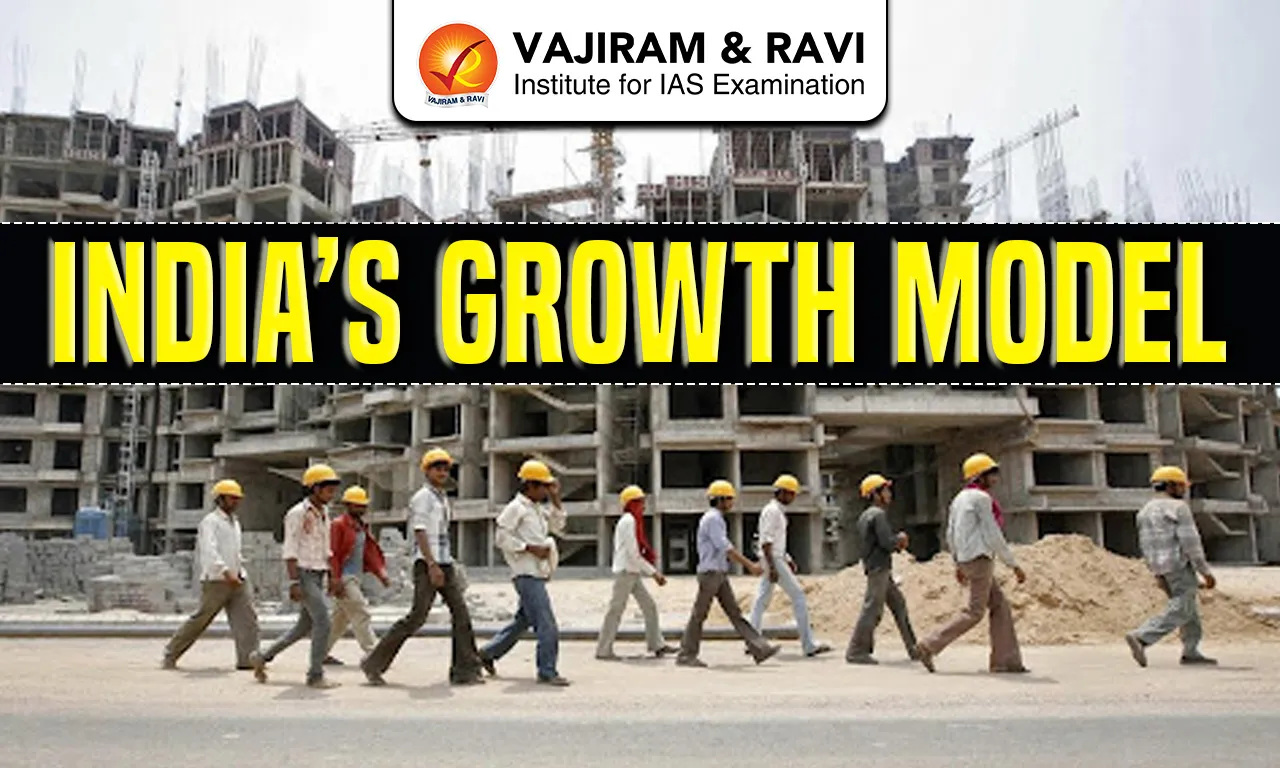
  • A recent analysis highlights structural weaknesses in India’s growth model and rising middle-class vulnerability. 

India’s Growth Model and Poverty Reduction

  • India’s economic growth over the last decade has been widely recognised for its success in reducing poverty.
  • The proportion of people living below the World Banks lower middle-income poverty line has declined significantly from over 50% a decade ago to nearly 30% in recent estimates. 
  • This reduction has been driven by a combination of economic growth and the expansion of welfare programmes. Key enabling factors include:
    • Improved delivery of welfare schemes such as subsidised food and direct benefit transfers. 
    • Expansion of financial inclusion through banking access. 
    • Strengthening of last-mile governance mechanisms. 
  • However, while poverty reduction is evident, it does not fully capture the broader picture of economic well-being.

Limits of Poverty-Based Measurement

  • Traditional poverty metrics rely on a threshold approach.
  • They classify individuals as either poor or non-poor based on whether their income crosses a fixed line. This method has two key limitations:
    • It does not capture the quality of life above the poverty line. 
    • It ignores income volatility and economic insecurity. 
  • A World Bank perspective suggests shifting towards a “well-being spectrum” approach. 
  • This approach evaluates how far individuals are from achieving a reasonable standard of living rather than simply whether they are above or below a threshold.

Rise of a Vulnerable Middle Class

  • India’s growth has led to a situation where many people have moved out of poverty but have not achieved economic stability.
  • This has resulted in the emergence of a “vulnerable middle class”.
  • These households are characterised by:
    • Low and uncertain incomes. 
    • Limited savings and high exposure to shocks. 
    • Restricted access to quality education and healthcare. 
  • Crossing the poverty line, therefore, often marks entry into vulnerability rather than stability. 

Structural Issues in Employment and Income

  • India’s growth model reveals a disconnect between output expansion and employment generation.
  • Growth has been concentrated in sectors that are capital-intensive or limited in labour absorption.
  • Key structural concerns include:
    • Less than 10% of workers are in formal employment with social security. 
    • Around 94% of informal workers earn below Rs. 10,000 per month. 
    • Real wages have remained largely stagnant despite productivity gains. 
  • This indicates that economic growth has not translated into stable income growth for the majority.

Sectoral Imbalances and Labour Shift

  • A major concern is the weak performance of the manufacturing sector.
  • Manufacturing has not expanded sufficiently to absorb the growing labour force. Between 2016 and 2021, the sector reportedly lost around 24 million jobs. 
  • As a result, many workers have moved back into agriculture.
    • Agriculture employs nearly 46% of the workforce. 
    • It contributes only about 18% of total output. 
  • This mismatch reflects low productivity and limited income growth.
  • The average farm household income remains modest, indicating persistent economic insecurity.

Inequality and Concentration of Wealth

  • While a large section of the population remains vulnerable, income and wealth concentration at the top have increased.
    • The top 1% accounts for over 22% of national income. 
    • A small group of billionaires holds a significant share of national wealth. 
  • This divergence highlights that growth benefits are unevenly distributed.
  • It also reinforces the idea that poverty reduction alone is not sufficient to ensure equitable development.

Indicators of Economic Fragility

  • Several indicators point towards growing economic fragility.
    • Youth unemployment is around 45%. 
    • Graduate unemployment is close to 29%. 
  • This suggests that education is not translating into employment opportunities.
    • Household financial stress is also increasing.
    • Financial savings have declined to around 5% of GDP. 
    • Household debt has risen, often driven by consumption needs. 
  • Human development indicators further reinforce this concern.
  • India has high levels of child wasting and stunting, indicating long-term constraints on productivity and mobility. 

Policy Implications and Way Forward

  • India’s development challenge is evolving. The focus must shift from merely reducing poverty to enabling upward mobility.
  • Key policy priorities include:
    • Expanding labour-intensive manufacturing and MSMEs. 
    • Strengthening skill development aligned with market needs. 
    • Improving wage growth and linking it to productivity. 
    • Expanding social security for informal workers. 
    • Adopting broader measures of welfare beyond poverty lines. 
  • These steps are essential to convert economic growth into inclusive and sustainable development.

Source: TH

India’s Growth Model FAQs

Q1: What is the key achievement of India’s growth model?

Ans: Significant reduction in poverty levels over the past decade.

Q2: What is meant by a vulnerable middle class?

Ans: People above the poverty line but economically insecure due to low and unstable incomes.

Q3: Why is India’s growth considered structurally weak?

Ans: Because it does not generate sufficient employment or income growth.

Q4: What is the limitation of poverty-based metrics?

Ans: They do not capture economic insecurity above the poverty line.

Q5: What is the key policy focus required ahead?

Ans: Enhancing upward mobility and ensuring inclusive economic growth.

Enquire Now

