OCI Card Eligibility Expansion in Sri Lanka – Explained

OCI Card

OCI Card Latest News

  • India has extended OCI card eligibility to the sixth generation of Indian-origin people in Sri Lanka.

Overseas Citizen of India (OCI) Scheme

  • The Overseas Citizen of India (OCI) scheme was introduced in 2005 through an amendment to the Citizenship Act, 1955
  • It provides a form of long-term residency and travel facility to persons of Indian origin who are citizens of other countries.
  • Eligibility and Features
    • OCI status is granted to foreign nationals who can prove Indian ancestry. Earlier, eligibility was generally limited to up to the fourth generation in certain cases.
    • OCI cardholders enjoy multiple-entry, lifelong visa access to India. They are exempt from registering with local police authorities for long stays. 
    • They are also granted parity with Non-Resident Indians (NRIs) in areas such as education and economic opportunities, except for political rights.
    • However, OCI is not dual citizenship. OCI holders cannot vote, hold constitutional posts, or acquire agricultural land.
  • Significance of OCI Scheme
    • The OCI scheme strengthens India’s engagement with its diaspora. It promotes cultural ties, facilitates investment, and enhances people-to-people connections.
    • It also plays a strategic role in foreign policy, particularly in regions with significant Indian-origin populations such as Sri Lanka, Mauritius, and Southeast Asia.
  • Merger of PIO and OCI
    • The Person of Indian Origin (PIO) scheme and the OCI scheme were both introduced to facilitate engagement with the Indian diaspora.
    • However, the PIO scheme was later merged with OCI in 2015 to simplify administrative processes and remove duplication between the two schemes. 
    • It also strengthened India’s engagement with its diaspora by offering a unified and more beneficial framework under OCI.

News Summary

  • During a two-day visit to Sri Lanka, Vice-President C. P. Radhakrishnan announced that OCI card eligibility will now be extended to the sixth generation of Indian-origin people in Sri Lanka. 
  • Previously, eligibility was restricted to the fourth generation. The new policy significantly expands the coverage of the Indian diaspora in Sri Lanka. 
  • OCI cards will now be issued based on documents provided by the Sri Lankan government in many cases, which simplifies the application process. 

Key Highlights of the Visit

  • During the visit, the Vice-President held discussions with Sri Lankan President Anura Kumara Dissanayake on bilateral issues, including economic cooperation, housing projects, and fishermen-related concerns. 
  • Both countries emphasised strengthening cooperation in sectors such as energy, trade, education, and tourism. A key focus was the proposed energy hub in Trincomalee, including infrastructure like fuel pipelines and oil tank farms. 
  • The discussions also included India-funded housing projects and assistance under a $450 million package for cyclone recovery. Several Memoranda of Understanding were signed to advance these projects. 
  • Fishermen’s issues, a sensitive aspect of India-Sri Lanka relations, were addressed with an emphasis on a humanitarian approach that considers the livelihoods of fishing communities on both sides. 
  • Additionally, India reiterated its commitment to Sri Lanka under its “Neighbourhood First” policy. 
  • Sri Lanka acknowledged India’s role as a “first responder” during crises, including economic assistance during the 2022 financial crisis and disaster support. 

Source: TH | IE

OCI Card FAQs

Q1: What is the OCI scheme?

Ans: It provides lifelong visa and residency benefits to persons of Indian origin.

Q2: What is the new change in OCI eligibility for Sri Lanka?

Ans: It has been extended to the sixth generation of Indian-origin people.

Q3: Does OCI grant full citizenship rights?

Ans: No, it does not provide political rights such as voting.

Q4: What sectors were discussed during the India-Sri Lanka visit?

Ans: Energy, trade, education, housing, and fisheries.

Q5: Why is OCI important for India’s foreign policy?

Ans: It strengthens diaspora engagement and regional ties.

Female Labour Force Participation in India: Why Female Labour Force Participation Still Lags in Leadership

Female labour force participation

Female Labour Force Participation Latest News

  • The Indian government failed to get Parliamentary approval to advance the implementation of the Women's Reservation Act, with its linkage to the delimitation bill proving to be a stumbling block. 
  • This has renewed focus on the broader question of women's participation in India's economy — not just in legislatures, but across the workforce, academia, and corporate boardrooms.

Why Women's Economic Participation Matters

  • The World Bank (2023) stated that for India to become a developed economy by 2047, it must grow at nearly 8% per year — a target that is impossible to achieve with low female workforce participation
  • A 2018 study found that constituencies with women legislators recorded 1.8 percentage points higher economic performance per year compared to those with male lawmakers.
  • This demonstrates that women's leadership directly translates into better economic outcomes.

Female Labour Force Participation Rate (LFPR) — Explained

  • Labour Force Participation Rate (LFPR) is the percentage of the working-age population (typically 15-64 years) that is either employed or actively seeking employment. 
  • It is a key indicator of how productively a country is utilising its human capital. 
  • A low female LFPR means a large section of women is neither working nor looking for work — representing a significant loss of economic potential.

India's Current Position

  • Female LFPR has risen from 33.9% (2022) to 40% (2025) — a positive trend.
  • However, it remains well below the global average of 49%.
  • Emerging market peers significantly outperform India — Brazil at 53% and Vietnam at 69%.

Why is India's Female LFPR Low?

  • India's low female LFPR is primarily a demand-side problem, not just a supply-side one. 
    • Supply-side approach — focuses on encouraging more women to enter the workforce by relaxing social norms, providing childcare, etc. 
    • However, in a labour-abundant economy like India — where most workers are in the informal sector with low wages — simply increasing female labour supply without creating new jobs would only reduce wages further, not improve welfare.
    • Demand-side approach — focuses on creating new jobs through promotion of labour-intensive industries. 
    • An increase in demand for labour raises both employment and wages simultaneously — a far more effective strategy for raising female LFPR in Indian conditions.
  • Other reasons include:
    • Persistent patriarchal norms and institutional barriers
    • Limited opportunities in high-productivity sectors
    • Underrepresentation in decision-making roles

Women in Senior Academic Positions

  • Despite rising LFPR, women remain significantly underrepresented in senior positions across India's premier institutions.
  • At the national level, women in professor-level roles increased from 25.9% (2011–12) to 29.5% (2021–22).
  • Indian Institutes of Technology (IITs)
    • Female faculty proportion is stagnant at around 14% of total strength nationally.
    • IIT-Jodhpur has the highest proportion at 22% (57 out of 259) in 2024-25 — an improvement from 14% in 2014-15.
    • Some IITs have even seen a decline in female faculty over the years.
  • IIMs (Top Management Institutes)
    • Indian Institute of Management Ahmedabad: ~20% 
    • Indian Institute of Management Bangalore: ~26% 
    • Indian Institute of Management Calcutta: ~31% 
    • Indian Institute of Management Lucknow: ~24% 
    • Indian Institute of Management Indore: ~19% 
    • Indian Institute of Management Kozhikode: ~30%

Women in Business and Corporate Leadership

  • Ownership and Entrepreneurship - Female-owned proprietary establishments stand at only 27% of total unincorporated sector enterprises (Statistics Ministry, 2025).
  • Senior Management - For every 100 males working as legislators, senior officials, and managers, there are only 13 females in similarly high positions (Periodic Labour Force Survey, 2025) — a stark gender gap in management.

Corporate Boards

  • Nearly all of India's leading firms have at least one woman director — but 77% of firms have only 1-2 women directors.
  • Only 7% of BSE 200 and 5% of NSE 500 board chairpersons are women.
  • Experts note that the "one-woman director" mandate is often treated as the maximum rather than the minimum, reducing it to a compliance exercise rather than genuine inclusion.
  • Research suggests that women need to constitute at least 30% of a board — the concept of "critical mass" — for their presence to be substantive rather than symbolic in influencing strategic decisions and board culture.

Conclusion

  • While India has made progress in increasing women’s workforce participation, deep structural gaps remain in leadership, academia, and business. 
  • Achieving inclusive growth requires not just more participation, but meaningful representation and economic empowerment at all levels.

Source: IE

Female Labour Force Participation FAQs

Q1: What is female labour force participation?

Ans: Female labour force participation refers to the percentage of working-age women who are employed or actively seeking jobs, indicating women’s economic engagement in a country.

Q2: Why is female labour force participation important for India?

Ans: Female labour force participation is crucial for economic growth, as India needs higher workforce inclusion to achieve developed economy status and sustain high GDP growth rates.

Q3: What is India’s current female labour force participation rate?

Ans: India’s female labour force participation has risen to about 40% in 2025 but remains below global and emerging market averages like Brazil and Vietnam.

Q4: Why are women underrepresented in leadership roles?

Ans: Despite rising female labour force participation, women face barriers like patriarchy, lack of opportunities, and institutional bias, limiting their presence in leadership positions.

Q5: How can female labour force participation be improved?

Ans: Female labour force participation can be improved by promoting labour-intensive industries, creating jobs, reducing social barriers, and ensuring women’s representation in decision-making roles.

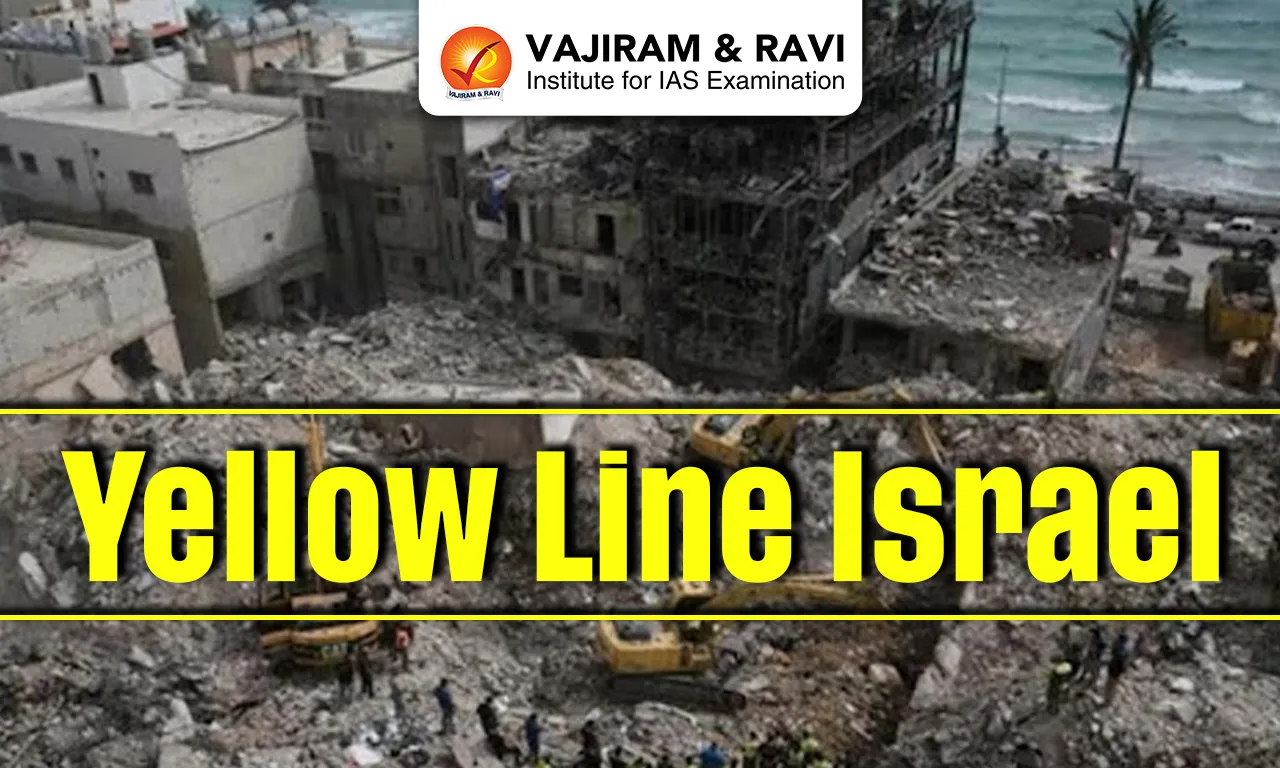
Yellow Line Israel: How Yellow Line Israel Strategy Is Redefining Levant Security

Yellow Line Israel

Yellow Line Israel Latest News

  • Israel has announced the creation of a “Yellow Line” buffer zone in southern Lebanon during a temporary ceasefire, allowing its forces to restrict civilian return, dismantle Hezbollah infrastructure, and conduct strikes beyond the zone. 
    • The 10-day ceasefire between Israel and Lebanon began on April 16.
  • Extending up to the Litani River, the move signals a shift in Israel’s security strategy toward establishing deeper defensive control inside neighbouring territory, with potential long-term implications for regional conflict dynamics.

Israel’s ‘Yellow Line’: A Forward Defensive Strategy

  • The “Yellow Line” emerged during the Gaza war of October 2025 as a military boundary dividing areas under Israeli control and Palestinian-held territory. 
  • Introduced in proposals linked to Donald Trump’s Gaza peace framework, it was physically marked by Israeli forces using barriers and markers inside Gaza.
  • From Israel’s perspective, the Line represents a forward defensive posture, aimed at preventing militant groups like Hamas and Hezbollah from re-establishing operational strength near its borders—especially after the October 7 attacks.
  • Initially conceived as a temporary measure for disarmament and security control, the Yellow Line has increasingly become a permanent feature of Israel’s military doctrine, signalling a shift toward deeper, pre-emptive territorial defence.

Yellow Line and the Militarisation of Gaza: Redefining the Operational Theatre

  • Strategic Re-engineering of the Battlefield - The “Yellow Line” reflects the Israel Defense Forces shift toward restructuring the operational theatre, enabling it to manage security challenges with available resources while maintaining sustained territorial control.
  • Expansion of Direct Military Control – Experts indicate that nearly 58% of the Gaza Strip falls under direct Israeli military control. Areas east of the line are treated as closed military and free-fire zones, restricting civilian access.
  • Shift from Mobile Warfare to Static Defence - The IDF has transitioned from mobile manoeuvre operations to a fixed defensive posture, marking a significant doctrinal change. The Yellow Line functions as a permanent defensive boundary rather than a temporary deployment.
  • Fortified Infrastructure and Heavy Deployment
    • To sustain this line, the IDF has built fortified positions featuring:
      • Elevated earth mounds 
      • Communication towers 
      • Concentrated troop deployments 
    • Maintaining the boundary requires two full IDF divisions, making it a resource-intensive and logistically demanding strategy.

The “Gaza Model”: Expanding Israel’s Yellow Line Strategy

  • The “Gaza Model” refers to the extension of Israel’s Yellow Line strategy beyond Gaza, particularly into southern Lebanon. 
  • It involves creating a deep, militarised buffer zone—potentially up to the Litani River—by dismantling militant infrastructure, displacing civilians, and preventing their return.
  • Unlike earlier boundaries such as the Green Line or West Bank divisions, which were largely political, the Yellow Line is a forward, fortified military boundary inside hostile territory. 
  • First applied in Gaza (2025) and later in Lebanon, it signals a shift toward permanent, control-oriented security zones that prioritise military dominance over temporary separation.

Humanitarian and Legal Concerns Over the Yellow Line

  • International bodies and watchdogs have raised serious concerns about Israel’s “Yellow Line”, viewing it as a potential violation of international humanitarian law and ceasefire norms
  • The Office of the United Nations High Commissioner for Human Rights reported significant civilian casualties and continued military strikes near the zone, highlighting the intensity of operations.
  • Human rights groups have described the policy as a form of systematic land seizure and forced ghettoisation. 
  • By restricting Palestinians to about 42% of Gaza, the Yellow Line limits access to key agricultural and urban areas, leading humanitarian agencies to characterise it as a tool of forced displacement and creeping annexation.

Internal Criticism of Israel’s Yellow Line Strategy

  • The “Yellow Line”, initially framed as a security measure, has faced strong opposition within Israel from military experts, civil society, and economists. 
  • Critics argue that the strategy risks becoming a strategic liability rather than a defensive asset.
  • They warn that shifting from mobile warfare to static defence exposes troops to guerrilla attacks, sniper fire, and anti-tank missiles.
  • Military historians also draw parallels with Israel’s costly occupation of the South Lebanon Security Zone occupation, cautioning that such fixed deployments could turn soldiers into “sitting targets” in a prolonged war of attrition.

Source: IE | HT

Yellow Line Israel FAQs

Q1: What is the Yellow Line Israel strategy?

Ans: Yellow Line Israel strategy is a military buffer zone inside hostile territory that restricts civilian movement, strengthens control, and prevents militant regrouping near Israeli borders.

Q2: Why did Israel introduce the Yellow Line?

Ans: Yellow Line Israel was introduced after security threats like the October 7 attacks to create forward defence zones and reduce risks from Hamas and Hezbollah.

Q3: What is the Gaza Model in Yellow Line Israel strategy?

Ans: The Gaza Model refers to extending Yellow Line Israel strategy to other regions, involving militarised zones, infrastructure destruction, and long-term territorial control.

Q4: What are the criticisms of Yellow Line Israel?

Ans: Critics argue Yellow Line Israel violates humanitarian law, causes displacement, and turns troops into vulnerable targets due to static defence positions.

Q5: How does Yellow Line Israel impact regional security?

Ans: Yellow Line Israel reshapes conflict by creating permanent buffer zones, escalating tensions, and redefining military engagement in the Levant region.

Enquire Now