
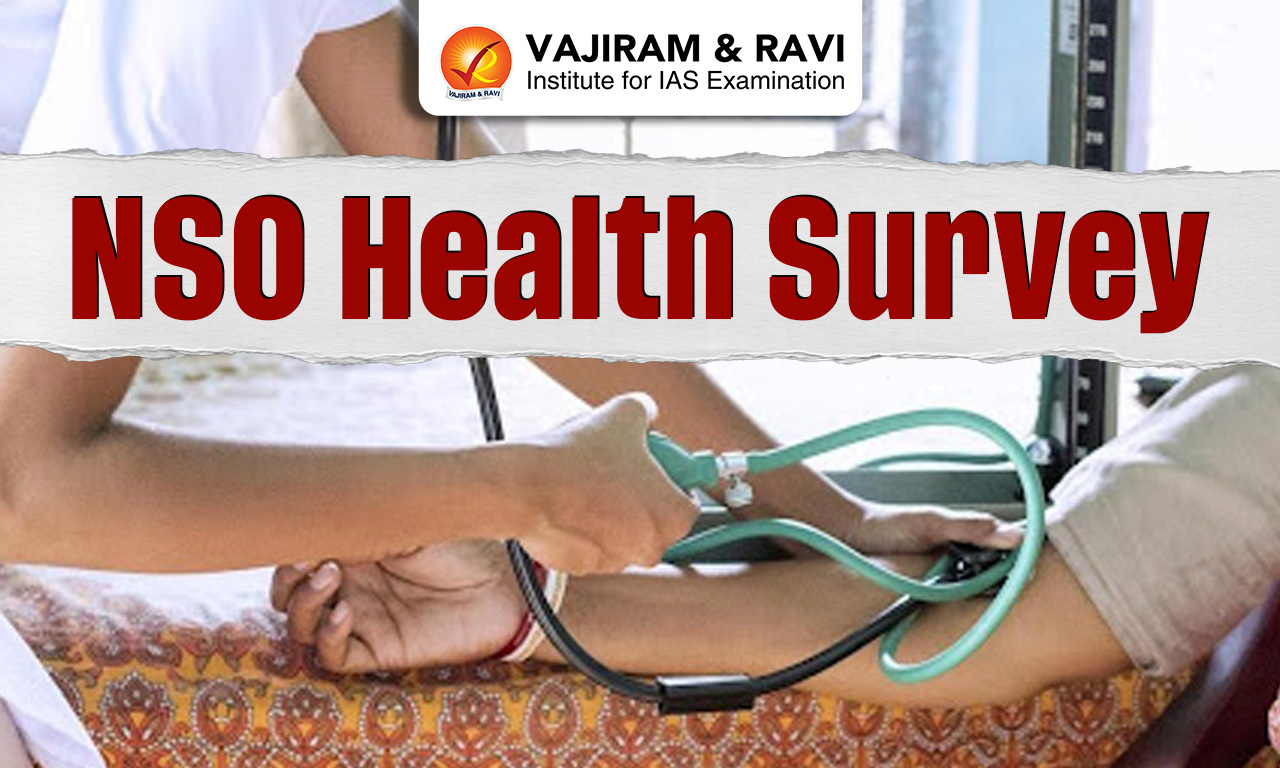
NSO Health Survey Findings – Expanding Health Insurance, Uneven Results

NSO Health Survey

NSO Health Survey Latest News

  • The National Statistical Office recently released findings from its 80th round survey on Household Social Consumption: Health (2025).
  • The report reveals a paradox in India’s healthcare trend wherein health insurance coverage has expanded significantly, yet financial distress persists for many households.

Overview of the 80th Round NSO Health Survey

  • The 80th round survey conducted from January to December 2025 provides a comprehensive picture of healthcare access, utilisation, and financial protection in India. 
  • Compared to the 75th round conducted in 2017-18, insurance coverage, healthcare access, and institutional deliveries have improved substantially. 
  • However, the survey also reveals that higher coverage has not necessarily translated into lower out-of-pocket expenditure (OOPE) or increased hospitalisation in public facilities.

Rising Insurance Coverage in India

  • According to the latest data, 47.4% of rural and 44.3% of urban households are now covered under some form of health insurance.
  • This is a significant increase, largely driven by an expansion of Government-Financed Health Insurance (GFHI) schemes such as Ayushman Bharat - Pradhan Mantri Jan Arogya Yojana (PMJAY) and various State-level initiatives.
  • Government records show a more than two-and-a-half-fold rise in GFHI coverage between 2017-18 and 2025. 
  • Schemes like the Employees’ State Insurance Scheme (ESIS)Central Government Health Scheme (CGHS), and state employee schemes are also part of this growth. 
  • The combined effect indicates India’s rapid movement toward universal health assurance.

Expanding Access and Government Interventions

  • The Union Health Ministry has hailed the survey results as evidence of improved healthcare access across India. 
  • Initiatives such as the Free Drugs and Diagnostics Initiatives (FDSI and FDI), launched in 2015, have expanded the availability of essential medicines and tests even in remote areas. 
  • The creation of 1.84 lakh Ayushman Arogya Mandirs (AAMs) has strengthened India’s network for comprehensive primary healthcare, focusing on preventive, promotive, and curative services.
  • Schemes like the Affordable Medicines and Reliable Implants for Treatment (AMRIT), offering up to 50% discounts on 6,500 medicines through 220 pharmacies, have also bolstered affordability. 
  • These reforms have supported early detection and management of chronic illnesses such as diabetes and cardiovascular conditions, reflecting a clear epidemiological transition toward non-communicable diseases.

Persisting Gaps: Hospitalisation and Expenditure Patterns

  • Despite expanded coverage, the hospitalisation rate has not risen notably since 2017-18 and remains below 2014 levels. 
  • Utilisation of public institutions for hospitalisation and childbirth has declined, while demand for private sector care has surged, especially in urban areas.
  • Contrary to government claims of declining expenditure, independent analysis of NSO data shows OOPE on hospitalisation has more than doubled between 2017-18 and 2025. 
  • Average hospitalisation expenses in private hospitals have increased by 70% in rural areas and 80% in urban areas. 
  • Even in public hospitals, patients often face costs for medicines, diagnostics, transport, and incidental charges due to systemic shortages.
  • Official data indicate a median OOPE of Rs. 11,285 per hospitalisation in 2025, with substantially lower costs in public facilities (median Rs. 1,100). 
  • However, many high-cost cases, particularly specialised treatments sought in private care, push the average far higher.

Inequities in Utilisation and the Role of GFHI

  • Government-financed insurance schemes such as PMJAY are designed to protect vulnerable families from catastrophic health expenditures. However, utilisation trends suggest uneven benefits:
    • 57% of insured individuals sought hospital care in private facilities.
    • Among urban beneficiaries using insurance-linked hospitalisation, only 13% belonged to the poorest income group.
    • The better-off classes disproportionately benefit from the system, while state governments bear heavy fiscal burdens, up to 15% of health budgets in states like Haryana and West Bengal.
  • The structure of these insurance models channels substantial public funds to the private healthcare sector, which operates largely on profit-driven principles. 
  • Despite GFHI reimbursements, many hospitals impose additional charges on patients, undermining the schemes’ promise of “free” treatment.

Financial Protection and Public Health Equity

  • From a macro perspective, the survey presents mixed outcomes. While coverage and access indicators have improved, financial risk protection remains inadequate. 
  • In rural India, the bottom two income quintiles have shown some decline in OOPE, but in urban areas, the financial strain persists due to heavy reliance on private providers.
  • The  AAMs, envisioned as the primary care backbone under Ayushman Bharat, demonstrate potential for sustainable UHC. 
  • Yet, underfunding of AAMs and the National Health Mission (NHM) continues to limit their impact.

Way Forward

  • India’s experience illustrates that insurance-led healthcare models alone cannot achieve equitable health outcomes. 
  • Strengthening the public health infrastructure, ensuring consistent drug and diagnostic availability, and rationalising private sector regulation are crucial for protecting citizens from medical impoverishment.
  • The focus must shift towards preventive and primary care, robust data systems for monitoring, and outcome-based financing that prioritises value over volume. 
  • A well-functioning public health system remains the cornerstone of inclusive development and social justice.

Source: TH | PIB

NSO Health Survey FAQs

Q1: What is the recent NSS 80th round survey about?

Ans: It assesses household healthcare access, utilisation, and financial protection in India during 2025.

Q2: How much health insurance coverage does India have now?

Ans: Around 47.4% of rural and 44.3% of urban households are covered under some health insurance.

Q3: What is the median out-of-pocket expenditure per hospitalisation?

Ans: The median OOPE in 2025 is Rs. 11,285 per hospitalisation case.

Q4: Which schemes have contributed most to rising insurance coverage?

Ans: Ayushman Bharat–PMJAY, Swasthya Saathi, and other state GFHI programmes.

Q5: What remains India’s biggest healthcare challenge?

Ans: High out-of-pocket spending and disproportionate reliance on private sector care despite expanding insurance coverage.
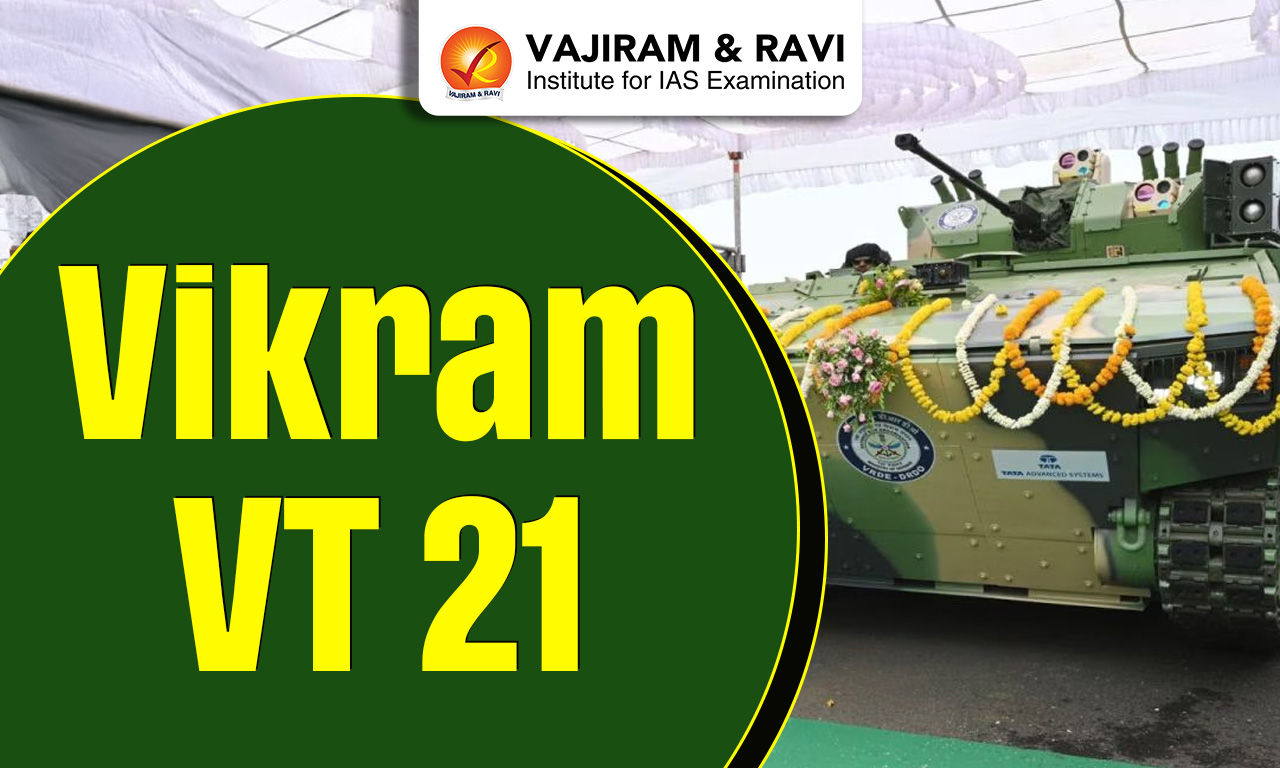
Vikram VT 21: How Vikram VT 21 Upgrades India’s Infantry Combat Vehicles

Vikram VT 21

Vikram VT 21 Latest News

  • The Defence Research and Development Organisation has launched the Vikram VT 21 project featuring two Advanced Armoured Platforms—wheeled and tracked. 
  • These are designed to meet the Indian Army’s need for a Futuristic Infantry Combat Vehicle (FICV).
  • The platform aims to replace the ageing BMP-2 fleet by offering improved mobility, protection, and adaptability across varied terrains, positioning it as a next-generation solution for modern battlefield requirements.

Vikram VT 21: Advanced Armoured Platform by DRDO

  • The Vikram VT 21 is an Advanced Armoured Platform (AAP) developed by the DRDO, designed as a modern infantry combat vehicle. 
  • It features enhanced armour protection capable of withstanding projectiles, blasts, and shrapnel, along with integrated weapons and surveillance systems. 
  • The platform also offers high mobility across diverse terrains, making it suitable for modern battlefield operations.

Two Variants: Wheeled and Tracked

  • The project includes two variants:
    • Wheeled variant: Runs on tyres, offering higher speed, easier maintenance, and suitability for urban, semi-urban, and road conditions. 
    • Tracked variant: Moves on continuous tracks like tanks, providing better grip, stability, and performance on rough, uneven, and off-road terrain.

Collaborative Development

  • The platform has been co-developed by the Vehicles Research and Development Establishment, a DRDO facility, in partnership with Bharat Forge Limited and Tata Advanced Systems Limited, with support from multiple MSMEs and other DRDO units.

Vikram VT 21: Features, Mobility, Armour and Weaponry

  • The Vikram VT 21 is equipped with an indigenously designed 30 mm crewless turret, a remotely operated system that enhances firepower, protection, and operational safety. 
  • It is paired with a 7.62 mm PKT machine gun and can launch third-generation Nag Anti-Tank Guided Missiles (ATGMs), enabling it to effectively engage heavily armoured targets with precision.

High Mobility and Performance

  • Powered by a high-capacity engine and automatic transmission, the platform offers a strong power-to-weight ratio, ensuring superior speed, agility, and manoeuvrability. 
  • It can climb steep gradients and navigate difficult terrains, including trenches and uneven surfaces. 
  • Additionally, its amphibious capability, supported by hydro jets and water propulsion systems, allows seamless movement across rivers and water bodies.

Robust Armour and Protection

  • The vehicle provides STANAG Level 4 and 5 protection, adhering to NATO standards for resistance against heavy gunfire, explosions, and artillery fragments. 
  • It also features modular blast and ballistic protection, enhancing survivability in diverse combat scenarios.

Modularity and Indigenous Development

  • Designed as a modular platform, it can be adapted for multiple roles such as troop transport, reconnaissance, and combat support. 
  • Currently, about 65% of the system is indigenously developed, with plans to increase this to 90%, strengthening India’s defence manufacturing ecosystem.

Futuristic Infantry Combat Vehicle (FICV): Need and Strategic Importance

  • The Indian Army requires a Futuristic Infantry Combat Vehicle (FICV) to replace its ageing BMP-2 fleet, which has been in service since the 1980s. 
  • The need arises from evolving threats and the shift towards modern, technology-driven warfare.

Role in Network-Centric Warfare

  • FICV is designed for network-centric warfare, where military units, sensors, and command systems are digitally connected. 
  • This enables real-time information sharing, faster decision-making, improved coordination, and enhanced situational awareness, significantly boosting operational effectiveness.

Operational Importance in High-Threat Areas

  • With enhanced mobility, protection, and firepower, FICVs are critical for infantry operations in high-risk zones, particularly along borders with China and Pakistan. 
  • They support rapid deployment, combined arms operations, and integration of advanced surveillance and communication systems.

Way Forward: Trials and Induction

  • Before induction, the platform must undergo development trials, user trials, and approval by the Indian Army, followed by large-scale production. 
  • DRDO has expressed confidence that these stages can be completed within three years.

Source: IE

Vikram VT 21 FAQs

Q1: What is Vikram VT 21?

Ans: Vikram VT 21 is an advanced armoured platform developed by DRDO to serve as a next-generation infantry combat vehicle for the Indian Army.

Q2: Why is Vikram VT 21 important for India?

Ans: Vikram VT 21 is crucial to replace ageing BMP-2 vehicles and enhance India’s combat readiness through improved mobility, protection, and network-centric warfare capabilities.

Q3: What are key features of Vikram VT 21?

Ans: Vikram VT 21 includes a 30 mm crewless turret, Nag missiles, amphibious capability, strong armour protection, modular design, and high mobility across terrains.

Q4: How does Vikram VT 21 support modern warfare?

Ans: Vikram VT 21 supports network-centric warfare by integrating sensors, communication systems, and real-time data sharing for better coordination and battlefield awareness.

Q5: What challenges remain for Vikram VT 21 induction?

Ans: Vikram VT 21 must undergo development trials, user trials, and approvals before large-scale production and induction into the Indian Army within the next few years.

Creamy Layer Debate: Why Creamy Layer Issue Returned to Supreme Court

Vikram VT 21

Creamy Layer Debate Latest News

  • Fresh petitions have been filed before the Supreme Court seeking to extend the creamy layer principle to SC/ST reservations
  • These petitions draw their claimed constitutional backing from the same source—the seven-judge bench ruling in State of Punjab v. Davinder Singh (2024). This has revived a major constitutional debate on whether income can replace caste as a basis of disadvantage.

Creamy Layer

  • The creamy layer refers to the more economically and socially advanced sections within a backward community — those who have already benefited enough and arguably no longer need reservation. 
  • Currently, the creamy layer concept applies to OBCs but not to SCs and STs.

Origin of the Creamy Layer Principle

  • The creamy layer doctrine entered Indian constitutional law through the landmark Indra Sawhney v. Union of India (1992) judgment — also known as the Mandal Commission case. 
  • The Supreme Court upheld OBC reservations but ruled that the more advanced sections — the "creamy layer" — should be excluded from reservation benefits.

How Was Creamy Layer Originally Defined

  • The 1993 Office Memorandum (OM) that followed Indra Sawhney identified creamy layer exclusion primarily through status, not just income. 
  • The key criterion was whether a parent held a Class I or Class II government post — recognising that institutional power and social status compound across generations, not just wealth.

How Was This Diluted Over Time

  • A 2004 clarificatory letter by the DoPT began treating PSU salaries alone as a disqualifying criterion — shifting the focus purely to income. 
  • This was subsequently struck down by the Supreme Court in Union of India v. Rohith Nathan (March 2025), which held that parental salary alone cannot determine creamy layer status and restored the original status-based logic of the 1993 OM.

Creamy Layer Vs. Sub-Classification

  • Sub-classification means dividing a reserved category (like SCs) into sub-groups and giving preferential treatment to the most marginalised sub-groups within that category. 
  • This is different from creamy layer exclusionsub-classification does not remove anyone from reservation eligibility; it just prioritises within the category.

What is the Current Issue

  • Two recent petitions have triggered the debate:
    • One seeks exclusion of the “creamy layer” from SC/ST quotas 
    • Another proposes income-based prioritisation within these reservations 
  • Both rely on interpretations of the Davinder Singh judgment, though this interpretation is widely debated.

The 2024 Davinder Singh Judgment — What Did It Actually Say

  • In State of Punjab v. Davinder Singh (2024), a seven-judge bench of the Supreme Court permitted states to sub-classify Scheduled Caste communities — to direct reservation benefits toward the most marginalised within the SC list. 
  • Four of the seven judges made passing observations that creamy layer logic might apply to SC/ST groups as well. The new petitions are based on these observations. 

Why Income Cannot Simply Replace Caste-Based Disadvantage — The Ambedkar Argument

  • The most powerful objection to applying the creamy layer to SC/ST communities comes from Dr. B.R. Ambedkar himself. 
  • In his 1932 note to the Lothian Committee and at the Mahar Conference of 1936, Ambedkar argued that excluding wealthy or educated individuals from the category of untouchables was "a totally erroneous view."
  • His reasoning was simple but profound — economic progress and social emancipation travel on different tracks
  • An educated, propertied Mahar (a Dalit sub-community) still cannot open a shop without customers leaving when his caste becomes known. 
  • A salary does not erase untouchability. The creamy layer doctrine collapses this crucial distinction.

What Does Data Say

  • Data presented in Jaishri Patil v. Union of India (2021) showed that even Group D government employees were rendered ineligible for post-matric scholarships due to income-testing — demonstrating how blunt an instrument income is.
  • Various studies showed that elite capture of quota benefits is a myth — the positive impact of reservation is actually concentrated among less-educated SC members in rural areas.
  • A family earning ₹6 lakh a year cannot be equated with one earning ₹24 lakh simply because both exceed a common income ceiling — yet that is what a uniform income test does.
  • This creates a "creamy layer trap"the income bar is set low enough to exclude the barely economically stable, while the social burdens that reservation was designed to address persist regardless of salary bracket.

Why the SC/ST Case is Fundamentally Different from OBCs

  • The case for creamy layer exclusion was always weaker for SC/ST communities than for OBCs for a crucial reason. 
  • OBC status was defined by social and educational backwardness — a more fluid category. 
  • SC/ST status, on the other hand, is defined by inclusion in the Presidential list under Articles 341 and 342 of the Constitution — and this inclusion was never conditioned on poverty. 
  • It was based on the experience of untouchability and tribal exclusion, which persist regardless of economic status.

What Should Be Done — The Way Forward

  • The Rohith Nathan judgment (2025) creates a narrow but real opportunity for legislative recalibration. 
  • Parliament has both the constitutional authority and the democratic obligation to:
    • Clearly establish that sub-classification and creamy layer exclusion are distinct instruments with different legal bases.
    • Clarify that the creamy layer has no application to SC/ST communities whose inclusion in the Presidential list was never based on economic criteria.
    • Develop a framework that measures social backwardness by the subordination communities continue to face — not merely by income.

Source: TH | TH

Creamy Layer Debate FAQs

Q1: What is the creamy layer debate about?

Ans: Creamy layer debate concerns whether economically advanced individuals within SC/ST communities should be excluded from reservation benefits using income-based criteria.

Q2: Why has creamy layer debate returned to court?

Ans: Creamy layer debate returned due to petitions citing the Davinder Singh judgment, seeking income-based exclusion or prioritisation within SC/ST reservation categories.

Q3: What did the Davinder Singh judgment say about the creamy layer debate?

Ans: Davinder Singh judgment allowed sub-classification within SCs but did not mandate creamy layer SC ST exclusion; references to it were only passing judicial observations.

Q4: Why is creamy layer debate controversial?

Ans: Creamy layer debate is controversial because caste-based discrimination persists despite income gains, making economic criteria an inadequate proxy for social disadvantage.

Q5: What is the difference between sub-classification and creamy layer?

Ans: Sub-classification redistributes benefits within SC/ST groups, while creamy layer excludes individuals based on income, fundamentally altering reservation eligibility.

Enquire Now
