
Why India Raised Gold and Silver Import Duties: Impact on Rupee, Forex Reserves and Economy

Gold and Silver Import Duties

Gold and Silver Import Duties Latest News

  • The India government has sharply raised import duties on gold, silver, and platinum to curb precious metal imports and protect foreign exchange reserves amid economic pressure from the West Asia crisis. 
  • Effective customs duty on gold and silver has increased from 6% to 15%, alongside higher duties on related products such as doré, coins, and jewellery components. 
  • The move aligns with PM Modi’s call for austerity measures, including postponing gold purchases, reducing fuel consumption, limiting non-essential foreign travel, and promoting public transport and electric mobility to ease pressure on India’s import bill and the weakening rupee.

Why India Raised Import Duty on Precious Metals

  • The government increased import duties on gold and silver to conserve foreign exchange reserves as economic pressures intensify due to the ongoing West Asia crisis.
  • The decision is linked to: soaring crude oil prices, disruption in the Strait of Hormuz, and rising pressure on India’s external economic stability.
  • Gold and silver are viewed as discretionary imports, and the duty hike aims to discourage their purchase so foreign exchange can be preserved for more critical needs.
  • The government intends to channel foreign exchange toward essential imports such as:
    • crude oil, 
    • fertilisers, 
    • industrial raw materials, 
    • defence equipment, and 
    • capital goods supporting economic activity and food security.
  • The move is part of a precautionary strategy to reduce India’s vulnerability to external shocks and prevent further strain on the current account during an uncertain global economic environment.

Rupee Under Pressure from Rising Import Costs

  • The Indian rupee has weakened sharply due to escalating import costs and geopolitical tensions linked to the West Asia crisis. 
  • As crude oil prices surged amid supply disruption fears, the rupee fell to a record low against the US dollar. 
  • Higher import bills increase dollar demand, worsening the current account deficit and further weakening the currency. 
  • The government has described the situation as a real-time balance of payments stress test with implications for inflation and economic stability.

Declining Forex Reserves Raise Economic Concerns

  • India’s foreign exchange reserves have fallen significantly since the West Asia conflict began, reflecting growing external economic pressure. 
  • The decline in reserves, especially foreign currency assets, has increased concerns about India’s ability to manage rising import costs. 
  • In response, the government is prioritising foreign exchange for essential imports such as energy, fertilisers, defence equipment, critical technologies, and industrial inputs, while seeking to curb non-essential imports to protect macroeconomic stability.
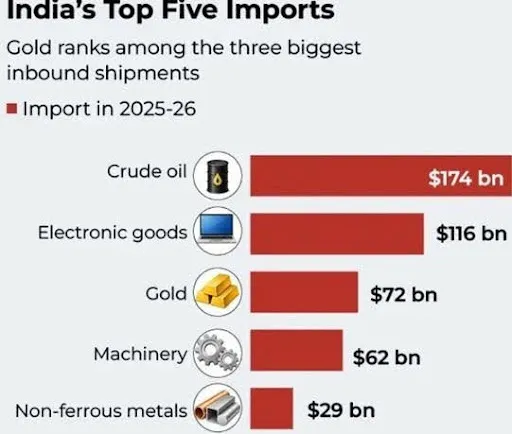
Gold Imports Increasing India’s External Economic Pressure

  • Heavy Dependence on Imported Gold - India is the world’s second-largest gold consumer and relies heavily on imports to meet domestic demand.
  • Pressure on Foreign Exchange - Since gold imports are paid for in U.S. dollars, they increase demand for foreign currency, put pressure on forex reserves, and widen the trade deficit.
  • Sharp Rise in Import Bill - India’s gold import bill surged significantly in 2025–26, despite lower import volumes, mainly because of a steep rise in global gold prices.
  • Discretionary Nature of Gold Imports - Officials view precious metal imports as largely consumption- and investment-driven rather than essential economic imports, making them a target for moderation during periods of external economic stress.
  • Macro-Economic Rationale - Reducing discretionary gold imports can help: conserve foreign exchange, ease pressure on the external account, and support broader macroeconomic stability during global uncertainty.

Oil Shock and Strait of Hormuz Disruption

  • India’s import duty hike comes amid a sharp increase in the oil import bill caused by the ongoing West Asia conflict.
  • Brent crude prices have risen steeply from pre-conflict levels, significantly increasing India’s energy import costs and external economic pressure.
  • India imports the vast majority of its crude oil needs, making it highly vulnerable to global supply disruptions and price shocks.
  • A large share of India’s crude oil shipments passes through or near the Strait of Hormuz, making disruptions in this route a major threat to energy security.
  • India also depends heavily on LPG imports, with most supplies sourced through the Gulf region, further increasing exposure to geopolitical instability in West Asia.

Impact of the Duty Hike on Gold Prices

  • Higher Import Costs - The increase in import duty will raise the landed cost of gold and silver, since India depends heavily on imported precious metals.
  • Cost Passed to Consumers - Jewellers are expected to transfer the higher import burden to buyers, making jewellery, bullion, and silver products more expensive in the domestic market.
  • Immediate Market Reaction - Following the announcement, gold and silver prices surged sharply in commodity markets, reflecting expectations of higher domestic prices.
  • Reversal of Earlier Policy - The move effectively reverses the government’s earlier customs duty reduction aimed at supporting the gems and jewellery industry, lowering prices, and discouraging smuggling.
  • Historical Precedent - India had adopted a similar import duty hike during the Russia-Ukraine crisis, when rising oil prices and rupee weakness created comparable external economic pressures.

Source: ToI | IE

Gold and Silver Import Duties FAQs

Q1: Why did India raise gold and silver import duties?

Ans: India raised gold and silver import duties to curb non-essential imports, conserve foreign exchange reserves, reduce current account pressure, and prioritise essential imports like crude oil and fertilisers.

Q2: How do higher gold import duties affect consumers?

Ans: Higher gold import duties increase the landed cost of imported precious metals, making jewellery, bullion, and silver products more expensive for Indian consumers.

Q3: What is the connection between gold imports and forex reserves?

Ans: Since gold imports require dollar payments, rising gold imports increase foreign currency demand, weaken forex reserves, widen trade deficits, and add pressure on the rupee.

Q4: How does the West Asia crisis influence India’s import policy?

Ans: The West Asia crisis has raised oil prices and disrupted supply routes, increasing India’s import bill and forcing measures like higher precious metals duties.

Q5: Can raising import duties help India’s economy?

Ans: Yes, temporarily. It can reduce discretionary imports, conserve foreign exchange, stabilise the rupee, and provide breathing space during external economic shocks.

Why NTA’s Zero Error Policy Fell Short: Lessons from the Exam Governance Crisis

NTA Zero Error Policy

NTA Zero Error Policy Latest News

  • Nine days after nearly 22 lakh students appeared for the NEET medical entrance exam, the National Testing Agency (NTA) announced that the examination had been compromised and ordered a re-test. 
  • The decision triggered nationwide outrage among aspirants and parents, raising serious concerns about examination integrity and administrative accountability. 
  • The Federation of All India Medical Association (FAIMA) has approached the Supreme Court, demanding either major structural reforms in NTA or its replacement.

NEET’s History of Controversies

  • The decision to conduct a re-test for nearly 22 lakh NEET aspirants is unprecedented, but concerns over exam integrity and paper leaks have surfaced before.

The 2024 Result Controversy

  • In 2024, NEET results triggered major controversy when:
    • 67 of the top 100 candidates scored full marks, 
    • compared to only 2 perfect scorers in 2023, and none in 2022. 
  • This led to severe rank inflation, making admissions to top medical colleges far more competitive.
  • In 2024:
    • around 13 lakh students qualified, 
    • while only about 1.1 lakh MBBS seats were available across government and private institutions. 
  • This intensified pressure and scrutiny over the fairness of the examination process.
  • Subsequent investigations in 2024 revealed allegations that around 155 students may have benefited from leaked question papers.
  • Despite widespread demands from aspirants for a re-examination following the leak controversy, no re-test was conducted at the time, adding to concerns about inconsistency in the response to exam compromises.

Why NTA’s ‘Zero Error’ Promise Failed

  • Despite repeated controversies over paper leaks and exam irregularities, the National Testing Agency appears to have struggled to address systemic weaknesses effectively.
  • After the 2024 NEET controversy, the then NTA chief was removed, but the agency functioned without a full-time head for over a year, creating concerns about administrative continuity and institutional accountability.

The ‘Zero Error, Zero Tolerance’ Commitment

  • Under new leadership, NTA promised a strict “Zero Error, Zero Tolerance” approach and claimed robust security measures for NEET-UG 2026, including:
    • sealed handling of confidential materials, 
    • GPS-tracked transport with police escorts, 
    • CCTV surveillance at exam centres, 
    • biometric Aadhaar verification, 
    • frisking with metal detectors, and 
    • centralised real-time monitoring.
  • The agency also acted against online fraud by blocking numerous Telegram channels allegedly spreading fake question papers and misleading candidates.

Security Failure Despite Safeguards

  • Despite these extensive precautions, police investigations indicated that a so-called “guess paper” containing a large number of actual exam questions had reportedly circulated well before the exam, exposing major gaps in the system.
  • The controversy suggests that while technological and procedural safeguards were expanded, underlying intelligence, monitoring, and institutional enforcement failures continued to undermine exam integrity.

What the Radhakrishnan Panel Recommended

  • Following the NEET-UG 2024 controversy, the Ministry of Education constituted a high-level committee headed by former ISRO chief K. Radhakrishnan to review examination security and reforms.
  • The committee identified the traditional pen-and-paper testing model as a major security vulnerability due to the higher risk of question paper leaks and logistical breaches.
  • The panel recommended transitioning NEET to a Computer-Based Testing format, similar to JEE Main, to improve exam security and reduce leak risks.
  • It also proposed a Computer-Assisted Secure Pen-and-Paper system, where encrypted question papers would be digitally transmitted to exam centres and printed locally just before the exam.

Implementation Gaps

  • Despite these recommendations, NTA reportedly continued with conventional paper-based arrangements relying on physical transport, GPS tracking, and police escorts instead of adopting the suggested technological safeguards.
  • NTA leadership cited limited CBT capacity, stating that existing infrastructure can handle only a fraction of NEET candidates in a single day. Expansion efforts through additional computer centres have reportedly not progressed sufficiently.
  • Moving NEET fully online requires broader ministerial approval involving both education and health authorities, and proposals for such a transition have remained pending for years.

Conclusion

  • The panel’s recommendations highlighted clear structural reforms, but slow implementation and infrastructure limitations appear to have prevented meaningful change.

Source: TH | OL

NTA Zero Error Policy FAQs

Q1: What was NTA’s Zero Error Policy?

Ans: NTA’s Zero Error Policy aimed to eliminate mistakes in examination conduct through strict protocols, technological safeguards, and tighter operational monitoring.

Q2: Why did NTA’s Zero Error Policy fail?

Ans: The policy fell short due to implementation gaps, operational lapses, inadequate accountability mechanisms, weak crisis management, and failure to anticipate systemic risks.

Q3: How did the failure affect students?

Ans: The failure created uncertainty, emotional stress, trust deficits, disrupted academic timelines, and raised concerns over fairness for lakhs of aspirants.

Q4: What does this reveal about exam governance in India?

Ans: It highlights the need for stronger institutional accountability, transparent communication, better technology oversight, decentralised monitoring, and independent audit mechanisms.

Q5: What reforms are needed after the NTA controversy?

Ans: Reforms should include robust auditing, third-party oversight, stronger cybersecurity, contingency protocols, transparent grievance redressal, and leadership accountability.

Cabinet Approves Rs. 37,500 Crore Coal Gasification Scheme

Coal Gasification

Coal Gasification Latest News

  • The Union Cabinet has approved a Rs. 37,500 crore scheme to promote surface coal and lignite gasification projects, aimed at boosting domestic syngas production.

About Coal Gasification

  • Coal gasification is a thermo-chemical process that converts coal or lignite into synthesis gas, commonly known as syngas, a mixture primarily composed of carbon monoxide (CO) and hydrogen (H₂)
  • Unlike direct combustion, gasification allows controlled conversion of coal into a clean and versatile industrial feedstock.

Working of Coal Gasification

  • In coal gasification, coal or lignite reacts with oxygen and steam under high temperature and pressure conditions. 
  • This controlled reaction breaks down the carbon-rich material into its gaseous components. 
  • The syngas produced is then cleaned of impurities such as sulphur and particulates before being processed for industrial use.

Applications of Syngas

  • Syngas is a versatile feedstock that can be used to produce:
    • Power and Synthetic Natural Gas (SNG)
    • Fertilisers such as urea and ammonia
    • Chemicals, including methanol, dimethyl ether (DME), and ammonium nitrate
    • Liquid fuels through further conversion processes
    • Hydrogen for industrial and energy applications

Why Coal Gasification is Important

  • India holds one of the world's largest reserves of coal and lignite, approximately 401 billion tonnes of coal and 47 billion tonnes of lignite. 
  • Coal currently contributes more than 55% of India's energy mix. Despite this abundance, India imports large volumes of high-value chemicals and fuels.
  • Coal gasification offers several strategic benefits:
    • Cleaner utilisation of coal compared to direct combustion, with lower emissions.
    • Import substitution for LNG, urea, ammonia, methanol, and coking coal.
    • Energy security by reducing exposure to global price volatility and geopolitical disruptions.
    • Industrial diversification in coal-bearing regions, creating new economic opportunities.
    • Alignment with Atmanirbhar Bharat and Make in India initiatives by strengthening domestic capabilities.
  • India aims to gasify 100 million tonnes of coal by 2030, and the new scheme is a significant step toward this national target

News Summary

  • The Union Cabinet, chaired by Prime Minister Narendra Modi, has approved a major scheme to accelerate surface coal and lignite gasification across the country. 
  • The scheme, titled "Scheme for Promotion of New Surface Coal/Lignite Gasification Projects for Production of Syngas and Downstream Products," marks one of the most significant initiatives toward building a domestic syngas ecosystem.

Key Features of the Scheme

  • Total Financial Outlay: Rs. 37,500 crore.
  • Gasification Target: Approximately 75 million tonnes of coal and lignite.
  • Project Selection: Through a transparent and competitive bidding process, with an evaluation framework benchmarking project cost, coal input, and syngas output.
  • Financial Incentives: Up to 20% of the cost of plant and machinery, disbursed in four equal instalments linked to project milestones.

Incentive Caps

  • To ensure equitable distribution, the scheme has set the following caps:
    • Rs. 5,000 crore per single project.
    • Rs. 9,000 crore per single product category (excluding Synthetic Natural Gas and Urea).
    • Rs. 12,000 crore per single entity or group across all projects.
  • The incentives under this scheme are additional and do not restrict access to other Central or State Government schemes, including those under the commercial coal mining regime.

Structural Reforms

  • A major accompanying reform is the extension of coal linkage tenure to 30 years under the "Production of Syngas leading to Coal Gasification" sub-sector in the Non-Regulated Sector (NRS) linkage auction framework. 
  • This provides long-term policy certainty for investments in coal gasification projects.

Strategic and Economic Benefits

  • Investment Mobilisation
    • The scheme is expected to attract investments worth Rs. 2.5-3 lakh crore across the value chain, creating significant industrial activity.
  • Import Substitution
    • India's import bill for key substitutable products, including LNG, urea, ammonium nitrate, ammonia, coking coal, methanol, and DME, stood at approximately Rs. 2.77 lakh crore in FY2025. 
    • The ongoing West Asia geopolitical situation has further exposed vulnerabilities in global supply chains. 
    • Coal gasification will help insulate India from global price volatility and geopolitical supply-chain disruptions.
  • Employment Generation
    • The scheme is projected to create around 50,000 direct and indirect jobs across 25 projects in coal-bearing regions, providing significant employment opportunities.
  • Revenue Generation
    • Coal and lignite utilisation under the scheme is expected to generate Rs. 6,300 crore annually from 75 million tonnes of gasification, in addition to downstream revenue from GST and other levies.

Source: TH | TOI | PIB

Coal Gasification FAQs

Q1: What is coal gasification?

Ans: Coal gasification is a thermo-chemical process that converts coal or lignite into synthesis gas (syngas), primarily comprising carbon monoxide and hydrogen.

Q2: What is the total outlay of the new Cabinet-approved scheme?

Ans: The scheme has a total financial outlay of Rs. 37,500 crore.

Q3: How much coal does the government aim to gasify under the scheme?

Ans: The scheme targets the gasification of approximately 75 million tonnes of coal and lignite.

Q4: What financial incentives does the scheme offer?

Ans: It provides up to 20% of the cost of plant and machinery, with caps of Rs. 5,000 crore per project, Rs. 9,000 crore per product category, and Rs. 12,000 crore per entity.

Q5: How does the scheme support India's energy security?

Ans: It reduces dependence on imported LNG, urea, ammonia, methanol, and coking coal, insulating India from global supply-chain disruptions.

Enquire Now

