India’s 8th WTO Trade Policy Review (TPR) – Reaffirming Commitment to an Inclusive Multilateral Trading System

WTO Trade Policy Review (TPR)

WTO Trade Policy Review (TPR) Latest News

  • India's 8th Trade Policy Review (TPR) commenced at the World Trade Organization (WTO) in Geneva on 21 July 2026 (~65 WTO Members participated), covering the review period 1 January 2021–31 December 2025. 
  • Led by Commerce Secretary Rajesh Agarwal, India presented its trade policy achievements, economic performance and reform agenda while responding to questions from WTO members. 
  • The review serves as a transparency mechanism to assess members' trade policies and their consistency with WTO principles.

What is the WTO Trade Policy Review Mechanism (TRPM)?

  • The TPRM is a transparency exercise under the WTO. It enables members to periodically examine each other's trade policies and practices.
  • The objective is to improve transparency, predictability and accountability in the multilateral trading system rather than to enforce compliance.

India’s Economic and Trade Performance

  • India highlighted its resilience despite geopolitical tensions, supply-chain disruptions and rising global protectionism.
  • Key achievements:
    • Recorded nearly 8% average annual GDP growth during 2021–2025.
    • Achieved record exports of USD 863.1 billion in 2025–26.
    • Continued pursuing the vision of Viksit Bharat @2047 while addressing the developmental needs of nearly one-fifth of the world's population.

Major Trade and Economic Reforms Highlighted

  • India showcased a broad range of structural and trade-related reforms aimed at enhancing competitiveness and integration with the global economy.
  • Key initiatives:
    • Aatmanirbhar Bharat: Strengthening domestic manufacturing while integrating with Global Value Chains (GVCs).
    • Jan Vishwas initiative: Regulatory simplification and ease of doing business.
    • Digital customs and trade facilitation measures.
    • Logistics modernisation and quality infrastructure development.
    • Expansion of Digital Public Infrastructure (DPI) for financial inclusion and trade efficiency.
    • Promotion of Artificial Intelligence (AI), innovation and startups.
    • Focus on sustainability, agricultural resilience and inclusive development.
    • Expansion of Regional Trade Agreements (RTAs).
    • Continued support through South-South Cooperation and the Indian Technical and Economic Cooperation (ITEC) Programme.
  • India reiterated its support for balanced, development-oriented WTO reforms that strengthen the multilateral trading system while safeguarding the interests of developing countries.

Recognition from WTO Leadership and Members

  • WTO TPR Body (TPRB):
    • Recognised India as one of the fastest-growing major economies.
    • Appreciated India's leadership in digitally delivered services exports.
    • Commended reforms in DPI, financial inclusion and trade facilitation.
    • Welcomed India's acceptance of the WTO Agreement on Fisheries Subsidies, following the deposit of its Instrument of Acceptance.
    • Praised India's timely responses to advance questions, reflecting transparency under the TPR mechanism.
  • Active participant (Brazil): Brazil's representative highlighted -
    • Success of the Goods and Services Tax (GST) in creating a unified domestic market.
    • India's digital trade reforms and expanding export strategy.
    • Importance of recent RTAs.
    • India's Duty-Free Tariff Preference (DFTP) Scheme for Least Developed Countries (LDCs).
    • India's DPI as a model for other developing countries.

Key Area of Conflict

  • India and key WTO members are at loggerheads over the 66-nation Agreement on Electronic Commerce (ECA), with India challenging the legality of bypassing multilateral consensus.
  • Core arguments and objections:
    • Consensus rule: 
      • India maintains that adding any new plurilateral pact to Annex 4 requires the agreement of all WTO members under the Marrakesh Agreement.
      • It failed to pass during General Council meetings in 2025.
      • Annex 4 contains plurilateral trade agreements that are binding only on the specific member countries who choose to accept them.
      • It currently includes two active pacts: the Agreement on Trade in Civil Aircraft and the Revised Agreement on Government Procurement.
      • Interim validity: Following the deadlock, 66 participating countries issued a declaration, establishing an interim arrangement to operationalize the e-commerce pact.
    • Institutional overreach: New Delhi formally questioned the institutional and legal basis, challenging a partial-membership deal.
  • Broader multilateral divide:
    • Plurilateral push: Proponent nations argue that coalition-based "Joint Statement Initiatives" are necessary to prevent total paralysis on new-age trade rules when complete consensus is unachievable.
    • Systemic risk: India contends that allowing subsets of countries to operationalize unapproved agreements undermines the core multilateral character of the global trading system.

Significance of TPR for India

  • Soft power and cultural diplomacy: On the sidelines of the review, India organised an exhibition showcasing  diverse Indian products, and traditional papier-mâché handicrafts.
  • Reinforces: India's image as a responsible stakeholder in the multilateral trading system.
  • Demonstrates: India's attempt to balance self-reliance (Aatmanirbhar Bharat) with greater global economic integration.
  • Highlights: India's growing role in digital trade, services exports, and South-South cooperation.
  • Strengthens: India's credibility in ongoing WTO negotiations and reform discussions.
  • Reflects: India's emphasis on inclusive, transparent and development-oriented global trade governance.

Source: PIB

WTO Trade Policy Review (TPR) FAQs

Q1: What is the primary objective of the WTO's Trade Policy Review Mechanism (TPRM)?

Ans: To enhance transparency, predictability and accountability in members' trade policies through periodic peer review.

Q2: How does Aatmanirbhar Bharat complement India's global trade strategy?

Ans: It strengthens domestic productive capacities while promoting deeper integration into Global Value Chains (GVCs).

Q3: Why is India's acceptance of the WTO Agreement on Fisheries Subsidies significant?

Ans: It demonstrates India's commitment to sustainable fisheries and constructive engagement in strengthening the multilateral trading system.

Q4: What role does Digital Public Infrastructure (DPI) play in India's trade policy?

Ans: DPI enhances trade facilitation, financial inclusion, digital commerce and overall economic competitiveness.

Q5: Why are Quality Control Orders (QCOs) an important issue in WTO discussions on India?

Ans: They seek to improve product quality and consumer safety but are scrutinised for their potential impact on international trade.

Internet Shutdowns in India – Legal Framework and Supreme Court Rulings

Internet Shutdowns

Internet Shutdowns Latest News

  • Mobile internet services were shut down in parts of Central Delhi during the 'Chalo Sansad' protest, raising fresh concerns about the legal framework governing internet shutdowns and their impact on fundamental rights.

About Internet Shutdowns

  • An internet shutdown, as defined by the web rights advocacy organisation Access Now, is "an intentional disruption of internet or electronic communications, rendering them inaccessible or effectively unusable, for a specific population or within a location, often to control the flow of information."
  • Forms of Internet Shutdowns
    • Full network disruptions: complete blackout of internet services.
    • Slowing down internet speed: throttling connectivity.
    • Blocking specific platforms: restricting access to particular websites or apps.
    • Mobile-only shutdowns: disabling mobile internet while keeping broadband active.
  • When Are They Ordered?
    • According to the International Federation of Journalists, most internet shutdowns are ordered when:
      • Large numbers of people gather for political reasons.
      • Peaceful demonstrations are expected to take place.
      • Violent protests may occur.
      • Religious celebrations draw large crowds.
      • Public examinations are being conducted to prevent cheating.

Legal Framework Governing Internet Shutdowns

  • Earlier Framework
    • Internet shutdowns in India were earlier governed by:
    • Section 5(2) of the Indian Telegraph Act, 1885.
    • Temporary Suspension of Telecom Services (Public Emergency or Public Safety) Rules, 2017.
  • Current Framework
    • Section 20 of the Telecommunications Act, 2023.
    • Telecommunications (Temporary Suspension of Services) Rules, 2024.
    • Under Section 20(2)(b) of the Telecommunications Act, 2023, telecommunication services may be suspended only:
      • On the occurrence of a public emergency.
      • In the interest of public safety.
      • On the grounds specified in the provision.
      • For reasons recorded in writing.
  • Procedural Requirements
    • Be reasoned and published.
    • Be limited in area and duration.
    • Be issued by the competent authority under the 2024 Rules.
    • Consider whether less restrictive measures would be sufficient.
    • Not remain in force for over 15 days.
    • A protest, by itself, is not a lawful ground for suspending internet services.

Continued Use of Outdated Provisions

  • Despite the updated legal framework, a review by the Digital Defenders Network found that several shutdown orders issued by State governments since late 2024 continue to invoke the older Indian Telegraph Act, 1885 and the 2017 Rules. For instance:
  • The Secretary, Home Department, Uttar Pradesh, issued an internet suspension order for Bareilly district on October 2, 2025.
  • The order invoked Section 7 of the Telegraph Act read with Rule 2(1) of the 2017 Rules.
  • By continuing to rely on these outdated provisions, some States appear to have bypassed the procedural safeguards introduced under the 2024 Rules.

Supreme Court Rulings on Internet Shutdowns

  • The Anuradha Bhasin Case (2020)
    • In the landmark Anuradha Bhasin v. Union of India (2020) case, the Supreme Court held that access to the internet is closely connected to fundamental freedoms under the Constitution:
    • Article 19(1)(a): freedom of speech and expression.
    • Article 19(1)(g): freedom of trade and profession.
  • The Court held that any shutdown must:
    • Be backed by law.
    • Pursue a legitimate objective.
    • Be necessary and proportionate.
    • Be the least restrictive measure available.
    • Be limited in scope and duration.
    • Be accompanied by detailed reasons.
    • Be published for public scrutiny.
    • Be reviewed by a competent committee.
  • The Court observed that "complete broad suspension of telecom services, be it the internet or otherwise, must be considered by the State only if 'necessary' and 'unavoidable'."

India's Track Record on Internet Shutdowns

  • India continues to record one of the highest numbers of internet shutdowns in the world:
    • Access Now's 2025 report recorded 65 shutdowns across 12 States and Union Territories.
    • India has recorded about 24 shutdowns in 2026 so far.
  • According to the SFLC Internet Shutdown Tracker:
    • Jammu & Kashmir: the highest number with about 449 since 2012.
    • Rajasthan: 115 shutdowns.
    • Manipur: 62 shutdowns.


News Summary

  • Mobile internet services were shut down in parts of Central Delhi during the 'Chalo Sansad' protest organised by the Cockroach Janta Party (CJP). Key aspects include:
    • Thousands of people gathered on the opening day of Parliament's Monsoon Session.
    • Protesters demanded the resignation of Union Education Minister Dharmendra Pradhan.
    • The protest followed the NEET paper leaks and irregularities in the CBSE school examination process.
    • The internet shutdown remained in place until the evening.
    • The Ministry of Home Affairs imposed the order across 150 cell sites, according to an industry source.
  • The order was imposed under Clause (b) of Sub-section (2) of Section 20 of the Telecommunication Act, 2023, read with the 2024 Rules.

Legal Recourse Against Shutdown Orders

  • A shutdown order may be challenged in court through:
    • High Court under Article 226: for writ petitions within a state's jurisdiction.
    • Supreme Court under Article 32: in appropriate cases involving fundamental rights.
  • Courts can examine whether the order was:
    • Lawful and issued by the competent authority.
    • Proportionate to the situation.
    • Properly limited in area and duration.
    • Supported by valid reasons.
  • Indefinite suspensions are unlawful. The government must publish its orders and provide reasons capable of judicial review.

Way Forward

  • Legislative Reforms
    • Ensure strict compliance with the Telecommunications Act, 2023 and the 2024 Rules.
    • Discontinue the use of outdated Telegraph Act provisions.
    • Establish clearer criteria for what constitutes a public emergency.
    • Provide for automatic judicial review of shutdown orders.
  • Institutional Safeguards
    • Strengthen the review committee mechanism.
    • Ensure timely publication of all shutdown orders.
    • Maintain a central public database of shutdowns.
    • Enable easier legal challenges to shutdown orders.
  • Policy Approaches
    • Explore less restrictive alternatives such as targeted platform blocking.
    • Provide advance notice where possible.
    • Ensure the shortest possible duration of shutdowns.
    • Consider the cumulative impact on affected populations.
  • Transparency Measures
    • Regular reporting to Parliament on shutdowns.
    • Public consultations on the framework.
    • Enhanced judicial oversight of orders.
    • Civil society engagement in policy formulation.

Source: TH

Internet S66hutdowns FAQs

Q1: Which law currently governs internet shutdowns in India?

Ans: Internet shutdowns are governed by Section 20 of the Telecommunications Act, 2023 and the Telecommunications (Temporary Suspension of Services) Rules, 2024.

Q2: What was the significance of the Anuradha Bhasin v. Union of India (2020) case?

Ans: The Supreme Court held that access to the internet is linked to fundamental freedoms under Articles 19(1)(a) and 19(1)(g), and any shutdown must be lawful, proportionate, and the least restrictive measure.

Q3: How many internet shutdowns did India record in 2025?

Ans: According to Access Now's 2025 report, India recorded 65 internet shutdowns across 12 States and Union Territories.

Q4: Which state has recorded the highest number of internet shutdowns in India?

Ans: Jammu & Kashmir has recorded the highest number of internet shutdowns, with about 449 since 2012, according to the SFLC Internet Shutdown Tracker.

Q5: What is the maximum duration of an internet suspension order under the 2024 Rules?

Ans: Under the 2024 Rules, a suspension order cannot remain in force for over 15 days.

Plainclothes Policing: Legal Position and Accountability Concerns in India

Plainclothes Policing

Plainclothes Policing Latest News

  • Videos from the July 20 "Sansad Chalo" protest in Delhi showed police and Rapid Action Force (RAF) personnel in civilian clothes, or in uniform without visible nameplates. 
  • This has triggered a debate on the legality of unidentified policing during crowd control situations.

What Triggered the Controversy

  • Protesters organised by the Cockroach Janata Party (CJP), demanding action over the NEET paper leak and the resignation of the Education Minister, marched towards Parliament. 
  • Police lathi-charged the swelling crowd, leading to violent clashes and injuries on both sides. 
  • Social media videos allegedly showed unidentified men in civilian clothes using police-style lathis against protesters, while uniformed personnel without nameplates ignored questions about their identity. 
  • Delhi Police has not officially responded, but has reportedly directed personnel at the protest site to report in uniform going forward.

Is Hiding Identity Legal?

  • Certain operations — particularly intelligence gathering — genuinely require concealment of identity or even impersonation. 
  • However, routine policing is bound by statutory procedure and judicial guidelines, which generally require identifiability.

Statutory basis

  • Maintenance of public order is governed by Chapter XI of the Bharatiya Nagarik Suraksha Sanhita (BNSS), Sections 148–160 (earlier Chapter X of the CrPC, formerly Chapter IX). 
  • While the law does not explicitly mandate identification, only a magistrate or a "police officer" is empowered to order a crowd to disperse — implying that the officer issuing such a command must be identifiable
  • Legal experts argue that an unidentifiable person cannot lawfully exercise this statutory power.

Judicial precedent

  • In DK Basu vs State of West Bengal (1997), the Supreme Court mandated that arresting officers must carry clear, visible identification. 
  • Though this ruling concerned arrests rather than crowd control, it reflects the judiciary's broader expectation that police be identifiable while exercising coercive authority.
  • In August 2025, the Andhra Pradesh High Court questioned how citizens could recognise plainclothes personnel as police while they discharged official duties, in a case involving a YSRCP MLA accused of obstructing police work.

Why Police Avoid Identification

  • Security concerns: The practice reportedly originated in conflict zones like Jammu and Kashmir, Punjab, and Chhattisgarh, where personnel avoided nameplates and rank insignia to reduce the risk of being targeted by militants.
  • Personal safety in routine duty: Officers argue visible identification can expose them to prolonged litigation, online harassment, and threats to their families.
  • Practice has spread: What began as a conflict-zone safeguard has gradually extended into routine law-and-order policing, a trend experts describe as contentious when applied outside genuine security threats.
  • Logistical compulsion: When additional personnel are urgently summoned to a protest site, all available officers from a unit — including those in plain clothes — are required to report, often due to overwhelming crowd size rather than deliberate strategy.

Acknowledged Ambiguity

  • While the law does not strictly bar deploying plainclothes personnel, senior officers concede the practice introduces ambiguity into already volatile protest situations. 
  • However, they argue such deployment remains important because anti-social elements can infiltrate protests and trigger violence or arson — special branch personnel are specifically tasked with blending into crowds to gather intelligence and monitor troublemakers.

Conclusion

  • The plainclothes policing debate captures a real tension between operational security concerns and democratic accountability. 
  • While Indian law does not explicitly bar unidentified policing, statutory logic and judicial precedent point toward identifiability as essential to the legitimate exercise of police power — making transparency, not anonymity, the constitutional default for routine law enforcement.

Source: IE | ToI

Plainclothes Policing FAQs

Q1: Is Plainclothes Policing legally permitted in India?

Ans: Plainclothes Policing is not expressly prohibited under Indian law, but routine policing generally requires identifiable officers while exercising statutory powers and coercive authority.

Q2: Why has Plainclothes Policing become controversial?

Ans: Plainclothes Policing has raised concerns because unidentified personnel during protests may reduce transparency, complicate accountability and undermine public confidence in law enforcement.

Q3: What judicial principles govern Plainclothes Policing in India?

Ans: Plainclothes Policing is influenced by judicial precedents such as DK Basu, which emphasise visible identification when police officers exercise coercive powers against citizens.

Q4: Why do police agencies deploy Plainclothes Policing?

Ans: Plainclothes Policing is used for intelligence gathering, identifying anti-social elements, ensuring operational security and responding quickly during large public gatherings or emergencies.

Q5: What constitutional concern does Plainclothes Policing highlight?

Ans: Plainclothes Policing highlights the need to balance operational security with transparency, accountability and citizens' ability to identify officers exercising public authority.

NSE Ahimsa Index: India’s New Benchmark for Ethical and Animal Welfare Investing

NSE Ahimsa Index

NSE Ahimsa Index Latest News

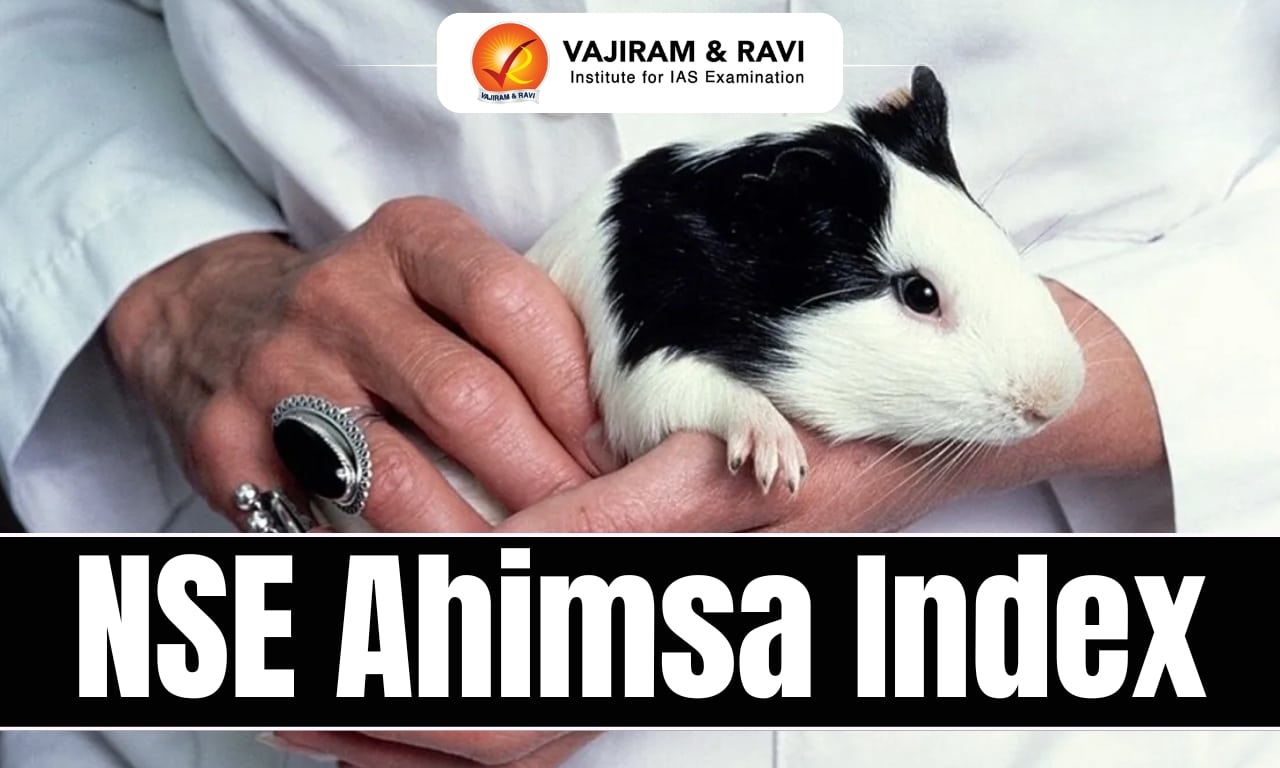
  • The National Stock Exchange (NSE) launched the Nifty 500 Ahimsa Index on July 10, 2026. 
  • This is India's first thematic index focused exclusively on animal cruelty-free companies, arriving weeks after BSE's similar Saatvik 100 Index launched on June 17, 2026.

National Stock Exchange: Structure, Role and Regulatory Framework

  • The National Stock Exchange (NSE) is India's premier stock exchange and a core pillar of the country's financial system. 
  • Established in 1992 and operational from 1994, it was set up to bring transparency, efficiency, and nationwide access to securities trading. 
  • Headquartered in Mumbai, NSE replaced India's earlier manual trading system with a fully automated, screen-based platform.

Legal Status and Recognition

  • NSE is a regulated stock exchange, officially recognised under the Securities Contracts (Regulation) Act, 1956
  • It offers trading across multiple asset classes:
    • Equities (shares)
    • Derivatives (futures and options)
    • Currency and commodity products
    • Debt securities
  • It is owned by major financial institutions, banks, and insurers, and operates under the regulatory oversight of the Securities and Exchange Board of India (SEBI).

Organisational Structure

  • Ownership - Key shareholders include major public institutions such as LIC, SBI, ICICI Bank, and GIC.
  • Management - NSE is run by a Board of Directors, supported by executive leadership and functional departments covering trading, clearing, settlement, and surveillance.
  • Regulatory Oversight - SEBI regulates NSE under multiple statutes, including the Companies Act, the SEBI Act, the Securities Contracts (Regulation) Act, and the Depositories Act.
  • Clearing, Settlement and Depository Services - Clearing and settlement functions are handled by NSE Clearing Limited; Depository services are provided through the National Securities Depository Limited (NSDL).

Governing Legal Framework

  • NSE's functioning is governed by four key legislations:
    • Securities Contracts (Regulation) Act, 1956
    • Companies Act, 2013
    • SEBI Act, 1992
    • Depositories Act, 1996

About Ahimsa Index

  • The Nifty 500 Ahimsa Index tracks top 500 NSE companies whose business practices align with the principle of "Ahimsa" (non-violence). 
  • It gives investors a way to invest specifically in companies that avoid activities harming animals. 
  • This marks a shift from conventional ESG (Environmental, Social, Governance) investing, which focuses on carbon emissions and governance metrics, toward a values-based screening rooted in Indian philosophical traditions.
  • The index was developed jointly by NSE Indices and the Ahimsagain Foundation, a non-profit established in November 2024 by ethical finance advocates.

Selection Framework

  • Companies are evaluated using the Ahimsa Investment Movement (AIM) framework, which classifies firms into three bands:
    • Green band: Fully compliant with animal-cruelty-free criteria
    • Orange band: Partial compliance
    • Red band: Non-compliant
  • Only green-band companies are included in the index.

Who Is Included and Excluded

  • The index includes leading companies from IT services, automobile, real estate, and healthcare sectors.
  • Notable exclusions include:
    • Most Reliance Group companies (except Reliance Power)
    • Pharmaceutical companies using animal testing
    • All commercial banks and major NBFCs
    • Dairy, meat, poultry, and leather companies
    • Fashion brands, retail chains, and cosmetics companies using leather or wool

Comparison with BSE's Saatvik Index

  • BSE's Saatvik 100 Index, launched earlier, has a broader mandate. It screens against animal cruelty, addictive or toxic products, and generally harmful or violent business activities
  • The near-simultaneous launch of two thematic ethical indices by India's major exchanges signals a new direction in India's capital markets — screening companies through indigenous philosophical lenses rather than only global ESG frameworks.
    • Global ESG frameworks are structured guidelines that help companies measure and report their performance on Environmental, Social, and Governance factors.
    • Environmental: Tracks a company's impact on nature, including greenhouse gas emissions, waste management, energy efficiency, and water use.
    • Social: Evaluates how a company treats people, covering labor practices, workplace health and safety, diversity, and community relations.
    • Governance: Assesses corporate leadership, executive pay, business ethics, internal controls, and shareholder rights.

Significance for Investors

  • Expected to serve as a benchmark for asset managers.
  • Likely to enable new passive investment products such as ETFs and index funds.
  • Reflects a broader trend of younger, values-conscious investors entering capital markets.
  • Market analysts note it will take time for mutual funds to build products around this theme, but see long-term growth potential.

Conclusion

  • NSE's Ahimsa Index reflects a maturing Indian capital market willing to root ethical investing in home-grown philosophical concepts rather than borrowed frameworks. 
  • As younger, values-driven investors enter the market, such indices could reshape how corporate responsibility is measured and rewarded in India.

Source: IE | ToI

NSE Ahimsa Index FAQs

Q1: What is the objective of the NSE Ahimsa Index?

Ans: The NSE Ahimsa Index enables investors to invest in companies that follow animal cruelty-free business practices while promoting values-based investing rooted in the principle of Ahimsa.

Q2: How does the NSE Ahimsa Index differ from conventional ESG investing?

Ans: The NSE Ahimsa Index goes beyond environmental and governance metrics by specifically screening companies based on animal welfare and non-violent business practices.

Q3: Which companies are excluded from the NSE Ahimsa Index?

Ans: The NSE Ahimsa Index excludes companies engaged in animal testing, leather, meat, poultry, dairy, and other businesses that do not satisfy its animal welfare criteria.

Q4: How are companies selected for the NSE Ahimsa Index?

Ans: The NSE Ahimsa Index uses the Ahimsa Investment Movement framework, admitting only companies placed in the "Green" category for compliance with animal welfare standards.

Q5: Why is the NSE Ahimsa Index significant for India's capital markets?

Ans: The NSE Ahimsa Index reflects the growing demand for ethical investing, encourages responsible corporate behaviour and expands values-based investment opportunities for Indian investors.

Enquire Now