
Indian Crafts and Luxury Brands: The Legal Gap Around Traditional Art

Indian Crafts and Luxury Brands

Indian Craft Latest News

  • Indian crafts and weaves are skills and visual languages carried across generations, rooted in specific regions and communities. 
  • Yet when they enter the global luxury fashion system, the people and places behind them become invisible.
  • After the controversy over Prada's Kolhapuri chappals, two more instances have drawn criticism.
    • Recently, Ralph Lauren presented a pink evening gown featuring aari work — hook embroidery from Gujarat. It was described only as hand-applied embellishment.
    • Fendi's autumn collection includes a mirror-work Baguette bag, made in Italy over 138 hours, using 39,500 beads and 475 mirrors, priced at $10,000. It closely resembles the mirrored purses sold at Indian craft fairs.
  • The pattern raises a sharp question. Why is it so easy to commercially appropriate a traditional Indian craft, and so hard for the community behind it to claim recognition, ownership or a share of the value?

The Core Legal Contradiction

  • Experts identify the root problem. Intellectual property is territorial, while culture is not. Laws stop at borders; crafts do not.
  • A centuries-old technique does not fit conventional IP categories. There may be a specific artistic expression, a design, a geographical identity or a protected name. 
  • But the underlying tradition belongs to a community and has evolved over generations. 
  • Hence, traditional crafts have cultural provenance but no clearly identifiable legal owner. 
  • That gap is what gets exploited.

What GI Can and Cannot Do

  • A Geographical Indication (GI) protects the name, origin and reputation of a qualifying product. 
  • It does not necessarily protect every motif, stitch or visual element associated with a craft. This is the crucial limitation.
  • Analysts argue that the guiding principle should be representation and custodianship. 
  • Those who have sustained and transmitted a tradition should have a meaningful role in decisions about its commercial use.
  • Key points on the GI framework:
    • Under India's GI Act, both registered proprietors and authorised users can seek relief for infringement.
    • Remedies include injunctions, damages and account of profits.
    • But recognising a right and giving a community the capacity to exercise it are two different things.
    • Cross-border litigation is resource-intensive, placing it beyond most artisan groups.
  • Institutional capacity therefore matters. Producer organisations, cooperatives and representative bodies can document provenance, organise authorised users, negotiate collectively and pursue enforcement.
  • Also, the government should assist with registration, recognition and enforcement. Ownership must remain with the community.

The Problem of Authorship

  • Traditional craft unsettles the very idea of an author. The first creator of a technique may be unknown, unidentifiable, or simply irrelevant to how the tradition actually grew. 
  • Each generation passes knowledge on and alters it slightly. The community keeps practising it.
  • However, the absence of an identifiable author cannot become an invitation to appropriate. The law must recognise the community as custodian wherever a continuing relationship exists between a cultural expression and the people who preserved it. 
  • Provenance could be established through historical records, regional practice, oral testimony and community knowledge.

Documentation: Necessary but Delicate

  • Traditional knowledge cannot simply be recorded and handed to an outside institution. 
  • Some knowledge is sacred or restricted. Documentation must not become a route to external control.
  • Experts propose a carefully maintained digital registry covering motifs, techniques, names, regions and custodial communities. 
  • Such a registry would not grant ownership over every visual similarity. But it would make it far harder for a company to claim that a centuries-old Indian tradition originated in a European design studio.

The 'Inspiration' Escape Route

  • As per the experts, the place of origin must be credited, not absorbed into a brand's own creative vocabulary.
  • European brands rely on the language of "inspiration." Their design and copyright frameworks are also stronger than those of developing countries. 
  • A further loophole exists in technique itself. If work is fully machine-made, it is not aari but computerised crewel work — and that relabelling becomes an escape route.

The Risk of Over-Protection

  • There is a real danger in protecting crafts too aggressively. The law meant to preserve them could freeze them.
  • Techniques have always moved between communities. Artisans have adapted motifs, colours, materials and methods. 
  • The aim, therefore, should be to prevent extraction, false authorship and unacknowledged exploitation — not to stop culture from moving. Protection should not turn a living craft into a museum piece.

Towards a Sui Generis Framework

  • This is why a sui generis — specially designed — legal framework for traditional cultural expressions is being debated. 
  • It could answer questions conventional copyright and design law cannot:
    • Who represents the community?
    • When is consent required?
    • When is attribution mandatory?
    • When must a commercial user share economic benefits?
    • How is legitimate inspiration distinguished from misappropriation?

International developments

  • The World Intellectual Property Organisation (WIPO) is negotiating rules on misappropriation, attribution, community rights and benefit-sharing. 
  • Its 2024 treaty on genetic resources and associated traditional knowledge shows international IP law is beginning to move beyond conventional copyright and patents. 
  • The Berne Convention also offers some avenues to challenge unauthorised use.

Conclusion

  • The debate is not about halting cultural exchange. It is about ending extraction without acknowledgement. 
  • India needs collective legal identity for artisan communities, documented provenance, and enforceable attribution with benefit-sharing. Inheritance must not enrich everyone except those who kept it alive.

Source: IE | ToI

Indian Craft FAQ

Q1: Why do Indian crafts face legal challenges when used by luxury brands?

Ans: Indian crafts face legal challenges because traditional techniques belong to communities, while conventional intellectual property laws often require identifiable authors or owners.

Q2: Can geographical indications protect Indian crafts?

Ans: Geographical indications can protect the name, origin and reputation of qualifying Indian crafts, but they do not necessarily protect every motif or stitch.

Q3: Why is community ownership important for Indian crafts?

Ans: Community ownership recognises artisans who preserve and transmit Indian crafts across generations, giving them meaningful participation in commercial decisions and benefit-sharing.

Q4: How can Indian crafts be better documented?

Ans: Indian crafts could be documented through digital registries recording motifs, techniques, names, regions and custodial communities while protecting sensitive traditional knowledge.

Q5: What legal framework could better protect Indian crafts?

Ans: A sui generis framework could protect Indian crafts by establishing community representation, attribution, consent requirements, commercial benefit-sharing and safeguards against misappropriation.

Public Insurance Registry – India’s UPI Moment for the Insurance Sector

Public Insurance Registry

Public Insurance Registry Latest News

  • IRDAI has released a consultation paper on a Public Insurance Registry (PIR), which is being described as having the potential to spark a revolution in insurance similar to what UPI achieved in payments.

About UPI and the Digital Public Infrastructure Model

  • UPI (Unified Payments Interface) is widely regarded as a landmark in India's Digital Public Infrastructure (DPI) journey. 
  • Its significance lies not merely in enabling digital transactions, but in creating an interoperable system that allowed an entire market to function differently.
  • The key features of the DPI approach, as articulated in India's G20 Task Force on DPI, include:
    • Interoperability: systems work across providers, but without forcing uniformity
    • Minimalist building blocks: simple foundational components
    • Federated architecture: data stays where it is collected rather than being centralised
  • The PIR proposal applies this same framework to insurance.

The Problem in Insurance

  • Insurance remains one of the last large financial sectors where policies are not accessible at a single point. Several frictions follow from this.
  • KYC has to be done multiple times, once for each insurer or policy, despite being the same individual.
  • Claims history is not easily available, even though it should be. This affects both underwriting accuracy and the policyholder's ability to switch providers.
  • Consumer awareness and product comparison still depend largely on a salesperson's narrative rather than verified information.
  • The consultation paper aims to shift the sector from the old adage that "insurance is sold" to a world where "insurance is also bought", where customers have enough verified information to make informed choices.

The Missing Connective Tissue

  • Recent legislation provides partial foundations:
    • Sabka Bima Sabki Raksha Act: gives IRDAI a statutory anchor for insurance digitisation
    • Digital Personal Data Protection Act: provides data privacy safeguards
    • Bima Sugam: boosts accessibility
  • What was missing was a connective tissue making these a unified framework. That is the role the PIR is intended to fill.

Design Principles of the PIR

  • The consultation paper not only borrows the language of DPI but also its discipline.
  • Its design principles derive from India's G20 Task Force on DPI, emphasising that systems should be interoperable but not uniform.
  • Two structural features stand out:
    • Minimalist building blocks: the registry provides foundational components rather than prescribing detailed operations.
    • Federated architecture with source-system primacy: data remains where it is collected and is not centralised. This addresses a significant privacy concern, since no single repository would hold all insurance data.

The Registry's Function

  • The PIR positions itself as a common information layer that lets participants discover, verify and exchange insurance information consistently.
  • The argument is that with free flow of information, competitive advantage shifts to innovation and customer experience rather than to information asymmetry. 
  • Every stakeholder, including insurers and customers, has a shared role in making the ecosystem more transparent.

Governance Structure

  • A critical element of the proposal is the governance model.
  • The paper proposes restructuring the Insurance Information Bureau (IIB) into a not-for-profit firm wholly owned by IRDAI.
  • Three features are highlighted as important:
    • Independent execution
    • Institutional neutrality
    • Rotating industry representation on the board
  • The stated objective is to ensure the PIR gains statutory legitimacy without regulatory capture, that is, without being captured by the very industry it is meant to serve transparently.
  • A phased rollout is proposed, focusing on early, visible wins rather than an all-out sweeping mandate from the outset.

What the PIR Offers Stakeholders

  • For Policyholders
    • A consolidated view of every policy across life, health, motor and property
    • Nominees, renewals, claims and unclaimed benefits visible in one place
    • Portability becomes genuinely practical rather than theoretical
  • For Insurers
    • Verified policy and claims history, improving underwriting accuracy
    • Better fraud control through access to consolidated records
    • Standardised reporting, reducing compliance costs
  • For Reinsurers and IRDAI
    • Aggregate exposure data, improving catastrophe preparedness
    • Stronger regulatory oversight through consolidated information
  • For Banks and Government
    • Verified coverage data supporting better credit decisions
    • More targeted welfare delivery

Significance

  • The framing of the PIR as insurance's "UPI moment" captures something important about its ambition. 
  • UPI did not merely digitise existing payment processes; it restructured how the market operated by making interoperability the default.
  • If the PIR achieves the same for insurance, the consequences could include:
    • Higher insurance penetration, as friction in purchase, comparison and claims reduces
    • Faster claim settlement, particularly for motor claims with VAHAN linkages
    • Reduced fraud, through verified history
    • Better catastrophe preparedness, through aggregate exposure data
    • Stronger credit markets, as verified coverage improves lender confidence

Considerations and Challenges

  • Several issues will determine whether the PIR delivers on this potential.
  • Data privacy and consent must be handled carefully, even with federated architecture. Federated systems still require query mechanisms, and those must operate within the Digital Personal Data Protection Act framework.
  • Voluntary versus mandatory participation will shape adoption. A phased approach suggests initial voluntary uptake, which may limit the completeness of the data layer in early years.
  • Governance independence will be tested in practice. Not-for-profit ownership by IRDAI with rotating industry representation is a careful design, but its effectiveness depends on implementation.
  • Insurer incentives matter too. Incumbents with large books may see less advantage in transparency than new entrants, and the rollout must account for that asymmetry.

Source: TH

Public Insurance Registry FAQs

Q1: What is the Public Insurance Registry?

Ans: It is a proposed common information layer for the insurance sector, designed to let participants discover, verify and exchange insurance information consistently.

Q2: Which body has released the consultation paper?

Ans: IRDAI has released the consultation paper, proposing to restructure the Insurance Information Bureau into a not-for-profit firm wholly owned by IRDAI.

Q3: What design principles does the PIR follow?

Ans: Principles from India's G20 Task Force on DPI, interoperable but not uniform, with minimalist building blocks and federated architecture with source-system primacy.

Q4: What benefits does the PIR offer policyholders?

Ans: A consolidated view of all policies across life, health, motor and property, with nominees, renewals, claims and unclaimed benefits visible in one place, and genuine portability.

Q5: What linkages could speed up motor claim settlement?

Ans: Linkages with VAHAN and e-DAR could cut motor claim settlement times and reduce disputes.

Project Cheetah – Gandhi Sagar Emerges as a 2nd Cheetah Habitat in MP

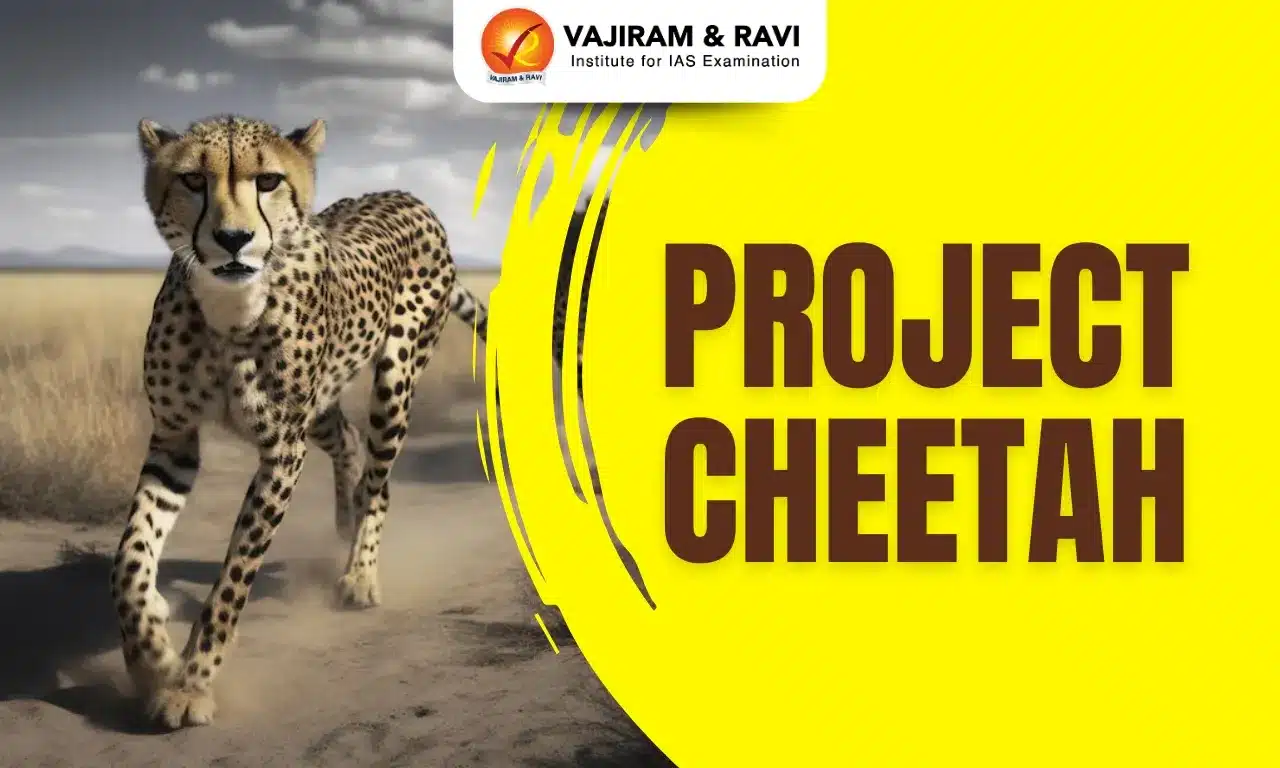
Project Cheetah

Project Cheetah Latest News

  • Recently, Madhya Pradesh CM released CCB-2, a three-year-old female cheetah brought from Botswana, into Gandhi Sagar Wildlife Sanctuary. 
  • The relocation from Kuno National Park aims to establish Gandhi Sagar as a viable second home for cheetahs in MP and strengthen the long-term conservation strategy under Project Cheetah.
  • The move comes shortly after KGP12, an India-born female cheetah, gave birth to four cubs at Kuno National Park, marking an important milestone for the programme.

Project Cheetah

  • Genesis: Discussions to bring the Cheetah back to India were initiated in 2009 by the Wildlife Trust of India. 
  • Plan: Under the ‘Action Plan for Reintroduction of Cheetah in India’, 50 cheetahs to be brought from African countries to various national parks over 5 years. 
  • Most suitable site - Kuno Palpur National Park (KNP) in MP: 
    • Amongst the surveyed sites of the central Indian states, KNP has been rated as the most suitable habitat with adequate prey base. 
    • It is assessed to be capable of supporting 21 Cheetahs and is likely the only wildlife site in the country where villages have been completely relocated from within the park.
    • Kuno also provides the possibility of harbouring four of India's big cats - tiger, lion, leopard and Cheetah, enabling them to coexist as they have in the past.
  • Other recommended sites: Nauradehi Wildlife Sanctuary and Gandhi Sagar Wildlife Sanctuary of MP; Shahgarh bulge and Mukundara Tiger Reserve of Rajasthan.
  • First reintroduction:
    • India’s cheetah reintroduction programme began in (September) 2022, with African cheetahs being brought to India after the species had become extinct in the country.
    • The programme is gradually moving beyond simply introducing individual animals towards creating multiple viable habitats and a sustainable, interconnected cheetah population.
  • Rise in population:
    • The birth of four cubs at Kuno is particularly significant because their mother, KGP12, was herself born in India to a cheetah brought from South Africa. 
    • Thus, the cubs represent the second generation of cheetahs born on Indian soil. The latest births reportedly took India’s cheetah population to 56.

Why Gandhi Sagar Matters

  • Location: 
    • The sanctuary (notified in 1974) is spread across (an area of 368.62 sq km) the districts of Mandsaur and Neemuch in western MP, right on the border with Rajasthan.
    • The Chambal river cuts the sanctuary into two almost equal halves and the Gandhi Sagar dam lies within the area of the sanctuary.
  • Ecosystem:
    • The savanna ecosystem - comprising open grasslands interspersed with dry deciduous trees and shrubs, belongs to the sanctuary. 
    • However, the riverine valleys of the sanctuary are evergreen.
  • Cheetah reintroduction: 
    • It became India’s second cheetah habitat after Kuno when two male cheetahs, Pawak and Prabhas, were relocated there in (April) 2025.
    • With the arrival of CCB-2, Gandhi Sagar now has four cheetahs—two males and two females.
    • The addition of another female is expected to improve the prospects of breeding and population establishment at the sanctuary.

Significance of the Relocation

  • Geographic diversification: Concentrating the population at a single site can increase vulnerability to disease, ecological disturbances and other risks. Gandhi Sagar provides an additional habitat.
  • Breeding potential: A balanced male-female composition can improve the prospects of establishing a breeding population.
  • Landscape-level conservation: Project Cheetah seeks to develop multiple suitable habitats rather than depend exclusively on Kuno.
  • Long-term population viability: The broader objective of Project Cheetah is not merely to increase the number of cheetahs but to establish ecologically viable, genetically diverse and sustainable populations across suitable landscapes.
  • Boon to the ecosystem: Conserve the big cat, save not just the prey base (including certain threatened species), but also other endangered species of grasslands in the region. They are not a threat to humans and do not attack large livestock either.

Way Forward

  • Strengthen habitat management and prey availability.
  • Monitor cheetah health, mortality and reproductive success scientifically.
  • Maintain adequate genetic diversity through carefully planned translocations.
  • Develop wildlife corridors and landscape connectivity where feasible.
  • Ensure community participation and minimise human–wildlife conflict.
  • Continuously assess carrying capacity before expanding the population.

Conclusion

  • The return of cheetahs to India is an important example of species reintroduction and ecological restoration. 
  • Gandhi Sagar’s development as a second cheetah habitat expands the geographical footprint of Project Cheetah and supports the objective of creating a self-sustaining wild population.
  • For Madhya Pradesh, which already hosts the country’s principal cheetah population at Kuno, Gandhi Sagar could become an important complementary landscape for the species.

Source: IE

Project Cheetah

Q1: What is the significance of Gandhi Sagar Wildlife Sanctuary for Project Cheetah?

Ans: It provides a second cheetah habitat in India, enabling geographical diversification, breeding, etc.

Q2: Why is the birth of four cubs at Kuno National Park significant?

Ans: The cubs represent the 2nd generation of cheetahs born in India, indicating successful reproduction and adaptation.

Q3: What are the major objectives of Project Cheetah?

Ans: To establish self-sustaining, genetically diverse and viable cheetah populations through species reintroduction.

Q4: How does habitat diversification strengthen wildlife conservation?

Ans: It facilitates population growth and genetic diversity, and improves resilience against disease and environmental disturbances.

Q5: What measures are essential for the long-term success of cheetah reintroduction in India?

Ans: Success requires genetic monitoring, disease surveillance and community participation to minimise human–wildlife conflict.

India-EU FTA: Copyright Rules and India’s Digital Sovereignty

India EU FTA

India-EU FTA Latest News

  • The European Commission has formally asked EU member states to approve the signing and conclusion of the India-EU Free Trade Agreement. Details of the commitments in covered areas, including intellectual property, are now public.
  • The draft IP Chapter carries detailed copyright provisions. Experts argue that these provisions could force amendments to India's Copyright Act, 1957, and weaken exceptions that students, researchers, archivists and internet service providers currently rely on.

The Structural Asymmetry

  • India's Copyright Act conforms to international IP treaties, including the WIPO Copyright Treaty (WCT) and the TRIPS Agreement. 
  • The draft chapter affirms both parties' commitment to these treaties. But it does something curious.
  • It omits the WCT from the National Treatment clause (Article 10.8), while retaining the WCT's enforcement mandates.

Why This Matters

  • The WCT was adopted specifically to protect works in the digital environment, particularly software and databases.
  • It also provides for Technological Protection Measures (TPMs).
  • Crucially, its Article 10 permits limitations and exceptions to copyright for digital works.
  • Excluding the WCT from National Treatment means these flexibilities would no longer be available to India.
  • Footnote 1 of Article 10.8(1) deepens the problem. It expands "protection" to cover enforcement against circumvention of TPMs (Article 10.18) and Rights Management Information (Article 10.19).
  • The result is an imbalance. The treaty's enforcement obligations are binding; its public-interest exceptions are excluded. 
  • The WCT's core principle — balancing authors' rights against public interest in education and research — is abandoned, leaving only a rigid enforcement mandate.

The Narrow Three-Step Test

  • Article 10.21 of the FTA introduces a narrow "three-step test" for limitations and exceptions, borrowed from EU copyright statutes.
  • If India's existing exceptions are not expressly preserved, foreign rightsholders could challenge the fair dealing provisions under Section 52 of the Copyright Act. 
  • This includes transient or incidental storage of a work purely in the technical process of electronic transmission. 
  • Under Article 10.11 of the FTA, such acts could attract civil and criminal remedies.

Threat to Section 65A

  • The imbalance directly threatens Section 65A of the Copyright Act, which governs TPMs.
  • Section 65A(2) provides exceptions permitting circumvention of digital locks for specified lawful purposes. 
  • Because of this, a student or researcher who bypasses a lock to perform an act protected under Section 52 attracts no criminal liability today. 
  • A strict anti-circumvention regime under the FTA would erode this safeguard.

Chilling Effect on Classrooms and Labs

  • Indian law today lets students and researchers open up software to test compatibility or find security flaws. 
  • Librarians may copy digital works to preserve old books. Strict anti-circumvention rules would make both illegal.
  • Paywalls and Digital Rights Management (DRM) would then override public-interest protections that Indian courts secured, most famously in the DU Photocopy Case.
    • The DU Photocopy Case was a landmark intellectual property lawsuit in India where top publishers sued a Delhi University photocopy kiosk for copyright infringement. 
    • In 2016, the Delhi High Court ruled that making educational coursepacks is legal under fair use.

Threat to Internet Service Providers

  • India currently shields intermediaries from liability for the temporary, transient copies created in RAM and server caches during routine data routing. 
    • This protection flows from Sections 52(1)(b) and (c). 
    • The notice-and-takedown regime under Rule 75 of the Copyright Rules, 2013 rests on these statutory safe harbours.
  • The draft text undermines this. Article 10.11(a) grants rightsholders an exclusive, unqualified right over all "temporary or permanent" reproductions.
  • This contradicts the Agreed Statements to Articles 8 and 10 of the WCT, which exempt transient network copies from liability.
  • With the WCT excluded from the National Treatment exception, Indian ISPs could face systemic liability from EU rightsholders.

Beyond Parliament's Mandate

  • Analysts contend that by accepting the draft text, negotiators appear to have gone beyond the mandate of Parliament, as reflected in the Copyright Act, 1957. 
  • If uncorrected, Parliament would be obliged to delete digital-work exceptions from the Act — even where the user was engaged in legitimate, lawful research.
  • Negotiators must press to re-insert the WCT into the National Treatment clause and preserve India's statutory copyright flexibilities.
  • The underlying argument is that India's rise as a digital power rests on open access to knowledge, robust educational inquiry and independent technical research. 
  • Deepening trade ties with the EU is important, but not at the cost of digital sovereignty.

Conclusion

  • The dispute is not about protecting creators. It is about who decides the balance between protection and access. 
  • A treaty that imports enforcement while leaving exceptions behind is not balanced law. India must negotiate flexibilities in, not trade them away.

Source: TH 

India-EU FTA FAQs

Q1: What is the main concern with the India-EU FTA copyright provisions?

Ans: The India-EU FTA could narrow copyright exceptions relied upon by students, researchers, archivists and internet service providers under Indian law.

Q2: How could the India-EU FTA affect India's Copyright Act?

Ans: The India-EU FTA could require amendments to India's Copyright Act by imposing stricter enforcement obligations and limiting existing digital-work exceptions.

Q3: Why is the WCT important under the India-EU FTA?

Ans: The India-EU FTA's treatment of the WCT is important because excluding it from national treatment could remove important copyright flexibilities.

Q4: How could the India-EU FTA affect students and researchers?

Ans: The India-EU FTA could restrict lawful circumvention of digital locks, potentially affecting software testing, security research, compatibility work and educational activities.

Q5: Why are internet service providers concerned about the India-EU FTA?

Ans: The India-EU FTA could expose Indian internet service providers to liability for temporary digital copies created during routine data transmission and caching.

Enquire Now