
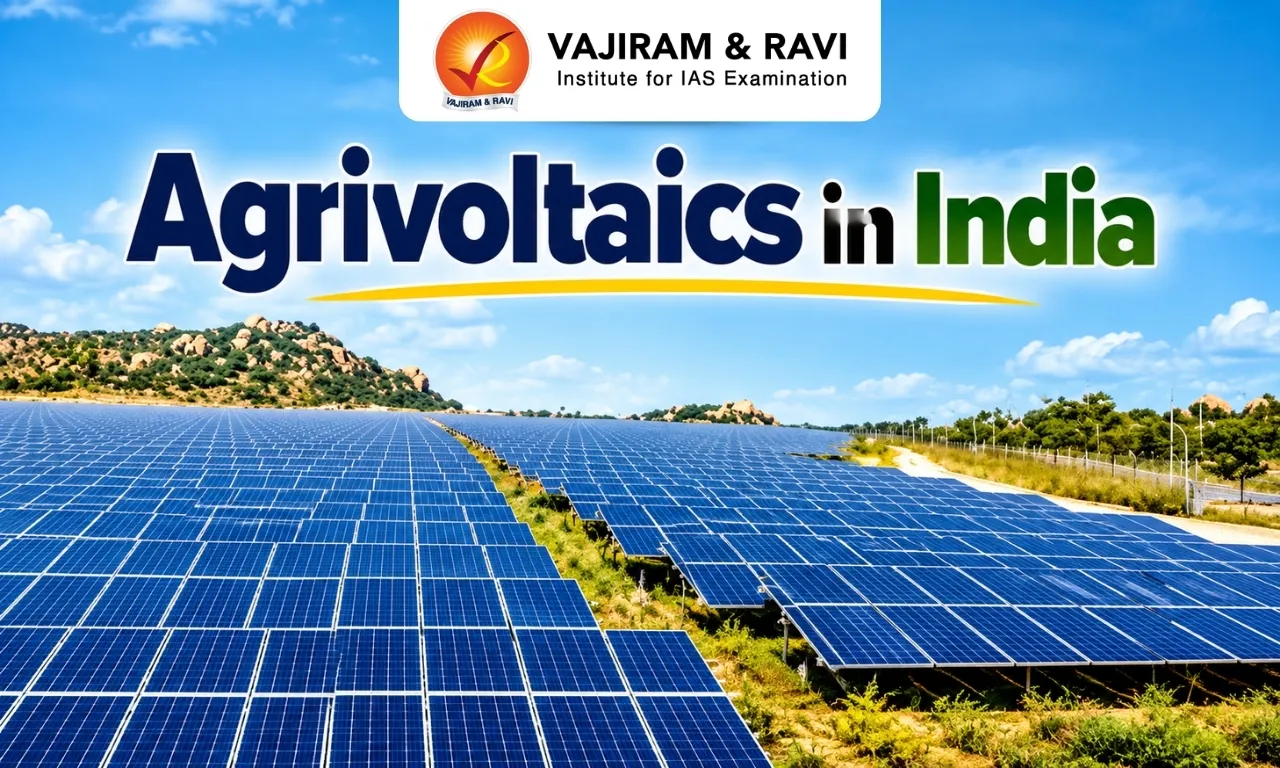
Agrivoltaics in India: Grow Crops and Generate Solar Power

Agrivoltaics in India

Agrivoltaics in India Latest News

  • The Government recently announced plans to introduce agri-photovoltaics (agrivoltaics) under the second phase of PM-KUSUM (Pradhan Mantri Kisan Urja Suraksha evam Utthaan Mahabhiyan) — its flagship scheme to solarise irrigation. 
  • The approach combines solar power generation with crop cultivation on the same land, letting farmers keep growing crops while earning extra income from electricity generation. 
  • The announcement came at the Agrivoltaics World Conference 2026 – “Powering the Global South” in New Delhi on October 25.

What Is Agrivoltaics?

  • Agri-photovoltaics (agri-PV) involves installing solar panels on elevated structures over agricultural land.
  • This lets farmers continue cultivation underneath, while electricity is generated from the same plot.
  • Technology-wise, the photovoltaic panels themselves are identical to those used in conventional ground-mounted solar projects.
  • The key difference: the additional infrastructure needed to elevate the panels, leaving enough space below for farming activities to continue.
  • As per MNRE, panels are installed at a height of 3.5 to 4 metres above ground — enough to allow routine agricultural operations, including movement of machinery, without interruption.

Why the Government Is Pushing This

  • The govt said the approach could address the shortage of land for solar projects while letting farming continue beneath elevated panels.
  • Around 30% of India’s 160 million hectares of cropland could be suitable for agrivoltaic projects.
  • Potential capacity estimated at 1-2 terawatts (TW), or 1,000-2,000 gigawatts (GW) — a massive scale compared to India’s current total renewable capacity.
  • Agri-PV is expected to mainly help states with less non-agricultural land, enabling large-scale solar deployment without compromising food security requirements.

Not All Crops Are Suitable

  • Agrivoltaics doesn’t work uniformly across all crop types.
  • Government assessment studies show agri-PV is suitable for fruits and leafy vegetables.
  • It has not been found suitable for crops like rice and sugarcane — meaning the approach currently applies to a limited crop range.

The Cost Factor

  • Agri-photovoltaic projects cost around 25-30% more than conventional ground-mounted solar projects, due to the additional civil and structural infrastructure needed to elevate panels.
  • This higher upfront cost is a key challenge for scaling the model, especially for small and marginal farmers.

Concerns Over Crop Yields and Farmers’ Interests

  • Most agri-PV projects in India are still at the pilot stage.
  • The government faces the challenge of developing a policy framework that allows solar power generation to expand without compromising crop yields, soil health, or farmers’ livelihoods.
  • Union Agriculture Minister Shivraj Singh Chouhan, speaking at the conference, flagged several issues needing resolution before the approach can be scaled up.
  • Key farmer-equity concern: Over 85% of India’s farmers are small and marginal, with average landholding just 0.96 hectares.
  • The minister stressed that the policy must be designed to benefit small farmers and protect agricultural production — not sideline them in favour of large-scale solar developers.
  • The model must ensure farmers don’t lose control of their agricultural land or suffer a decline in crop production.
  • Since most projects remain at the pilot stage, their impact on farming must be properly assessed before scaling up.

Conclusion

  • Agrivoltaics represents a genuinely promising solution to one of India’s toughest land-use dilemmas: how to expand solar capacity without competing with agriculture for scarce land. 
  • With an estimated 1-2 terawatt potential, the approach could meaningfully advance India’s renewable energy goals while giving farmers a new income stream. 
  • However, with over 85% of India’s farmers being small and marginal landholders, and projects still largely at the pilot stage, the real test will be whether the policy framework protects farmer control over land, crop yields, and livelihoods — rather than letting higher project costs and limited crop suitability turn agrivoltaics into a model that benefits large developers more than the smallholders it is meant to serve.

Source: IE | DTE

Agrivoltaics in India FAQs

Q1: What is agrivoltaics in India?

Ans: Agrivoltaics in India involves installing elevated solar panels over agricultural land, allowing farmers to cultivate suitable crops underneath while generating electricity from the same plot.

Q2: What are the benefits of agrivoltaics in India?

Ans: Agrivoltaics in India can reduce competition for land, expand renewable energy capacity, support continued cultivation, and provide farmers with an additional source of income.

Q3: Which crops are suitable for agrivoltaics in India?

Ans: Agrivoltaics in India is considered suitable for fruits and leafy vegetables, while government assessments have not found it suitable for crops such as rice and sugarcane.

Q4: How much does agrivoltaics in India cost?

Ans: Agrivoltaics in India costs approximately 25–30% more than conventional ground-mounted solar projects because elevated panels require additional civil works and structural infrastructure.

Q5: What are the major challenges of agrivoltaics in India?

Ans: Agrivoltaics in India faces higher installation costs, limited crop suitability, uncertain effects on yields and soil health, and concerns about protecting small farmers’ land rights and livelihoods.
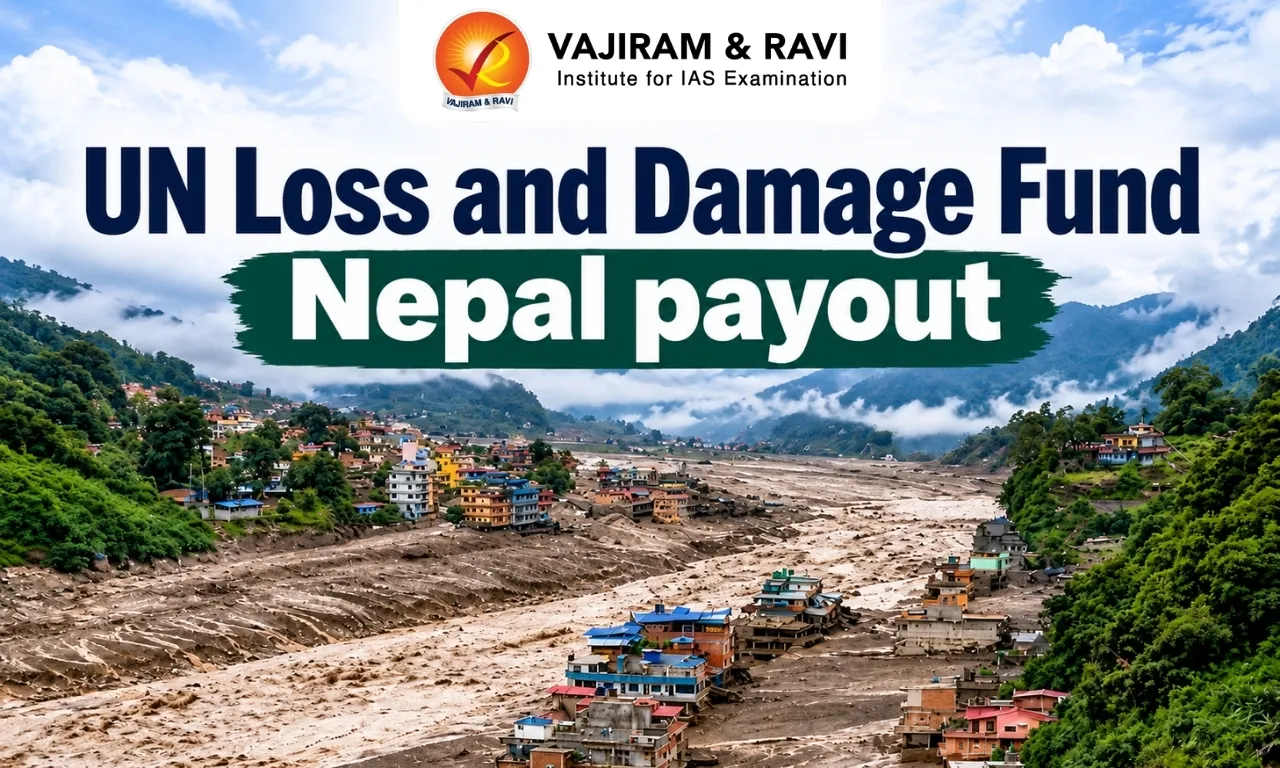

UN Loss and Damage Fund Nepal Payout: Significance and Challenges

UN Loss and Damage Fund Nepal Payout

UN Loss and Damage Fund Nepal Payout Latest News

  • The UN climate convention’s Loss and Damage Fund has approved a $21.6 million payout (approx. ₹205 crore) to Nepal — its first-ever country-specific allocation — to aid rebuilding after devastating August 2026 floods. 
  • Nepal’s own request was for $20 million (~₹190 crore), against an estimated $4.75 billion (~₹44,600 crore) recovery and reconstruction need — making the payout extremely small relative to the actual damage. 
  • Still, it marks the beginning of implementation of a new international loss-and-damage regime, arriving weeks before COP31 opens in Turkiye.

What Triggered This

  • On August 26, 2026, an ice-and-rock avalanche — linked by experts to human-accelerated climate change — triggered flooding along the Bhotekoshi-Trishuli-Narayani river system.
  • Nepal’s estimated losses: at least $2.69 billion, with recovery needs of at least $4.71-4.75 billion.

What Is the Loss and Damage Fund?

  • Formally called the Fund for Responding to Loss and Damage (FRLD) — created to help developing countries vulnerable to climate change cope with economic and non-economic losses, particularly the most fragile nations facing climate-related disasters.
  • Operates under the UNFCCC’s financial mechanism.
  • Origin: Agreed at COP27 (2022); Governing Instrument adopted at COP28 (2023).
  • Current Funding Status (as of March 2026): 
    • 27 countries pledged $822.06 million (~₹7,809.6 crore); $629.70 million as grant contributions.
    • Start-up allocation: $342 million, with at least half reserved for small island states and least developed countries.
  • Top 5 donors to FRLD: Italy ($110.31M), France ($108.23M), UAE ($100M), Germany ($98.24M), UK ($91.92M).
  • First funding call drew 176 requests from 119 countries, worth ~$2.8 billion; Board deferred decisions to December 2026.
  • India has also made three requests to the FRLD — underscoring that even large developing economies are turning to this fund for climate-disaster support.

Why the Nepal Decision Is Significant

  • The first time the Fund has earmarked money for a specific country — decided at its first “extraordinary meeting” (virtual, October 22, 2026).
  • The Board approved a pilot mechanism letting Nepal submit its request outside the normal closed submission window; future exceptions need separate Board approval.
  • Nepal’s case is being treated as a template for how the mechanism should ideally work — swift consideration and quick access to money for disaster-hit nations.

How the Money Actually Flows

  • Of the $21.6 million approved, $1.6 million is oversight fees for implementing organisations.
  • Nepal must submit a formal funding request, reviewed at the Fund’s tenth meeting in Manila, December 2026 — money releases only after this approval.
  • The Fund hasn’t disclosed cash holdings beyond signed contributions — disbursement depends on donors honouring pledges.

The Larger Climate Finance Shortfall

  • Huge Demand, Limited Supply: Most pending FRLD requests involve both economic and non-economic losses — extreme weather, slow-onset events like glacial melt, sea-level rise, biodiversity loss, and desertification — requiring resilience-building, early warning systems, and psychosocial support for affected populations.
  • Broken Promises on Climate Finance: Developed nations had pledged to mobilise $100 billion/year between 2020-2025 — a target never fully delivered.
    • In 2024, developing countries assessed their actual climate finance need at $1.3 trillion/year — yet developed nations committed only to $300 billion/year, starting only from 2035.
    • Under the UNFCCC and the 2015 Paris Agreement, developed countries are mandated to fund developing nations’ climate response — but just as they’ve lagged on greenhouse gas reduction targets, they’ve similarly failed to fully meet their financial obligations.

Credibility Concerns

  • Experts noted the Fund still operates like a conventional development fund — an 11-step funding cycle from origination to Board approval, with the World Bank as interim trustee. 
  • The US withdrew its board representation in January 2025 (Trump administration), part of its Paris Agreement exit.
  • In Nepal’s case, the analysts called it landmark but noted the sum is less than 0.5% of Nepal’s reconstruction cost, risking delays since funds release only after further approvals.

Conclusion

  • The Nepal payout is a genuine procedural breakthrough, proving the Loss and Damage Fund can act on a specific crisis rather than remain an abstract pledge-collection exercise. 
  • But it also lays bare a much larger pattern: the persistent gap between what developed nations promise and what they actually deliver on climate finance — from the unmet $100-billion annual target to a $300-billion commitment pushed out to 2035, against an assessed need of $1.3 trillion a year. 
  • For Nepal, and for India’s own pending FRLD requests, this episode is a reminder that symbolic firsts matter, but without faster disbursement and genuinely scaled-up funding, the global loss-and-damage architecture risks remaining more aspiration than action.

Source: TH | ToI

UN Loss and Damage Fund Nepal Payout FAQs

Q1: What is the UN Loss and Damage Fund Nepal payout?

Ans: The UN Loss and Damage Fund Nepal payout is a $21.6 million allocation approved to support Nepal’s recovery after devastating floods in August 2026.

Q2: Why is the UN Loss and Damage Fund Nepal payout significant?

Ans: The UN Loss and Damage Fund Nepal payout marks the first country-specific allocation, demonstrating that the international climate fund can respond to an actual disaster.

Q3: How much funding did Nepal receive from the Loss and Damage Fund?

Ans: The UN Loss and Damage Fund Nepal payout totals $21.6 million, including $1.6 million in oversight fees for implementing organisations, subject to further approval.

Q4: What challenges affect the UN Loss and Damage Fund Nepal payout?

Ans: The UN Loss and Damage Fund Nepal payout faces delays, additional approval requirements, uncertain donor contributions, and a funding amount far below Nepal’s estimated reconstruction needs.

Q5: How does the UN Loss and Damage Fund Nepal payout affect developing countries?

Ans: The UN Loss and Damage Fund Nepal payout offers a potential model for disaster assistance, but it highlights the urgent need for faster disbursement and greater climate finance.

Judicial Restraint in India – Judicial Propriety and Judicial Speech

Judicial Restraint

Judicial Restraint Latest News

  • Supreme Court Judge Ujjal Bhuyan’s recent remarks on voter deletions and the right to vote have revived debate over the limits of judicial speech, judicial propriety and comments on matters pending before courts.

Meaning and Importance of Judicial Restraint

  • Judicial restraint refers to the exercise of caution by judges in interpreting laws, reviewing the actions of other branches of government and making public statements that may affect judicial proceedings.
  • It does not require judges to remain silent on every public issue. Rather, it seeks to preserve judicial independence, impartiality and public confidence in the administration of justice.
  • Judges occupy a unique constitutional position: they must protect fundamental rights and examine governmental actions while ensuring that their conduct does not create an impression of political alignment or prejudgment.
  • Judicial restraint is therefore important in maintaining the balance between judicial accountability, freedom of expression and the impartial administration of justice.

The Debate over Justice Ujjal Bhuyan’s Remarks

  • On October 4, 2026, Justice Ujjal Bhuyan, speaking at a moot court competition at NALSAR University of Law, stated that the right to vote is constitutional and integral to the basic structure of the Constitution. 
  • He argued that a process disenfranchising millions would be arbitrary and violate Articles 14 and 326. 
  • He also emphasised that voters should receive notice and an opportunity to be heard before their names are deleted, except in cases of death.
  • His remarks came while litigation concerning the Special Intensive Revision (SIR) of electoral rolls in West Bengal remained pending before the Supreme Court.
  • Former Chief Justice of India B.R. Gavai and other retired judges questioned whether commenting on an ongoing controversy was consistent with judicial propriety.

Indian Standards of Judicial Conduct

  • The Restatement of Values of Judicial Life, adopted by the Supreme Court's Full Court on May 7, 1997, establishes ethical expectations for judges.
  • Clause 8 states that judges should not enter public debate or express views on political matters or matters pending, or likely to arise, for judicial determination. Clause 1 requires judicial conduct that sustains public confidence in impartiality.
  • Although the Restatement does not prescribe a separate sanction of its own, it has been referred to in judicial decisions and remains an important ethical framework.
  • The central concern is not whether judges can discuss constitutional law, but whether a public statement could reasonably create an impression that a judge has prejudged a dispute that may come before them.

Constitutional Principles Governing the Right to Vote

  • The controversy also highlights the constitutional and statutory framework governing electoral participation.
  • Article 14: Guarantees equality before the law and equal protection of the laws, prohibiting arbitrary State action.
  • Article 326: Provides for elections to the Lok Sabha and State Legislative Assemblies on the basis of adult suffrage, subject to constitutional and statutory qualifications.
  • Articles 325 and 326: Support an inclusive electoral framework by prohibiting specified forms of exclusion and establishing adult suffrage.
  • Representation of the People Act, 1950: Provides the statutory framework for preparing and revising electoral rolls.
  • Rule 21A of the Registration of Electors Rules, 1960: Provides procedural requirements relating to notice, inquiry, hearing and reasoned determination before deletion of names in applicable circumstances.
  • In its May 27, 2026 decision in Association for Democratic Reforms v. Election Commission of India, the Supreme Court upheld the Bihar SIR while reiterating that eligible electors must be included and ineligible persons excluded through lawful procedures.
  • The ruling provides important context for Justice Bhuyan’s remarks: the constitutional right to vote is protected, but electoral rolls must also be maintained according to the law.

Comparative Standards of Judicial Speech

  • International standards recognise that judicial independence does not require complete silence on matters of law and public importance.
  • Bangalore Principles of Judicial Conduct
    • The Bangalore Principles recognise judicial freedom to write, lecture and teach on legal issues, judicial independence and the administration of justice. 
    • At the same time, judges should avoid comments that could reasonably affect proceedings before them or matters likely to come before them.
  • United States
    • The US Supreme Court's 2023 Code of Conduct allows judges to speak, write, lecture and teach, while cautioning against comments on the merits of pending or impending cases.
  • United Kingdom
    • During the 2016 Brexit litigation, Lady Hale outlined competing legal arguments but stopped short of expressing a conclusion because the case was expected to come before the Supreme Court.

Judicial Independence and Public Engagement

  • The debate over Justice Bhuyan also raises a broader question about the public role of judges.
  • Judges have addressed issues such as judicial appointments, executive influence, civil liberties, restrictive bail conditions and the criminalisation of dissent. Such interventions can contribute to public understanding of constitutional governance.
  • However, public visibility can also create concerns when remarks become closely connected to pending litigation. A judge's earlier decisions or public speeches should not automatically be treated as predictors of how they would decide a future case.
  • The appropriate assessment depends on the subject of the speech, the specificity of its conclusions and its proximity to judicial proceedings. 
  • Where a judge's remarks raise a reasonable concern about impartiality in a particular case, recusal may need to be considered.

Source: TH

Judicial Restraint FAQs

Q1: What is judicial restraint?

Ans: Judicial restraint involves exercising caution in judicial decision-making and public commentary to preserve constitutional balance and judicial impartiality.

Q2: What is the Restatement of Values of Judicial Life?

Ans: It is an ethical framework adopted by the Supreme Court in 1997 that sets standards for judges’ conduct, including restrictions on public comments about pending matters.

Q3: Why were Justice Ujjal Bhuyan’s remarks controversial?

Ans: His remarks concerned voter deletions while related SIR litigation was pending, raising questions about whether judicial commentary approached prejudgment.

Q4: Can judges publicly discuss constitutional issues?

Ans: Yes, judges can contribute to legal education and public discussion, but they should avoid comments that could reasonably affect pending or impending proceedings.

Q5: What is the central principle governing judicial speech?

Ans: Judges should be able to explain legal principles while avoiding statements that create a reasonable impression of bias or prejudgment in a specific case.

Enquire Now

