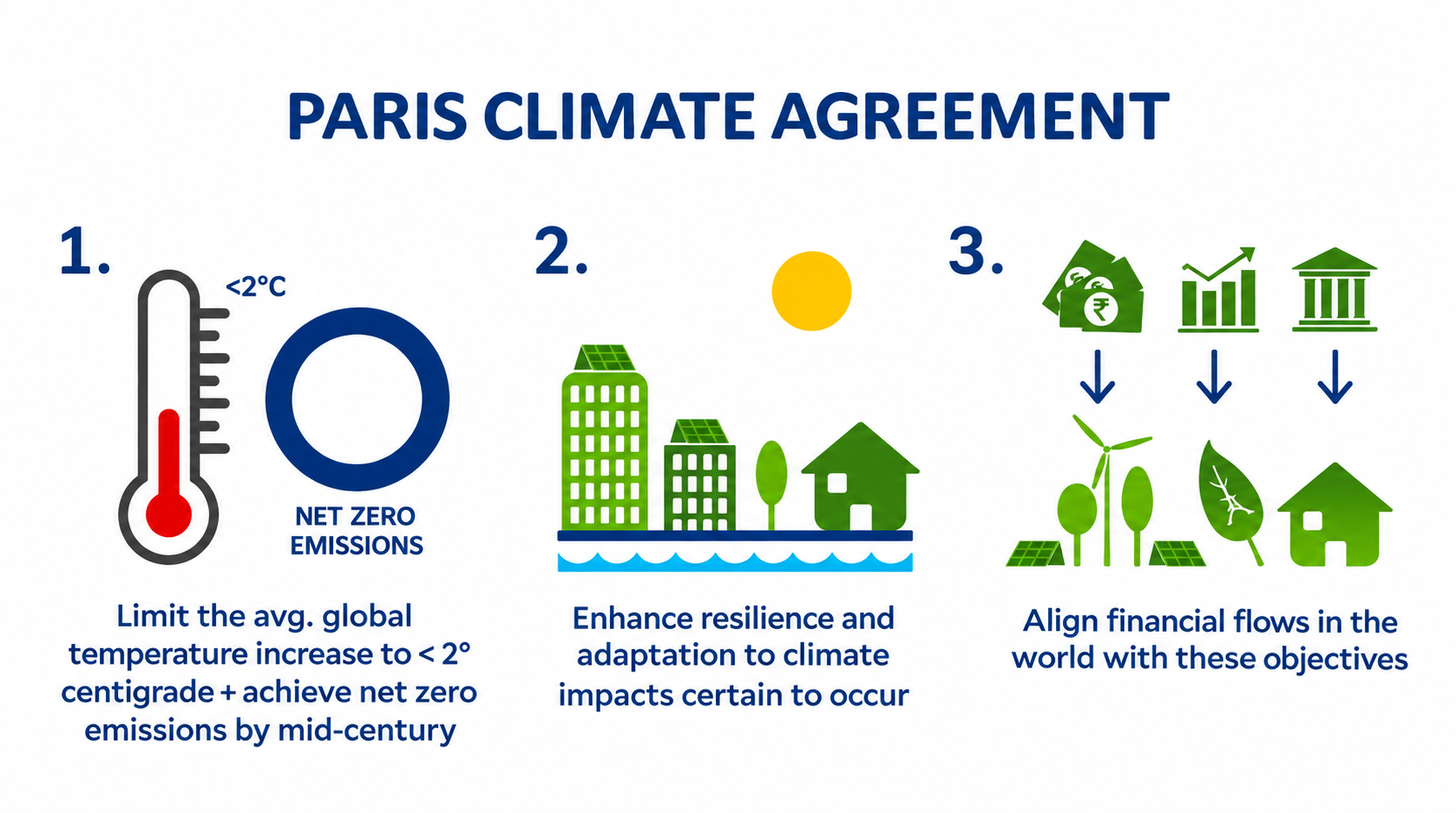
The Paris Agreement is a landmark international climate treaty adopted under the UNFCCC in 2015 to strengthen global action against climate change. It seeks to keep the rise in global average temperature well below 2°C while pursuing efforts to limit it to 1.5°C. The Paris Agreement establishes a framework based on nationally determined contributions (NDCs), transparency, climate finance, adaptation, technology transfer and periodic global stocktakes.
The Paris Agreement reflects the principle of common but differentiated responsibilities while requiring progressively stronger climate commitments from countries. India has played an active role, submitting successive NDCs and aligning its climate action with sustainable development. The Agreement has strengthened global cooperation, but challenges remain in ambition, implementation, finance, technology and climate equity.
Paris Agreement Overview
The Paris Agreement is the landmark global climate treaty under the UNFCCC that brings countries together to limit global warming, strengthen resilience, mobilise climate finance and progressively increase climate ambition.
- Adopted at COP21 in Paris on 12 December 2015, the Agreement entered into force on 4 November 2016. It aims to keep the rise in global average temperature well below 2°C above pre-industrial levels while pursuing efforts to limit warming to 1.5°C.
- The Paris Agreement is a legally binding international treaty under the UNFCCC that establishes a common framework for mitigation, adaptation, climate finance, transparency and progressively stronger national climate action.
- Unlike the Kyoto Protocol's largely top-down approach, the Paris Agreement follows a bottom-up architecture, allowing each country to determine its own climate commitments through NDCs.
- At the same time, countries are expected to progressively increase their ambition over time.
Paris Agreement Background and Need
The background of the Paris Agreement lies in the limitations of earlier climate arrangements and the need for a universal framework involving both developed and developing countries.
The international climate regime evolved through several stages:
- 1992 – UNFCCC: Established the basic framework for international climate cooperation.
- 1997 – Kyoto Protocol: Imposed quantified emission-reduction commitments mainly on developed countries.
- 2009 – Copenhagen: Strengthened negotiations towards a broader post-2020 agreement.
- 2011 – Durban Platform: Initiated negotiations for a new legal instrument applicable to all Parties.
- 2014 – Lima: Advanced the preparation of nationally determined climate commitments.
- 2015 – Paris: Countries adopted the universal Paris Agreement.
- The Paris framework was therefore designed to address the limitations of a system in which binding mitigation obligations were concentrated primarily among developed countries.


Paris Agreement Objectives
The objectives of the Paris Agreement combine temperature stabilisation with adaptation, financial support and long-term transformation towards climate-resilient development.
- Limit global temperature rise: The Agreement seeks to keep warming well below 2°C above pre-industrial levels while pursuing efforts to limit it to 1.5°C.
- Strengthen adaptation: It seeks to increase the capacity of countries to adapt to climate impacts, strengthen resilience and reduce vulnerability.
- Align financial flows: The Agreement aims to make financial flows consistent with pathways towards low greenhouse-gases emissions and climate-resilient development.
- Increase climate ambition: Countries are expected to progressively strengthen their climate commitments rather than simply maintain existing levels of ambition.
- Promote sustainable development: Climate action is intended to be compatible with sustainable development and efforts to eradicate poverty.
- Support developing countries: The Agreement recognises the importance of financial, technological and capacity-building support, particularly for developing countries.
Paris Agreement Working
The working of the Paris Agreement is based on a repeating cycle of national climate plans, implementation, reporting, global assessment and stronger commitments.
- Step 1: Countries prepare NDCs: Each Party prepares and communicates its Nationally Determined Contribution (NDC), describing its intended climate actions.
- Step 2: Implement climate policies: Countries implement domestic policies relating to renewable energy, energy efficiency, transport, forests, industry, adaptation and other sectors.
- Step 3: Report progress: The Enhanced Transparency Framework requires countries to provide information on emissions, progress towards NDCs, adaptation and support.
- Step 4: Global Stocktake: Every five years, the collective progress of countries is assessed through the Global Stocktake (GST).
- Step 5: Increase ambition: The findings of the Global Stocktake inform subsequent NDCs, creating a cycle of progressively stronger climate action
Paris Agreement Important Articles
The important articles of the Paris Agreement define its core framework for mitigation, adaptation, climate finance, transparency, cooperation and accountability among Parties.
- Article 2 – Purpose and Long-Term Goals: Article 2 establishes the overarching objectives of the Paris Agreement. It provides three major directions:
- Temperature goal: Hold the increase in global average temperature to well below 2°C above pre-industrial levels and pursue efforts to limit it to 1.5°C.
- Adaptation: Strengthen the ability of countries to adapt to climate change, build resilience and reduce vulnerability.
- Finance: Make financial flows consistent with a pathway towards low greenhouse-gas emissions and climate-resilient development.
- It also states that implementation should reflect equity and the principle of common but differentiated responsibilities and respective capabilities (CBDR-RC) in light of different national circumstances.
- Article 3 – Nationally Determined Contributions: Requires ambitious climate action based on equity and national circumstances.
- Parties should ensure progression in successive climate contributions.
- Developed countries should continue to take the lead.
- Provides the basis for progressively strengthening NDCs.
- Article 4 – Mitigation and NDCs: Provides the framework for GHG mitigation.
- Parties must submit successive NDCs every 5 years, showing progression and the highest possible ambition, and pursue domestic mitigation measures to achieve them.
- Aims for global emissions to peak as soon as possible, followed by rapid reductions to achieve net-zero in the second half of the century.
- Developed countries should lead through economy-wide absolute emission-reduction targets.
- Article 5 – Forests and Carbon Sinks: Promotes the conservation and enhancement of GHG sinks and reservoirs, including forests.
- Recognises REDD+ and encourages incentives for forest conservation and sustainable management.
- Article 6 – International Cooperation and Carbon Markets: Article 6 provides a framework for voluntary cooperation among countries in implementing their NDCs. It contains three important areas:
- Article 6.2: Allows countries to cooperate through internationally transferred mitigation outcomes (ITMOs), subject to accounting rules.
- Article 6.4: Establishes a UN-supervised mechanism for generating and transferring emission reductions.
- Article 6.8: Promotes non-market approaches, such as cooperation involving finance, technology and capacity building without relying on carbon trading.
- A major objective is to ensure environmental integrity and avoid double counting of emission reductions.
- Article 7 – Adaptation: Establishes a global goal on adaptation to enhance adaptive capacity, strengthen resilience and reduce climate vulnerability.
- Promotes country-driven, participatory, gender-responsive and transparent adaptation planning and implementation.
- Recognises the adaptation needs of developing and vulnerable countries and encourages international cooperation and support.
- Article 8 – Loss and Damage: Article 8 recognises the importance of averting, minimising and addressing loss and damage associated with climate change. It covers issues such as:
- Extreme weather events
- Slow-onset climate impacts
- Sea-level rise
- Loss of livelihoods
- Loss of ecosystem
- Economic and non-economic losses
- Displacement and migration
- Article 8 does not provide a basis for liability or compensation.
- Article 9 – Climate Finance: Requires developed countries to provide climate finance to developing countries for mitigation and adaptation.
- Other countries may contribute voluntarily.
- Developed countries should report finance provided and mobilised.
- Provides the basis for global climate-finance discussions, including the New Collective Quantified Goal on Climate Finance (NCQG).
- Article 10 – Technology Development and Transfer: Promotes technology development and transfer to support climate action.
- Establishes a technology framework and encourages support for developing countries.
- Covers mitigation and adaptation technologies to enable low-emission, climate-resilient development.
- Article 11 – Capacity Building: Promotes capacity-building in developing countries based on country-driven needs.
- Strengthens capacity for climate action, with developed countries enhancing support and developing countries strengthening their own capacities.
- Covers planning, implementation, reporting and access to climate finance.
- Article 12 – Education, Awareness and Public Participation: Article 12 promotes public understanding and participation in climate action. It calls for strengthening:
- Climate education
- Public awareness
- Public participation
- Public access to information
- International cooperation
- Article 13 – Enhanced Transparency Framework: Article 13 establishes the Enhanced Transparency Framework (ETF). Its purpose is to build mutual trust and confidence by improving transparency regarding:
- Greenhouse-gas emissions
- Progress towards NDCs
- Adaptation efforts
- Climate finance provided and received
- Capacity-building and technology support
- Article 14 – Global Stocktake: Article 14 establishes the Global Stocktake (GST). The GST assesses collective progress towards achieving the objectives of the Paris Agreement.
- It covers mitigation, adaptation and means of implementation and support.
- It takes place every five years.
- The first GST concluded at COP28 in Dubai in 2023.
- Article 15 – Compliance Mechanism: Article 15 establishes a mechanism to facilitate implementation and promote compliance with the Paris Agreement.
- It is expert-based and facilitative.
- Article 16 – CMA: Article 16 establishes the Conference of the Parties serving as the meeting of the Parties to the Paris Agreement (CMA).
- The CMA is the principal decision-making body which reviews implementation of the Paris Agreement.
- Countries that are Parties to the UNFCCC but not yet Parties to the Paris Agreement may participate as observers.
- Article 20 – Signature and Ratification: Article 20 deals with the formal process through which countries become Parties to the Agreement.
- Article 21 – Entry into Force: Article 21 specifies when the Paris Agreement would become legally operational.
- The Agreement entered into force on 4 November 2016, after the required conditions concerning the number of Parties and their share of global greenhouse-gas emissions were fulfilled.
- Article 28 – Withdrawal: A Party may withdraw after 3 years of the Agreement’s entry into force by written notification to the Depositary.
- Withdrawal takes effect 1 year after notification or on a later specified date.
Paris Agreement and Common but Differentiated Responsibilities
The principle of Common but Differentiated Responsibilities and Respective Capabilities (CBDR-RC) remains relevant under the Paris Agreement, but it operates alongside differentiation based on national circumstances.
- The Agreement recognises that countries have different responsibilities, capabilities and national circumstances. It therefore does not impose identical numerical emission targets on every country. CBDR-RC is reflected through:
- Different national circumstances.
- Developed-country leadership in climate action.
- Financial obligations and support.
- Technology transfer.
- Capacity building.
- Special consideration for vulnerable developing countries.
- Recognition of developing countries' development priorities.
- India has consistently emphasised climate equity, CBDR-RC, sustainable development and the principle of climate justice in international climate negotiations
Paris Agreement and Nationally Determined Contributions (NDCs)
Nationally Determined Contributions are the core mechanism through which countries translate the Paris Agreement's global goals into nationally determined climate policies and measurable commitments.
- Under Article 4, every Party is required to prepare, communicate and maintain successive NDCs. NDCs are submitted every five years and are expected to represent progression beyond previous efforts. NDCs primarily communicate:
- Greenhouse-gas emission reduction
- Renewable energy
- Energy efficiency
- Forest and carbon sinks
- Adaptation
- Resilience
- Climate finance
- Technology
- Capacity building
- The first Global Stocktake concluded at COP28 in 2023 and is intended to inform the next generation of NDCs, known as NDCs 3.0.
Paris Agreement and New Collective Quantified Goal on Climate Finance
The New Collective Quantified Goal on Climate Finance represents a major development under the Paris Agreement, replacing the earlier developed-country climate-finance goal of USD 100 billion annually.
- At COP29 in Baku in 2024, Parties agreed a new goal under which developed countries would take the lead in mobilising at least USD 300 billion per year for developing countries by 2035.
- The decision also called for scaling up finance from public and private sources to at least USD 1.3 trillion annually by 2035. Significance of the NCQG
- Strengthens climate finance for developing countries.
- Supports implementation of NDCs and adaptation plans.
- Addresses mitigation and resilience needs.
- Encourages mobilisation of public and private finance.
- Provides a framework for scaling financial flows towards developing countries.
- Recognises the importance of grants, concessional finance and non-debt-creating instruments.
- The NCQG is particularly significant for developing countries that face high adaptation costs and limited fiscal space.
Paris Agreement and India
India's engagement with the Paris Agreement combines ambitious climate action with development priorities, climate justice, equity, technology transfer and the need for international financial support.
- India signed the Paris Agreement on 22 April 2016 and ratified it on 2 October 2016.
- India's climate commitments are implemented through its NDCs alongside domestic policies on renewable energy, energy efficiency, forests, electric mobility and sustainable development.
India's Original 2015 NDC
India's original NDC included three major quantified targets:
- Reduce emissions intensity of GDP by 33–35% from 2005 levels by 2030.
- Achieve about 40% cumulative installed electricity capacity from non-fossil-fuel sources by 2030.
- Create an additional carbon sink of 2.5–3 billion tonnes of CO₂ equivalent through additional forest and tree cover by 2030.
India's Updated NDC Targets (NDC 2.0)
India updated its NDC in 2022, increasing its climate ambition while retaining its emphasis on development and climate justice. The updated 2030 commitments included:
- Reduce emissions intensity of GDP by 45% from the 2005 level by 2030.
- Achieve about 50% cumulative electric power installed capacity from non-fossil-fuel-based energy resources by 2030.
- Create an additional carbon sink of 2.5–3 billion tonnes of CO₂ equivalent through additional forest and tree cover.
- Promote sustainable lifestyles through LiFE – Lifestyle for Environment.
- Mobilise domestic and international finance and technology for climate action.
India's New NDC 2031–2035 (NDC 3.0)
India's latest NDC for 2031–2035, approved by the Union Cabinet in March 2026, further increases its quantified climate targets under the Paris Agreement. The new NDC commits India to:
- Reduce emissions intensity of GDP by 47% by 2035 from the 2005 level.
- Achieve 60% cumulative installed electric power capacity from non-fossil-fuel-based energy resources by 2035.
- Create a 3.5–4.0 billion tonne CO₂-equivalent carbon sink through forest and tree cover by 2035, compared with the 2005 baseline.
Paris Agreement Recent Developments
Recent developments under the Paris Agreement have focused on implementing the first Global Stocktake, strengthening NDCs, increasing climate finance and accelerating the transition away from fossil fuels.
COP28 and First Global Stocktake
COP28 in Dubai concluded the first Global Stocktake, which found that global progress remained insufficient across mitigation, adaptation, finance and technology. It called for efforts towards:
- Tripling renewable-energy capacity globally by 2030.
- Doubling the global average annual rate of energy-efficiency improvement by 2030.
- Transitioning away from fossil fuels in energy systems in a just, orderly and equitable manner.
- Accelerating action on adaptation and resilience.
COP29 and Climate Finance
COP29 in Baku produced the new climate-finance goal of at least USD 300 billion annually by 2035, alongside efforts to scale total climate finance towards USD 1.3 trillion annually.
NDC 3.0
The next generation of NDCs is expected to be informed by the Global Stocktake and contain stronger climate ambition.
- The UNFCCC notes that NDCs 3.0 need to be more progressive and ambitious if the world is to return to a pathway consistent with the 1.5°C goal.
Carbon Markets
Article 6 of the Paris Agreement sets up the rules for countries to cooperate voluntarily through carbon markets and non-market methods to hit their climate targets, known as NDCs.
- Recent negotiations have therefore increasingly focused on ensuring environmental integrity, transparency and avoidance of double counting.
Paris Agreement Achievements
The achievements of the Paris Agreement include establishing universal climate commitments, strengthening international cooperation and shifting global investment and policy towards cleaner technologies.
- Universal climate framework: The Agreement created a common framework in which virtually all countries participate in climate action.
- Temperature goal: It established the internationally agreed objective of limiting warming to well below 2°C while pursuing efforts towards 1.5°C.
- Progressive NDC system: The five-year NDC cycle creates a mechanism for periodically increasing national ambition.
- Global Stocktake: The GST provides a structured process for assessing collective progress.
- Enhanced transparency: The transparency framework has strengthened reporting and accountability concerning climate action.
- Growth of clean technology: The Paris era has coincided with rapid expansion of renewable energy, electric vehicles and other clean technologies.
- Shift in projected warming: WRI reports that projected warming has fallen substantially compared with pre-Paris trajectories, although current commitments still remain insufficient for the 1.5°C objective.
- Greater focus on adaptation: Adaptation and resilience have become central components of international climate negotiations.
- Climate finance architecture: The Agreement has strengthened the international framework for climate finance and contributed to the development of new quantified finance goals.
- Loss and damage: The broader Paris-era climate architecture has also strengthened international attention to loss and damage, including the establishment of a dedicated fund at COP27.
Paris Agreement Challenges
The challenges of the Paris Agreement arise from the gap between international commitments and actual emissions reductions, inadequate finance and continuing disagreements over equity and responsibility.
- 1.5°C ambition gap: Current policies and commitments remain insufficient to keep global warming safely within the 1.5°C pathway. World Resources Institute's assessment notes that none of the 45 indicators examined in its 2025 State of Climate Action report was on track for their 1.5°C-aligned targets.
- Implementation gap: National commitments do not automatically guarantee effective domestic implementation.
- Climate finance deficit: Developing countries continue to face significant difficulties accessing adequate and affordable climate finance.
- Equity disputes: Disagreements remain over historical responsibility, burden-sharing and the respective roles of developed and developing countries.
- Fossil-fuel dependence: Many economies continue to depend heavily on coal, oil and natural gas for energy security and economic activity.
- Weak enforcement: The Paris Agreement's compliance mechanism is facilitative and non-punitive rather than based on conventional legal sanctions.
- Technology and capacity gaps: Developing countries require greater access to technology, expertise, infrastructure and institutional capacity.
Paris Agreement Way Forward
The way forward for the Paris Agreement requires faster implementation, stronger NDCs, adequate climate finance and a just transition that combines environmental ambition with developmental realities.
- Align NDCs with 1.5°C: Countries should ensure that their next NDCs are consistent with the scientific requirements of the Paris temperature goal.
- Close the finance gap: The NCQG should translate into predictable, accessible and affordable financial resources for developing countries.
- Accelerate clean-energy transition: Countries should rapidly expand renewable energy, storage, grids, electrification and energy efficiency.
- Ensure a just transition: Decarbonisation should address workers, vulnerable communities, energy access and regional economic impacts.
- Strengthen adaptation: Greater resources should be directed towards climate-resilient agriculture, water systems, health, infrastructure and disaster preparedness.
- Improve transparency: Reliable emissions data, comparable reporting and effective monitoring are essential for building trust.
- Strengthen carbon-market integrity: Article 6 mechanisms should deliver genuine emission reductions while preventing double counting and other forms of environmental harm.
- Expand technology cooperation: Developing countries need greater access to affordable clean technologies, technical expertise and capacity-building.
Paris Agreement UPSC PYQs
Q1. Write a review on India’s climate commitments under the Paris Agreement (2015) and mention how these have been further strengthened in COP26 (2021). In this direction, how has the first Nationally Determined Contribution intended by India been updated in 2022? (UPSC Mains 2025)
Q2. Consider the following statements: (UPSC Prelims 2025)
Statement I: At the 28th United Nations Climate Change Conference (COP28), India refrained from signing the “Declaration on Climate and Health”.
Statement II: The COP28 Declaration on Climate and Health is a binding declaration; and if signed, it becomes mandatory to decarbonize the health sector.
Statement III: If India’s health sector is decarbonized, the resilience of its health-care system may be compromised.
Which one of the following is correct in respect of the above statements?
a) Both Statement II and Statement III are correct and both of them explain Statement I
b) Both Statement II and Statement III are correct but only one of them explains Statement I
c) Only one of the Statements II and III is correct and that explains Statement I
d) Neither Statement II nor Statement III is correct
Ans: (c)
Q3. Consider the following statements: (UPSC Prelims 2025)
Statement I: Article 6 of the Paris Agreement on climate change is frequently discussed in global discussions on sustainable development and climate change.
Statement II: Article 6 of the Paris Agreement on climate change sets out the principles of carbon markets.
Statement III: Article 6 of the Paris Agreement on climate change intends to promote inter-country non-market strategies to reach their climate targets.
Which one of the following is correct in respect of the above statements?
a) Both Statement II and Statement III are correct and both of them explain Statement I
b) Both Statement II and Statement III are correct but only one of them explains Statement I
c) Only one of the Statements II and III is correct and that explains Statement I
d) Neither Statement II nor Statement III is correct
Ans: (a)
Q4. With reference to the Agreement at the UNFCCC Meeting in Paris in 2015, which of the following statements is/are correct? (UPSC Prelims 2016)
- The Agreement was signed by all the member countries of the UN and it will go into effect in 2017.
- The Agreement aims to limit greenhouse gas emissions so that the rise in average global temperature by the end of this century does not exceed 2 ‘C or even 1.5 ‘C above pre-industrial levels.
- Developed countries acknowledged their historical responsibility in global warming and committed to donate $ 1000 billion a year from 2020 to help developing countries to cope with climate change.
Select the correct answer using the code given below.
a) 1 and 3 only
b) 2 only
c) 2 and 3 only
d) 1, 2 and 3
Ans: (b)

 Last updated on Oct, 2026
→ UPSC 2027 Notification will be released on 13 January 2027 at upsconline.nic.in.
→ Asian Games 2026 are being held in Aichi-Nagoya, Japan, from 19 September to 4 October.
→ Check Nobel Prize 2026 Winners List here.
→ Download PIB PRiSM Monthly Magazine 2026 here.
→ Check UPSC Monthly Current Affairs Magazine The Recitals here.
→ Check out the latest UPSC Syllabus here.
→ Download UPSC Model Answers for Mains 2026
→ UPSC Mains Question Paper 2026 is out now for Essay & GS Paper 1, 2, 3 & 4.
→ UPSC Calendar 2027 has been released.
→ Enroll in Vajiram & Ravi’s UPSC Mains Test Series 2027 for structured answer writing practice, expert evaluation, and exam-oriented feedback.
→ Join Vajiram & Ravi’s UPSC Mentorship Program 2027 for personalized guidance, strategy planning, and one-to-one support from experienced mentors.
→ Go through the UPSC Mains Previous Year Papers to enhance your preparation.
→ UPSC has released UPSC Toppers List 2025 with the Civil Services final result on its official website.
→ Also check Best UPSC Coaching in India
Paris Agreement FAQs
Q1. What is the Paris Agreement and its purpose?+
Q2. Did India join the Paris Agreement?+
Q3. When was the Paris Agreement established?+
Q4. Which countries are not in the Paris Agreement?+
Q5. How many countries are in the Paris Agreement?+
Tags: paris agreement quest UPSC Environment & Ecology Notes