Falkland Islands

Falkland Islands

Falkland Islands Latest News

Beneath that stern exterior of the Falkland Islands, researchers have just uncovered a buried forest that flourished long before humans or sheep ever set foot on the archipelago.

About Falkland Islands

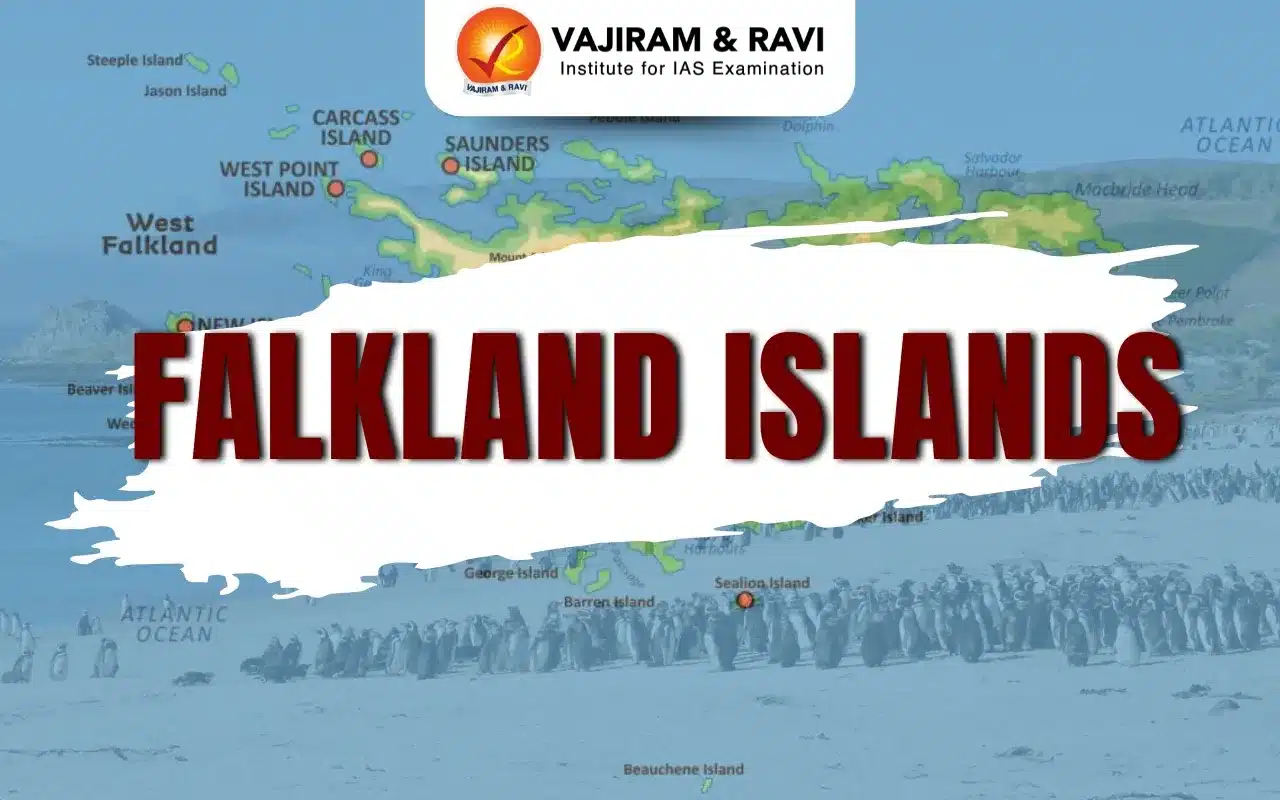
  • Also known as the Malvinas Islands, the Falkland Islands is an internally self-governing overseas territory of the United Kingdom in the South Atlantic Ocean.
  • It lies about 480 km northeast of the southern tip of South America and a similar distance east of the Strait of Magellan.
  • It consists of two main islands, East Falkland and West Falkland, together with 776 smaller islands.
  • The two large islands are separated by the Falkland strait. 
  • The islands are positioned both in the southern and western hemispheres of the Earth. 
  • It covers a total area of 12,173 sq.km.
  • Capital: The capital and major town is Stanley, on East Falkland.
  • Climate: A cool temperate oceanic climate that is characterised by its lack of extremes.
  • Demographics: The population is English-speaking and consists primarily of Falklanders of African-Irish descent (88% of population). 
  • Economy: The economy was formerly based on agriculture, mainly sheep farming, but fishing and tourism currently comprise the bulk of economic activity.
  • Currency: The official currency is the Falkland pound, which is on par with the British pound.
  • History: 
    • At various times, the islands have had French, British, Spanish, and Argentine settlements. 
    • Britain reasserted its rule in 1833, although Argentina maintains its claim to the islands. 
    • In April 1982, Argentine forces temporarily occupied the islands. 
    • British administration was restored two months later at the end of the Falklands War. 
    • Most Falklanders favour the archipelago remaining a UK overseas territory, but its sovereignty status is part of an ongoing dispute between Argentina and the United Kingdom.
  • Government:
    • Executive authority is vested in the British crown, and the islands’ government is headed by a governor appointed by the crown.
    • The islands are self-governing, although foreign affairs and defence matters are handled by the British government.
    • The government of the Falkland Islands also administers the British overseas territory of South Georgia and the South Sandwich Islands, including the Shag and Clerke rocks, lying from 700 to 2,000 miles (1,100 to 3,200 km) to the east and southeast of the Falklands.
  • Wildlife:
    • Rich in seabird and marine life.
    • Home to five species of penguins, sea lions, elephant seals, and albatrosses.

Source: EARTH

Falkland Islands FAQs

Q1: The Falkland Islands are located in which ocean?

Ans: South Atlantic Ocean

Q2: What is the capital of the Falkland Islands?

Ans: Stanley

Q3: What is the status of the Falkland Islands in relation to the UK?

Ans: It is an internally self-governing overseas territory of the United Kingdom.

Q4: Which country also claims sovereignty over the Falkland Islands?

Ans: Argentina

Q5: What is the official currency of the Falkland Islands?

Ans: The official currency is the Falkland pound, which is on par with the British pound.

Trigeminal Neuralgia

Trigeminal Neuralgia

Trigeminal Neuralgia Latest News

Salman Khan recently revealed that he's currently dealing with multiple serious health conditions including trigeminal neuralgia.

About Trigeminal Neuralgia

  • Trigeminal neuralgia, also known as tic douloureux, is a condition that causes intense pain similar to an electric shock on one side of the face. 
  • Cause:
    • It affects the trigeminal nerve, which carries signals from the face to the brain. 
    • It happens when a blood vessel puts pressure on the trigeminal nerve. 
    • The pain comes suddenly and can be triggered by simple activities like eating, brushing teeth, or even smiling.
  • People with trigeminal neuralgia may at first experience short, mild episodes of pain. But the condition can get worse, causing longer periods of pain that happen more often. 
  • It's more common in women and people older than 50.
  • It is a chronic disorder, and the pain can be difficult to manage, often needing medication or even surgery.
  • It is often called the "suicide disease" because of how painful it can be.

Source: HT

Trigeminal Neuralgia FAQs

Q1: Which nerve is affected in Trigeminal Neuralgia?

Ans: Trigeminal nerve (V)

Q2: What type of sensation do people with Trigeminal Neuralgia commonly experience?

Ans: Intense electric shock-like pain on one side of the face.

Q3: What is a common cause of Trigeminal Neuralgia?

Ans: Pressure on the trigeminal nerve by a blood vessel.

Q4: Can you live a normal life with trigeminal neuralgia?

Ans: Living with trigeminal neuralgia can be extremely difficult, and your quality of life can be significantly affected.

Q5: What foods should I avoid with trigeminal neuralgia?

Ans: Many people with the condition avoid foods that are hot or spicy, caffeine, citrus, and cold drinks.

Per- and Polyfluoroalkyl Substances (PFAS)

Per- and Polyfluoroalkyl Substances

Per- and Polyfluoroalkyl Substances Latest News

Researchers recently discovered nearly 20 species of bacteria capable of breaking down Per- and polyfluoroalkyl substances (PFAS).

Per- and Polyfluoroalkyl Substances Substances 

  • PFAS, also known as the Forever Chemicals, are a large chemical family of over 4,700 highly persistent, toxic, man-made, hazardous chemicals.
  • They have been used in consumer products around the world since about the 1950s. 
  • They are ingredients in various everyday products. For example, PFAS are used to keep food from sticking to packaging or cookware, make clothes and carpets resistant to stains, and create firefighting foam that is more effective. 
  • PFAS molecules have a chain of linked carbon and fluorine atoms. Because the carbon-fluorine bond is one of the strongest, these chemicals do not degrade easily in the environment.
  • How Are People Exposed to PFAS?
    • Human exposure to PFAS is widespread but variable by geography and occupation. 
    • PFAS are used in the aerospace, automotive, construction, and electronics industries. Over time, PFAS may leak into the soil, water, and air.
    • People are most likely exposed to these chemicals by consuming PFAS-contaminated water or food, using products made with PFAS, or breathing air containing PFAS. 
    • Because PFAS breaks down slowly, if at all, people and animals are repeatedly exposed to them, and blood levels of some PFAS can build up over time.
  • Impacts of PFAS on Human Health: A variety of health risks that are attributed to PFAS exposure, including decreased fertility, developmental effects in children, interference with body hormones, increased cholesterol levels, and increased risk of some cancers.
  • Regulation: The Stockholm Convention has listed some PFAS, such as Perfluorooctane sulfonic acid (PFOS) and Perfluorooctanoic acid (PFOA), as persistent organic pollutants (POPs).

Source: EARTH

Per- and Polyfluoroalkyl Substances FAQs

Q1: Why are PFAS often called "Forever Chemicals"?

Ans: They do not degrade easily in the environment.

Q2: What makes PFAS extremely persistent in the environment?

Ans: Their carbon-fluorine bonds, which is one of the strongest.

Q3: Which of the following is a major route of human exposure to PFAS?

Ans: Consuming contaminated food and water.

Q4: Which industries commonly use PFAS?

Ans: Aerospace, automotive, construction, and electronics

International Day against Drug Abuse and Illicit Trafficking 2025

International Day against Drug Abuse and Illicit Trafficking

International Day against Drug Abuse and Illicit Trafficking Latest News

The Department of Social Justice and Empowerment (DoSJE) recently observed the International Day Against Drug Abuse and Illicit Trafficking 2025, with a central event at Dr. Ambedkar International Centre, New Delhi.

About International Day against Drug Abuse and Illicit Trafficking

  • The International Day against Drug Abuse and Illicit Trafficking, or World Drug Day, is marked on 26 June every year, to strengthen action and cooperation in achieving the goal of a world free of drug abuse.
  • History:
    • It was established by the United Nations General Assembly in December 1987, following the recommendation of the International Conference on Drug Abuse and Illicit Trafficking. 
    • The observance was created to strengthen global action and cooperation to combat drug abuse and trafficking. 
    • Each year, the United Nations Office on Drugs and Crime (UNODC) selects a theme for the day, focusing on specific aspects of the global drug problem and promoting strategies to address it effectively.
  • The theme for 2025, "Break the cycle. #StopOrganizedCrime," highlights the need for coordinated long-term action to break the cycle of organized crime and drug trafficking by addressing root causes, investing in prevention, and building stronger health, education, and social systems.
  • Every year, UNODC issues the World Drug Report, full of key statistics and factual data obtained through official sources, a science-based approach, and research.
  • Following is the Drug Use Statistics 2025: 
    • Over 300 million people aged 15-64 worldwide have used drugs in the past year.  
    • Cannabis use has increased by 25% in the last decade, with rising concerns over synthetic opioids like fentanyl and methamphetamine. 
    • 1 in 8 people with substance use disorders receive treatment, highlighting the urgent need for improved healthcare access. 
    • The global drug trade generates over $400 billion annually, fueling organized crime, corruption, and violence.

Source: DDN

International Day against Drug Abuse and Illicit Trafficking FAQs

Q1: When is the International Day against Drug Abuse and Illicit Trafficking observed?

Ans: 26 June

Q2: What is the theme for the International Day against Drug Abuse and Illicit Trafficking in 2025?

Ans: Break the cycle. #StopOrganizedCrime

Q3: n which year was the observance of the International Day against Drug Abuse and Illicit Trafficking established by the UN General Assembly?

Ans: 1987

Q4: What is the main purpose of World Drug Day?

Ans: Strengthen global cooperation to combat drug abuse and trafficking.

Q5: According to the World Drug Report 2025, how many people worldwide (aged 15–64) used drugs in the past year?

Ans: Over 300 million

K-6 Missile

K-6 Missile

K-6 Missile Latest News

In a major boost to its strategic deterrence and naval capabilities, India is developing the K-6 hypersonic submarine-launched ballistic missile (SLBM).

About K-6 Missile

  • It is a nuclear-capable submarine-launched ballistic missile (SLBM).
  • It is under development at DRDO’s Advanced Naval Systems Laboratory in Hyderabad.
  • It is designed specifically for the advanced S-5 class SSBNs (nuclear-powered ballistic missile submarines) of the Indian Navy.
    • Larger than the Arihant, the S-5 will be 12 metres long, 2 metres wide, and capable of carrying two to three tonnes of warheads.
  • K-6 Missile Features:
    • It is a hypersonic SLBM capable of reaching speeds up to Mach 7.5—or approximately 9,261 kilometres per hour. 
    • This staggering speed dramatically reduces enemy reaction time and makes interception by conventional missile defence systems virtually impossible.
    • The K-6 missile boasts an impressive range of 8,000 kilometers. India has previously tested the K-3 (1,000 to 2,000 km range), K-4 (3,500 km range), and K-5 (5,000 to 6,000 km range) SLBMs, with the K-4 and K-5 already inducted into the Navy. 
    • The missile is capable of carrying both nuclear and conventional warheads, offering strategic flexibility in both wartime and deterrent scenarios.
    • It is being designed with MIRV (Multiple Independently Targetable Reentry Vehicle) capability—allowing a single missile to carry and deploy multiple warheads at different targets.

Source: N18

K-6 Missile FAQs

Q1: What type of missile is the K-6?

Ans: Hypersonic Submarine-launched ballistic missile (SLBM)

Q2: Which Indian organization is developing the K-6 missile?

Ans: DRDO’s Advanced Naval Systems Laboratory in Hyderabad.

Q3: The K-6 missile is being developed for which class of submarines?

Ans: It is designed specifically for the advanced S-5 class SSBNs (nuclear-powered ballistic missile submarines).

Q4: What is the approximate range of the K-6 missile

Ans: 8,000 km

Q5: What advanced capability allows the K-6 missile to hit multiple targets with a single launch?

Ans: MIRV (Multiple Independently Targetable Reentry Vehicle)

Registrar General of India

Registrar General of India

Registrar General of India Latest News

Recently, the Registrar General of India (RGI) has asked all States to ensure that birth certificates are issued to mothers of new-born children before they are discharged from hospitals, particularly government run-hospitals.        

About Registrar General of India

  • In 1949, the Government of India established a permanent organisation under the Ministry of Home Affairs, headed by the Registrar General and Ex-Officio Census Commissioner of India.
  • This position’s role is mainly to ensure a systematic collection of statistics related to India’s population size, growth, and distribution.
  • The RGI is also responsible for implementing the Registration of Births and Deaths Act, 1969.
  • The Registrar General is typically a civil servant of Joint Secretary rank.
  • The office also conducts demographic and linguistic surveys in addition to the decennial Census.

Key Functions of the RGI

  • Conducting the Census of India: The Census of India offers detailed data about the demographic, socio-economic, and geographic characteristics of the population.
  • Linguistic Survey of India (LSI): Conducted alongside the decennial Census, this survey provides a comprehensive picture of the linguistic diversity in India.
  • The first Linguistic Survey was completed by George Abraham Grierson in 1928.
  • Civil Registration System (CRS): It is a mandatory system for birth and death registration in India.
  • It serves as a real-time, continuous population data collection mechanism.
  • A birth certificate is issued by the registrar in accordance with Section 12 of the Registration of Births and Deaths (RBD) Act, 1969. The RBD Act, 1969 which was amended in 2023, mandates registration of all births and deaths on the Centre’s portal from October 1, 2023. 

Source: TH

Registrar General of India FAQs

Q1: Who appoints the Registrar General of India?

Ans: Central Government

Q2: Which Ministry oversees the Office of the Registrar General of India?

Ans: Ministry of Home Affairs

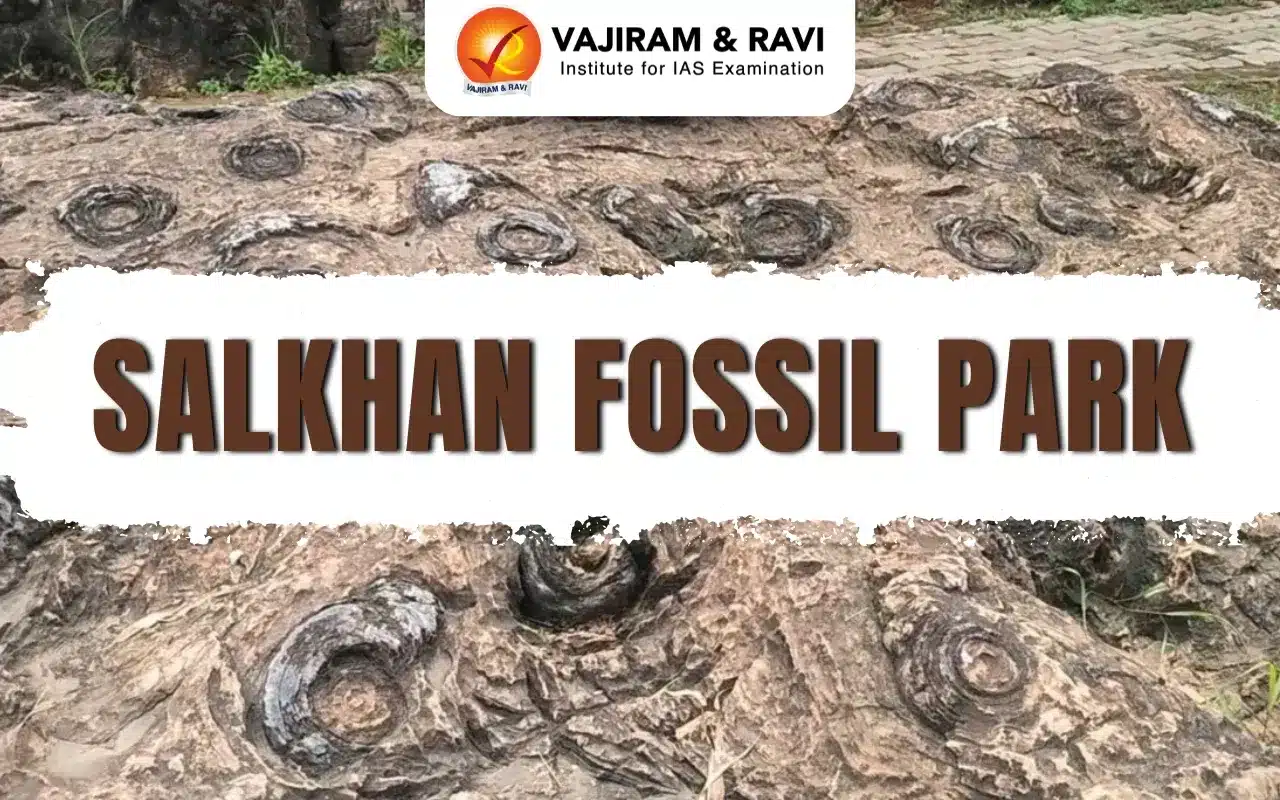
Salkhan Fossil Park

Salkhan Fossil Park

Salkhan Fossil Park Latest News

Recently, the Salkhan Fossil Park has been added to UNESCO’s Tentative List for World Heritage Sites. 

About Salkhan Fossil Park

  • It is also known as Sonbhadra Fossils Park located in the state of Uttar Pradesh.
  • It is nestled amidst the verdant embrace of the Kaimoor Wildlife Sanctuary and within the Vindhyan mountain range.
  • It is home to a rich repository of fossils dating back approximately 1.4 billion years, making it one of the oldest and most well-preserved fossil sites in the world.
  • The site’s fossil assemblage, scattered across various formations, primarily features an exceptional collection of stromatolites, i.e. formations created by communities of cyanobacteria or blue-green algae.
  • It is home to Prehistoric stromatolites and living relics of the Mesoproterozoic.
  • Salkhan is much older than sites like Shark Bay in Australia and Yellowstone the USA.
  • The site’s Proterozoic stromatolites illustrate a critical watershed in the early history of life on Earth: The Great Oxidation Event. 
  • Salkhan Fossil Park Significance: The diversity of stromatolite morphologies at the park—ranging from domal to columnar structures—reflects dynamic environmental conditions in the Proterozoic, including variations in water depth, sedimentation, and wave activity.
  • It falls under one of the key geo-heritage interest categories indicated by IUCN – ‘Evolution of life’ - in the 2020 ‘Guidelines for geoconservation in protected and conserved areas’. 

Source: TOI

Salkhan Fossil Park FAQs

Q1: What fossil is Salkhan Fossil Park known for?

Ans: Stromatolites

Q2: Which is Asia's oldest fossil park?

Ans: Shivalik Fossil Park

Q3: What is meant by stromatolites?

Ans: Stromatolites are mineral structures built by microorganisms.

UN80 Initiative

UN80 Initiative

UN80 Initiative Latest News

Recently, the United Nations under-Secretary-General for Policy and chair of the UN80 Task Force Secretary-General spoke about the UN80 Initiative.

About UN80 Initiative

  • The UN80 Initiative wants to reaffirm the value of multilateralism at a time when confidence is low and the needs are high.
  • It aims to strengthen the UN capacity to meet the global challenges of today – ranging from conflicts, travel and inequalities to climatic shocks and rapid technological changes.
  • Objective: To improve the efficiency, effectiveness, and transparency of the United Nations system.
  • It wants to improve the impact and effect of multilateralism and the UN.
  • It is structured around three key work streams: 
    • Striving to rapidly identify efficiencies and improvements under current arrangements. 
    • Reviewing the implementation of all mandates given by Member States. 
    • Undertaking consideration of the need for structural changes and programme realignment across the UN system.
  • Under this initiative seven thematic clusters are formed under the UN80 Task Force; each coordinated by senior UN leaders from across the system.
  • These cover peace and security, humanitarian action, development (Secretariat and UN system), human rights, training and research, and specialised agencies.

Source: UN

UN80 Initiative FAQs

Q1: What is the UN 80 initiative?

Ans: It is a system-wide push to streamline operations, sharpen impact, and reaffirm the UN's relevance for a rapidly changing world.

Q2: What is United Nations?

Ans: The United Nations is an international organization founded in 1945.

Enquire Now