Machilipatnam

Machilipatnam

Machilipatnam Latest News

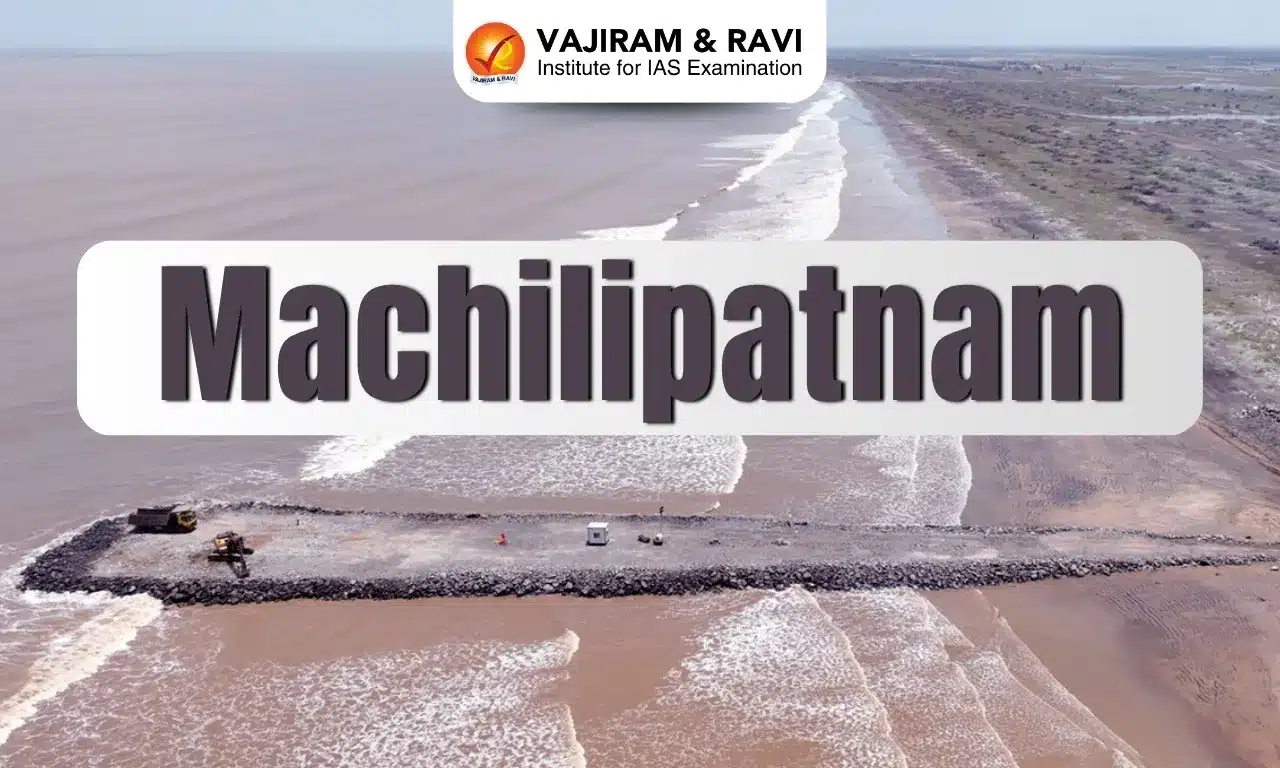
After being a dead dock town for ages, Machilipatnam is witnessing a revival with nearly 48% of the new Greenfield port at Manginapudi already completed.

About Machilipatnam

  • Machilipatnam, also known as Masulipatnam, is a coastal city in the Krishna district of Andhra Pradesh.
  • The city is nestled on the southeastern or Coromandel Coast of India.
  • It was a flourishing port and a prominent trading centre during the medieval period, attracting traders from various parts of the world. 
  • The city is also famous for its handloom industry, particularly for its Kalamkari art. 
    • Kalamkari is a traditional hand-painted or block-printed textile art showcasing intricate designs and motifs.

Machilipatnam History

  • The city of Machilipatnam came into existence in the era of the Satavahana Kings in the 3rd century B.C.  
  • During that period, the city was known as Maisolos and Masalia. 
  • They used this port as the gateway for their sea trade. 
  • It was famous for Muslin, a thin, plain-weave cotton cloth. Perhaps, this was the reason why it was referred to as Masalia or Masulipatnam.
  • During the year 1478, the place of Machilipatnam came under Muhammad Shah Bahamani II. 
  • Later in 1515, Sri Krishna Devaraya defeated the king, after which the city was captured by Orissa kings like Golconda King and Quli Qutb Shah
  • But at the same time, European traders, particularly Portuguese and Dutch, established their trade centers near the port. 
  • Thereafter, the British came to the port by locating their factory in 1611. 
  • Masulipatam was the first British trading settlement on the Bay of Bengal. 
  • The Masulipatnam Fort was built by the Dutch in the 17th century.
  • From 1686 to 1759, the city was held by the French and Dutch, until it was finally ceded to the British, who captured the city and fort from the French in 1759. 
  • With the entrance of foreign traders and frequent wars and disasters, Machilipatnam could not grow further.
  • In the year 1779, the city had to confront a major cyclone in which almost 20,000 people were killed and the Dutch factory got damaged.

Source: THBL

Machilipatnam FAQs

Q1: Machilipatnam is located in which Indian state?

Ans: Andhra Pradesh

Q2: What traditional art form is Machilipatnam particularly famous for?

Ans: Kalamkari

Q3: Which early dynasty is credited with establishing Machilipatnam as a port city in the 3rd century B.C.?

Ans: Satavahanas

Q4: When did the British establish their first factory at Machilipatnam?

Ans: 1611

Magnetic Levitation (Maglev) Technology

Maglev Technology

Magnetic Levitation (Maglev) Technology Latest News

China has successfully tested Magnetic Levitation (Maglev) technology, with the potential to make trains even faster than jets.

About Maglev Technology

  • Magnetic levitation, or maglev, is an advanced transportation technology that uses the principles of electromagnetism to enable vehicles to float above tracks, eliminating physical contact and significantly reducing friction. 
  • Maglevs were conceptualized during the early 1900s by American professor and inventor Robert Goddard and French-born American engineer Emile Bachelet and have been in commercial use since 1984.

How Maglev Technology Works?

  • Maglev trains operate using two key electromagnetic principles: magnetic attraction and repulsion
  • The system typically consists of three main components:
    • Levitation: Magnets lift the train above the track, ensuring there is no physical contact. This minimizes wear and tear while providing a smooth ride.
    • Guidance: Electromagnets stabilize the train laterally, keeping it centered on the track.
    • Propulsion: Linear motors generate magnetic fields that push and pull the train along the track. This replaces the need for traditional engines or fuel.
  • The tracks, known as guideways, are embedded with powerful electromagnets, while the trains themselves contain superconducting magnets or electromagnets. 
  • By carefully controlling the magnetic fields, maglev trains achieve levitation and propulsion with minimal energy loss.

Benefits of Maglev Technology

  • Speed and Efficiency: Maglev trains can reach speeds of over 600 km/h (373 mph), making them faster than conventional trains and competitive with short-haul flights.
  • Reduced Friction: With no physical contact between train and track, maglev systems have significantly lower maintenance costs and higher energy efficiency.
  • Eco-Friendly: Maglev trains produce zero direct emissions and can be powered by renewable energy sources, making them a sustainable alternative to fossil fuel-based transport.
  • Comfort: Passengers experience minimal vibrations and noise, thanks to the absence of wheels and rails.

Source: INDIA

Maglev Technology FAQs

Q1: What does the term Maglev stand for?

Ans: Magnetic Levitation

Q2: Which two scientists are credited with conceptualizing Maglev technology in the early 1900s?

Ans: Robert Goddard and Emile Bachelet

Q3: What speed can Maglev trains typically reach?

Ans: Over 600 km/h

Q4: Why are Maglev trains considered environmentally friendly?

Ans: They produce no direct emissions and can use renewable energy.

Quantum Noise

Quantum Noise

Quantum Noise Latest News

Researchers at the Raman Research Institute (RRI) recently made the discovery that “quantum noise” which was always thought to be detrimental to quantum systems, is potentially beneficial in some situations.

About Quantum Noise

  • It refers to the unwanted disturbances that affect quantum systems, leading to errors in quantum computations. 
  • Unlike classical noise, which might simply add random errors to a signal, quantum noise can have more complex and detrimental effects. 
  • What Causes Quantum Noise?
    • Quantum noise comes from the fact that energy—like light or radio waves—exists in discrete packets, or quanta. 
    • For example, light is made of photons, and radio waves are made of individual electromagnetic excitations. When you try to measure or amplify these signals, there’s a natural limit to how accurately you can do so.
    • This is a direct result of the Heisenberg uncertainty principle, which says you can’t perfectly measure certain pairs of properties (like the strength and phase of a wave) at the same time. These unavoidable fluctuations are what we call quantum noise.
    • Even if you had a perfect detector in a perfectly quiet room at absolute zero temperature, quantum noise would still be present.
  • Quantum noise can arise from various sources, including thermal fluctuations, electromagnetic interference, imperfections in quantum gates, and interactions with the environment. 
  • Different types of quantum noise affect qubits in distinct ways. For example, phase noise alters the relative phase between the basis states of a qubit, while amplitude noise affects the probabilities of measuring different states. 
  • Understanding and characterizing these noise sources is crucial for error mitigation.
  • It's a major challenge in the development of quantum computers, as it can cause qubits to lose their delicate quantum state, known as decoherence.
    • Even small amounts of noise can lead to decoherence, causing qubits to lose their superposition and entanglement properties. 
    • This loss of quantum information can render computations meaningless and limit the size and complexity of feasible quantum algorithms.

Source: PIB

Quantum Noise FAQs

Q1: What is quantum noise?

Ans: Quantum noise refers to the unwanted disturbances that affect quantum systems, leading to errors in quantum computations.

Q2: What fundamental principle of quantum mechanics explains the inevitability of quantum noise?

Ans: Heisenberg Uncertainty Principle

Q3: What is the consequence of quantum noise on qubits in quantum computing?

Ans: It causes decoherence and loss of quantum information.

Cnemaspis Brahmaputra

Cnemaspis Brahmaputra

Cnemaspis Brahmaputra  Latest News

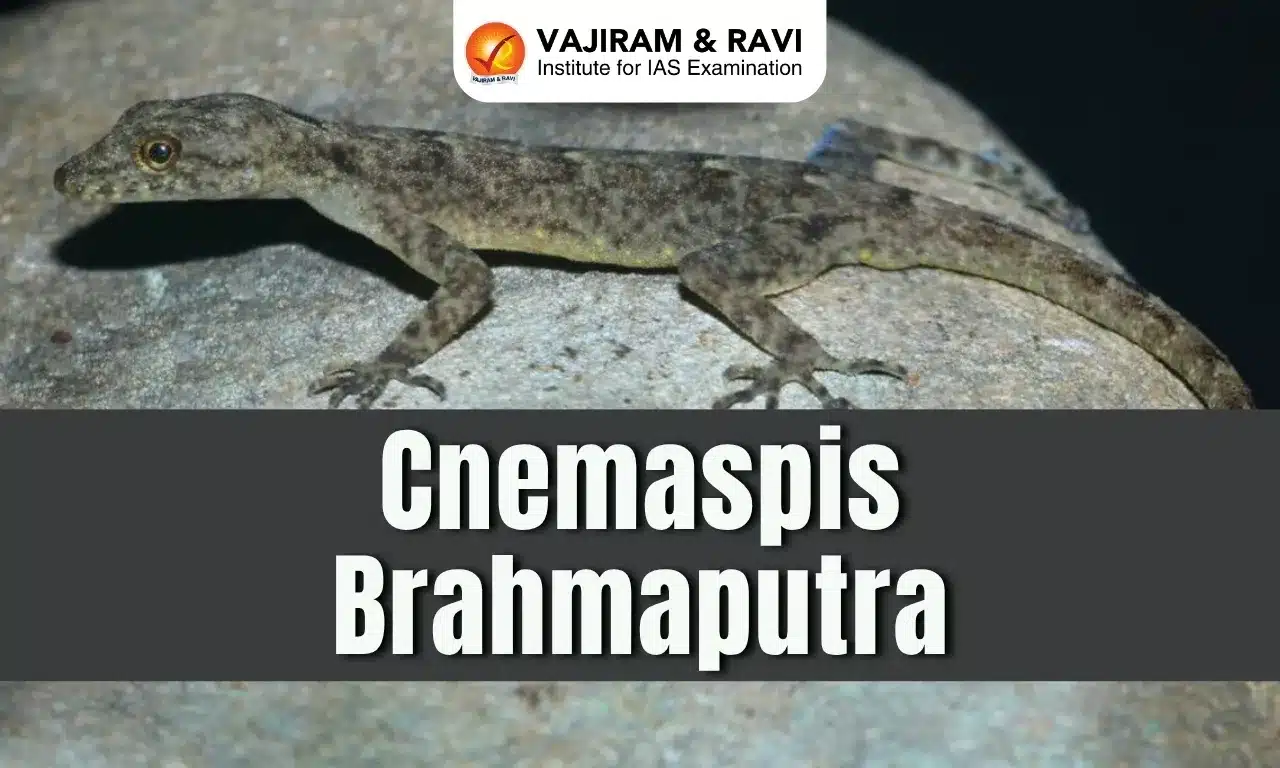
Recently, a new species of gecko recorded from Assam has been named after the Brahmaputra River.

About Cnemaspis Brahmaputra

  • It was found at Dirgheswari Temple on the northern bank of the Brahmaputra river in Assam.
  • The new species belongs to the Cnemaspis podihuna clade, a group of small, diurnal geckos previously thought to be largely restricted to Sri Lanka.
  • Its discovery in Assam strengthens the evidence for an ancient biogeographic link between Sri Lanka and India’s northeast, reflecting historical faunal exchanges across the Indian subcontinent.
  • The new species is genetically and morphologically distinct from its Sri Lankan relatives, showing significant evolutionary divergence.

Features of Cnemaspis Brahmaputra

  • It is distinguished by its larger body size but with fewer mid-body scale rows, more ventral scale rows across the belly, no tubercles on lower flanks, and three enlarged rows of thigh scales parallel to the enlarged femoral scale row.
  • Cnemaspis brahmaputra is the second species of the genus Cnemaspis known from the northeastern region. The first, Cnemaspis assamensis, was described in 2000.
  • Both species are members of the podihuna clade and are restricted to the Brahmaputra River valley.
  • They occur on opposite banks of the river and have significant genetic differences.

Source: TH

Cnemaspis brahmaputra FAQs

Q1: What is a gecko known for?

Ans: Geckos have many special abilities. They can climb with their sticky feet and regrow their tails if they lose them.

Q2: What is called Reptilia?

Ans: Reptiles are tetrapod animals in the class Reptilia, comprising today's turtles, crocodilians, snakes, amphisbaenians, lizards, tuatara, and their extinct relatives.

Behdeinkhlam Festival

Behdeinkhlam Festival

Behdeinkhlam Festival Latest News

The sacred Behdeinkhlam Festival was celebrated with fervor in Jowai, Meghalaya, blending ancient Pnar rituals with modern social themes.

About Behdeinkhlam Festival

  • Meaning: Beh Dien means to drive away the plague with sticks and prayers and Khlam means plague or pestilence.
  • It is a significant cultural festival celebrated by the Pnar community in Meghalaya.
  • It translates to “driving away the plague” or “chasing away the demon of cholera”;
  • It is a festival that seeks to ward off evil spirits, diseases, misfortune, and invoke blessings for a good harvest and communal prosperity.
  • Timing: It is celebrated annually in July after the sowing period.

Rituals of Behdeinkhlam Festival

  • The main part of the festival was the making of the Dein Khlam and Khnong which are rounded, polished and straight tree trunks from the forest.
  • During the cultural festival tour, young men make a symbolic gesture of driving away of the evil spirit, plague and disease by beating of the roof of every house with bamboo poles. 
  • It is carried out for three days and on the last day, in the afternoon people would gather in a place called Aitnar and both young and old would dance to the tunes of the pipes and drums.
  • On the final day people would converge to a place called Mynthong to witness a game played similar to football, called dad-lawakor.

Source: NA

Behdeinkhlam Festival FAQs

Q1: In which state is Behdienkhlam festival celebrated?

Ans: Meghalaya

Q2: What is the meaning of behdienkhlam?

Ans: Behdienkhlam (chasing away the Demon of Cholera) is celebrated annually in July after the sowing period, the most important dance festival of the Jaintia tribes.

Prime Minister Professorships

Prime Minister Professorship

Prime Minister Professorships Latest News

Recently, the Anusandhan National Research Foundation (ANRF) — the newly constituted body for funding scientific research — has announced the Prime Minister Professorships.

About Prime Minister Professorships

  • It is a prestigious initiative aimed at fostering world-class research and innovation within emerging institutions.
  • It seeks to leverage the expertise of eminent scientists, senior faculty, and accomplished industry professionals to provide mentorship and support to faculty and students in less-endowed state universities, thereby strengthening their research and development culture.
  • Objective: To utilize the extensive knowledge and experience of active, eminent, and superannuated/retired scientists and professionals.
  • Duration: The tenure of the PM Professorship will be up to 5 years, based on performance evaluated by the expert committee constituted for the purpose.
  • Age limit: Superannuated on the date of application (no upper age limit)
  • Funding Support: A PM Professor will receive a fellowship of Rs. 30 lakh plus Rs. 24 lakh as research grant (consumables, domestic travel, contingencies, equipment etc.) per annum. Also, an overhead of a fixed amount of Rs.1 lakh per year to be provided under the program.

Eligibility Criteria for Prime Minister Professorship

  • Superannuated faculty or scientists from reputed Indian institutions, research laboratories or from private institutions are eligible to apply.
  • Overseas scientists—including Non-Resident Indians (NRIs), Persons of Indian Origin (PIOs), and Overseas Citizens of India (OCIs)—are also encouraged to apply under this scheme.
  • In addition, professionals from industry/ experienced Professor of Practice, with a distinguished record of research and innovation may also apply.
  • Applicants with strong research credentials, must be actively involved in research and innovation activities, and demonstrate a strong commitment to mentor faculty at the eligible state universities where research and innovation is still at a nascent stage.
  • Eligible host institutions are the state universities which have been qualified as spoke institutions in Category A of recently awarded PAIR program of ANRF (see category list here) Applicants must  be willing to relocate to the proposed host institution on full time basis and should have a proper  plan to contribute significantly to the development of its research capabilities and innovation culture.

Source: TH

Prime Minister Professorships FAQs

Q1: What is the Anusandhan National research Scheme?

Ans: Anusandhan National Research Foundation (ANRF) - established through an Act of Parliament: ANRF Act, 2023, to provide high-level strategic directions for research, innovation, and entrepreneurship in the fields of natural sciences, including mathematical sciences, engineering and technology.

Q2: Who are overseas citizens of India?

Ans: A foreign national, who was eligible to become citizen of India on 26.01. 1950 or was a citizen of India on or at anytime after 26.01. 1950 or belonged to a territory that became part of India after 15.08. 1947 and his/her children and grand children, is eligible for registration as an Overseas Citizen of India (OCI).

Insurance Regulatory and Development Authority of India (IRDAI)

insurance-regulatory-and-development-authority-of-india

Insurance Regulatory and Development Authority of India

The Insurance Regulatory and Development Authority of India (IRDAI) recently constituted panels of its whole-time members to decide on the violations by certain insurers/insurance intermediaries.

About Insurance Regulatory and Development Authority of India

  • It is a statutory body formed under an Act of Parliament, i.e., the Insurance Regulatory and Development Authority Act, 1999 (IRDAI Act 1999), for the overall supervision and development of the insurance sector in India.
  • It acts as an autonomous authority under the Ministry of Finance, Government of India.
  • The main goals of IRDAI are:
    • To safeguard the interest of the policyholders by fair business conduct and settlement of claims within time.
    • Developing and nurturing the Indian insurance industry.
    • To regulate the business of insurance with transparency, fairness, and honest practice.
    • Facilitating financial prudence of the insurers through solvency and stability checks of insurers.
    • To regulate premium charges and policy terms for preventing unscrupulous pricing and unaffordability.
  • It is responsible for registering and/or licensing insurance, reinsurance companies, and intermediaries according to the regulations. 
  • It sets the eligibility criteria, qualifications, and capital requirements for obtaining licenses in the insurance business.
  • Head Office: Hyderabad
  • Entities regulated by IRDAI:
    • Life Insurance Companies: Both public and private sector companies
    • General Insurance Companies: Both public and private sector companies. Among them, there are some standalone health insurance companies which offer health insurance policies.
    • Re-Insurance Companies
    • Agency Channel
    • Intermediaries, which include the following:
      • Corporate Agents
      • Brokers
      • Third-party Administrators
      • Surveyors and Loss Assessors.
  • Composition: It consists of a Chairman, five full-time members, and four part-time members, all appointed by the Government of India.
  • To protect the interests of policyholders, the IRDAI was granted significant responsibilities, including
    • Efficiently conducting the insurance business and protecting the interests of the policyholders in matters concerning assigning of policy, nomination by policyholders, insurable interest, settlement of insurance claims, surrender value of the policy, and other terms and conditions of contracts of insurance.
    • Approving product terms and conditions offered by various insurers.
    • Regulating the investment of funds by insurance companies and maintaining a margin of solvency.
    • Specifying the financial reporting norms of insurance companies.
    • Specify code of conduct, qualifications, and training for intermediary or insurance agents.
    • Undertaking inspections, calling for information, and investigations, including an audit of insurance companies, intermediaries, and other organizations associated with the insurance business.
    • Ensuring insurance coverage is provided in rural areas and also to the vulnerable sections of society.

Source: TH

Insurance Regulatory and Development Authority of India FAQs

Q1: Under which Act was the Insurance Regulatory and Development Authority of India (IRDAI) established?

Ans: Insurance Regulatory and Development Authority Act, 1999 (IRDAI Act 1999)

Q2: Where is the headquarters of IRDAI located?

Ans: Hyderabad

Q3: What is the primary objective of IRDAI?

Ans: To safeguard policyholders' interests and regulate the insurance industry.

Q4: IRDAI operates under which ministry?

Ans: Ministry of Finance

Klyuchevskoy Volcano

Klyuchevskoy Volcano

Klyuchevskoy Volcano Latest News

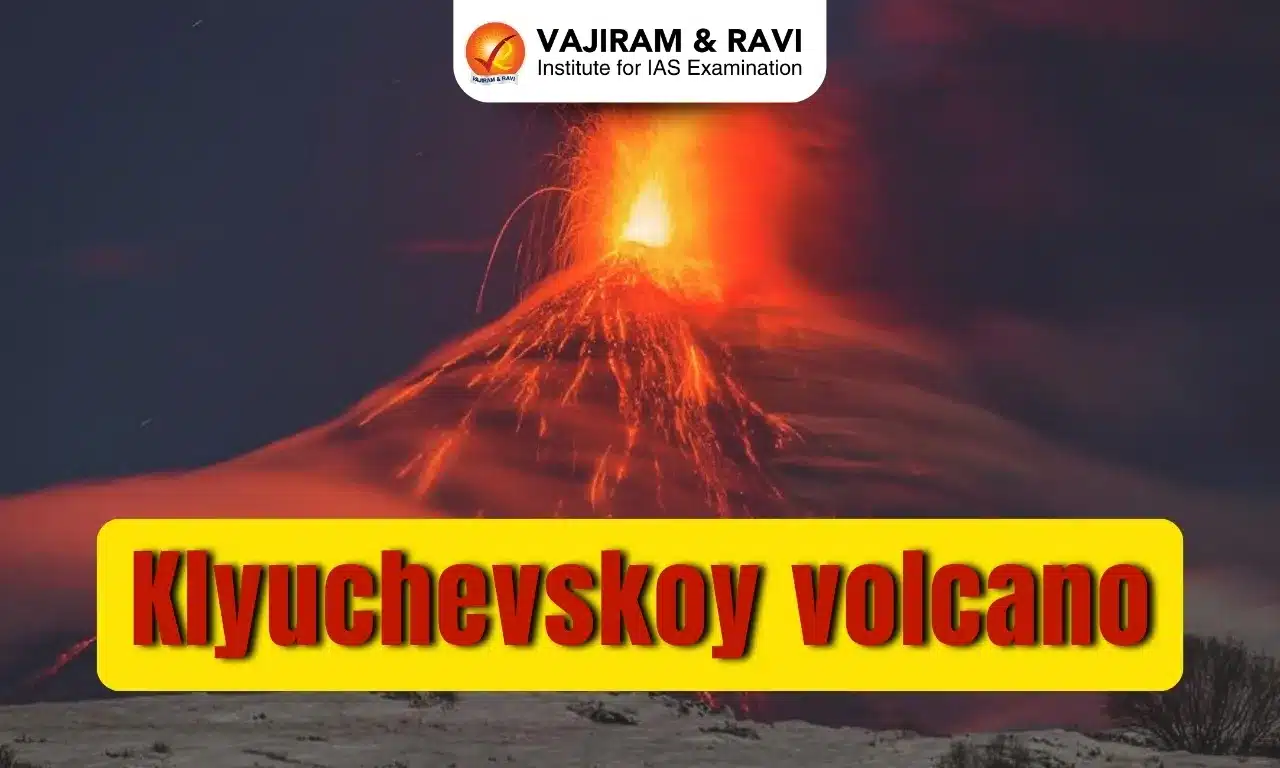
A false-color satellite photo from 2023 shows a devilish pair of lava flows and an enormous plume of smoke spewing from Klyuchevskoy, the tallest volcano in Europe and Asia.

About Klyuchevskoy Volcano

  • It is an active stratovolcano located on the Kamchatka Peninsula, far eastern Russia
  • It is one of the highest active volcanoes (tallest active volcano in Eurasia) in the world, rising to a height of 15,584 feet (4,750 meters), the highest point on the peninsula. 
  • The volcano consists of a truncated cone with a central crater, with some 70 lateral craters and cones on the lower slopes.
  • The volcano, which has erupted more than 50 times since 1700, is characterized by smoke continuously billowing above its summit. 
  • The Kamchatka Volcanological Station, established in 1935, is located at its base.

Key Facts about Kamchatka Peninsula

  • It is located in far eastern Russia. 
  • It is bordered by the Sea of Okhotsk on the west and the Pacific Ocean and Bering Sea on the east. 
  • Two mountain ranges, the Sredinny (“Central”) and Vostochny (“Eastern”) extend along the peninsula. 
  • It is one of the largest peninsulas in the world.
  • Climate: Severe, with prolonged, cold, and snowy winters and wet, cool summers.
  • The Kamchatka Peninsula is the northern link in the 2000 km Kuril-Kamchatka island arc. 
    • This region contains 68 active volcanoes, over 10 percent of the total found on land anywhere on Earth.
    • This arc is part of the "Ring of Fire," a string of volcanoes that encircles the Pacific Ocean.

Source: LS

Klyuchevskoy Volcano FAQs

Q1: Where is the Klyuchevskoy volcano?

Ans: Kamchatka Peninsula, far eastern Russia.

Q2: How tall is the Klyuchevskoy volcano?

Ans: It is the tallest active volcano in Eurasia rising to a height of 15,584 feet (4,750 meters).

Q3: What type of volcano is Klyuchevskoy?

Ans: Stratovolcano

Kaziranga National Park

Kaziranga National Park

Kaziranga National Park Latest News

Kaziranga National Park and Tiger Reserve has released its first Grassland Bird Survey Report, highlighting critical habitats and threatened species in the Brahmaputra floodplains.

About Kaziranga National Park

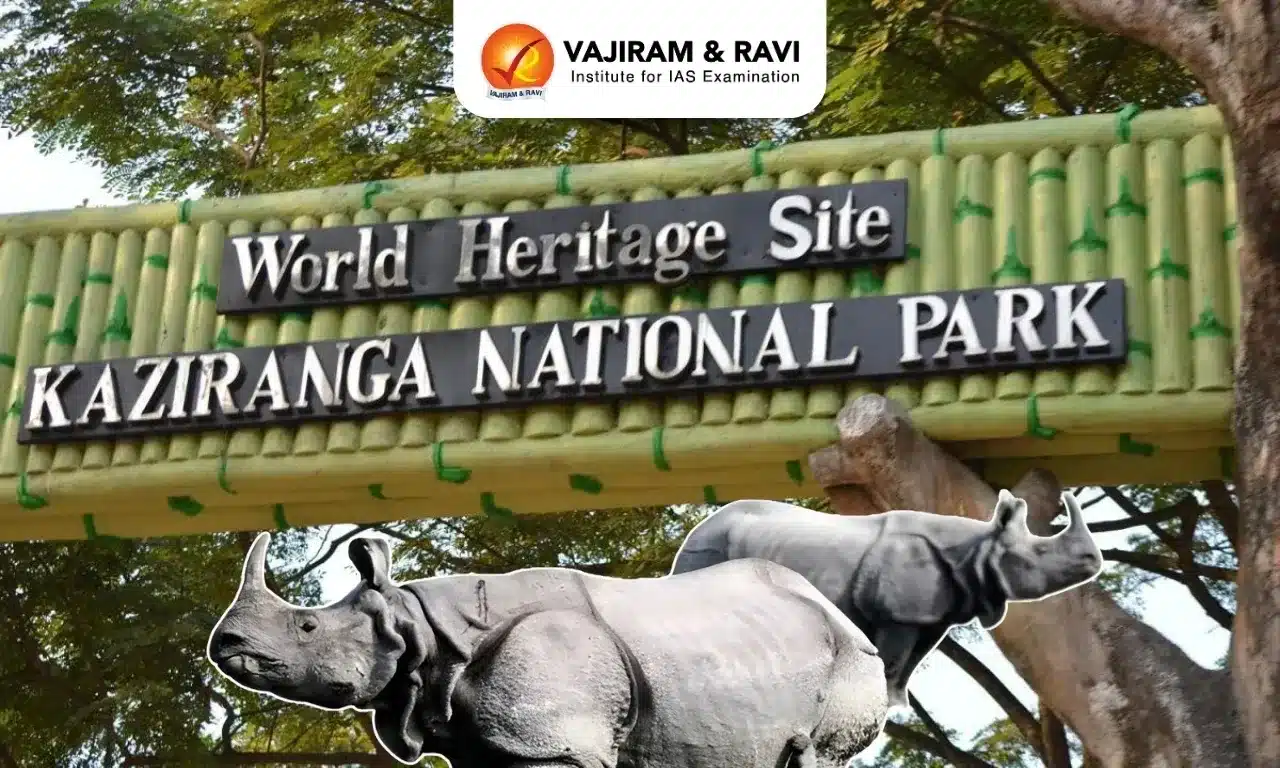
  • Location: It is situated in the north-eastern part of India in the state of Assam.
  • It is the single largest undisturbed and representative area in the Brahmaputra Valley floodplain.
  • In 1985, the park was declared a World Heritage Site by UNESCO.
  • Terrain: It is of sheer forest, tall elephant grass, rugged reeds, marshes, and shallow pools.
  • Rivers: The River Diffalu, a tributary of the Brahmaputra, flows through the National Park while another tributary, Moradifalu, flows along its southern boundary.

Flora and Fauna of Kaziranga National Park

  • Flora: It is primarily famous for its dense and tall elephant grasses intermixed with small swamplands. It also includes an abundant cover of water lilies, water hyacinths and lotus.
  • Fauna: Many endangered and threatened species like Rhino, Tiger, Eastern swamp deer, Elephant, Buffalo, Hoolock gibbon, Capped langur, and Gangetic River dolphin are commonly found in the habitat. It is inhabited by the world’s largest population of one-horned rhinoceroses, as well as many mammals.

Highlights of Grassland Bird Survey Report

  • Bird experts, scientists, and conservationists recorded 43 grassland species across Kaziranga’s three wildlife divisions. 
  • It reported that the Finn’s weaver (IUCN Status: Endangered), locally known as tukura chorai, is breeding successfully.
  • This bird is an important indicator of grassland health and is known for building nests atop trees.

Source: TH

Kaziranga National Park FAQs

Q1: In which state is Kaziranga National Park located?

Ans: Assam

Q2: Which river passes through Kaziranga National Park?

Ans: River Brahmaputra

Enquire Now