Palna Scheme

Palna Scheme 

Palna Scheme  Latest News

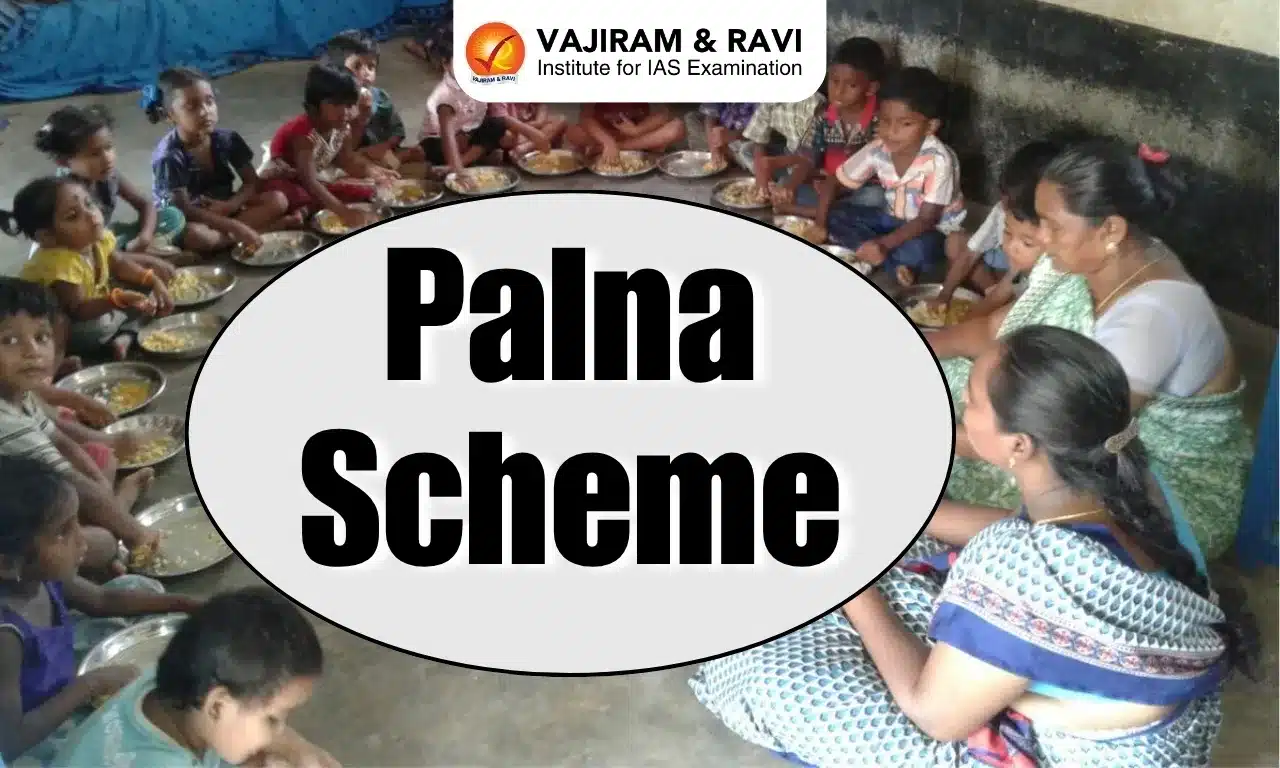
Recently, the Minister of State for Women and Child Development informed the Rajya Sabha about the Palna Scheme.

About Palna Scheme

  • It is a Centrally Sponsored Scheme introduced by the Ministry of Women and Child Development under the Samarthya Vertical of Umbrella Mission Shakti for all States and UTs.
  • Objective: The objective of the Scheme is to provide quality crèche facilities in a safe and secure environment for children (from ages 6 months – 6 years), nutritional support, health and cognitive development of children, growth monitoring & immunization.
  • Crèche facilities under Palna are provided to all mothers, irrespective of their employment status.
  • There are two types of Crèches under Palna: Standalone Crèches and Anganwadi-cum-Crèches (AWCCs).
  • The Mission Shakti Guidelines state that the crèche timings need to be flexible depending on the local requirements.
  • Crèches shall be open for 26 days in a month and for seven and half (7.5) hours per day as per the work schedule of the majority of the mothers in the area.
  • The Standard Operating Procedures for AWCCs also state that the Creche timings may be decided by State/ UT governments as per local need.
  • Funding: For General States it is in the ratio 60:40, for North Eastern & Special Category States (90:10) UTs with Legislature (60:40) and for UTs without Legislature centre will provide 100% assistance.
  • Services: The scheme will provide an integrated package of the following services:
    • Daycare Facilities including Sleeping Facilities.
    • Early Stimulation for children below 3 years and Pre-school Education for 3 to 6 years old children.
    • Supplementary Nutrition (to be locally sourced)
    • Growth Monitoring.
    • Health Check-up and Immunization

Source: PIB

Palna Scheme FAQs

Q1: What is the Palna scheme under Mission Shakti?

Ans: The Ministry of women and Child Development has introduced Palna Scheme under the Samarthya Vertical of Umbrella Mission Shakti for all States and UTs w.e.f. 01 April 2022, to provide day care facilities and protection to children.

Q2: What is the Mission Shakti of Umbrella Yojana?

Ans: Mission Shakti' is a scheme of Ministry of Women and Child Development aimed at strengthening interventions for women safety, security and empowerment.

Syros Island

Syros Island

Syros Island Latest News

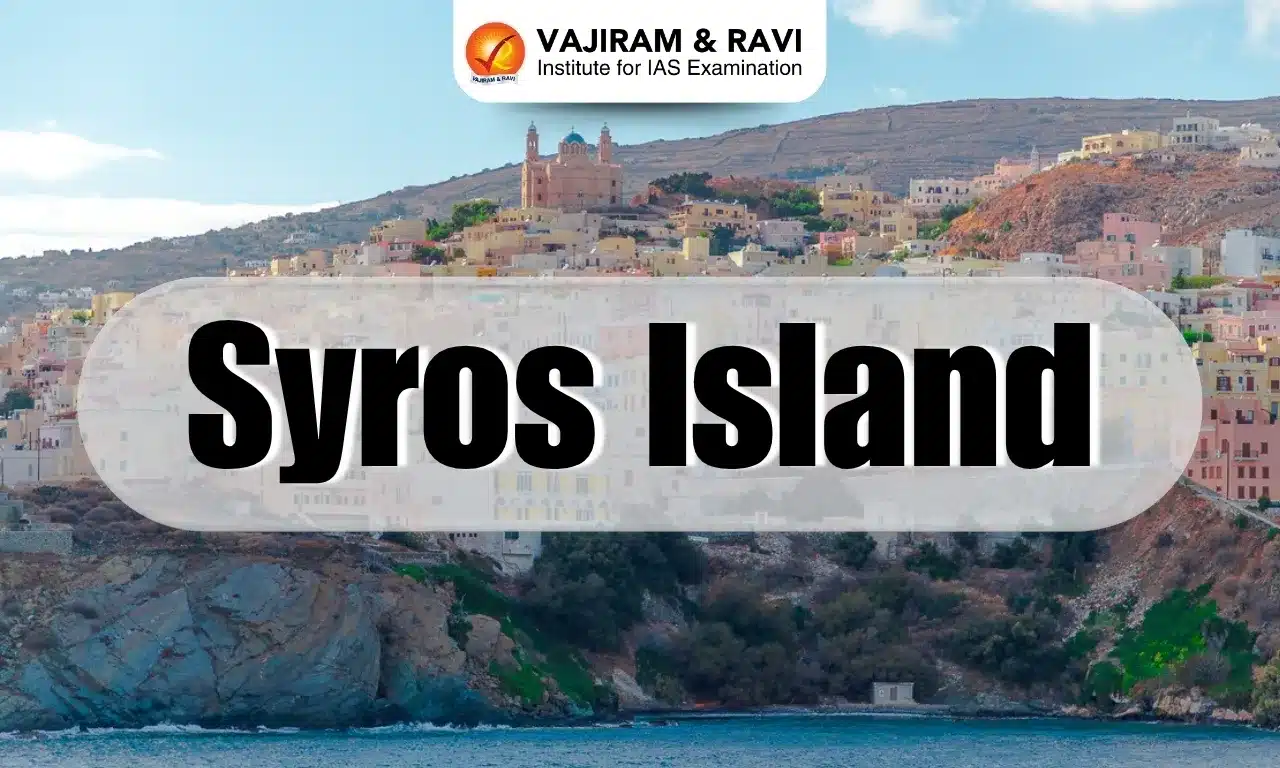
A cruise liner carrying Israeli tourists has been forced to reroute to Cyprus after being turned away from the Greek island of Syros after a quayside protest over the Gaza war.

About Syros Island

  • Syros, also known as Siros or Syra, is a Greek island in the Cyclades island group, in the Aegean Sea.
  • The island is hilly, denuded, and irregular in shape, and it reaches an elevation of 1,450 feet (442 metres). 
  • Syros is about 78 nautical miles (144 km) south-east of Athens, the capital of Greece. 
  • The island covers an area of 83.6 sq.km. 
  • In 2021, about 21,124 people lived there.
  • The biggest towns on Syros are Ermoupoli, Ano Syros, and Vari. 
  • Ermoupoli is the main city of the island. 
    • It is a hillside town that overlooks the Aegean Sea.
    • It is also the capital for the whole Cyclades region and the South Aegean area. 
  • The island is famous for its stunning beaches, charming villages, and cultural festivals.
  • Industries include shipbuilding, tanning, cotton mills, weaving, and confectionery, but the main source of revenue is from maritime trade and commercial shipping.

Source: TG

Syros Island FAQs

Q1: Where is Syros Island located?

Ans: It is a Greek island located in the Aegean Sea.

Q2: Syros Island is part of which island group?

Ans: Cyclades Islands

Q3: Which is the main city on Syros Island?

Ans: Ermoupoli

Preah Vihear Temple

Preah Vihear Temple

Preah Vihear Temple Latest News

Fighter jets, landmines, and diplomatic expulsions marked the sharpest escalation in tensions between Thailand and Cambodia in years over a dispute that stretches back over a century, and at the centre of it lies the 11th-century Preah Vihear Hindu temple.

About Preah Vihear Temple

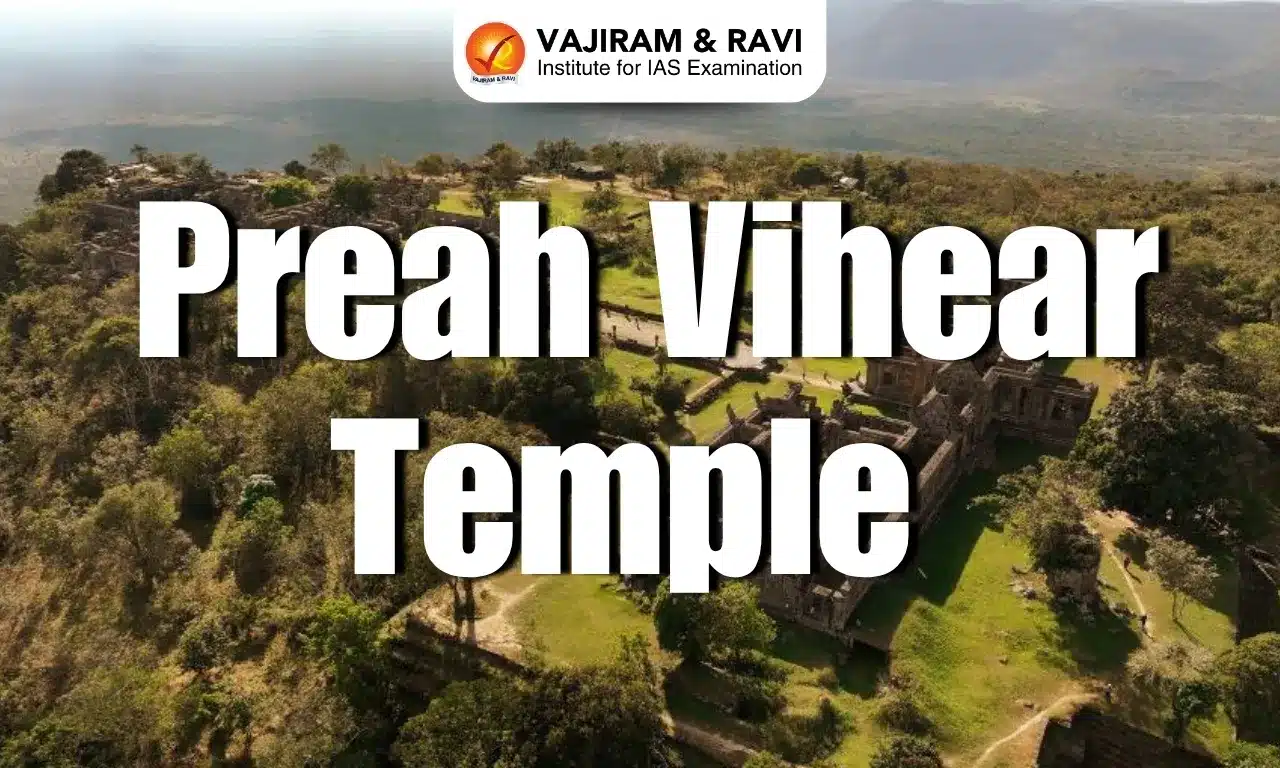
  • It is a Hindu temple located in the Preah Vihear Province, in the northern part of Cambodia.
  • It is located atop a cliff on the Cambodia–Thailand border in the Dangrek Mountain range .
  • It is dedicated to Lord Shiva. 
  • It was built primarily during the golden period of the Khmer Empire, in the eleventh and twelfth centuries.
  • It was built firstly by King Suryavarman I (1002-50) and then expanded upon by Suryavarman II (1113-50).
  • It is a UNESCO World Heritage Site.

Preah Vihear Temple Architecture

  • It is an outstanding masterpiece of Khmer architecture.
  • The temple is composed of a series of sanctuaries linked by a system of pavements and staircases over an 800-metre-long axis.
  • It features more than five successive gopuras. 
  • Unlike other structures of this kind, the gopuras here are connected by a long path and topped with multi-tiered platforms. 
  • Each gopura has a small staircase. Some of these gopuras have stone roofs, while others have wooden roofs, many of which are in ruins. 

Preah Vihear Temple Dispute

  • Preah Vihear Temple is the subject of a long-running territorial dispute between Thailand and Cambodia. 
  • In 1962, the International Court of Justice ruled that it belonged to Cambodia.
  • However, Thailand has maintained that the land surrounding the temple — especially a 4.6 sq.km. patch —remains unresolved. 
  • Tensions escalated again in 2008 after Cambodia succeeded in registering Preah Vihear as a UNESCO World Heritage Site. 
  • Thai nationalists objected, and skirmishes broke out, culminating in a deadly exchange in 2011 that killed at least 15 people.
  • The ICJ reaffirmed its ruling in 2013, this time declaring that the surrounding land was also Cambodian — a decision that still stings in Bangkok.

Source: TOI

Preah Vihear Temple FAQs

Q1: Preah Vihear Temple is located in which country?

Ans: Cambodia

Q2: The Preah Vihear Temple is dedicated to which Hindu deity?

Ans: Shiva

Q3: In which mountain range is Preah Vihear Temple located?

Ans: Dangrek Mountains

Q4: When was the Preah Vihear Temple constructed?

Ans: 11th and 12th centuries

AI for India 2.0 Programme

AI for India 2.0 Programme

AI for India 2.0 Programme Latest News

The Minister of State (Independent Charge), Ministry of Skill Development and Entrepreneurship (MSDE), informed the Rajya Sabha about AI for India 2.0 Programme.

About AI for India 2.0 Programme

  • It was launched in 2023 on the occasion of the ‘World Youth Skills’ Day.
  • The objectives and components of the Programme are
    • Free online training in Artificial Intelligence and Machine Learning.
    • Special focus on vernacular accessibility—content available in nine Indian languages (e.g., Hindi, Telugu, Kannada).
  • Aim: It is aimed at college students, fresh graduates, and early-career professionals, especially from rural and non‑english-speaking backgrounds.
  • This programme has been a tech platform, enabled tech learning in 9 vernacular languages empowering the youth by providing them with the access to expert-curated Python courses.
  • The Programme had nationally accredited recognition.
  • It is a joint initiative by GUVI (Grab Ur Vernacular Imprint), IIT Madras- IIM Ahmedabad incubated ed-tech company and Skill India, which targets the education of students in vernacular languages.
  • This online program reportedly holds the accreditation of NCVET and IIT Madras, which aim to equip young individuals with cutting-edge skills.

Source: PIB

AI for India 2.0 Programme FAQs

Q1: What is the national program on AI in India?

Ans: The Ministry of Electronics and Information Technology (MeitY) of India envisions the AI program as an umbrella initiative for utilizing transformative technologies to promote inclusion, innovation, and adoption for social impact.

Q2: What is Artificial Intelligence?

Ans: Artificial Intelligence refers to machines performing human-like tasks. Its main components are Machine Learning algorithms that train on data, Neural Networks that mimic the brain’s structure, and Natural Language Processing that understands human language.

Long-Billed Bush Warbler

Long-Billed Bush Warbler

Long-Billed Bush Warbler Latest News

A team of birders recently recorded the first confirmed Indian sighting of the elusive Long-billed Bush Warbler in 46 years, spotting the Near Threatened species in Ladakh’s Suru Valley.

About Long-Billed Bush Warbler

  • It is a medium-sized bush warbler (songbird) with a relatively long tail and long bill.
  • Scientific Name: Locustella major
  • Distribution: 
    • It has a limited distribution in the mountains of Central Asia. 
    • It's found in parts of China, India, Pakistan, and Tajikistan.
  • Habitat: It inhabits grassy slopes dotted with bushes, weeds, and grass; upland terraced cultivation; and edges of alpine meadows and forest clearings, at 2400-3600 m.
  • Features:
    • Plumage is generally brownish-olive with fine streaking on the back.
    • The underparts are paler, usually whitish or buff.
    • Size: Around 15–17 cm in length.
    • Sexes alike.
    • Like other bush warblers, typically very skulking and furtive, preferring to run instead of fly when threatened. 
    • Emerges onto small bushes to sing, producing a dull clicking that would underwhelm a grasshopper.
  • Conservation Status:
    • IUCN Red List: Near Threatened
  •  

Source: HT

Long-Billed Bush Warbler FAQs

Q1: What is the scientific name of the Long-Billed Bush Warbler?

Ans: Locustella major

Q2: Where is the Long-Billed Bush Warbler found?

Ans: It has a limited distribution in the mountains of Central Asia and found in parts of China, India, Pakistan, and Tajikistan.

Q3: What is the IUCN Red List status of the Long-Billed Bush Warbler?

Ans: Near Threatened

India Skills Accelerator Initiative

India Skills Accelerator Initiative

India Skills Accelerator Initiative Latest News

Recently, the Minister of State (Independent Charge), Ministry of Skill Development and Entrepreneurship (MSDE) informed the Rajya Sabha about the India Skills Accelerator initiative.

About India Skills Accelerator Initiative

  • It is an initiative of the Ministry of Skill Development and Entrepreneurship (MSDE), in collaboration with the World Economic Forum (WEF).
  • Aim: It aims to close these gaps through inclusive upskilling and reskilling, mobilizing investment in lifelong learning, and fostering government-industry collaboration.
  • It functions as a national public-private collaboration platform designed to enable cross-sectoral efforts in unlocking innovative ideas and driving systemic progress on complex challenges that demand a multi-stakeholder approach. 
  • At its core, the Accelerator aims to catalyze change across three critical levels:
    • By improving awareness and shifting mindsets around future skills needs
    • Increasing collaboration and knowledge sharing among stakeholders, and
    • Committing to upgrade institutional structures and policy frameworks to support a more adaptive and responsive skilling ecosystem.
  • By enabling agile career transitions, promoting scalable training, and aligning education with industry need - especially in high-growth sectors like AI, robotics, and energy - the initiative is to empower India’s youth and drive future-ready workforce development.

Source: PIB

India Skills Accelerator initiative FAQs

Q1: What is the India skills accelerator program?

Ans: The initiative focuses on bridging skill gaps through investment in lifelong learning, enabling agile career transitions, and aligning education and training with industry needs, particularly in high-growth sectors like artificial intelligence (AI), robotics, and clean energy.

Q2: When was skill India Mission launched in UPSC?

Ans: The Skill Mission launched by the Prime Minister on 15 July 2015.

Scheduled Caste and Scheduled Tribe (Prevention of Atrocities) Act, 1989

Scheduled Castes and Scheduled Tribes (Prevention of Atrocities) Act

Scheduled Castes and Scheduled Tribes (Prevention of Atrocities) Act, 1989 Latest News

The Madras High Court recently held the police cannot conduct preliminary inquiry on receipt of complaints disclosing cognisable offences under the Scheduled Castes and Scheduled Tribes (Prevention of Atrocities) Act of 1989 and that the law enforcing agency should straightaway register FIRs against the suspects.

About Scheduled Castes and Scheduled Tribes (Prevention of Atrocities) Act, 1989

  • It is an act to prevent the commission of offences of atrocities against the members of the Scheduled Castes (SCs) and the Scheduled Tribes (STs) by persons other than SCs and STs.
  • It provides for punishment for offences of atrocities committed against SCs and STs. 
  • It authorizes the Central Government to frame rules for carrying out the purpose of the Act. 
  • The Act is implemented by the respective State Governments and Union Territory Administrations, which are provided due central assistance under the Centrally Sponsored Scheme for effective implementation of the provisions of the Act.
  • In 2015, it was amended to expand offences of atrocities and strengthen legal safeguards for victims and witnesses. The amendments came into force on 26 January 2016. 
  • Offences:
    • This Act does not apply to crimes committed between SCs and STs or between STs and SCs.
    • There are 37 offences included in the Act that involve patterns of behaviour inflicting criminal offences and breaking the self-respect and esteem of the SCs and STs community.
    • Among these are the denial of economic, democratic, and social rights, as well as the exploitation and abuse of the legal system.
  • Investigation:
    • All offences listed in the Act are cognizable. 
    • An investigation of offence committed under the Act cannot be investigated by an officer not below the rank of Deputy Superintendent of Police (DSP).
    • The investigation should be completed within 30 days, and the report should be sent directly to the director of the state police.
  • Special Courts:
    • The act clearly states the constitution of special courts for hearing cases on atrocities against SCs and STs.
    • For the purpose of providing for a speedy trial, the State Government shall, with the concurrence of the Chief Justice of the High Court, establish in each district a Court of Session to be a Special Court exclusively to try the offences under this Act. 
    • The exclusive Special Courts shall try offences under this Act on a day-to-day basis.
    • For every Special Court, the State Government shall specify a Public Prosecutor or appoint an advocate who has been in practice as an advocate for not less than seven years, as a Special Public Prosecutor for the purpose of conducting cases in that Court.
  • Punishment:
    • The minimum punishment in most cases is six months of imprisonment, while the maximum is a five-year sentence with a fine.
    • In some cases, the minimum is enhanced to one year, while the maximum goes up to life imprisonment or even a death sentence.
    • Section 4 of the act deals with punishment for neglect of duties by a public servant. According to this section, if a public servant, who is not a member of the SC or ST, deliberately neglects his duties, which he should perform under the Act, he is liable for punishment with imprisonment up to six months.
  • Immediate Relief:
    • According to the Scheduled Castes and Scheduled Tribes (Prevention of Atrocities) Rules, 1995, the District Magistrate or the Sub-Divisional Magistrate, or any other Executive Magistrate, shall make arrangements for providing immediate relief in cash or in kind, or both, to the victims of atrocity, their family members, and dependents.
    • Such immediate relief shall also include food, water, clothing, shelter, medical aid, transport facilities, and other essential items necessary for human beings.

Source: TH

Scheduled Castes and Scheduled Tribes (Prevention of Atrocities) Act, 1989 FAQs

Q1: Who is responsible for implementing the provisions of the SC/ST Act?

Ans: State Governments and Union Territory Administrations

Q2: How many offences are listed under the Scheduled Castes and Scheduled Tribes (Prevention of Atrocities) Act, 1989?

Ans: 37

Q3: What is the minimum punishment for most offences under the Scheduled Castes and Scheduled Tribes (Prevention of Atrocities) Act, 1989?

Ans: 6 months imprisonment

Q4: Who can investigate offences under the SC/ST (Prevention of Atrocities) Act?

Ans: Deputy Superintendent of Police (DSP) or above

Q5: What is the maximum time frame within which an investigation under the SC/ST (Prevention of Atrocities) Act should be completed?

Ans: 30 days

Enquire Now