Mount Cilo

Mount Cilo

Mount Cilo Latest News

According to our researchers, the glaciers of Mount Cilo have had almost 50% of their ice cover in 40 years.

About Mount Cilo

  • Location: It is located southeast of Lake Van and the southeast end of the Taurus mountain range in the Anatolia region of Turkey.
  • The glaciers of Mount Cilo, which rises to 4,135 meters in the province of Hakkari on the Iraqi border, are the second largest in the country behind those of Mount Ararat (5,137 meters ) 
  • It is the peak of the easternmost extension of the Taurus mountain range.
  • It is situated in the Alpine-Himalayan Fold System and emerged as a result of the movement of the Arabian, Anatolian and Eurasian plates.
  • Physical features of Mount Cilo
    • It has five important high peaks. These; Uludoruk Peak,  Suppa Durek Peak, Kosedireği Mountain, Kisara Mountain and Maunseli Sivrisi.
    • The present shape of Cilo Mountain has been formed by tectonic movements and erosions. 
    • It has rugged topography with ridges, steep limestone cliffs, deep gorges, and glacial valleys.
  • Impact of Climate Change: Turkey, which is experiencing heatwaves and drought, even registered a record temperature of 50.5C recently and has been affecting glaciers.

Source: TOI

Mount Cilo FAQs

Q1: What is the second highest peak in Turkey?

Ans: Mount Cilo

Q2: What is a glacier?

Ans: A glacier is a large, perennial accumulation of crystalline ice, snow, rock, sediment, and often liquid water that originates on land and moves down slope under the influence of its own weight and gravity.

Barbados Threadsnake

Barbados threadsnake

Barbados Threadsnake Latest News

Recently, the world's smallest known snake Barbados threadsnake was rediscovered after vanishing for decades.

About Barbados Threadsnake

  • It is a tiny snake belonging to the family Leptotyphlopidae.
  • The snake is blind, burrows in the ground, eats termites and ants and lays one single, slender egg. 

Features of Barbados Threadsnake

  • It reaches a maximum adult length of only 10.4 cm (4.1 inches) and an average weight of 0.6 g (0.02 ounce), it is thought to be the world’s smallest known snake.
  • They are solitary fossorial creatures adapted to burrowing.
  • They are nocturnal and during the day usually hide under rocks.
  • Due to their diet preferences, they are often found near ant and termite nests.
  • The pheromones these snakes produce protect them from attack by termites.
  • Habitat: Its habitat is most likely limited to the forests of eastern Barbados. They inhabit tropical dry forests.
  • Distribution: Barbados threadsnakes are found on the Caribbean island of Barbados.
  • Diet: Barbados threadsnakes are carnivores and their diets consist mostly of termite or ant larvae.
  • Reproduction: They are oviparous meaning they lay eggs to reproduce.
  • Conservation Status: Critically Endangered (IUCN Red List)
  • Threats: Habitat loss is the main threat to the Barbados threadsnake.

Source: TH

Barbados Threadsnake FAQs

Q1: Is thread snake venomous?

Ans: They are generally harmless and considered non-venomous.

Q2: What does a threadsnake eat?

Ans: This species eats small insects and their larvae and eggs, spiders, centipedes, and millipedes, but their favorites are ants and termites.

Skill Impact Bond

Skill Impact Bond

Skill Impact Bond Latest News

Recently, the Minister of State for skill development and entrepreneurship cited that Skill Impact Bond (SIB) as delivering measurable social impact.

About Skill Impact Bond

  • It is an innovative financing tool aimed at improving employment outcomes for young people.
  • Under this initiative, first skilling is provided to young people, and then provide them jobs or making them perform better within their current jobs.
  • India’s Skill Impact Bond (SIB) was launched in November 2021.
  • It is the country’s first development impact bond focused on employment.
  • It is backed by the Ministry of Skill Development and Entrepreneurship through the National Skill Development Corporation,
  • Its objective is to benefit 50,000 young Indians over four years, with 60% of the beneficiaries being women.
  • This innovative outcomes-based financing tool uses private sector capital and expertise, focusing on job placement and retention rather than merely on training and certification.

How does it Work?

  • There are ‘risk investors’ usually from the private sector who provide funding to service providers (organisations that deliver skills training and support job placement).
  • Then there are outcome funders who repay the ‘risk investors’ if the programme has met its employment targets. There is also a third-party evaluator who verifies employment outcomes.

Source: TOI

Skill Impact Bond FAQs

Q1: What is the first skill impact bond in India?

Ans: It is the first development impact bond in India dedicated to skills training and job placement.

Q2: What is National skills Development Corporation?

Ans: NSDC was set up by Ministry of Finance as Public Private Partnership (PPP) model. The Government of India through Ministry of Skill Development & Entrepreneurship (MSDE) holds 49% of the share capital of NSDC, while the private sector has the balance 51% of the share capital.

CRIB Blood Group

CRIB Blood Group

CRIB Blood Group Latest News

A new blood group CRIB, previously unidentified anywhere in the world, has been discovered in a South Indian woman from Kolar district in Karnataka. 

About CRIB Blood Group

  • It is part of the Cromer (CR) blood group system and, in recognition of its origin, has been officially named CRIB, with ‘CR’ representing ‘Cromer’ and ‘IB’ standing for ‘India’, ‘Bangalore’.
  • This historic announcement was made at the 35th Regional Congress of the International Society of Blood Transfusion (ISBT) held in Milan, Italy.
  • It is a new blood group, previously unidentified anywhere in the world.
  • After ten months of research and molecular testing, international experts identified a new antigen in the Cromer (CR) blood group system.
  • The blood group nomenclature is decided by the International Society of Blood Transfusion.
  • Identifying new antigens like CRIB enhances global transfusion safety, improves compatibility testing, and lays the foundation for better donor matching in future medical emergencies.
  • Cromer blood group system involves 12 high-prevalence and 3 low-prevalence antigens on decay-accelerating factor (DAF).

What are Rare Blood Types?

  • Rare blood type is when a person’s blood type is present in only 0.1% of the population.
  • If a Rare type patient develops an antibody, they can only receive blood from another Rare Type donor.
  • It poses serious challenges in emergency transfusions, organ transplants, and complex surgeries.

Source: TH

CRIB Blood Group FAQs

Q1: Which blood group is known as golden blood?

Ans: Rh-null

Q2: Which one is called Bombay blood group?

Ans: H antigen deficiency is known as the "Bombay phenotype" (h/h, also known as Oh) and is found in 1 of 10,000 individuals in India and 1 in a million people in Europe.

Digital Payments Index

RBI's Digital Payments Index

Digital Payments Index Latest News

Recently, the Reserve Bank of India (RBI) announced that its Digital Payments Index (RBI-DPI) surged to 493.22 in March 2025, up from 465.33 in September 2024.

About Digital Payments Index

  • It has been constructed by the Reserve Bank of India to measure the extent of digitisation of payments across the country.
  • It was first launched in January 2021.
  • It is based on multiple parameters and reflects the expansion of various digital payment modes accurately.
  • It is a first-of-its kind index to measure the spread of digital payments across the country.
  • Base Year: It has been constructed with March 2018 as the base period, i.e., the DPI score for March 2018 is set at 100.
  • The DPI index comprises five broad parameters that enable the measurement of deepening and penetration of digital payments in the country over different time periods. 
  • The parameters include:
    • Payment enablers (25 per cent weightage in the index)
    • Demand-side and supply-side payment infrastructure factors (10 per cent each) 
    • Payment performance (45 per cent) 
    • Consumer centricity (5 per cent) 
    • Each of the parameters has sub-parameters, which, in turn, consist of various measurable indicators.

Source: DD News.

Digital Payments Index FAQs

Q1: Which institution releases the Digital Payments Index in India?

Ans: Reserve Bank of India

Q2: What is the DPI index?

Ans: The RBI constructed a composite Digital Payments Index (DPI) to capture the extent of digitisation of payments across the country.

Tsunami

Tsunami

Tsunami Latest News

A powerful 8.8-magnitude earthquake struck Russia’s Kamchatka Peninsula recently, triggering tsunami warnings across the northern Pacific, including Alaska, Hawaii, and down to New Zealand.

About Tsunami

  • A tsunami is a series of waves generated by a large and sudden displacement of the ocean. 
  • Tsunamis can have devastating and wide-ranging effects, especially in coastal regions.
  • The word tsunami is composed of the Japanese words "tsu" (which means harbor) and "nami" (which means "wave"). 
  • Large earthquakes below or near the ocean floor are the most common cause (about 80% of all known tsunamis are triggered by earthquakes), but landslides, volcanic activity, certain types of weather, and meteorites can also cause tsunamis. 
    • Not all earthquakes cause tsunamis; they must be strong and shallow (at least 6.5 magnitude and less than 70 km from the Earth’s surface), and move the seafloor vertically.
  • Tsunamis radiate outward in all directions from their source and can move across entire ocean basins, around islands,  and into bays, sounds, and up rivers. 
  • Out in the depths of the ocean, tsunami waves do not dramatically increase in height. 
  • But as the waves travel inland, they build up to higher and higher heights as the depth of the ocean decreases.
  • The speed of tsunami waves depends on ocean depth rather than the distance from the source of the wave. 
  • Tsunami waves may travel as fast as jet planes over deep waters, only slowing down when reaching shallow waters. 
    • Tsunamis can have heights of up to 30 m (98 ft) and reach speeds of 950 km per hour.
  • It is hard to see that a tsunami is approaching. The most obvious sign is when coastal water retreats just before the waves reach the shore. This is actually the trough of the wave following behind.

Source: TOI

Tsunami FAQs

Q1: What is the most common cause of tsunamis?

Ans: Earthquakes

Q2: In which direction do tsunami waves radiate from their source?

Ans: In all directions

Q3: What happens to tsunami waves as they approach the coastline?

Ans: Their speed decreases and height increases.

Q4: What is often the first visible sign of an approaching tsunami?

Ans: Coastal water retreats abnormally.

Musi River

Key Facts about Musi River

Musi River Latest News

The Hyderabad Disaster Response and Asset Protection Agency (HYDRAA) has cracked its whip against the illegal encroachments into the Musi river bed.

About Musi River

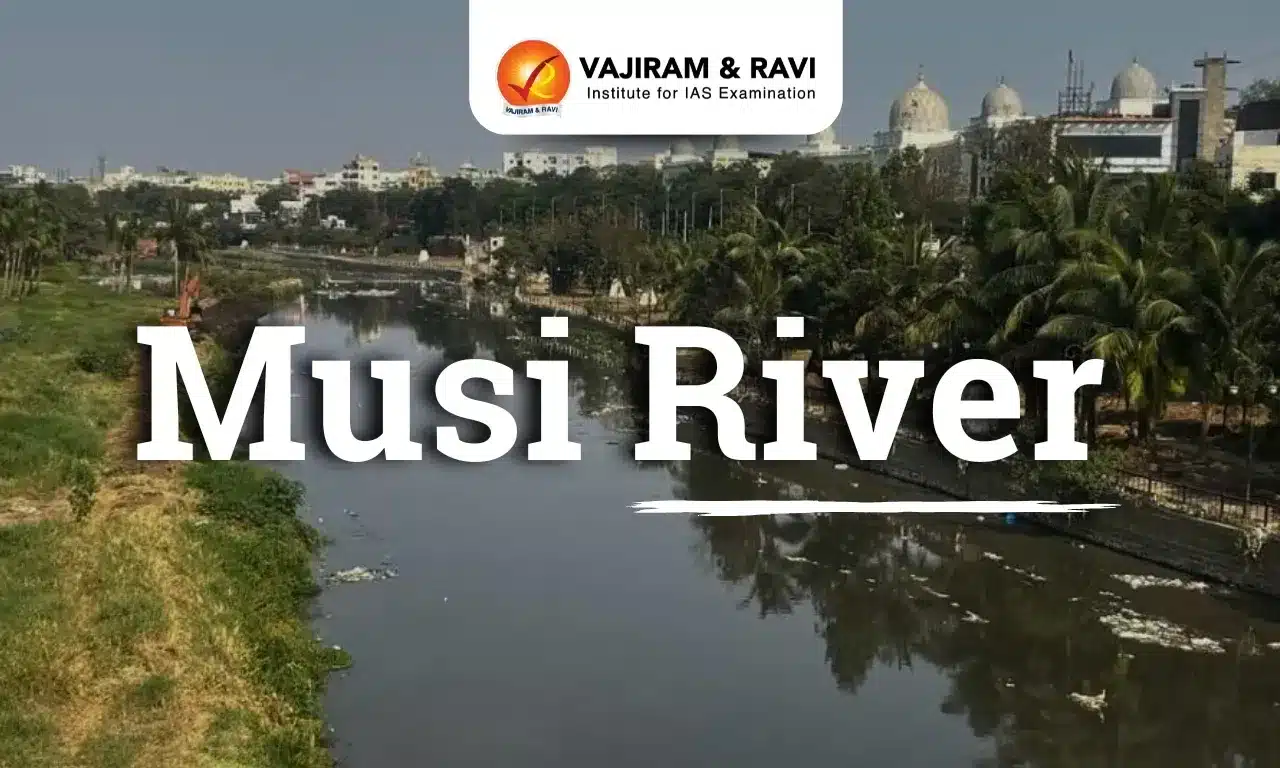
  • The Musi River, also known as the Muchukunda or Musunuru River, is a major tributary of the Krishna River in the Deccan Plateau, flowing through Telangana.
  • Course:
    • Source: Anantagiri Hills, Vikarabad, Telangana
    • The river is formed by the merging of two small rivulets: Esi (8 km) and Musa (13 km).
    • After originating, the Musi River flows in an eastward direction, cutting through the heart of Hyderabad city, where it historically divided the Old City from the New City.
    • The river then continues its journey through the southern Telangana plains, passing through parts of Rangareddy and Nalgonda districts.
    • Confluence: The Musi ultimately joins the Krishna River near Wazirabad in Nalgonda district.
  • The river’s total length is approximately 240 kilometers.
  • Dams: Himayat Sagar and Osman Sagar are the two dams that are constructed over the river.
  • The Musi River has 24 diversion weirs for irrigation, locally known as kathwas.
  • Irrigation and drinking water for villages downstream is heavily polluted with waste from the city.

Source: TH

Musi River FAQs

Q1: The Musi River is a major tributary of which river?

Ans: Krishna

Q2: What is the origin of the Musi River?

Ans: Anantagiri Hills, Vikarabad, Telangana

Q3: Which city does the Musi River flow through?

Ans: Hyderabad

Q4: What is the approximate length of the Musi River?

Ans: 240 km

Schengen Visa Scheme

schengen visa

Schengen Visa Latest News

Indian travellers with a clean visa history now have access to a fast-tracked, long-term Schengen visa under a new “cascade” system rolled out by the European Commission.

About Schengen Visa

  • A Schengen visa is an entry permit that allows non-EU nationals to temporarily visit or transit through the Schengen Area, which comprises 29 European countries. 
  • Within this area, there are no internal borders, allowing for unrestricted movement between the countries.
  • The visa is valid for up to 90 days within a 180-day period, which begins the day you enter a Schengen country. 
  • You can enter and leave the area multiple times, but the total stay must not exceed 90 days within the 180-day period.
  • Schengen visas are issued for various purposes, such as tourism, business, visiting family, medical treatment, and participation in cultural or sporting events.
  • The visas do not give the right to work.

Which Countries Issue Schengen Visas?

  • There are currently 29 European countries in the Schengen.
  • Members of this area include 25 of the 27 EU member states (except for Cyprus and Ireland) and all members of the European Free Trade Association (Iceland, Liechtenstein, Norway and Switzerland).
  • Being part of this area means that countries:
    • Do not carry out checks at their internal borders, except in cases of specific threats;
    • Carry out harmonized controls at their external borders, based on clearly defined criteria.

The Cascade Visa Scheme

  • The cascade visa scheme rewards “trusted travellers” with a documented travel record. 
  • Indian citizens who have obtained two Schengen visas within the past three years are now eligible for a two-year multi-entry visa. 
  • This can later be upgraded to a five-year visa, provided their passport is valid for the full term.
  • During its validity, the visa allows holders to travel freely across the Schengen area, mirroring the travel rights of visa-free nationals. 
  • However, the visa does not grant the right to work and still limits stays to 90 days within any 180-day period.
  • It applies a tiered structure for visa validity based on prior usage:
    • 1-year visa if the traveller used three Schengen visas in the previous two years.
    • 2-year visa if they used a 1-year multiple-entry visa in the previous two years.
    • 5-year visa if they used a 2-year multiple-entry visa in the previous three years.

Source: BT

Schengen Visa FAQs

Q1: What is the maximum duration of stay allowed under a Schengen visa within a 180-day period?

Ans: 90 days

Q2: What is the primary purpose of the Schengen visa?

Ans: What is the Schengen Area?

Q3: How many countries are currently in the Schengen Area?

Ans: 2929

Enquire Now