Grant in Aid to National Cooperative Development Corporation (NCDC) Scheme

Grant in Aid to NCDC Scheme

Grant in Aid to National Cooperative Development Corporation (NCDC) Scheme Latest News

The Union Cabinet, chaired by the Prime Minister, recently approved the Central Sector Scheme “Grant in Aid to National Cooperative Development Corporation (NCDC)”

About Grant in Aid to National Cooperative Development Corporation (NCDC) Scheme

  • It is a Central Sector Scheme with an outlay of  ₹2, 000 crore for a period of four years from 2025-26 to 2028-29 (₹500 crore each year from FY 2025-26).
  • The grant of ₹2,000 crore will be sourced through budgetary support from the Government of India. 
  • The approved grant will enable NCDC to raise ₹20,000 crore from the open market over the next four years. 
  • These funds will be utilised by NCDC for granting loans to Cooperatives for setting up new projects/expansion of plants, and loans for meeting the working capital requirements.
  • Benefits: Approximately 2.9 crore members of 13,288 Cooperative societies of various sectors like Dairy, Livestock, Fisheries, Sugar, Textile, Food Processing, Storage and Cold Storage; Labour and Women led cooperatives. across the country are likely to get benefitted.
  • Implementation Strategy and Targets:
    • NCDC will be the executing agency for this scheme for the purpose of disbursement, follow-up, monitoring of implementation of the project, and recovery of loans disbursed out of the fund.
    • NCDC will provide loans to cooperatives either through state government or directly, as per NCDC guidelines. Cooperatives that meet the criteria of direct funding guidelines of NCDC would be considered for financial assistance directly against admissible security or a state government guarantee.
    • NCDC will provide loans to cooperatives, long-term credit for setting up/ modernization/ technology upgradation/ expansion of project facilities for various sectors, and working capital to run their businesses efficiently and profitably.

Source: PMI

Grant in Aid to National Cooperative Development Corporation (NCDC) Scheme FAQs

Q1: What is the total outlay of the Grant-in-Aid to National Cooperative Development Corporation (NCDC) Scheme?

Ans: It has an outlay of ₹2, 000 crore for a period of four years from 2025-26 to 2028-29.

Q2: How much grant is allocated annually under Grant in Aid to National Cooperative Development Corporation (NCDC) Scheme starting FY 2025–26?

Ans: ₹500 crore

Q3: What kind of assistance will NCDC provide to cooperatives under Grant in Aid to National Cooperative Development Corporation (NCDC) Scheme?

Ans: Loans to Cooperatives for setting up new projects/expansion of plants, and loans for meeting the working capital requirements.


Supply and Use Table

Supply and Use Tables

Supply and Use Table Latest News

Recently, the Ministry of Statistics and Programme Implementation (MoSPI) has released the ‘Supply and Use Tables of 2020-21 and 2021-22’.

About Supply and Use Table

  • It represents a detailed snapshot of all economic activities taking place in the economy.
  • They are powerful analytical tools that present the structure of an economy as well as interlinkages among the various economic actors.

Purpose of Supply and Use Tables

  • They serve multiple purposes and have gained prominence due to their statistical robustness and analytical flexibility.
  • They offer a comprehensive framework that integrates the three approaches to measuring Gross Domestic Product (GDP)—production, income, and expenditure within a unified structure.
  • SUT is a very powerful tool for comparing and reconciling data from diverse sources, thereby improving the coherence and consistency between production and expenditure estimates.
  • Supply and Use Tables (SUT) are presented as two interlinked matrices: the Supply Table and the Use Table, structured in a product-by-industry matrix.
  • The Supply Table captures the total supply of goods and services, both from domestic production by industry and from imports.
  • In contrast, the Use Table records the utilization of these products across various components—intermediate consumption by industries, final consumption, gross capital formation, and exports.

Source: PIB

Supply and Use Table FAQs

Q1: What is the use table?

Ans: The use table describes the destination of goods and services by type of use, distinguishing between intermediate consumption (use of a product as an input into a production process) and various categories of final demand such as consumption, investment and exports.

Q2: What is the supply use product classification?

Ans: Supply-use product classification (SUPC) The SUPC is the detailed level product classification, organised according to the industry to which each product is primary.

INS Himgiri

INS Himgiri

INS Himgiri Latest News

Recently, INS Himgiri (Yard 3022) was delivered to the Indian Navy at GRSE, Kolkata.

About INS Himgiri 

  • It is the third ship of Nilgiri Class (Project 17A) and the first of the class built at Garden Reach Shipbuilders & Engineers (GRSE), 
  • It is a reincarnation of the erstwhile INS Himgiri, a Leander-class frigate,that was decommissioned on 06 May 2005 after 30 years of glorious service to the nation.
  • It is designed by the Warship Design Bureau (WDB) and overseen by the Warship Overseeing Team (Kolkata).

Features of INS Himgiri 

  • P17A ships are fitted with an advanced weapon and sensor suite compared to the P17 (Shivalik) class.
  • These ships are configured with Combined Diesel or Gas (CODOG) propulsion plants, comprising a diesel engine and gas turbine, that drives a Controllable Pitch Propeller (CPP) on each shaft, and a state-of-the-art Integrated Platform Management System (IPMS).
  • The weapon suite comprises supersonic Surface-to-Surface missile system, Medium-Range Surface to Air Missile system, rapid-fire Close-in Weapon Systems.
  • It has indigenous content of 75%, which has involved over 200 MSMEs at GRSE.
  • P17A frigates reflect a generational leap in indigenous ship design, stealth, survivability, and combat capability.
  • Significance: Delivery of Himgiri showcases the design, ship construction and engineering prowess of the nation, and reflects Indian Navy’s unrelenting focus on Aatmanirbharta in both ship design and shipbuilding.

Source: PIB

INS Himgiri FAQs

Q1: What are the ships under Project 17A?

Ans: Nilgiri, Himgiri, Taragiri, Udaygiri, Dunagiri, and Vindhyagiri

Q2: Which is India's first AI enabled warship?

Ans: INS Surat

UN Women

UN Women

UN Women Latest News

Recently, the UN Women celebrated its 15th anniversary.

About UN Women

  • It is the United Nations (UN) entity dedicated to gender equality and the empowerment of women.
  • It was created in July 2010 by the UN General Assembly.
  • The creation of UN Women came about as part of the UN reform agenda, bringing together resources and mandates for greater impact.
  • The main roles of UN Women are:
    • To support inter-governmental bodies, such as the Commission on the Status of Women, in their formulation of policies, global standards, and norms.
    • To help member states implement these standards, standing ready to provide suitable technical and financial support to those countries that request it, and to forge effective partnerships with civil society.
    • To lead and coordinate the UN system’s work on gender equality as well as promote accountability, including through regular monitoring of system-wide progress.
  • It works globally to make the vision of the Sustainable Development Goals (SDG’s) a reality for women and girls and stands behind women’s equal participation in all aspects of life.
  • Within countries that request its assistance, UN Women works with government and non-governmental partners to help them put in place the policies, laws, services, and resources that women require to move towards equality.
  • Grant-making Funds: UN Women provides grants to fuel innovative, high-impact programmes by government agencies and civil society groups through two funds—the Fund for Gender Equality and the UN Trust Fund to End Violence against Women.
  • Commission on the Status of Women (CSW): A global policy-making body, the CSW is a functional commission of the United Nations Economic and Social Council (ECOSOC), dedicated exclusively to gender equality and the advancement of women.
  • Aside from the CSW, UN Women offers regular information on women’s rights issues to the General Assembly, the ECOSOC, and the Security Council.
  • It maintains the UN Secretary-General’s database on violence against women, which tracks measures to end violence taken by UN Member States and UN organizations.

Source: UN

UN Women FAQs

Q1: What is UN Women ?

Ans: It is the United Nations entity dedicated to gender equality and the empowerment of women

Q2: What is SDG and its goals?

Ans: The Sustainable Development Goals (SDGs), also known as the Global Goals, were adopted by the United Nations in 2015 as a universal call to action to end poverty, protect the planet, and ensure that by 2030 all people enjoy peace and prosperity.

Sabarmati River

Sabarmati River

Sabarmati River Latest News

Thirteen stretches of rivers in Gujarat have been officially classified as polluted, with the Sabarmati emerging as the most contaminated, according to data tabled by the Union govt in the Lok Sabha recently.

About Sabarmati River

  • It is a monsoon-fed, west-flowing river.
  • Course:
    • It originates in the Aravalli Mountain Range in the Udaipur district of the northern Indian state of Rajasthan
    • The river is also called Wakal in its initial course. 
    • The river flows in a southwesterly direction across Rajasthan and Gujarat.
    • It finally empties into the Gulf of Khambhat of the Arabian Sea.
  • It is about 371 km in length. In Gujarat, the river extends to a length of about 323 km, while in Rajasthan the river has a length of about 48 km.
  • The Sabarmati basin extends over an area of 21,674 sq.km with a maximum length and width of 300 km and 150 km.
  • The basin is bounded by Aravalli hills on the north and north-east, by the Rann of Kutch on the west, and by the Gulf of Khambhat on the south.
  • The major part of the basin is covered with agriculture, accounting for 74.68% of the total area. 
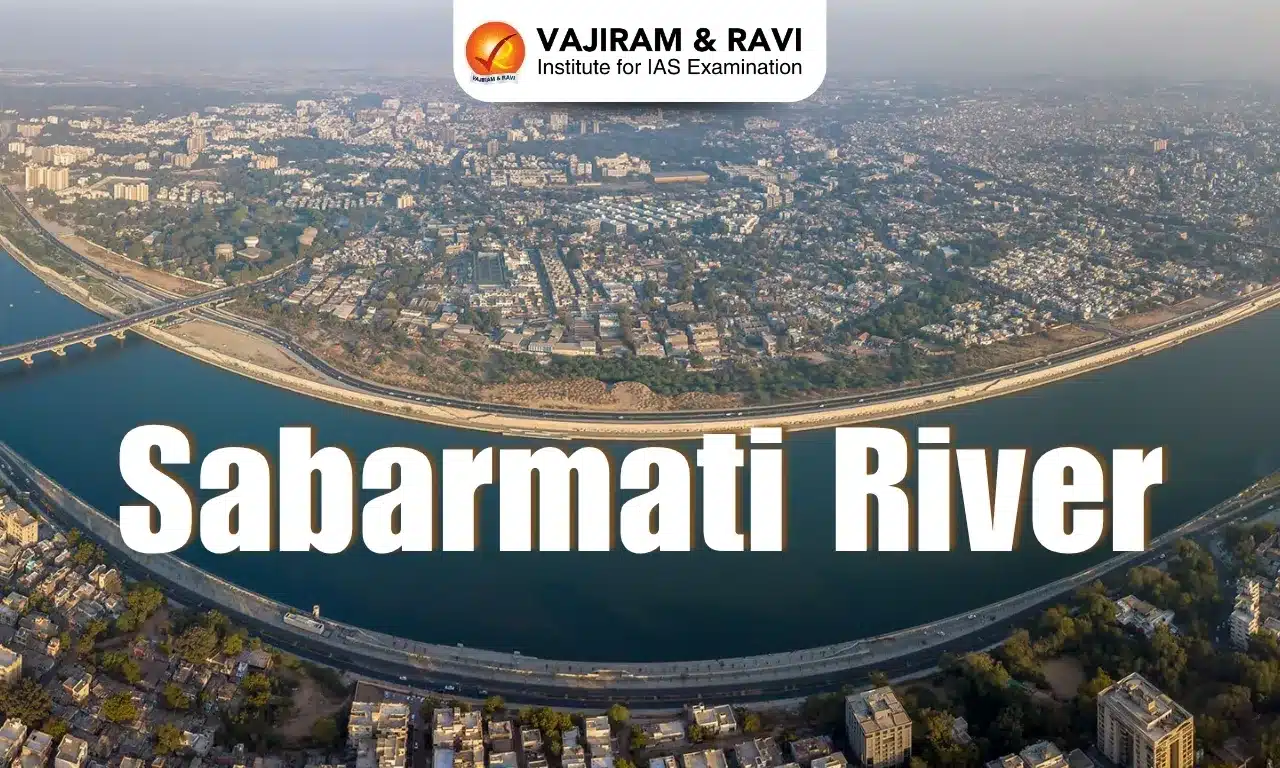
  • The banks of the Sabarmati River have Indian cities like Ahmedabad and Gandhinagar.
  • It flows north-south through Ahmedabad, bisecting the city into its western and eastern halves.
  • Major Tributaries: Wakal River, Harnav River, Hathmati River, Watrak River, and Madhumati River.

Source: TOI

Sabarmati River FAQs

Q1: Where does the Sabarmati River originate?

Ans: Aravalli Hills, Rajasthan

Q2: What is the total length of the Sabarmati River?

Ans: 371 km

Q3: Into which water body does the Sabarmati River empty?

Ans: Arabian Sea – Gulf of Khambhat

Q4: Which two Indian cities are located on the banks of the Sabarmati River?

Ans: Ahmedabad and Gandhinagar

Darwin’s Frog

Darwin's Frog

Darwin's Frog Latest News

Recently, Chile has launched a new effort to save the endangered Darwin's frog.

About Darwin's Frog

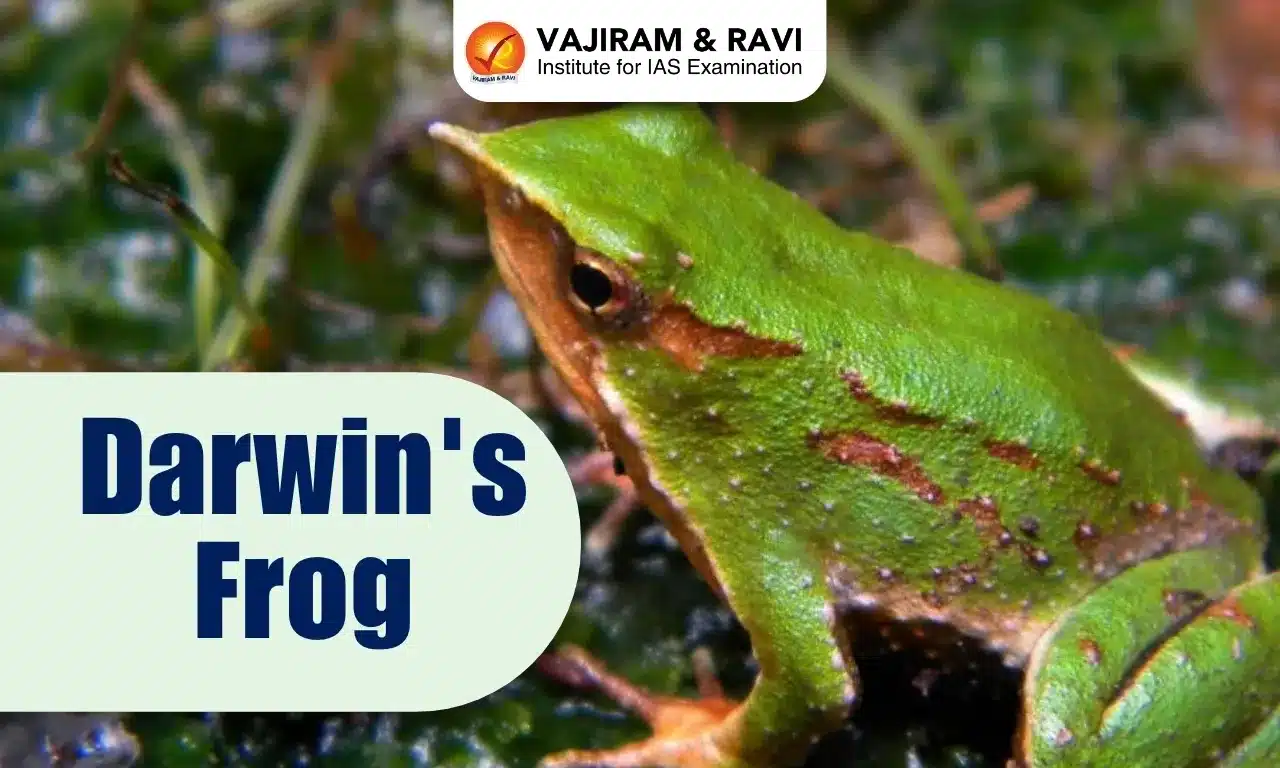
  • Darwin's frog (Rhinoderma darwinii ), also called the southern Darwin's frog.
  • Features of Darwin's Frog
    • It is unique among amphibians for its brooding habits.
    • It is a tiny amphibian with leaf-like skin whose males carry tadpoles within pouches in their mouths.
    • It is a diurnal creature, meaning it sleeps at night and is mostly active during daytime.
    • When threatened by predators, the frog plays dead. It lays very still on the forest floor or floating in a stream.
    • It measures 3 cm (1.18 inches), was discovered in Chile's southern Chiloe islands by Charles Darwin during his 1834 trip around the world.
  • Distribution: It is a rhinodermatid frog native to the forest streams of Chile and Argentina.
  • Habitat: It is found in a variety of vegetation types and it appears that a mixture of grassland, mossy areas, coarse woody debris, and young trees and bushes in a mature native forest provides its optimum habitat requirements.
  • Diet: Darwin's frog feeds on insects and other arthropods.
  • It actually comprises two: the endangered Rhinoderma darwinii (Southern Darwin's frog) and the Rhinoderma rufum (Northern Darwin's frog), which is categorized as "critically endangered" and has already virtually disappeared.
  • Threats: Forest fires, climate change, invasive species and urbanization have hurt the humid forests of southern Chile and Argentina where Darwin's frog typically lives.

Source: TH

Darwin's Frog FAQs

Q1: Why is it called Darwin's frog?

Ans: Darwin's frogs were named after the father of evolution, who discovered them in 1834 in Chile during his voyage around the world on the ship HMS Beagle.

Q2: What is a Darwin's frog mouth brooding?

Ans: Mouth-brooding frogs carry their litters, or broods, of young in their mouths, particularly in the males' vocal sacs.

Enquire Now