Bio-Fortified Potatoes

Bio-fortified Potatoes

Bio-Fortified Potatoes Latest News

India is taking a significant step in tackling micronutrient deficiencies and improving agricultural sustainability by introducing bio-fortified potatoes with enhanced iron content, developed by the International Potato Center (CIP) based in Peru.

What are Bio-Fortified Potatoes?

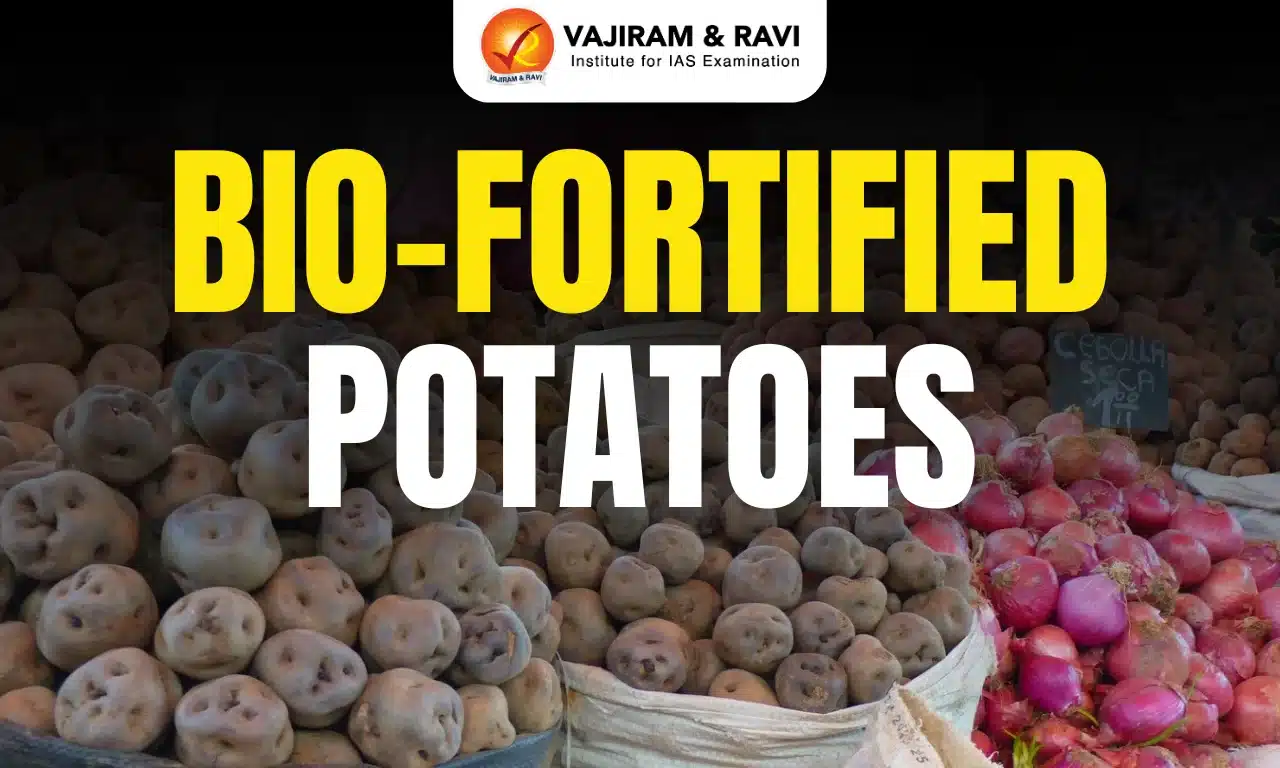
  • Bio-fortified potatoes are a new variety enriched with higher iron content aimed at addressing iron deficiency and hidden hunger. These are developed using conventional breeding and biotechnology without altering taste or yield.
  • The initiative is led by the International Potato Centre (CIP), based in The CIP is a global research leader in tuber crops and is working actively to promote nutritionally improved potatoes in India.

About Bio-Fortified Sweet Potatoes

  • Bio-fortified sweet potatoes enriched with Vitamin A are already available in Karnataka, Assam, West Bengal, and Odisha. Plans are underway to expand their access to more farmers across India.
  • The current focus is on iron-fortified potato varieties, for which germplasm has been shared with ICAR-Central Potato Research Institute (CPRI), Shimla.
  • A variety has already been released in Peru and is currently under evaluation and adaptation for Indian agro-climatic conditions.
  • CIP is establishing a South Asia regional centre in Agra, Uttar Pradesh, acknowledging the Indo-Gangetic plains as the world’s largest potato-producing region. This centre will boost regional R&D and seed access.
  • ICAR has released biofortified seed varieties across 61 crops, including 34 field crops (cereals, pulses, millets, oilseeds) and 27 horticultural crops (tubers, vegetables, medicinal plants).
  • Examples of Biofortified Crops
    • CR Dhan 416: Salinity-resistant rice variety with multiple pest resistances.
    • Durum Wheat: Adapted to irrigated areas, rich in zinc (41.1 ppm) and iron (38.5 ppm), and contains 12% protein.

About Biofortification

  • Biofortification is the process of enhancing the nutrient content of crops using conventional breeding, agronomic techniques, or modern biotechnology.
  • It helps increase vitamin and mineral levels in staple crops.

Source: TH

Bio-Fortified Potatoes FAQs

Q1: What are bio-fortified potatoes?

Ans: Bio-fortified potatoes are specially bred varieties enriched with iron to combat micronutrient deficiencies like anaemia. They are developed through conventional breeding and biotechnology.

Q2: Who developed the bio-fortified potato variety introduced in India?

Ans: The International Potato Center (CIP), based in Peru, developed the iron-rich variety and has shared its germplasm with ICAR’s Central Potato Research Institute in Shimla.

Q3: Why is bio-fortification of potatoes important for India?

Ans: Bio-fortified potatoes help address iron-deficiency anaemia, which affects over 50% of Indian women and children, according to NFHS-5.


Collusive Litigation

Collusive Litigation

Collusive Litigation Latest News

The Supreme Court has taken a suo motu cognisance of "collusive litigations" by officials of the Bengaluru Development Authority (BDA) recently.

About Collusive Litigation

  • It is defined as a lawsuit where the parties involved are not genuinely adversarial, but rather cooperate to achieve a desired outcome or to challenge the constitutionality of a law.
  • These suits often involve a degree of cooperation between the parties, who may share a common goal or interest in the outcome.
  • Some of the key issues surrounding these suits include:
    • The potential for abuse, where parties may collude to manipulate the judicial process or achieve an outcome that might not be possible through other means.
    • The risk of undermining the adversarial system, where the court's decision is based on a genuine dispute between parties.
    • The potential for collusive suits to be used as a means of circumventing the normal legislative process.
  • In India, collusive decrees can be set aside if the party challenging the decree is not a party to it and can prove collusion or fraud.
  • The High Court has the authority to intervene in cases where a decree is found to be collusive, particularly under Article 227.
  • A party to a collusive decree cannot seek to have it set aside. This principle is established in various cases where the courts have ruled that only parties not involved in the collusion may challenge the decree.
  • The burden of proving that a decree was obtained collusively lies with the party seeking to set it aside.
  • Courts have held that under a general prayer for relief, they can set aside a decree if it is found to be collusive, even if a specific prayer for setting aside was not made.

Source: DH

Collusive Litigation FAQs

Q1: What best describes a collusive litigation?

Ans: A lawsuit where the parties cooperate to achieve a predetermined outcome.

Q2: What is one major risk posed by collusive suits?

Ans: They can manipulate the judicial process.

Q3: Can a party involved in a collusive decree seek to set it aside?

Ans: No, they cannot challenge their own collusion.

HQ-16 Missile

HQ-16 Missile

HQ-16 Missile Latest News

The United States military publicly unveiled a mockup of a Chinese HQ-16 surface-to-air missile system, drawing attention at this year’s Experimental Aircraft Association ‘AirVenture Show’ in Oshkosh, Wisconsin.

About HQ-16 Missile

  • The HQ-16, known by its NATO designation CH-SA 16, is a medium-range surface-to-air missile (SAM) system developed by China and based heavily on Russia’s Buk missile family.
  • It is designed to engage enemy aircraft, cruise missiles, helicopters, and unmanned aerial vehicles.

HQ-16 Missile Features

  • HQ-16 features a vertical launch system, giving it 360-degree coverage and the capability to fire in a complicated geographical environment.
  • The missile system is mounted on a Chinese-designed 6x6 high mobility chassis instead of tracked platforms, providing ease of maintenance and better road mobility. 
  • Each launch vehicle carries up to 6 missiles.
  • The missile weighs 650 kg, has a length of 5.2 m and a diameter of 0.34 m. 
  • It can intercept flying aerial targets at altitudes of 15 km to 18 km. 
  • The maximum interception range for aircraft is 40 km, between 3.5 km and 12 km for cruise missiles flying at 300 m/s.
  • The missile guidance system comprises inertial guidance and semi-active radar homing at the terminal phase.

Source: EURT

HQ-16 Missile FAQs

Q1: The HQ-16 surface-to-air missile system was developed by which country?

Ans: China

Q2: What is the maximum interception range of the HQ-16 missile against enemy aircraft?

Ans: 40 km

Q3: What kind of mobility platform does the HQ-16 system use?

Ans: 6x6 high mobility wheeled chassis

Q4: What type of guidance does the HQ-16 use?

Ans: The missile guidance system comprises inertial guidance and semi-active radar homing at the terminal phase.

El Salvador

El Salvador

El Salvador Latest News

Recently, El Salvador's ruling party passed a bill that will allow indefinite presidential reelection and extend presidential terms to six years.

About El Salvador

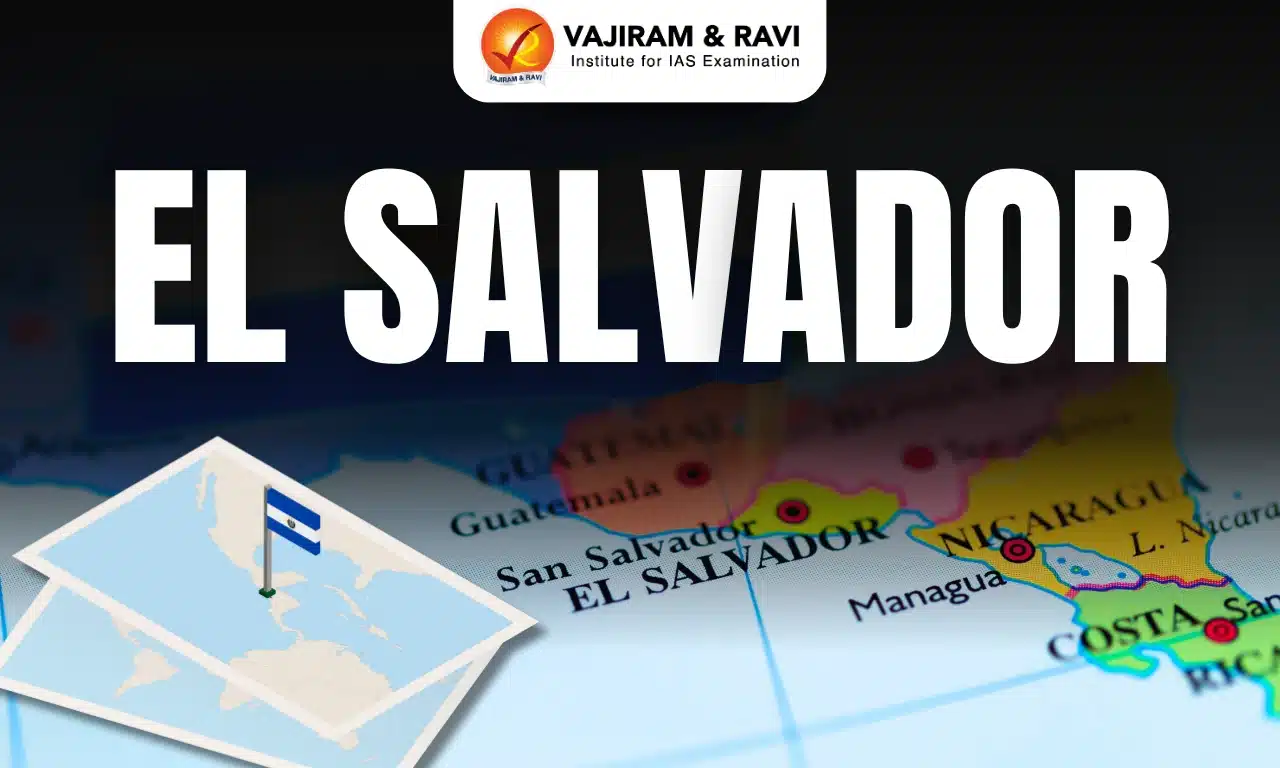
  • It is a small mountainous Central American nation.
  • Bordered by: It is bordered by Honduras to the northeast; Guatemala to the northwest and by the Pacific Ocean to the south.
  • It is the only Central American nation without a coast on the Caribbean.
  • Topography: The Central Region of El Salvador is characterized by a mix of mountains, valleys, and a volcanic plateau.
  • The region is dominated by the volcanic chain, part of the larger Sierra Madre mountains, which includes several volcanoes such as San Salvador, Ilopango, and San Vicente.
  • Highest Point: The highest point in the country, Cerro El Pital, stands at 2,730 meters (8,957 feet) and is located on the border with Honduras in the northern part of this region.
  • River:  Lempa River plays a significant role in the geography of the country.
  • Major Lakes: Lake Ilopango, Lake Coatepeque , Lake Güija 
  • Climate: The climate of El Salvador is tropical but is moderated by elevation in the interior; in general it is warm rather than hot
  • Capital City: San Salvador

Source: TH

El Salvador FAQs

Q1: Why is El Salvador so famous?

Ans: El Salvador earns its nickname as the “Land of Volcanoes” with around 20 volcanoes. Two of the most famous are San Miguel Volcano and Santa Ana Volcano.

Q2: Is San Salvador volcano active?

Ans: San Salvador volcano has not erupted for more than 80 years but it has a long history of repeated, and sometimes violent, eruptions.

ICRISAT’s AI-based Agromet Advisory Service

ICRISAT’s AI-based Agromet Advisory Service

ICRISAT’s AI-based Agromet Advisory Service Latest News

Recently, International Crops Research Institute for the Semi-Arid Tropics (ICRISAT) and ICAR have launched an AI-based context-specific Agromet Advisory Service to boost farming.

About ICRISAT’s AI-based Agromet Advisory Service

  • ICRISAT’s AI-based Agromet Advisory Service is a new initiative which harness artificial intelligence (AI) and machine learning (ML) to provide real-time, personalised climate advisory services to farmers.
  • It aims to equip smallholder farmers with hyper-local, actionable weather and climate insights, enabling them to make informed decisions amid increasing climate variability.
  • The initiative will provide farmers with timely, actionable recommendations for critical decisions such as sowing, irrigation, and pest management.
  • These advisories will be delivered through user-friendly digital channels, including an AI-powered WhatsApp bot, ensuring easy access even in remote farming communities. ​
  • The project is supported under the Government of India’s Monsoon Mission III.
  • The project will first be implemented in Maharashtra, through ICAR’s Agro-Meteorological Field Units (AMFUs) to reach smallholder farmers. Insights from this phase will inform a national rollout and serve as a model for South-South expansion.
  • Organisations involved: The Central Research Institute for Dryland Agriculture (CRIDA-ICAR), the International Livestock Research Institute (ILRI), the Indian Institute of Tropical Meteorology (IITM), and Indian Meteorological Department (IMD) joined the initiative.
  • The Intelligent Systems Advisory Tool (iSAT), a digital platform developed and piloted by ICRISAT and partners during Monsoon Mission II is now being upgraded into a fully functional AI-powered tool under this new initiative.
    • iSAT was initially designed to transform complex climate and agronomic data into personalised, science-based advisories.

Source: BL

ICRISAT’s AI-based Agromet Advisory Service FAQs

Q1: Where is the International Crops Research Institute for the Semi-Arid Tropics situated?

Ans: Hyderabad, India.

Q2: What is ICRISAT and its functions?

Ans: ICRISAT stands as the premier drylands agricultural research institute, dedicated to uplifting smallholder farmers and ensuring food security in semi-arid tropics.

National Green Hydrogen Mission

National Green Hydrogen Mission

About National Green Hydrogen Mission: 

  • It was approved by the Union Cabinet on January 4, 2023.
  • Aim: To make India a Global Hub for the production, utilization, and export of Green Hydrogen and its derivatives.

What are the components of the scheme?

  • The Strategic Interventions for Green Hydrogen Transition Programme (SIGHT): Under this two distinct financial incentive mechanisms will be provided
    • Targeting domestic manufacturing of electrolysers and
    • Production of Green Hydrogen
  • The Mission will also support pilot projects in emerging end-use sectors and production pathways. 
  • Regions capable of supporting large-scale production and/or utilization of Hydrogen will be identified and developed as Green Hydrogen Hubs.
  • A public-private partnership framework for R&D (Strategic Hydrogen Innovation Partnership – SHIP) will be facilitated under the Mission.
  • A coordinated skill development programme will also be undertaken under the Mission.

Norms issued for funding testing facilities

  • The Scheme will be implemented with a total budgetary outlay of Rs. 200 Crores till the financial year 2025-26.
  • The National Institute of Solar Energy (NISE) will be the Scheme Implementation agency (SIA).
  • The scheme encompasses the development of robust quality and performance testing facilities to ensure quality, sustainability, and safety in GH2 production and trade.

Source: ET

National Green Hydrogen Mission FAQs

Q1: What is Green hydrogen?

Ans: It is also referred to as ‘clean hydrogen’ that is produced by using electricity from renewable energy sources, such as solar or wind power, to split water into two hydrogen atoms and one oxygen atom through a process called electrolysis.

Enquire Now