PAHAL (Direct Benefit Transfer for LPG) Scheme

PAHAL Scheme

PAHAL Scheme Latest News

The Indian government has deactivated more than 4 crore duplicate or inactive domestic LPG connections under its PAHAL direct benefit transfer scheme, the Petroleum Minister told parliament recently.

About PAHAL Scheme

  • Pratyaksh Hanstantrit Labh/Direct Benefits Transfer For LPG (PAHAL) scheme, launched by the Ministry Of Petroleum and Natural Gas, is India’s Direct Benefit Transfer (DBT) system for LPG subsidies. 
  • Instead of subsidized cylinders being delivered directly, the consumer pays the full market price for LPG and the government transfers the subsidy amount to the registered bank account.
  • It covers over 17 crore LPG consumers nationwide, making it the largest cash transfer program globally.

PAHAL Scheme Objectives

  • Ensures transparency and eliminates intermediaries.
  • Removing incentives for diversion.
  • Protect the entitlement and ensure the payment of subsidy to the consumers.
  • Improving the availability or delivery of LPG cylinders for genuine customers.
  • Eliminating the fake or duplicate connections.
  • Providing self-selection in subsidy.

PAHAL Scheme Eligibility

  • The applicant must be an LPG user.
  • The combined taxable income of the applicant and their spouse should not exceed ₹10,00,000 in the previous financial year, as per the Income Tax Act, 1961.

PAHAL Scheme Working

  • The consumer books a gas cylinder at the market price.
  • Once delivered, the government credits the subsidy amount directly into the linked bank account of the consumer.
  • There are two types of consumers in the scheme:
  • Primary Aadhaar-Based DBT (preferred): Aadhaar is linked with both the LPG consumer number and the bank account.
  • Alternative (Non-Aadhaar-Based): Bank account is linked directly with the LPG consumer number if Aadhaar linking is not available.

Source: CNBC

PAHAL Scheme FAQs

Q1: Which ministry launched the PAHAL (Direct Benefit Transfer for LPG) scheme?

Ans: Ministry of Petroleum and Natural Gas

Q2: What is the primary objective of the PAHAL scheme?

Ans: Transfer LPG subsidies directly to consumers' bank accounts.

Q3: What was one of the key motivations behind introducing the PAHAL scheme?

Ans: To prevent diversion and misuse of subsidized LPG.
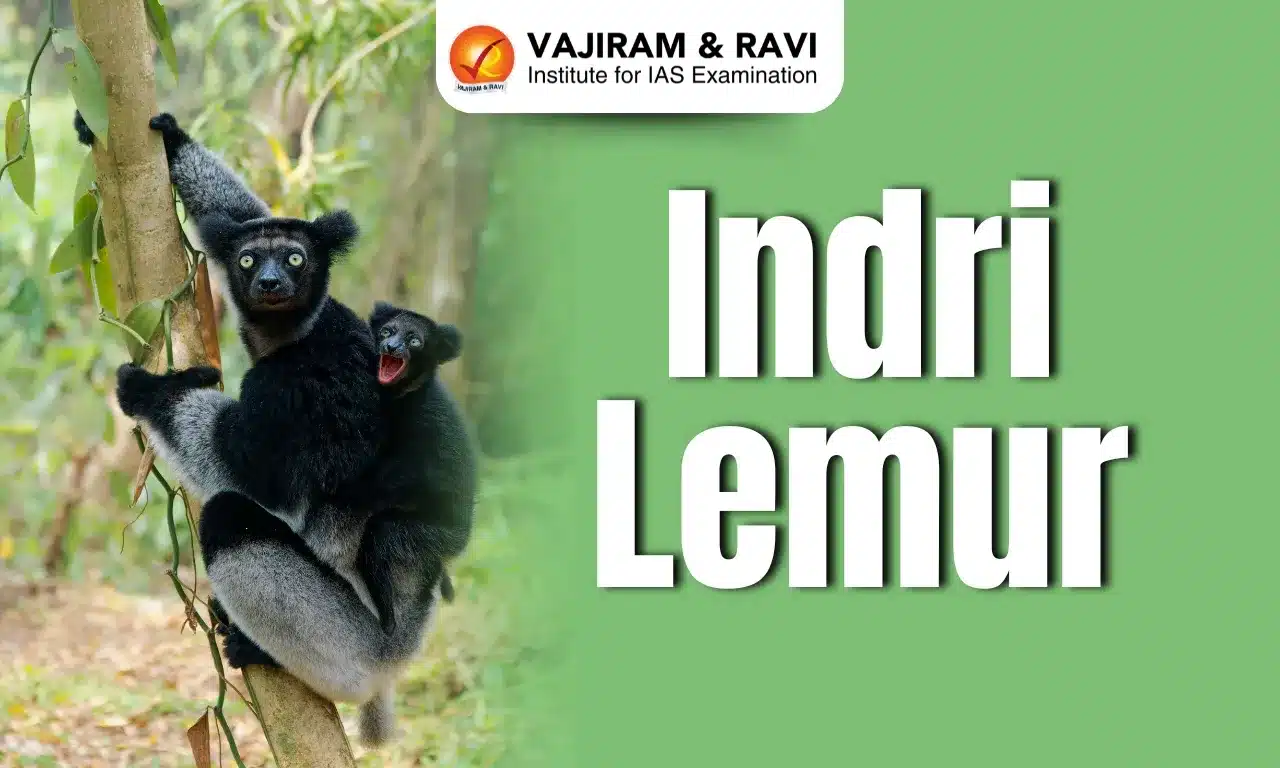
Indri Lemur

Indri Lemur

Indri Lemur Latest News

Joint research has, for the first time, ascertained the composition of the intestinal microbiome of the indri, a critically endangered lemur only found in the north-east of Madagascar.

About Indri Lemur

  • Indri, or babakoto in the local language, is the largest of the surviving lemur species.
  • Scientific Name: Indri indri

Indri Lemur Distribution

  • Found only in remote parts of northeastern Madagascar.
  • Resides in coastal and montane rainforest from sea level to 1,800 m.

Indri Lemur Features

  • It is 60–70 cm (24–28 inches) long, with a rudimentary tail and large hands and feet. 
  • The round head has a pointed face and round, furry ears. 
  • Indris have smooth, silky fur covering their whole bodies. 
  • Its fur is black, with white on the head, throat, forearms, and buttocks; the relative proportions of white and black vary geographically. 
  • In the wild, indris live between 15 and 18 years.
  • Active during the day and thoroughly arboreal, the indri clings to trees and climbs in an upright position as it feeds on leaves, fruit, flowers, and other vegetation.

Indri Lemur Conservation Status

It is classified as 'Critically Endangered' under the IUCN Red List.

Source: PHYS

Indri Lemur FAQs

Q1: Where do indri lemurs live?

Ans: Indri lemurs are found only in remote parts of northeastern Madagascar.

Q2: What is the conservation status of the Indri lemur as per the IUCN Red List?

Ans: Critically Endangered

Q3: What is the average lifespan of an Indri in the wild?

Ans: 15–18 years

India Cine Hub Portal

India Cine Hub Portal

India Cine Hub Portal Latest News

Recently, the central government urged states to use India Cine Hub Portal to facilitate Global film Production locally.

About India Cine Hub Portal

  • It was launched on June 28, 2024.
  • It is a single-window system streamlining filmmaking permissions, incentives, and resource mapping across India.
  • It was set up by the Ministry of Information & Broadcasting, Government of India in the National Film Development Corporation (NFDC) with a view to promote and facilitate film shootings by foreign filmmakers in India.
  • It acts as a single-window facilitation and clearance mechanism that eases filming in India, as well as endeavouring to create a film-friendly ecosystem and promoting the country as a filming destination.

Features of India Cine Hub Portal

  • It features GIS-based location mapping and a common application form, the portal enhances ease of doing business and promotes India as a global filming destination.
  • Seven states and two Union Territories have fully integrated with the platform, while 21 states and six Union Territories have been on boarded.
  • The services rendered by the India Cine Hub (ICH) have now been extended to Indian filmmakers as well.

Source: PIB

India Cine Hub Portal FAQs

Q1: What does National Film Development Corporation do?

Ans: It functions in areas of film financing, production and distribution and under the Ministry of Information and Broadcasting, Government of India. The primary goal of the NFDC is to plan, promote and organise an integrated and efficient development of the Indian film industry and foster excellence in cinema.

Q2: Who is called the father of Indian cinema?

Ans: Dadasaheb Phalke

Bay of Bengal Initiative for Multi-Sectoral Technical and Economic Cooperation (BIMSTEC)

BIMSTEC

BIMSTEC Latest News

The first-ever BIMSTEC Traditional Music Festival was recently held at Bharat Mandapam in New Delhi.

About BIMSTEC

  • It is a grouping of seven member states lying in the littoral and adjacent areas of the Bay of Bengal.
  • The organization came into existence on 6 June 1997 through the 'Bangkok Declaration'. 
  • Membership: It is a unique link connecting South Asia with Southeast Asia - five Members from South Asia (Bangladesh, Bhutan, India, Nepal, and Sri Lanka) and two from South-East Asia (Myanmar and Thailand). 
  • BIMSTEC organizes intergovernmental interactions through Summits, Ministerial Meetings, Senior Officials Meetings, Permanent Working Committee, Joint Working Groups, and Experts Level Meetings,
  • The BIMSTEC region brings together 1.7 billion people - 22% of the world population with a combined GDP of US$ 5 trillion.
  • Permanent Secretariat: Dhaka, Bangladesh.
  • BIMSTEC has identified 14 priority areas of cooperation where a member country takes the lead.
    • India is the lead country for Transport & Communication, Tourism, Environment & Disaster Management, and Counter Terrorism & Transnational Crime.

Source: NOA

BIMSTEC FAQs

Q1: What is BIMSTEC?

Ans: It is a grouping of nations lying in the littoral and adjacent areas of the Bay of Bengal.

Q2: How many countries are in BIMSTEC?

Ans: There are 7 member countries in BIMSTEC.

Q3: Which are the member countries of BIMSTEC?

Ans: The member countries of BIMSTEC are Bangladesh, Bhutan, India, Myanmar, Nepal, Sri Lanka, and Thailand.

Q4: Where is BIMSTEC headquarters?

Ans: BIMSTEC headquarters is located in Dhaka, Bangladesh.

Leap-1 Mission

Leap-1 Mission

Leap-1 Mission Latest News

A budding space tech startup Dhruva Space from India, is set to launch its first commercial satellite mission called LEAP-1.

About Leap-1 Mission

  • It is Dhruva Space’s first commercial satellite mission, which is carrying payloads for AI and Earth observation.
  • It utilises Dhruva Space’s indigenously developed P-30 satellite platform which was successfully space-qualified during the LEAP-TD mission on ISRO’s PSLV-C58 in January 2024.
  • It is developed by Dhruva Space and Australia-based Akula Tech and Esper Satellites.
  • The mission carries two distinct payloads:
    • Nexus-01: It features an advanced artificial intelligence (AI) module.
    • AI module promises unprecedented on-orbit intelligence with onboard data processing and AI/ML model re-training capabilities for rapid, near-real-time insights.
    • AI flexibly supports applications such as fire detection and spectral analysis, continuously improving via live sensor data retraining.
    • Esper Satellites’ OTR-2 mission: It is equipped with a cutting-edge hyperspectral imager.
    • This hyperspectral imager delivers spectrally rich Earth observation data through their EarthTones API, setting a new standard in remote sensing technology.
  • Significance: This payload fusion enhances capabilities across applications including defense, disaster response, agriculture, mining, and environmental monitoring.

Source: India today

Leap-1 Mission FAQs

Q1: What is a satellite platform?

Ans: A satellite platform provides the support on which to mount instruments and the infrastructure for the mission such as power, communications to the ground and navigation.

Q2: What is the earth engine API?

Ans: Earth Engine is a platform for geospatial data storage, analysis, and visualization.

CLOVES Syndrome

CLOVES Syndrome

CLOVES Syndrome Latest News

Researchers believe that CLOVES Syndrome is caused by mutations in a gene called PIK3CA and less than 200 cases are believed to have been reported worldwide.     

About CLOVES Syndrome

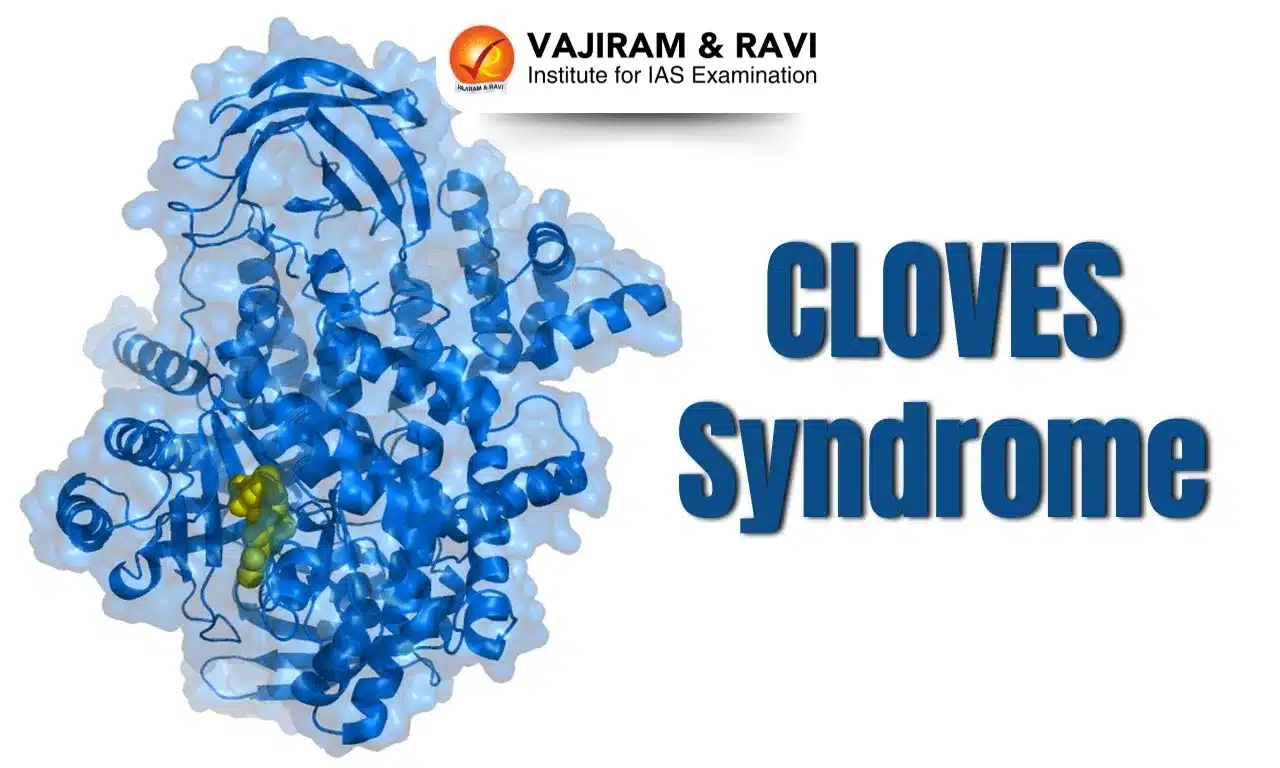
  • CLOVES Syndrome, in which the letters stand for: Congenital; Lipomatous; Overgrowth; Vascular malformations ; Epidermal nevi and Spinal/skeletal anomalies/Scoliosis, is very rare condition.       
  • It is a rare genetic disorder.
  • Cause: It is caused by mutations in a gene called PIK3CA which makes one of the proteins in an enzyme called PI3K, which is involved in many important functions in a cell.
  • Mutations in the PIK3CA gene may cause the PI3K enzyme to become overactive, which may cause cancer cells to grow.
  • PIK3CA gene mutations have been found in many types of cancer, including cancers of the breast, lung, ovary, stomach, brain, colon, and rectum.
  • CLOVES Syndrome is an overgrowth disorder, part of a larger group of similar disorders called PIK3CA-related overgrowth spectrum or PROS.
  • The mutations in the PIK3CA gene are believed to occur spontaneously in the womb.
  • It is not hereditary and cannot be passed on.   

Symptoms of CLOVES Syndrome

  • Growth of Soft masses of fatty tissue on the abdomen, back, sides and buttocks.
  • Vascular or blood vessel anomalies such as dilated veins that may be seen in the chest, arms and legs and that may pose a risk of blood clots
  • Large and wide hands or feet, with large gaps between fingers and toes; ‘port wine stain’ birthmarks;
  • Spinal problems such as scoliosis or a tethered cord; kidney problems; skin abnormalities such as raised bumps,
  • Treatment: There is no cure as yet for CLOVES syndrome. However, with the right diagnosis, healthcare providers can help patients manage symptoms.

Source: TH

CLOVES Syndrome FAQs

Q1: What is the difference between CLOVES and Klippel Trenaunay syndrome?

Ans: CLOVES is caused by a mosaic mutation in PIK3CA. This is the same gene that is mutated in M-CM. Klippel-Trenaunay syndrome (KTS) is characterized by a triad of findings including slow-flow vascular malformations involving the veins and capillaries, an abnormally developed lymphatic system, and hemihyperplasia.

Q2: What is CLOVES syndrome?

Ans: Congenital Lipomatous Overgrowth, Vascular Malformations, Epidermal Nevis, Spinal/Skeletal Anomalies/Scoliosis (CLOVES) syndrome is a very rare congenital (present at birth) disorder characterized by a combination of vascular (involving the blood vessels), skin, spinal, and bone or joint abnormalities.

Intermediate-Range Nuclear Forces (INF) Treaty

Intermediate-Range Nuclear Forces (INF) Treaty

Intermediate-Range Nuclear Forces (INF) Treaty Latest News

Russia has officially declared it no longer considers itself bound by the Intermediate-Range Nuclear Forces (INF) Treaty.        

About Intermediate-Range Nuclear Forces (INF) Treaty

  • It was signed between the United States and Russia (Formerly known as the Soviet Union) in 1987.
  • Objective: Under this treaty both powers agreed to destroy two categories of lethal missile systems from their own stocks as a means to decelerate the nuclear arms race.
  • The need for such an expansive treaty was felt after a considerable build-up of missiles capable of carrying nuclear warheads by both sides in their European spheres of influence, threatening the security of the entire continent.
  • The treaty came to fruition after years of negotiations during the leadership of US President Ronald Reagan and Soviet leader Mikhail Gorbachev.
  • The treaty led to the elimination of an entire class of weapons, ground-launched missiles with a range of 500 to 5,500 kilometres.
  • It also allowed verification by observers from both sides — thus leading to the dismantling of 2,619 missiles in three years.
  • Present status of the treaty: The US withdrew from it, citing violations by Russia.      

Source: News on air

Intermediate-Range Nuclear Forces (INF) Treaty FAQs

Q1: What are the intermediate range nuclear weapons?

Ans: An intermediate-range ballistic missile (IRBM) is a ballistic missile with a range between 3,000 to 5,500 km (1,864 to 3,418 miles).

Q2: What is the difference between ICBM and intermediate range?

Ans: The Intermediate-range ballistic missiles travell between 3,000–5,500 kilometers (approximately 1,860-3,410 miles) and Intercontinental ballistic missiles (ICBMs), traveling more than 5,500 kilometers.

Defence Acquisition Council (DAC)

Defence Acquisition Council

Defence Acquisition Council Latest News

The Defence Acquisition Council (DAC) recently sanctioned multiple procurement proposals worth nearly ₹67,000 crore to strengthen the nation’s military preparedness.

About Defence Acquisition Council

  • It is the highest decision-making body of the Defence Ministry on procurement.
  • The main objective of the DAC is to ensure expeditious procurement of the approved requirements of the armed forces in terms of capabilities sought and time frame prescribed by optimally utilizing the allocated budgetary resources.
  • Formation: It was formed after the Group of Minister’s recommendations on ‘Reforming the National Security System’, in 2001, post-Kargil War (1999).

Defence Acquisition Council Composition

  • Chairman: Defence Minister 
  • Members: 
    • Minister of State for Defence
    • Chief of Defence Staff (CDS) 
    • Chief of Army Staff (COAS) 
    • Chief of Naval Staff (CNS) 
    • Chief of Air Staff (CAS) 
    • Defence Secretary 
    • Secretary, Dept. of Defence Production and Supplies 
    • Secretary, Defence Research and Development 
    • Secretary, Defence Finance 
    • Vice Chief of Defence Staff (when appointed)/CISC 
    • Special Secretary (Acquisition) 
  • Member Secretary: Dy. Chief of Defence Staff (PP&FD)

Defence Acquisition Council Functions

  • Give in principle approval of a 15-year Long Term Integrated Perspective Plan (LTIPP) for defence forces.
  • Accord of acceptance of necessity to acquisition proposals. 
  • Categorisation of the acquisition proposals relating to ‘Buy’, ‘Buy & Make’, and ‘Make’. 
  • Look into issues relating to single vendor clearance.
  • Take decisions regarding ‘offset’ provisions in respect of acquisition proposals above Rs 300 crore.
  • Take decisions regarding the Transfer of Technology under the ‘Buy & Make’ category of acquisition proposals. 
  • Field trial evaluation.

Source: TH

Defence Acquisition Council FAQs

Q1: What is the Defence Acquisition Council?

Ans: It is the highest decision-making body of the Defence Ministry on procurement.

Q2: Who chairs the Defence Acquisition Council in India?

Ans: Defence Minister

Q3: When was the Defence Acquisition Council (DAC) established?

Ans: It was formed after the Group of Minister’s recommendations on ‘Reforming the National Security System’, in 2001, post-Kargil War (1999).

Lalit Kala Akademi

Lalit Kala Akademi

Lalit Kala Akademi Latest News

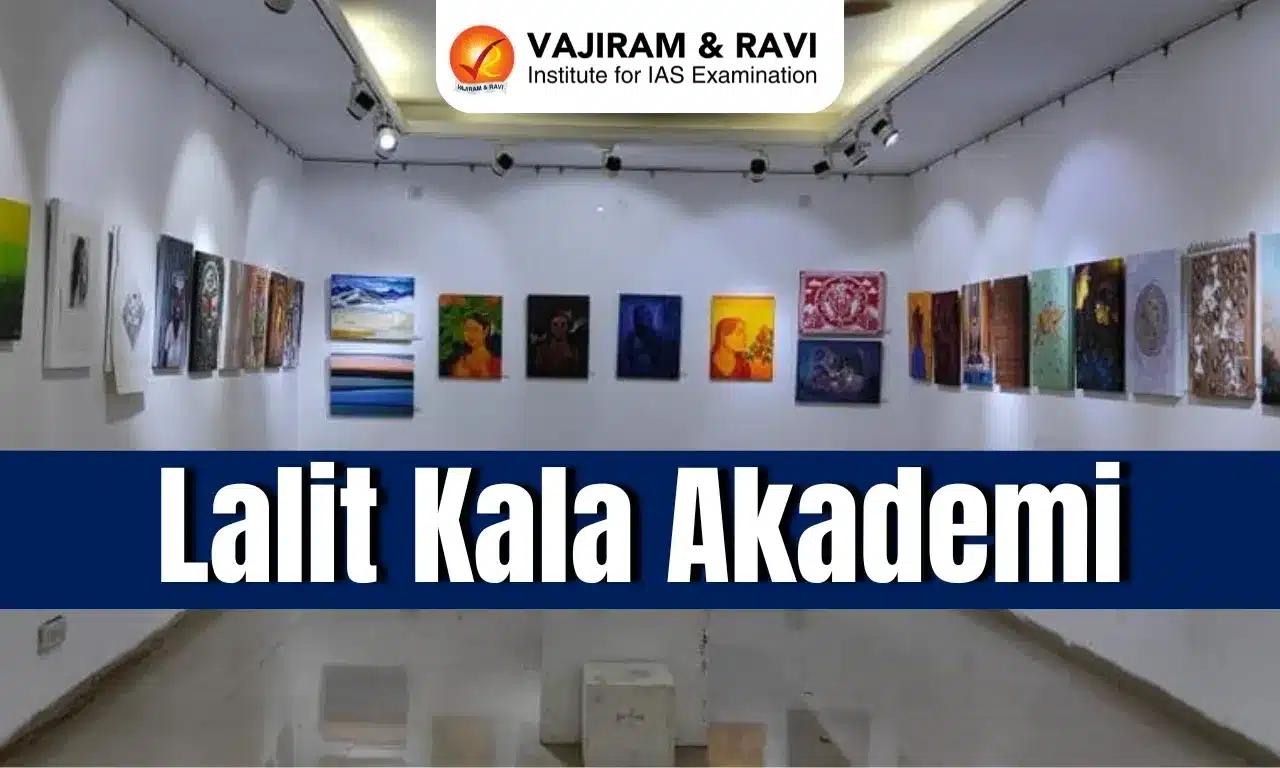
The 64th National Exhibition of Art (NEA), organized by the Lalit Kala Akademi, India’s National Academy of Art, was recently inaugurated in New Delhi with a grand ceremony.

About Lalit Kala Akademi

  • Lalit Kala Akademi, National Academy of Art, New Delhi, was set up by the Government of India as an autonomous body, on 5th August, 1954, to promote and propagate understanding of Indian art, in and outside the country.
  • It was inaugurated on 5th August 1954 by the then Minister for Education, Maulana Abul Kalam Azad.
  • The Akademi was given the status of statutory authority in 1957, under the Societies Registration Act 1860.
  • Headquarters: New Delhi.
  • It functions through its General Council, Executive Board, and other Committees.
  • It has regional centres situated at Chennai, Lucknow, Kolkata, Bhubaneswar, Garhi.
  • Funding: It is funded by the Ministry of Culture.
  • The institution has been involved in identifying and showcasing visual art. 
  • It has preserved and documented a permanent collection of the highest order that reflects the vitality, complexity, and unfolding patterns of contemporary, modern, folk, and tribal art in India. 
  • It promotes the Visual Art of India in various countries of the world through Cultural Agreements and Cultural Exchange Programmes.
  • The National Exhibition of Art is the most prestigious annual event of the Lalit Kala Akademi. 
    • Begun in 1955, it is directed towards showcasing and representing visual advances in the year.

Source: PIB

Lalit Kala Akademi FAQs

Q1: When was the Lalit Kala Akademi established?

Ans: 1954

Q2: Where is the headquarters of the Lalit Kala Akademi located?

Ans: New Delhi

Q3: The Lalit Kala Akademi functions under which Ministry?

Ans: Ministry of Culture

Q4: What is the primary focus of Lalit Kala Akademi’s efforts?

Ans: Propagating visual arts.

Nilgiri Tahr

Nilgiri Tahr

Nilgiri Tahrs Latest News

Recently, a joint census in Kerala and Tamil Nadu has reported a population of 2,668 Nilgiri tahrs.    

About Nilgiri Tahrs

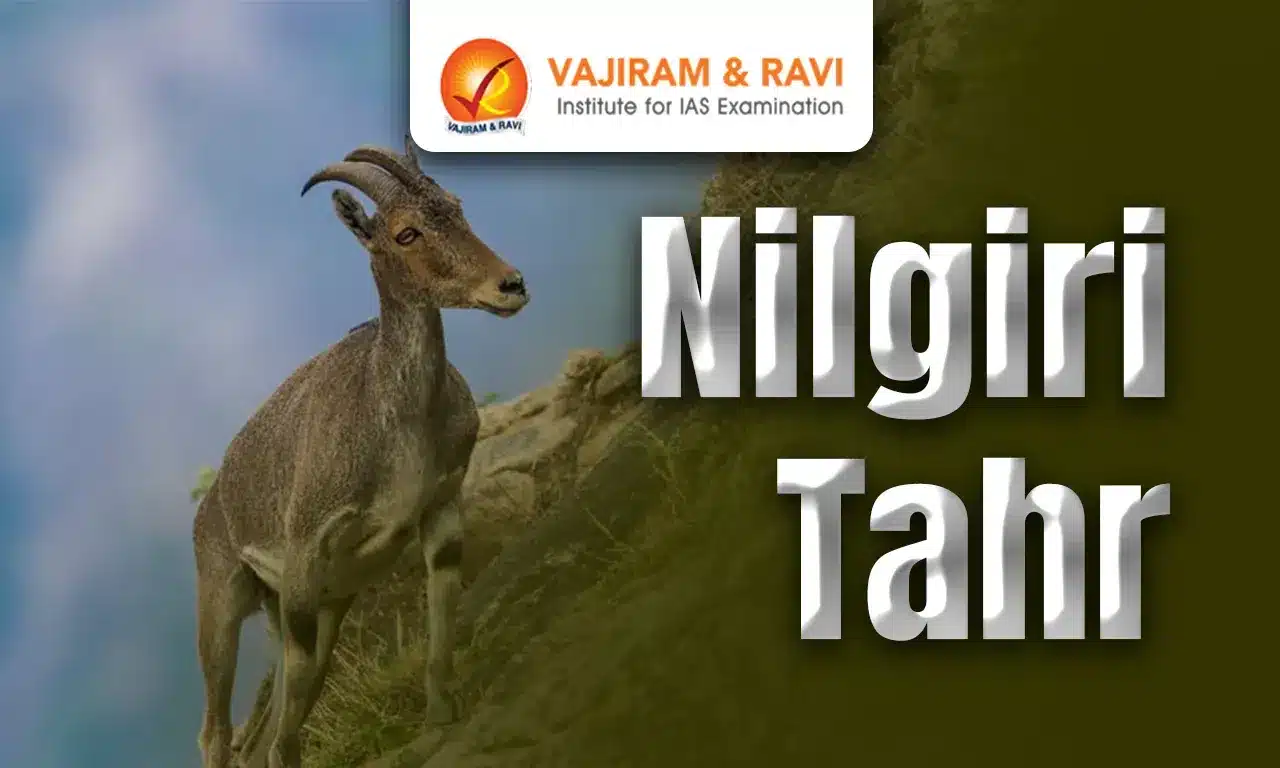
  • The Nilgiri Tahr is a mountain ungulate endemic to the southern part of the Western Ghats. 
  • It is also known by the name Nilgiri Ibex or simply Ibex. Locally the animal is called ‘Varayaadu’.
  • It is the only mountain ungulate in southern India.

Features of Nilgiri Tahr

  • These are stocky goats with short, coarse fur and a bristly mane. 
  • The males are found to be larger than the females, and have a darker color when mature. 
  • Both sexes have curved horns, which are larger in the males.
  • There are facial markings, particularly distinct in mature males.

Habitat and Distribution of Nilgiri Tahr

  • It is found in a roughly 400 km stretch in the Western Ghats, which falls in the states of Kerala and Tamil Nadu. 
  • These tahrs inhabit the open montane grassland habitat of the southwestern ghats montane rain forests ecoregion. 
  • At elevations ranging from 1200 to 2600 m, the jungle opens into grasslands interspersed with pockets of stunted forests, known as ‘sholas.’
  • The Eravikulam National Park (Kerala) has the highest density and largest surviving population of Nilgiri tahr. 

Conservation Status Nilgiri Tahr

  • IUCN Red List: Endangered 
  • Wildlife (Protection) Act of India, 1972: Schedule I

Source: TH

Nilgiri Tahr FAQs

Q1: What is the IUCN status of Nilgiri tahr?

Ans: Endangered 

Q2: Where is Nilgiri Tahr endemic to?

Ans: The Nilgiri Tahr (also known as Nilgiri Ibex) is found primarily in the Western Ghats of southern India.

Q3: The Nilgiri Tahr is the state animal of which Indian state?

Ans: Tamil Nadu

Enquire Now