Vishnugad Pipalkoti Hydro Electric Project

Vishnugad Pipalkoti Hydro Electric Project

Vishnugad Pipalkoti Hydro Electric Project Latest News

Twelve workers were injured, four of them critically, in a sudden landslide that struck the dam site of the under-construction Vishnugad Pipalkoti Hydroelectric Project in Helang, Chamoli district, Uttarakhand, recently.

About Vishnugad Pipalkoti Hydro Electric Project

  • It is located on Alaknanda River, a major tributary of the Ganga River, in the district Chamoli in the state of Uttarakhand.
  • It has been designed as a 444-megawatt, run-of-river hydropower scheme, which, when completed, will generate an estimated 1,665 gigawatt-hours, (or million kilowatt-hours) of electricity in a typical year. 
  • The project will build a 65-meter  concrete gravity dam near Helang village in the Chamoli district of Uttarakhand to create a small reservoir in the Alaknanda River.
  • This reservoir will store about 3.63 million cubic meters of water, the equivalent of about 4.9 hours of average flow of the river.
  • A 13.4-kilometer headrace tunnel will carry the water to an underground powerhouse near Haat village to generate the power. 
  • A 3-km tail race tunnel will return all the diverted water back to the Alaknanda, approximately 18 km downstream from where the water was diverted.
  • It is being developed by THDC India Ltd  (formerly Tehri Hydro Development Corporation Limited) and financed by a US$ 648 million loan from the World Bank.

    • THDC is a joint venture between the government of India and the government of Uttar Pradesh.

Source: NIE

Vishnugad Pipalkoti Hydro Electric Project FAQs

Q1: The Vishnugad Pipalkoti Hydro Electric Project is located on which river?

Ans: Alaknanda River

Q2: What is the installed capacity of the Vishnugad Pipalkoti Hydro Electric Project?

Ans: 444 MW

Q3: Which organisation is developing the Vishnugad Pipalkoti Hydro Electric Project?

Ans: It is being developed by THDC India Ltd (formerly Tehri Hydro Development Corporation Limited) and financed by a US$ 648 million loan from the World Bank.


World Tribal Day 2025

World Tribal Day 2025

World Tribal Day Latest News

The Adivasi Girijana Sangham has urged tribal representatives, youth, and elected leaders to actively participate in World Tribal Day celebrations on August 9 and commit to resolving tribal issues.

About World Tribal Day

  • It is observed on August 9 every year to support and protect the rights of the world’s indigenous people. 
  • Also referred to as World Indigenous Day or International Day of World's Indigenous People, this day offers an excellent chance to effectively work towards defending the fundamental rights of tribal communities around the world.
  • World Tribal Day 2025 Theme: "Indigenous Peoples and Artificial Intelligence – Defending Rights, Shaping the Future"

World Tribal Day History

  • The observance of this day originates from a worldwide movement pointed toward recognizing the rights and significant commitments of tribal people. 
  • Regardless of comprising around 6% of the worldwide population, tribal communities are often marginalized, despite the fact that they have wealthy cultural diversity.
  • The origins of the International Day of the World's Indigenous People date back to December 1994, when the United Nations General Assembly designated 9 August for this annual observance. 
  • This date holds symbolic significance as it marks the first meeting of the UN Working Group on Indigenous Populations of the Sub-commission on the Promotion and Protection of Human Rights.
  • This meeting took place in Geneva in 1982.

Source: DC

World Tribal Day FAQs

Q1: On which date is World Tribal Day observed each year?

Ans: It is observed on August 9 every year.

Q2: What is the theme for World Tribal Day 2025?

Ans: Indigenous Peoples and Artificial Intelligence – Defending Rights, Shaping the Future

Q3: Approximately what percentage of the global population is made up of indigenous or tribal communities?

Ans: 6%

Ectopic Pregnancy

Ectopic Pregnancy

Ectopic Pregnancy Latest News

A recent case of pregnancy stunned doctors in Bulandhshahr, Uttar Pradesh: an MRI scan revealed a fetus growing in the liver and this extremely rare condition is known as an intrahepatic ectopic pregnancy.

About Ectopic Pregnancy

  • An ectopic pregnancy occurs when the fertilised egg, instead of implanting itself in the uterus, implants outside of it, commonly in the fallopian tube.
  • It most often occurs in a fallopian tube, which carries eggs from the ovaries to the uterus. This type of ectopic pregnancy is called a tubal pregnancy.
  • It sometimes occurs in other areas of the body, such as the ovary, abdominal cavity or the lower part of the uterus (cervix), which connects to the vagina.
  • In an ectopic pregnancy, the fertilised egg attaches itself to a structure other than the uterus.

Reasons for Ectopic Pregnancies

  • Ectopic pregnancies occur when the movement of the fertilised egg is blocked.
  • This could occur due to inflammation or scarring of the fallopian tubes, damage to the fallopian tubes (due to prior surgeries or infections), or an irregularly-shaped fallopian tube.

Symptoms of Ectopic Pregnancies

  • It may also be similar to those in early pregnancy such as a missed period, nausea and tenderness of breasts.
  • Other symptoms may become noticeable later and may include: vaginal bleeding, pain in the lower abdomen, as well as pelvic and back pain, dizziness, pain in the shoulder, discomfort during bowel movements, and low blood pressure.
  • Treatment: In some cases doctors suggest using a medication called methotrexate to stop the fertilized egg from growing, ending the pregnancy.

Source: TH

Ectopic Pregnancy FAQs

Q1: How long can an ectopic pregnancy last?

Ans: The structure containing the ectopic pregnancy typically ruptures after about 6 to 16 weeks.

Q2: What is the concept of ectopic pregnancy?

Ans: An ectopic pregnancy is when a fertilised egg implants itself outside of the womb, usually in one of the fallopian tubes.

SheLeads Programme

SheLeads Programme

SheLeads Programme Latest News

Recently, the Union Minister for Women and Child Development inaugurated the second edition of UN Women’s flagship capacity-building programme — SheLeads II: Workshop for Women Leaders, in New Delhi.

About SheLeads Programme

  • It is a flagship initiative of the UN Women India Country Office.
  • Aim: It is aimed to advance gender equality in public and political leadership, aiming to support women leaders in contesting the upcoming/next Lok Sabha and State Assembly elections.
  • It is an effort to ensure women have the platform, skills, and networks to step into roles such as shaping policies and governance that reflect the aspirations of all citizens with confidence.
  • Significance: This initiative is pivotal in equipping women with the skills and networks needed to lead from the front, ensuring that development agenda is truly inclusive and representative of every voice.

Key Facts about UN Women

  • It is the United Nations (UN) entity dedicated to gender equality and the empowerment of women.
  • It was created in July 2010 by the UN General Assembly.
  • The creation of UN Women came about as part of the UN reform agenda, bringing together resources and mandates for greater impact.
  • The main roles of UN Women are:
    • To support inter-governmental bodies, such as the Commission on the Status of Women, in their formulation of policies, global standards, and norms.
    • To help member states implement these standards, standing ready to provide suitable technical and financial support to those countries that request it, and to forge effective partnerships with civil society.

Source: PIB

SheLeads Programme FAQs

Q1: What are leadership programmes?

Ans: It is a program of learning solutions aimed at improving the skill sets, abilities and confidence of current business leaders, and bringing on the company's next generation of future leaders.

Q2: What does the United Nations organisation do?

Ans: Maintain International Peace and Security. Protect Human Rights. Deliver Humanitarian Aid. Support Sustainable Development and Climate Action.

Notary Portal

Notary Portal

Notary Portal Latest News

Recently, the Ministry of Law and Justice informed the Rajya Sabha about the Notary Portal.

About Notary Portal

  • It was launched by the Government of India as a dedicated platform for providing online services for the works related to the Notaries Act, 1952 and the Notaries Rules, 1956.
  • Objectives: The objective of the Notary Portal is to provide an online interface between the Notaries appointed by the Central Government and the Government of India for various services like,
    • Submission of applications for appointment as Notaries,
    • Verification of eligibility for appointment as Notaries,
    • Issuance of digitally signed Certificate of Practice as a Notary,
    • Also renewal of certificate of practice, change of practice area, submission of annual return etc.
  • The Notary Portal provides a faceless, paperless, transparent and efficient system. Presently, the module related to verification of documents and eligibility, and issuance of digitally singed Certificate of Practice to the newly appointed Notaries is live.

 Source: PIB

Notary Portal FAQs

Q1: What is a Notary Portal?

Ans: It is an online interface between the Notaries and the Government for various services like submission of applications for appointment as Notaries.

Q2: For what purpose is notary used?

Ans: A notary serves as an official witness to the signing of documents.

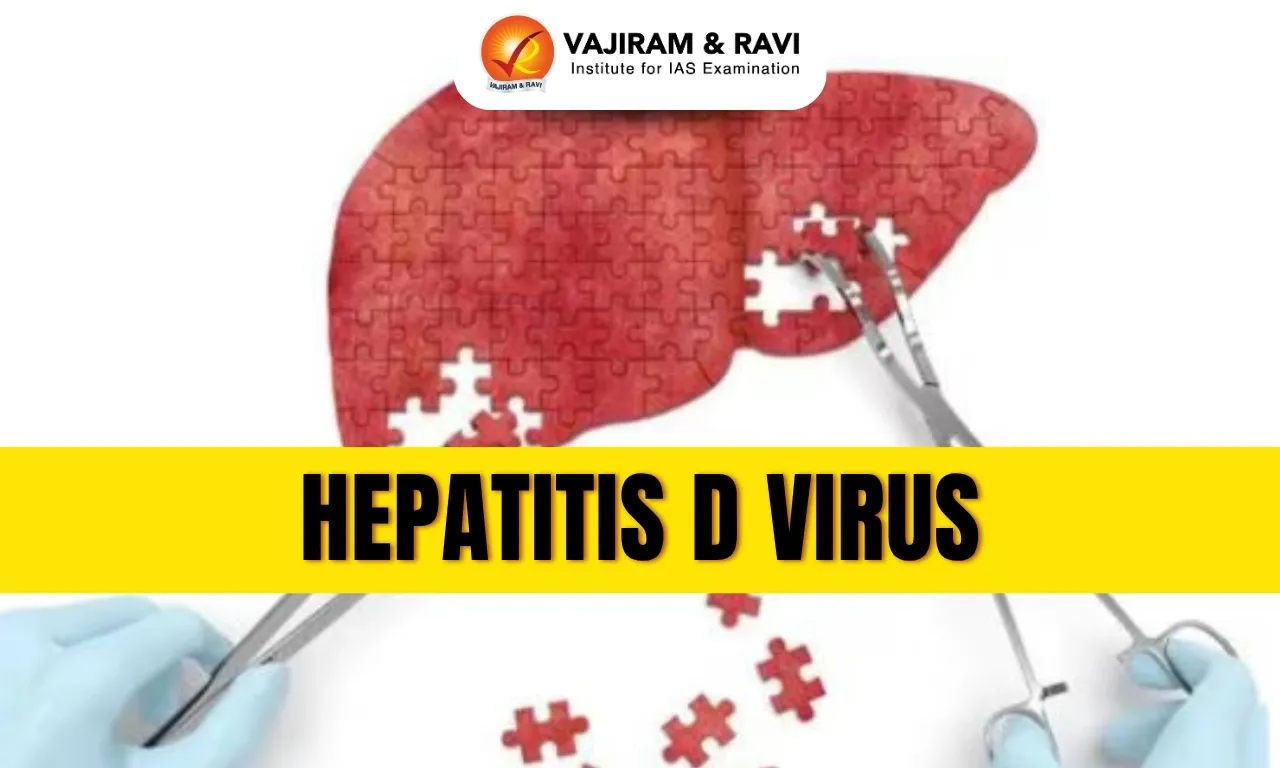
Hepatitis D

Hepatitis D

Hepatitis D Latest News

Recently, the World Health Organisation (WHO) announced the reclassification of hepatitis D as cancerous, emphasising the urgency for preventing viral hepatitis, which is a growing public health crisis.

About Hepatitis D

  • It is a serious liver infection caused by the hepatitis D virus (HDV).
  • It is an incompetent virus that requires hepatitis B virus (HBV) for replication.
  • This means it cannot cause infection alone and triggers co-infections only with the hepatitis B virus.
  • Hepatitis D only affects people who already have hepatitis B either simultaneously or sequentially.
  • Hepatitis B & D co-infection runs a more severe course for risk of cirrhosis and liver cancer. Hepatitis B can cause liver cancer even without causing cirrhosis as it gets integrated in the DNA of cells.
  • Hepatitis D virus augments the carcinogenic effect of Hepatitis B.
  • All types of hepatitis are associated with acute liver infection; however, only hepatitis B, C, and D can lead to chronic infections with a higher risk of liver cirrhosis, failure or cancer. 
  • Hepatitis D is associated with a two- to six-fold higher risk of liver cancer compared with hepatitis B.
  • Transmission: The mode of transmission is similar to hepatitis B and C, that is through parenteral route or injections and transfusion, mother to child transmission and sexual contact.
  • Prevention: Universal hepatitis B vaccination indirectly prevents hepatitis D. 
    • Hepatitis B vaccine may be given in any of the following schedules: Birth, 1 and 6 months; birth, 6 and 14 weeks; 6, 10 and 14 weeks; birth, 6, 10 and 14 weeks. In catch up vaccination, use 0, 1 and 6 months schedule.
    • An adult, especially if in a high risk comorbidity group, should take the hepatitis B vaccine in three shots. The second dose is given a month after the first, and the third dose is given six months after the second.

Source: IE

Hepatitis D FAQs

Q1: Can hepatitis D be cured?

Ans: There's currently no cure or vaccine for hepatitis D.

Q2: How is hepatitis D spread?

Ans: One can get hepatitis D if he/she comes in contact with infected blood or body fluids.

Key Facts about France

France

France Latest News

Recently, a massive wildfire has scorched 16,000 hectares (39,537 acres) of forest and villages in southern France.

About France

  • It is geographically positioned both in the Northern and Eastern hemispheres of the Earth.
  • It is one of the oldest nations on Earth and the most ethnically diverse country in Europe.
  • Bordering countries: It is bordered by 7 countries: Belgium, Luxembourg, Germany, Switzerland, Italy, Spain and Andorra
  • It is also bounded by the Bay of Biscay (North Atlantic Ocean) in the west; by the English Channel in the northwest and by the Mediterranean Sea in the south. 
  • Major Rivers:  Loire (drains into Atlantic ocean ), Seine (drains into English channel).
  • Major Mountains:  Alps (southern France), Jura Mountains (north of Alps), Pyrenees (forms border with Spain).
  • Natural Resources: coal, iron ore, bauxite, zinc, uranium, antimony, arsenic, potash, feldspar, fluorspar, gypsum, 
  • It has 5 overseas regions namely: Guadeloupe, Guyane(French Guiana), La Réunion(Réunion), Martinique and Mayotte
  • Capital City: Paris

Source: Reuters

France FAQs

Q1: What type of country is France?

Ans: Semi-presidential republic

Q2: What is the currency of France?

Ans: Euro

Dark Eagle Hypersonic Missile System

Dark Eagle Anti Missile System

Dark Eagle Hypersonic Missile System Latest News

The United States recently deployed its ‘Dark Eagle’ Long-Range Hypersonic Weapon (LRHW) during the Talisman Sabre military drills in Australia.

About Dark Eagle Hypersonic Missile System

  • The Long-Range Hypersonic Weapon (LRHW), or “Dark Eagle,” is a hypersonic missile system of the United States Army.
  • The missile component of the LRHW is reportedly being developed by Lockheed Martin and Northrop Grumman.
  • Built for strategic attack missions, the weapon is capable of penetrating anti-access/area-denial (A2/AD) defenses, suppressing long-range enemy fires, and delivering rapid precision effects when and where they are needed.

Dark Eagle Hypersonic Missile System Features

  • It is a land-based hypersonic weapon designed to strike targets at distances of up to 1,700 miles (2,735 kilometers).
  • It comprises a mobile ground-based battery equipped with four Transporter Erector Launchers (TEL), supported by command and control elements, with each TEL capable of launching two missiles for a total of eight.
  • The system’s ballistic missile features two stages, one of which includes a hypersonic glide warhead (C-HGB), an unpowered but highly maneuverable vehicle capable of reaching extreme speeds of Mach 17, making interception particularly difficult.
  • The missile climbs to the edge of space, flies through the upper atmosphere out of reach of most enemy defenses, then maneuvers toward its target. 
  • Each hypersonic missile is powered by a solid-fueled two-stage rocket booster.

Source: ET

Dark Eagle Hypersonic Missile System FAQs

Q1: The Long-Range Hypersonic Weapon (LRHW), nicknamed “Dark Eagle,” is developed for which country’s army?

Ans: United States

Q2: What is the maximum strike range of the Dark Eagle Hypersonic Missile System?

Ans: 1,700 miles (2,735 kilometers)

Q3: What powers each hypersonic missile in the Dark Eagle system?

Ans: Solid-fueled two-stage rocket booster.

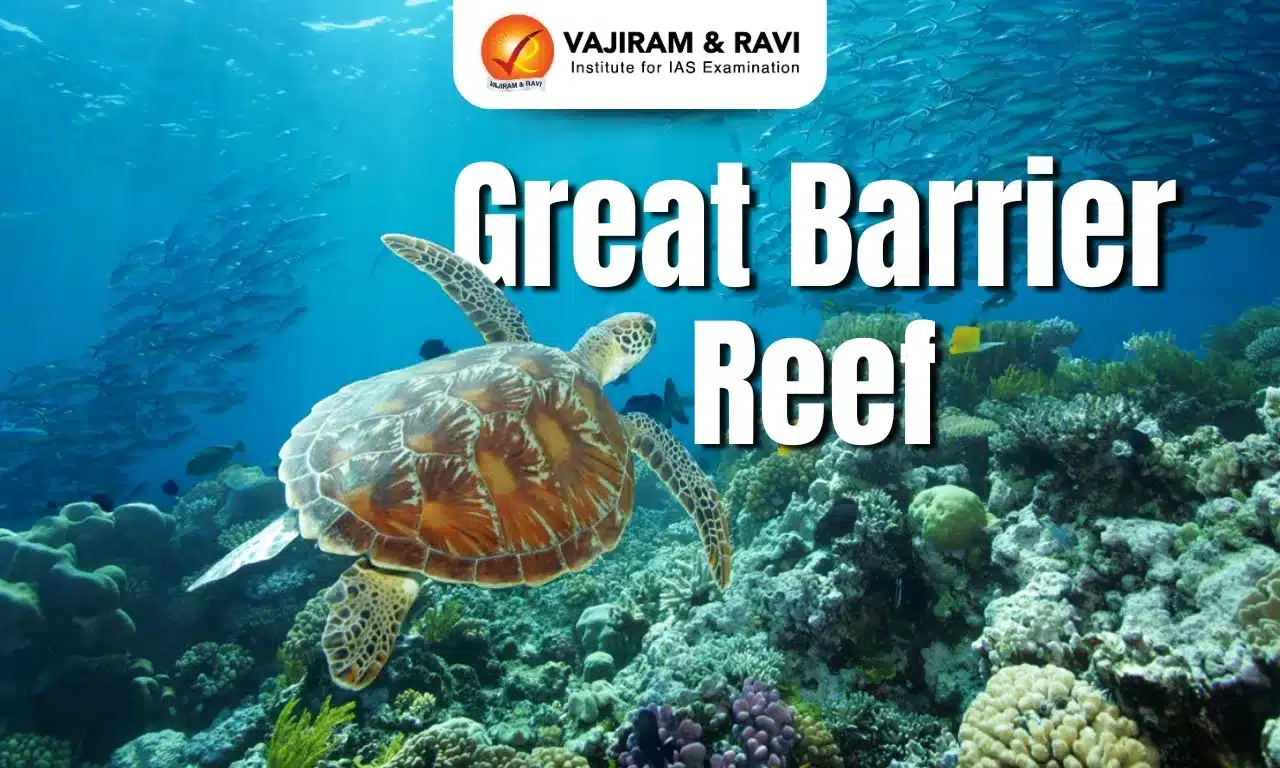
Great Barrier Reef

Great Barrier Reef

Great Barrier Reef Latest News

The Great Barrier Reef has recorded its steepest decline in hard coral cover in almost four decades, as climate change-induced heat stress, cyclones and outbreaks of coral-eating starfish drive the ecosystem to the brink.

About Great Barrier Reef

  • It is a complex of coral reefs, shoals, and islets in the Pacific Ocean off the northeastern coast of Australia in the Coral Sea.
  • It is the longest and largest reef complex in the world and is the largest living structure on Earth.
  • It extends in roughly a northwest-southeast direction for more than 2,000 km, at an offshore distance ranging from 16 to 160 km, and its width ranges from 60 to 250 km. 
  • It has an area of some 350,000 sq.km. It makes up about 10 percent of the world’s coral reef ecosystems.
  • The reef, which is large enough to be visible from space, actually consists of some 2,100 individual reefs and some 800 fringing reefs (formed around islands or bordering coastlines).
  • It contains 400 types of coral, 1,500 species of fishes, and 4,000 types of mollusks species. 
  • The reef is also home to six of the seven known species of sea turtles, more than a dozen sea snakes, and nearly two dozen species of birds.
  • It also holds great scientific interest as the habitat of species such as the dugong (‘sea cow’) and the large green turtle, which are threatened with extinction.
  • Much of the Great Barrier Reef is a marine protected area, managed by the Great Barrier Reef Marine Park Authority of Australia.
  • UNESCO declared the Great Barrier Reef a World Heritage Site in 1981.

Source: DTE

Great Barrier Reef FAQs

Q1: Where is the Great Barrier Reef located?

Ans: It is located in the Pacific Ocean off the northeastern coast of Australia in the Coral Sea.

Q2: Approximately how long is the Great Barrier Reef?

Ans: 2,000 km

Q3: What is the approximate total area of the Great Barrier Reef?

Ans: 350,000 sq. km

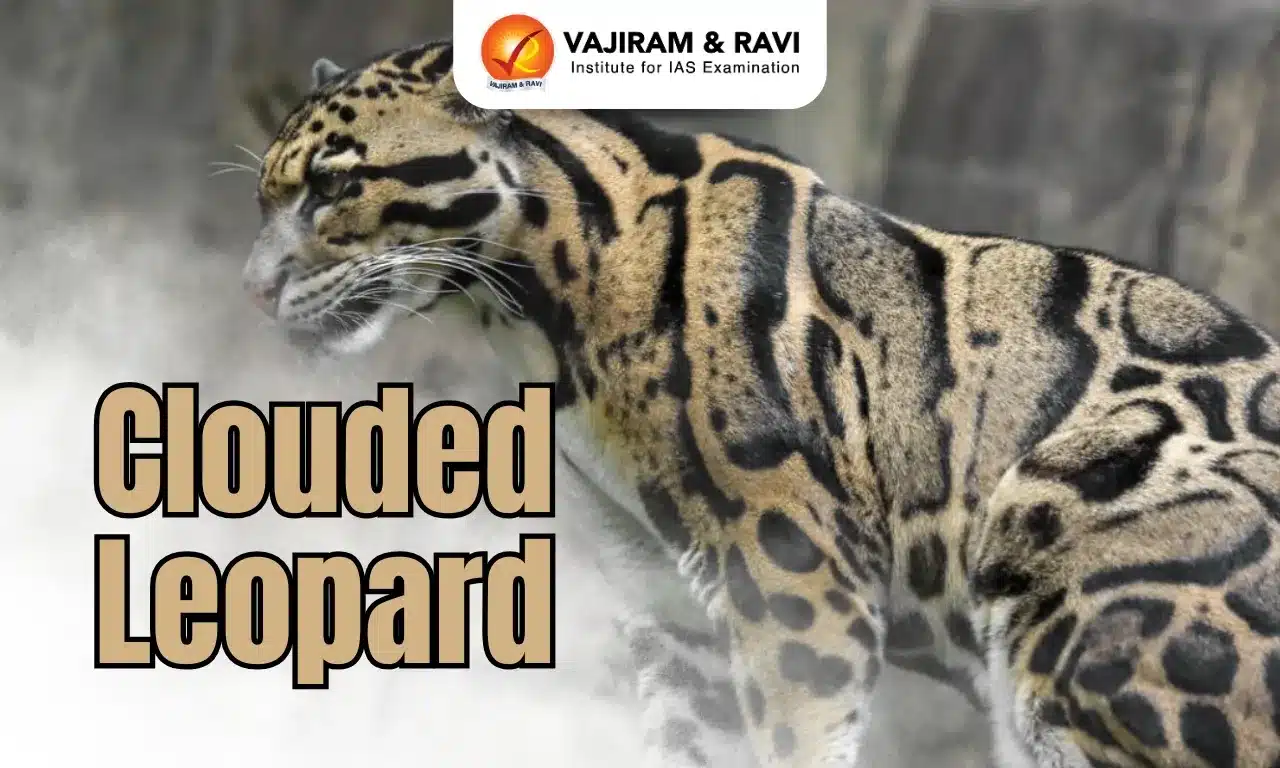
Clouded Leopard

Clouded Leopard

Clouded Leopard Latest News

Retired Indian Forest Service (IFS) officer Susanta Nanda recently shared an old video featuring a rare sighting of a family of clouded leopards in a now-viral post on X.

About Clouded Leopard

  • It is a wild cat inhabiting dense forests of the Himalayas through mainland Southeast Asia into South China.
  • They have a stocky build and are larger than small cat species, and smaller than the large cats. 
  • There are two species of clouded leopards: the clouded leopard (Neofelis nebulosa), found on the mainland of southeastern Asia, and the Sunda clouded leopard (Neofelis diardi), found on the islands of Sumatra and Borneo.
  • They are one of the most ancient cat species. However, they are neither a true great cat nor a true small cat, because they cannot roar or purr.

Clouded Leopard Distribution

  • It is found from Nepal, Bangladesh, and India through Indochina to Sumatra and Borneo, and northeastward to southern China and formerly Taiwan
  • It has been found at relatively high altitudes in the Himalayas.
  • In India, it is found in Sikkim, northern West Bengal, Meghalaya, Tripura, Mizoram, Manipur, Assam, Nagaland, and Arunachal Pradesh.
  • It is the State animal of Meghalaya.

Clouded Leopard Habitat

  • They prefer to live in lowland tropical rainforests
  • However, they can also be found in dry woodlands and secondary forests, and in Borneo, they are reported to live in mangrove swamps. 

Clouded Leopard Features

  • It is a medium-sized cat, 60 to 110 cm long and weighing between 11 and 20 kg.
  • It is named after the distinctive ‘clouds’ on its coat – ellipses partially edged in black, with the insides a darker colour than the background colour of the pelt.
  • The base of the fur is a pale yellow to rich brown, making the darker cloud-like markings look even more distinctive.
  • It has an exceptionally long tail for balancing, which can be as long as the body itself, thick with black ring markings.
  • Their long canine teeth are the same size as those of a tiger, even though a tiger is 10 times larger in body size!
  • It has relatively short legs and broad paws, which make it excellent at climbing trees and creeping through thick forest. 
  • They are arboreal and nocturnal inhabitants.
  • They are one of the only cats in the world that can climb down, hang upside down from, and hunt in trees.
  • It is a shy and elusive wildcat. It is a solitary animal.
  • They have a lifespan of around 13-17 years.

Clouded Leopard Conservation Status

It is classified as ‘Vulnerable’ under the IUCN Red List.

Source: NDTV

Clouded Leopard FAQs

Q1: Which Indian state has the Clouded Leopard as its state animal?

Ans: Meghalaya

Q2: In which Indian states is the clouded leopard found?

Ans: In India, it is found in Sikkim, northern West Bengal, Meghalaya, Tripura, Mizoram, Manipur, Assam, Nagaland, and Arunachal Pradesh.

Q3: What is the IUCN Red List conservation status of both species of Clouded Leopards?

Ans: Vulnerable

Enquire Now