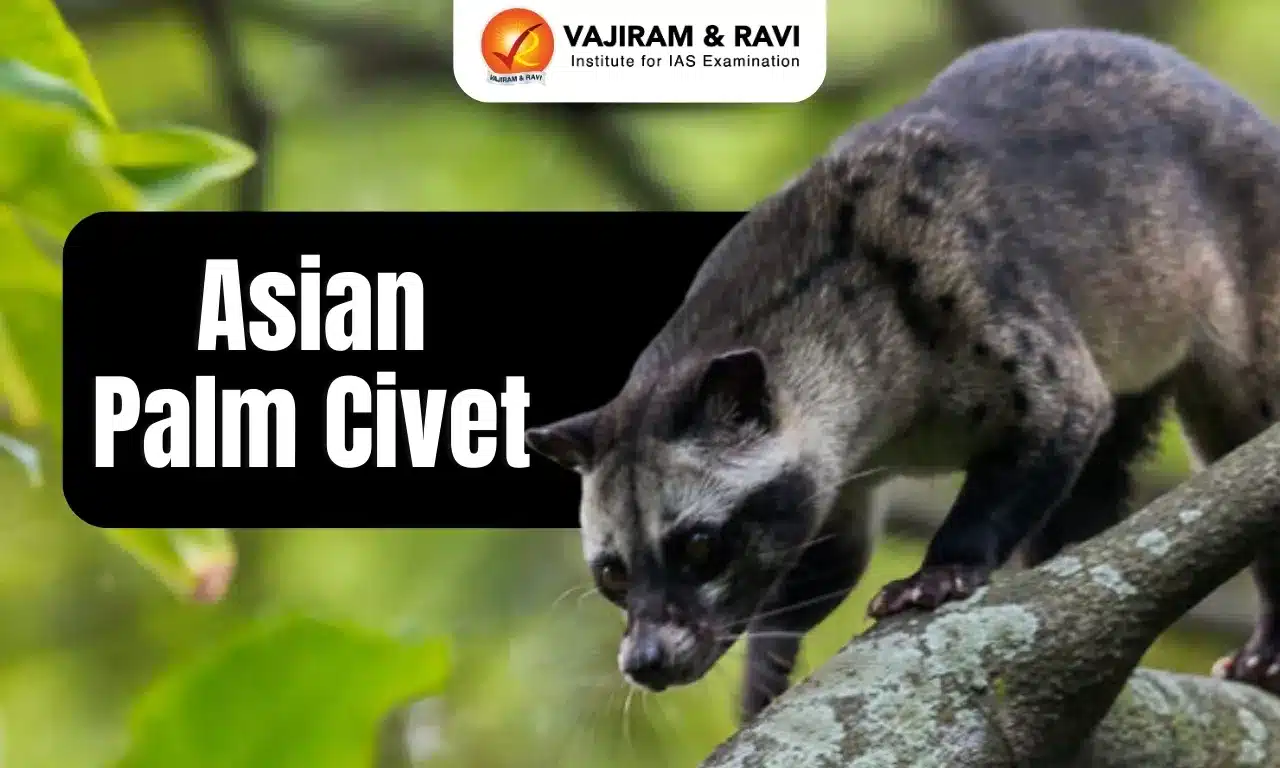
Asian Palm Civet

Asian Palm Civet

Asian Palm Civet Latest News

In a bizarre incident, Kerala High Court’s Chamber 1 proceedings got disrupted recently due to a foul stench caused by Asian Palm Civet.

About Asian Palm Civet

  • The Asian Palm Civet, also known as the Toddy Cat or Common Palm Civet, is a small, nocturnal mammal that is found throughout South and Southeast Asia, including India, Sri Lanka, Indonesia, and the Philippines. 
  • It is a member of the Viverridae family, which also includes other civet and mongoose species.
  • Scientific Name: Paradoxurus hermaphroditus

Asian Palm Civet Features

  • It has a long, slender body, short legs, and a pointed snout. 
  • It weighs between 2 to 5 kg (4.4 to 11 lbs) and measures around 53 to 71 cm (21 to 28 inches) in length, including the tail.
  • Its fur is brownish-gray with black spots, and it has a white mask-like marking around its eyes. 
  • It is a nocturnal animal and feeds on a variety of prey, including insects, small mammals, and fruits.
  • One of the most distinctive features of Asian palm civets is their ability to digest coffee beans, which makes them an important part of the coffee production process in some countries.
  • They are also known for their strong sense of smell and excellent climbing skills, allowing them to easily climb trees and forage for food. 

Asian Palm Civet Conservation Status

It is classified as 'Least Concern' under the IUCN Red List

Source: N18

Asian Palm Civet FAQs

Q1: What is the scientific name of the Asian Palm Civet?

Ans: Paradoxurus hermaphroditus

Q2: What is the IUCN conservation status of the Asian Palm Civet?

Ans: Least Concern

Q3: In which regions is the Asian Palm Civet naturally found?

Ans: It is found throughout South and Southeast Asia, including India, Sri Lanka, Indonesia, and the Philippines.

Q4: What is the fur color and markings of the Asian Palm Civet?

Ans: Its fur is brownish-gray with black spots, and it has a white mask-like marking around its eyes.

Mines and Minerals (Development and Regulation) Amendment Bill, 2025

Mines and Minerals (Development and Regulation) Amendment Bill

Mines and Minerals (Development and Regulation) Amendment Bill, 2025 Latest News

The Rajya Sabha cleared the Mines and Minerals (Development and Regulation) Amendment Bill recently, even as the Opposition members walked out.

About Mines and Minerals (Development and Regulation) Amendment Bill, 2025

  • The bill will amend the Mines and Minerals (Development and Regulation) Act, 1957. 
  • The Bill provides that leaseholders may apply to the state government for adding other minerals to an existing lease. 
    • For inclusion of critical and strategic minerals and other specified minerals, no additional amount needs to be paid.  
    • These include minerals such as lithium, graphite, nickel, cobalt, gold, and silver. 
  • The Act establishes the National Mineral Exploration Trust to fund mineral exploration in the country. The Bill widens the scope of the Trust to also fund the development of mines and minerals. 
  • Under the Act, captive mines are allowed to sell up to 50 percent of minerals produced in a year, after meeting end-use requirements. The Bill removes the limit on the sale of minerals. 
  • The Bill allows for a one-time extension of the area under a mining or composite lease.  
    • This will be applicable for deep-seated minerals. Deep-seated minerals are minerals which occur at a depth of more than 200 metres from the surface of land. 
  • The Bill provides for establishing an authority to register and regulate mineral exchanges.
    • The Bill defines mineral exchange as a registered electronic trading platform or marketplace for trading minerals and metals. 
    • The central government will frame rules regarding mineral exchanges on matters including: 
      • manner of registration
      • levy of fees and other charges
      • prevention of insider trading and market manipulation
      •  grievance redressal.

Source: TH

Mines and Minerals (Development and Regulation) Amendment Bill, 2025 FAQs

Q1: The Mines and Minerals (Development and Regulation) Amendment Bill, 2025 amends which existing Act?

Ans: Mines and Minerals (Development and Regulation) Act, 1957

Q2: What does the National Mineral Exploration Trust fund under the original Act?

Ans: Mineral exploration

Q3: What new function has been added to the National Mineral Exploration Trust under the Bill?

Ans: Fund the development of mines and minerals.

Pamba River

Pamba River

Pamba River Latest News

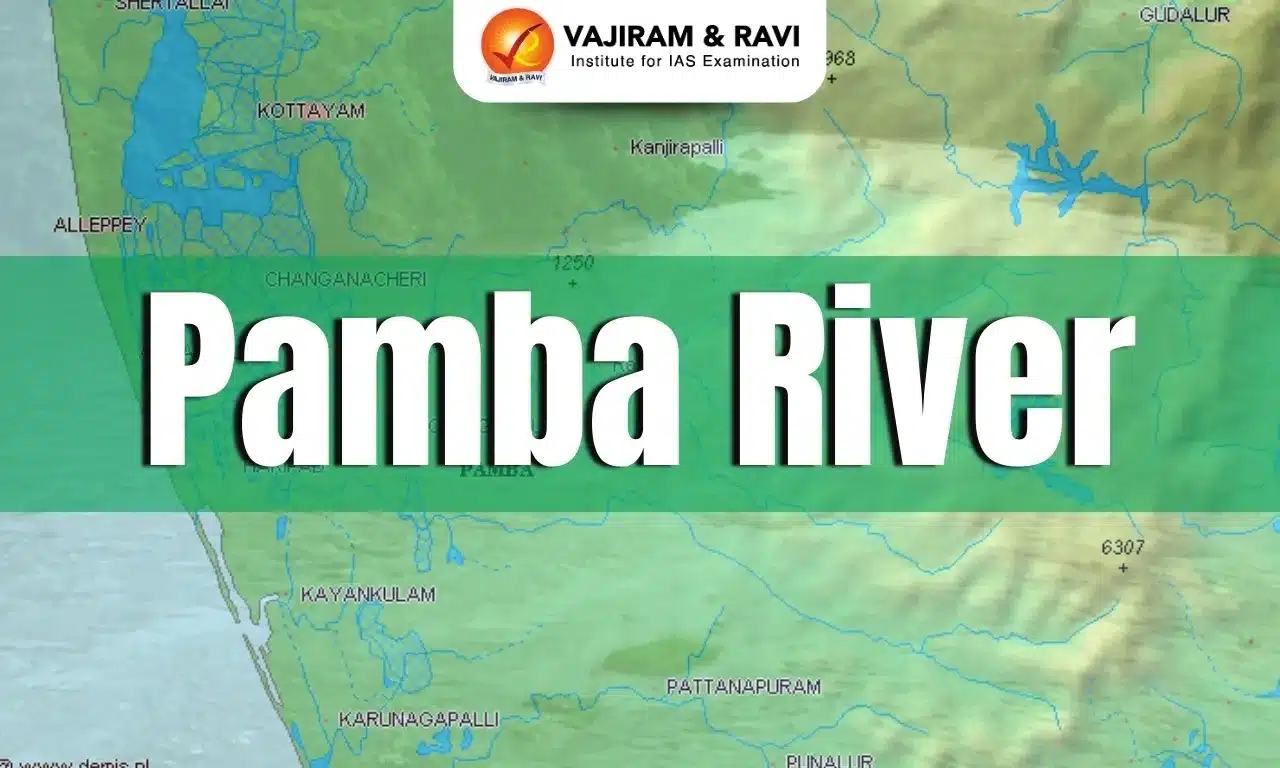
The central government recently initiated steps to include the Pampa River under the National River Conservation Plan (NRCP), a multi-crore initiative aimed at protecting major rivers in the country.

About Pamba River

  • It is the third longest river in the state of Kerala after the Periyar River and the Bharathappuzha River.
  • Also called the 'Dakshina Bhageerathi' or the Ganga of Kerala, the significance of the river is associated with the Sabarimala temple. 
    • Pilgrims visiting Sabarimala take a dip in the river here before and after trekking the hill.
  • Pamba is also called Thriveni Sangam, as it is the meeting point for three rivers-Pamba, Achankovil & Manimala.
  • Course:
    • It rises at an altitude of 1650 m in the Pulachimalai Hill on the Peerumedu plateau of the Western Ghats.
    • After traversing a distance of 176 km, it joins the Arabian Sea branching into a number of channels. 
  • The basin extends over an area of 2235 sq.km. 
  • The entire catchment area lies in Kerala state. 
  • The basin is bounded on the east by the Western Ghats and on the west by the Arabian Sea.
  • The main tributaries of the river are Kakki Ar, Azhuta Ar, Kakkad Ar, Kallar, Manimala, and Achenkovil.

Source: NIE

Pamba River FAQs

Q1: Pamba River is located in which state?

Ans: Kerala

Q2: With which famous temple is the Pamba River most closely associated?

Ans: Sabarimala Temple

Q3: What is the total length of the Pamba River?

Ans: 176 km

Q4: Into which water body does the Pamba River ultimately flow?

Ans: Arabian Sea

Thattekad Bird Sanctuary

Thattekad Bird Sanctuary

Thattekad Bird Sanctuary Latest News

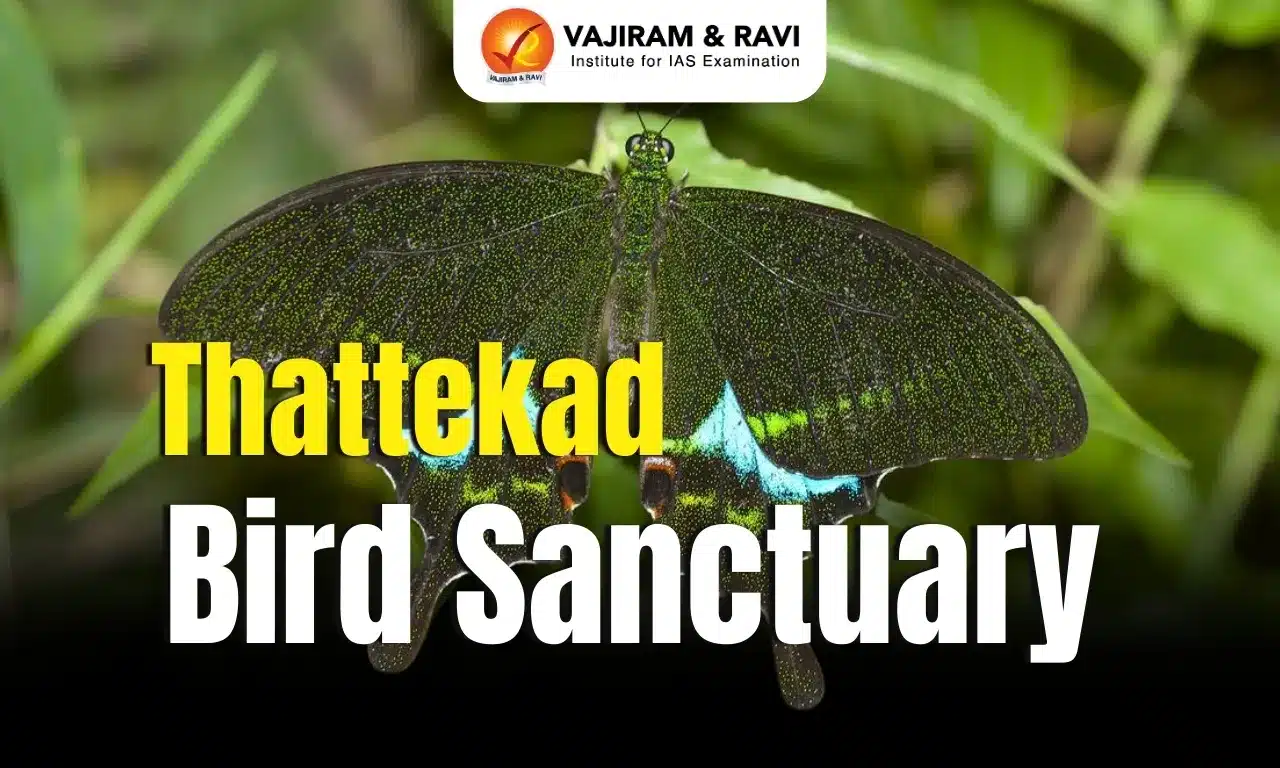
A comprehensive faunal survey at the Thettekad Bird Sanctuary, Ernakulam, Kerala, has added nine species records to its official biodiversity checklist. 

About Thattekad Bird Sanctuary

  • It is the first bird sanctuary in Kerala, located on the banks of Periyar River.
  • Thattekad bird sanctuary is also known as Dr. Salim Ali bird sanctuary, named after Dr Salim Ali, the best known ornithologist in India.
  • The sanctuary, which spreads across the foot of western Ghats , was notified in 1983 based on previous recommendation by Dr. Salim Ali.
  • Vegetation: It consists of Tropical Evergreen Forests, Tropical Semi-evergreen forests, Moist Decidious forests.
  • It consists of natural habitats which includes Periyar river, lagoons and marshes formed by Bhootattankettu dam reservoir, tropical semi & evergreen forests of the western Ghats.
  • Major peaks in the sanctuary are Thoppimudi and Nyayapillimudi.
  • Flora: Myristica dactyloides, Hopea parviflora, Tetrameles mudiflora, eak, Rosewood, Mahagony
  • Fauna: It is famous for many endemic and rare birds like Ceylon Frogmouth, Black Bazza, Oriental dwarf kingfisher, Bay owl etc. 

Source:  TH

Thattekad Bird Sanctuary FAQs

Q1: Which is the largest bird sanctuary in Kerala?

Ans: Thattekad Bird Sanctuary

Q2: Which river flows through Thattekad Bird Sanctuary?

Ans: Periyar River

Vihar Lake

Vihar Lake

Vihar Lake Latest News

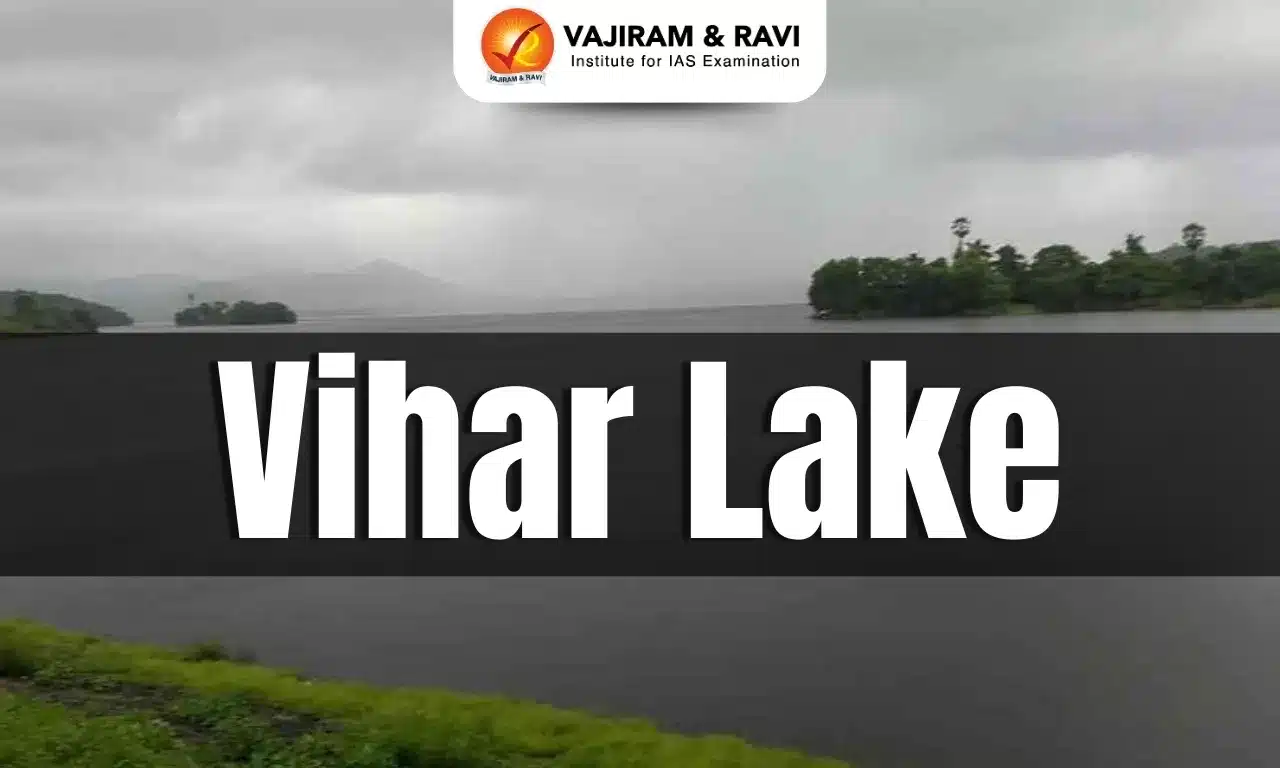
In the wake of heavy rains in Mumbai over the last few days, Vihar Lake, one of the key sources of potable water for the metropolis, started overflowing.

About Vihar Lake

  • It is a man-made reservoir located near Vihar village on the Mithi River within the grounds of the Borivali National Park, which is also known as Sanjay Gandhi National Park, in North Mumbai, Maharashtra.
  • The lake was built from 1856 to 1860 by the British government to overcome the drinking water woes of the people of southern Mumbai.
  • It gets its water from the Powai-Kanheri hill ranges in the catchment area.
  • It is the largest lake in Mumbai in the Salsette group of islands.
  • It is bordered between the Tulsi Lake and the Powai Lake.
  • It partly meets the drinking water needs of the South Mumbai region. 
  • It supplies 3% of the Mumbai city’s water requirement, after filtration at Bhandup, where the large water filtration plant is located.

Source: BS

Vihar Lake FAQs

Q1: Vihar Lake is located in which state?

Ans: It is located in North Mumbai, Maharashtra.

Q2: Which hill ranges form the catchment area of Vihar Lake?

Ans: Powai-Kanheri hill ranges

Q3: Vihar Lake is the largest lake in Mumbai belonging to which group of islands?

Ans: Salsette group of islands

Q4: Which two lakes border Vihar Lake?

Ans: Tulsi Lake and the Powai Lake

Saltwater Crocodile

Saltwater Crocodile

Saltwater Crocodile Latest News

The estimated population of saltwater crocodiles, one of the largest reptiles in the world, has increased in the Sundarban Biosphere Reserve (SBR) from last year, according to a population survey by the State’s Forest Department.

About Saltwater Crocodile

  • It is the largest and heaviest of all living reptiles in the world.
  • Scientific Name: Crocodylus porosus
  • It is also known as the estuarine crocodile, Indo-Pacific crocodile, marine crocodile, sea crocodile,  or informally as saltie.
  • It is an opportunistic hypercarnivorous apex predator.
  • Distribution: It is native to saltwater habitats and brackish wetlands from India's east coast across Southeast Asia and the Sundaic region to northern Australia and Micronesia.

Saltwater Crocodile Features

  • The average male is 5 m in length and weighs around 500 kg, while females are significantly smaller, with the average female saltwater crocodile measuring a little under 3 m in length and weighing less than 100 kg.
  • Their coloration varies, typically featuring a dark, greenish-brown hue with lighter underbellies, which helps them blend into their aquatic surroundings. 
  • They have thick, armored skin made of tough scales that protect them from potential threats.
  • They are solitary creatures, especially when it comes to adult males. 
  • They are highly territorial, with large male saltwater crocodiles often controlling extensive stretches of rivers, estuaries, or coastlines.

Saltwater Crocodile Conservation Status

It is classified as 'Least Concern' under the IUCN Red List.

Source: TH

Saltwater Crocodile FAQs

Q1: What is the largest and heaviest living reptile in the world?

Ans: Saltwater Crocodile

Q2: What type of predator is the Saltwater Crocodile

Ans: Opportunistic hypercarnivorous apex predator

Q3: What is the IUCN conservation status of the Saltwater Crocodile?

Ans: Least Concern

Q4: What is the typical coloration of the Saltwater Crocodile?

Ans: Their coloration varies, typically featuring a dark, greenish-brown hue with lighter underbellies, which helps them blend into their aquatic surroundings.

United Nations High Commissioner for Refugees

United Nations High Commissioner for Refugees

United Nations High Commissioner for Refugees Latest News

The United Nations High Commissioner for Refugees (UNHCR) has temporarily suspended the process of facilitating the repatriation of Sri Lankan Tamil refugees. 

About United Nations High Commissioner for Refugees

  • It is a UN Refugee Agency which protects refugees worldwide and facilitates their return home or resettlement.
  • History: It was established by the General Assembly of the United Nations in 1950 in the aftermath of the Second World War to help the millions of people who had lost their homes.
  • It is a global organization dedicated to saving lives, protecting rights and building a better future for people forced to flee their homes because of conflict and persecution.
  • Funding:  It is funded voluntarily, contributed by governments, private donors, and organisations.
  • It was awarded Nobel Peace Prizes in 1954 and 1981.
  • It started the Nansen Refugee Award in 1954 for recognition of outstanding service to the cause of refugees, displaced or stateless people.
  • Governance structure
    • It is governed by the UN General Assembly and the Economic and Social Council (ECOSOC).
    • The UNHCR Executive Committee approves the agency's biennial programmes and the corresponding budget.
    • These are presented by the High Commissioner, who is appointed by the UN General Assembly.
  • Headquarters: Geneva, Switzerland

Source: TH

United Nations High Commissioner for Refugees FAQs

Q1: Where is UNHCR headquarters in India?

Ans: New Delhi

Q2: Who is the largest donor to the UNHCR?

Ans: United States

Anna Chakra

Anna Chakra

Anna-Chakra  Latest News

Recently, the Union Minister of State for the Ministry of Consumer Affairs, Food and Public Distribution informed about Anna-Chakra.

About Anna-Chakra

  • It is a supply chain optimization tool under the Public Distribution System (PDS).
  • It is developed in collaboration with the World Food Programme (WFP) and Foundation for Innovation and Technology Transfer (FITT), IIT-Delhi.
  • It is spearheaded by the Department of Food Public Distribution.

Working of Anna Chakra

  • The project leverages advanced algorithms to identify optimal routes and ensure seamless movement of food grains across supply chain nodes. 
  • An operation of this magnitude involves a complex supply chain, relying on multiple stakeholders starting from farmers to Fair Price Shops.
  • This exercise has covered 4.37 Lakhs Fair Price Shops and approx. 6700 warehouses involved in PDS supply chain.
  • The interstate route optimization tool has been developed for optimization of the PDS movement between the states and it is integrated with the FOIS (Freight Operations Information System) portal of the Railways through Unified Logistics Interface Platform (ULIP).
  • A significant milestone in this effort is the integration of the optimization tool with the PM Gati Shakti platform which now houses geo -locations of FPSs and warehouses across the states.

Advantages of Anna Chakra

  • It is a unique initiative which helps improve the speed and efficiency of the world’s largest food security program providing food safety net to 81 Crore beneficiaries. 
  • Reduces fuel consumption, time, and logistics costs, it also provides environmental benefits of lower carbon footprint due to reduced transportation-related emissions.

Source:  PIB

Anna-Chakra FAQs

Q1: What is the main objective of the Anna Chakra?

Ans: Its main objective is to ensure food security and reduce hunger by distributing essential commodities at affordable prices.

Q2: What is Anna Darpan?

Ans: The ANNADARPAN SMART is a non-invasive digital image processing technology based system for quality inspection of rice.

NAVYA Initiative

NAVYA Initiative

NAVYA Initiative Latest News

Recently, the Minister of State (Independent Charge), Ministry of Skill Development and Entrepreneurship (MSDE) informed  the Lok Sabha about the NAVYA Initiative.

About NAVYA Initiative

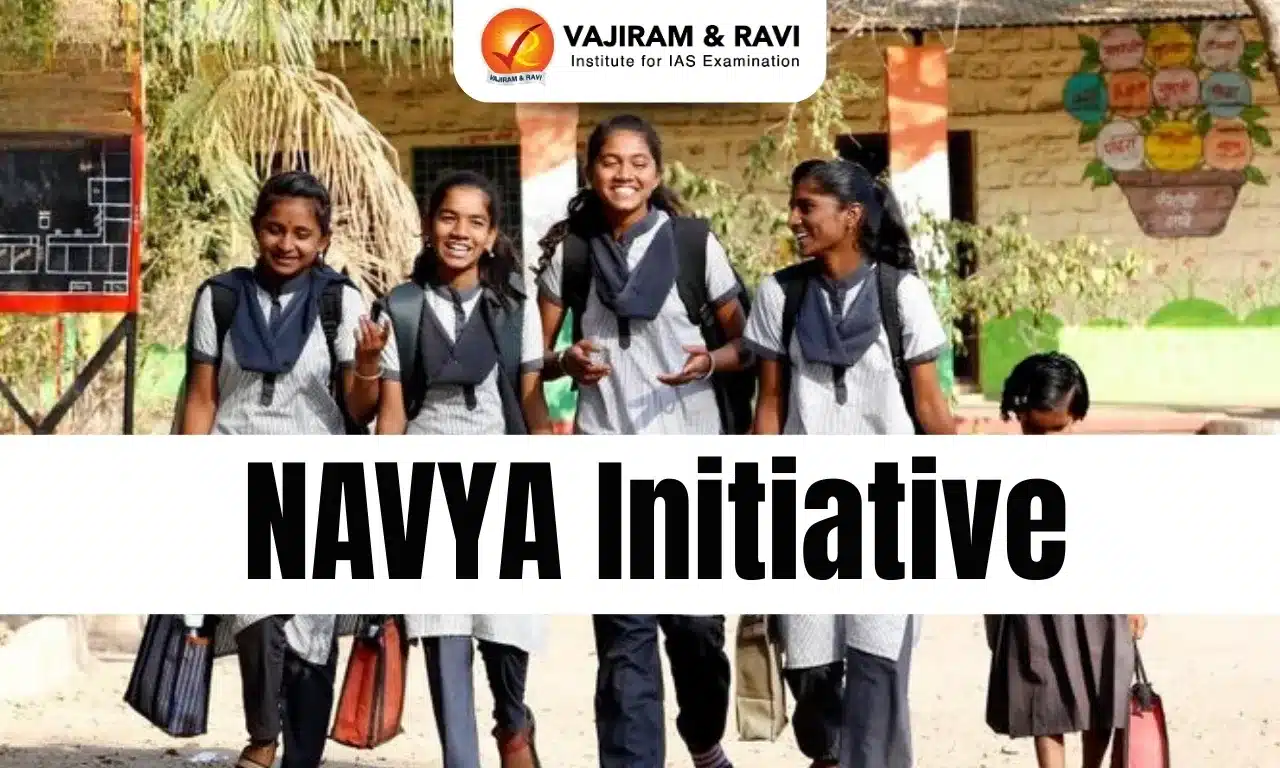
  • The NAVYA (Nurturing Aspirations through Vocational training for Young Adolescent Girls) aims to empower adolescent girls (AGs) aged 16–18 years in aspirational districts by equipping them with relevant skills for socio-economic independence.
  • It is a joint initiative of the Ministry of Skill Development & Entrepreneurship and the Ministry of Women & Child Development.

Objective of NAVYA Initiative

  • Provide demand-driven vocational training aligned with traditional and non-traditional sectors.
  • Facilitate holistic development through modules on health, nutrition, hygiene, financial literacy, life skills, and legal awareness.
  • Promote employability, self-employment, and forward linkages such as internships, apprenticeships, and job opportunities.
  • Strengthen gender-inclusive skilling and create a safe, supportive training environment.
  • Bridge the gap between education and livelihood, particularly for girls in underserved and remote areas.
  • Under the NAVYA initiative, it has been decided to train 3850 adolescent girls under Pradhan Mantri Kaushal Vikas Yojana 4.0 (PMKVY 4.0) in non-traditional and modern job roles such as digital marketing, cybersecurity, AI-enabled services, green jobs, and other emerging sectors.
  • Further, training in life skills, financial literacy, and digital competence is to be provided to equip them for both current and future workforce demands.

Source: PIB

NAVYA Initiative FAQs

Q1: What is the meaning of vocational training?

Ans: Vocational education and training, abbreviated as VET, sometimes simply called vocational training, is the training in skills and teaching of knowledge related to a specific trade, occupation or vocation in which the student or employee wishes to participate.

Q2: What is meant by an aspirational district?

Ans: The Aspirational Districts Programme ranks districts on the basis of a composite index comprising health, nutrition, education, basic infrastructure and poverty.

Q3: What is the Pradhan Mantri Kaushal Vikas Yojana?

Ans: Pradhan Mantri Kaushal Vikas Yojana is a skill development programme launched by government of India in 2015 that aims to empower the youth of India to engage in industry relevant skill training and secure a better livelihood.

Enquire Now