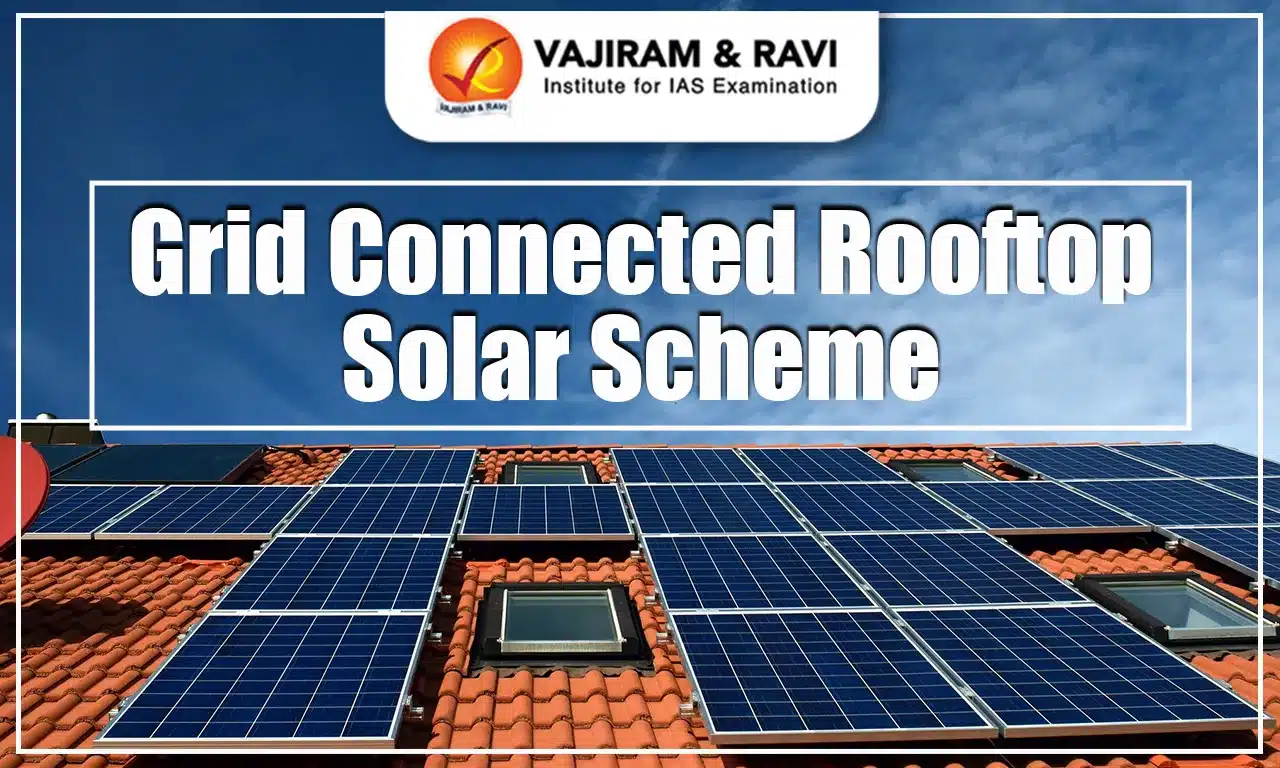
Grid Connected Rooftop Solar Scheme was launched with an aim of controlling pollution, reducing the use of natural nonrenewable resources such as coal and petroleum, coal combustion etc. Rooftop Solar Scheme explores the ways that can be adopted to generate electricity using sunlight. Installing solar panels on residential or institutional rooftops can give the advantage of generating electricity at a lower cost as well as contributing to a cleaner environment. In this article, we are going to look into the benefits of Grid Connected Rooftop Solar Scheme.
Solar Rooftop System
Solar Rooftop System is the mechanism of installing solar panels on the roofs of buildings including residential, industrial, commercial and institutional. The solar panels are of two types: Solar Rooftop Systems with battery storage and another is the grid-connected solar rooftop system.
- Under the solar rooftop system a battery storage facility is used.
- The Grid Connected Solar Rooftop System is also known as SPV System. In this system, the DC power is generated by the SPV panel and transformed to AC power using a power conversion unit and fed into the grid via 33kV/11kV three phase liners. The performance of this installation is also dependent on the institution installing this system, commercial establishment, house building and the regulatory environment. The power generated during the day is effectively utilized to operate captive loads, with any surplus energy sent to the grid. In cases where solar energy is insufficient due to cloud cover, the grid supplies the necessary power to sustain the captive loads.
Grid Connected Rooftop Solar Programme Objectives
The objectives of Grid Connected Rooftop Solar Programme include:
- Goal is to produce 40,000 MW of total capacity by 2022.
- The scheme has received a central funding of Rs. 11,814.
- Phase II offers central financial support of up to 40% for roofs up to 3kW and 20% for the ones with capacity range between 3 to 10kW.
- This phase will increase distribution company involvement (DISCOMs).
Grid- Connected Rooftop Solar System Advantages
Advantages of Rooftop Solar System Scheme are:
- Decreases the cost of electricity bills for consumers.
- Installation on the rooftop makes it feasible without the requirement of any new space.
- The scheme has a short gestation period.
- Reduces the transmission and distribution lines as well as losses.
- Leads to carbon emission reduction in addition to providing long term energy and environment security.
- There is a reduction in system congestion and an increase in tail end line voltage.
Grid Connected Rooftop Solar Scheme Implementation
The Ministry of New and Renewable Energy is responsible for implementing the Grid Connected Rooftop Solar Scheme . The Ministry of New and Renewable Energy, led by a Union Cabinet Minister, is responsible for fostering research, innovation, intellectual property rights, and global collaboration in clean energy sectors such as solar, wind, hydropower, and biogas. Its primary goal is to promote and deploy clean, renewable energy to supplement India’s energy demands.
The ministry aims to reduce dependence on oil-based transportation, increase the share of clean energy in the energy mix, and support energy needs for cooking, heating, and other activities. By ensuring energy is cost-effective, convenient, and safe, the ministry also works to improve energy equity across the country.
Challenges associated with Solar Rooftop System installation
The challenges associated with implementing the Grid Connected Rooftop Solar Scheme are:
- The primary challenge with this system is the inconsistent power supply, as it relies on factors like sunlight intensity and availability. Solar cells cannot generate electricity at night, even though off-grid locations often require alternative energy sources during these hours.
- While energy storage offers a potential solution, current storage technologies are still in their early stages and remain prohibitively expensive.
Grid Connected Rooftop Solar Scheme FAQs
Q1: What is a grid-connected solar rooftop?
Ans: A system where solar panels installed on rooftops generate electricity and are connected directly to the power grid.
Q2: What is a grid-connected solar PV system?
Ans: A solar photovoltaic system that generates electricity and feeds the surplus power directly into the grid while drawing power when needed.
Q3: What is the rooftop solar scheme?
Ans: A government initiative to promote solar energy adoption by providing financial incentives for installing solar panels on rooftops.
Q4: What is a grid-connected solar rooftop system?
Ans: A solar power setup on rooftops that operates in synchronization with the grid, enabling both power generation and energy exchange.
Q5: What is the Surya Rashmi scheme?
Ans: A scheme aimed at promoting solar energy installations, particularly in rural and off-grid areas, through subsidies and awareness programs.