Bordeaux Mixture

Bordeaux Mixture

Bordeaux Mixture Latest News

Planters in the Chikkamagaluru and Hassan districts of Karnataka are gearing up to apply Bordeaux mixture for the third or fourth time this year, following earlier crop damage caused by unseasonal rainfall.

About Bordeaux Mixture

  • Bordeaux mixture is a bactericide and fungicide made by mixing copper sulfate and lime (calcium hydroxide) with water. 
  • Discovered in the late 19th century in France's Bordeaux region, from which it takes its name, Bordeaux mixture has stood the test of time and continues to be a reliable solution for disease management, particularly in organic farming systems.
  • This mixture is especially effective in controlling fungal and bacterial diseases in various crops such as fruits, vegetables, and plantation crops.
  • It has a low aqueous solubility and is not volatile.
  • It persists in rainy weather and can provide long-lasting protection against a variety of diseases.
  • Bordeaux mixture is usually applied after harvest, before rainy weather starts.
  • Additionally, because it contains copper, it has a multi-site mode of action and may be a particularly useful spray in a pesticide resistance management program.
  • However, applying Bordeaux mixture to newly growing leaves, however, can cause injury to the new growth.

Source: TOI

Bordeaux Mixture FAQ's

Q1: What is the mixture of Bordeaux?

Ans: It is made by mixing copper sulfate and lime (calcium hydroxide) with water.

Q2: What property makes Bordeaux mixture effective during rainy weather?

Ans: Low aqueous solubility and persistence.

Q3: Bordeaux mixture is particularly useful in which type of farming system

Ans: Organic farming

Q4: When is Bordeaux mixture usually applied?

Ans: After harvest, before rainy weather.

Mira Stars

Mira Stars

Mira Stars Latest News

Recently, the most precise determination of the expansion rate of the universe was made using cool, giant variable stars ‘Mira’ by the scientists from Inter-University Centre for Astronomy and Astrophysics (IUCAA).

About Mira Stars

  • Mira, also known as Omicron Ceti, is a star that remarkably changes its brightness over time, in a regular pattern.
  • The name, Mira, means "the wonderful" in Latin, and it lived up to that name by becoming the prototype for an entire class of stars known as Mira variables.
  • With the variability first measured by astronomers in the 17th century, Mira was the first known example of a "variable star"—a star that doesn't shine with a constant brightness.
  • Mira variables are a type of giant star that go through regular cycles of expanding and contracting.
  • These cycles cause their brightness to vary in a predictable way, typically over periods ranging from 100 to 1,000 days.
  • These stars are relatively cool, with surface temperatures around 3,000 Kelvin (about half the temperature of the Sun’s surface), and they are in the late stages of their life.
  • One of the most important things about Mira variables is that there is a strong relationship between how bright they are and how long their pulsation cycles last.
  • This relationship allows astronomers to use them as "standard candles."
  • A standard candle is an object in space whose true brightness is known. By comparing how bright the object appears from Earth to how bright it actually is, scientists can calculate how far away it is.
  • This is a key method used to measure distances in the universe, forming part of what astronomers call the "extragalactic distance ladder."

Source: PIB

Mira Stars FAQs

Q1: What type of star is Mira?

Ans: Variable red giant

Q2: What causes Mira's variability?

Ans: They are pulsating due to the entire star expanding and contracting. This produces a change in temperature along with radius, both of which factors cause the variation in luminosity.

Exercise Yudh Kaushal 3.0

Exercise Yudh Kaushal 3.0

Exercise Yudh Kaushal 3.0 Latest News

The Indian Army recently conducted Exercise Yudh Kaushal 3.0 in the high-altitude Kameng region of Arunachal Pradesh.

About Exercise Yudh Kaushal 3.0

  • It was conducted by the Indian Army in the high-altitude Kameng region of Arunachal Pradesh.
  • The exercise demonstrated an impressive integration of advanced technology, operational innovation, and professional expertise by the troops.
  • The large-scale manoeuvres highlighted the Army’s capability to operate across multi-domain environments, with demonstrations including drone surveillance, real-time target acquisition, precision strikes, air-littoral dominance, and coordinated battlefield operations.
  • A key feature was the operational debut of the newly raised ASHNI platoons, showcasing how next-generation technology, combined with proven tactical experience, can provide a decisive advantage in both current and future conflicts.
  • A unique aspect of Exercise Yudh Kaushal 3.0 was the active involvement of the Indian Civil Defence Industry, reflecting India’s ongoing “Decade of Transformation.”
  • The exercise validated the Army’s readiness to operate in high-altitude, harsh climatic conditions and reaffirmed its commitment to integrating emerging technologies, including unmanned systems, precision weaponry, and multi-domain operational strategies.

Source: TH

Exercise Yudh Kaushal 3.0 FAQs

Q1: Exercise Yudh Kaushal 3.0 was conducted by the Indian Army in which region?

Ans: Kameng region of Arunachal Pradesh

Q2: Which newly raised platoons made their operational debut during Exercise Yudh Kaushal 3.0?

Ans: ASHNI platoons

Q3: Which strategic advantage did the Exercise Yudh Kaushal 3.0 aim to demonstrate?

Ans: Decisive edge in high-altitude warfare through technology integration.

Dhauliganga Hydroelectric Project

Dhauliganga Hydroelectric Project

Dhauliganga Hydroelectric Project Latest News

Nineteen workers and officials of the NHPC were rescued after they were trapped inside the tunnel of the 280 MW Dhauliganga hydroelectric project in Pithoragarh's Dharchula area for almost 22 hours recently.

About Dhauliganga Hydroelectric Project

  • It is a 280 MW hydropower project located on the Dhauliganga River near Dharchula in the Pithoragarh district of Uttarakhand. 
    • The Dhauliganga River is one of the prominent tributaries of the Alaknanda River, which is a key component of the Ganga River system. 
  • The project construction commenced in 2000 and subsequently entered into commercial operation in 2005. 
  • The project is currently owned by the National Hydroelectric Power Corporation (NHPC).
  • It is a run-of-river project. 
  • It consists of a concrete-faced rock-fill embankment dam with a height of 56 meters and a length of 315 meters.
  • The hydro reservoir capacity is 6.2 million cubic meters.
  • The gross head and net head of the project are 310 m and 297 m, respectively.

Source: TOI

Dhauliganga Hydroelectric Project FAQs

Q1: The Dhauliganga Hydroelectric Project is located in which state?

Ans: Uttarakhand

Q2: What is the installed capacity of the Dhauliganga Hydroelectric Project?

Ans: 280 MW

Q3: The Dhauliganga River is a tributary of which major river?

Ans: The Dhauliganga River is one of the prominent tributaries of the Alaknanda River.

Q4: When did the Dhauliganga Hydroelectric Project begin commercial operation?

Ans: 2005

Dioscorea balakrishnanii

Dioscorea balakrishnanii

Dioscorea balakrishnanii Latest News

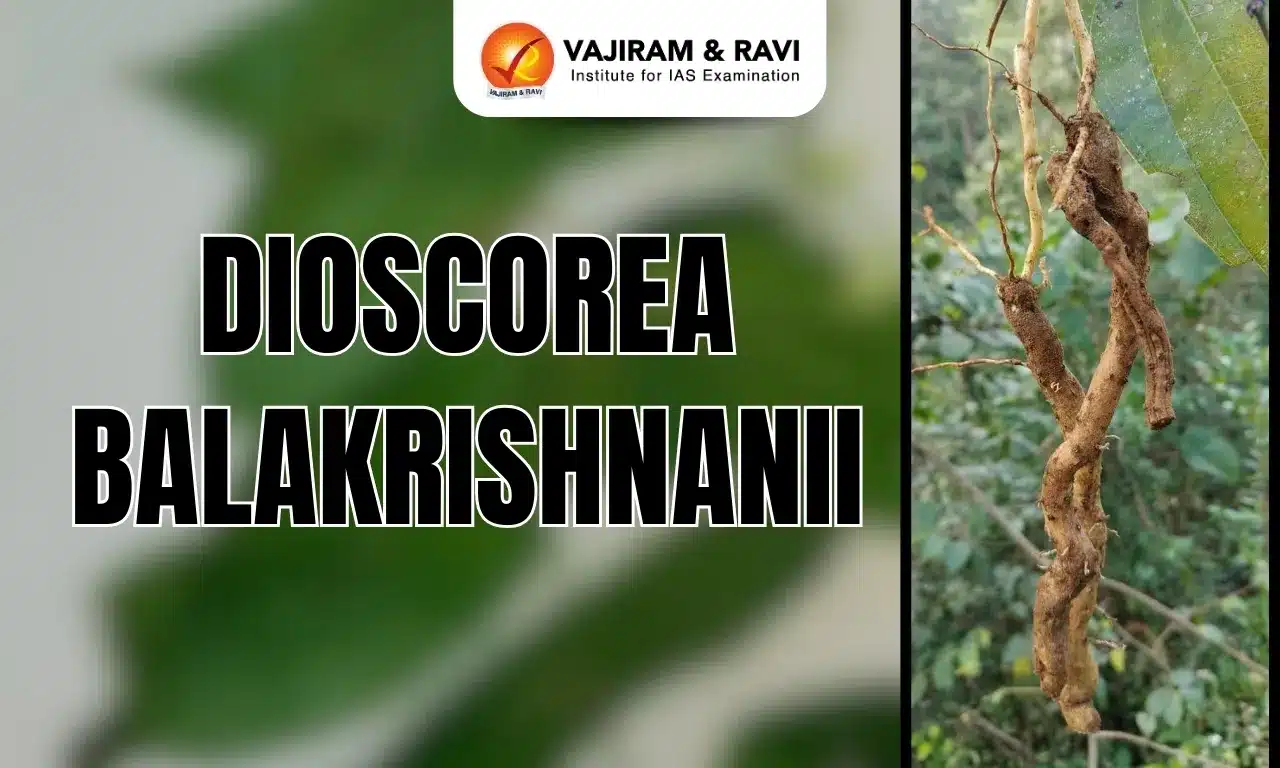
Researchers from Kerala have identified an edible tuber and named it as Dioscorea balakrishnanii.

About Dioscorea balakrishnanii

  • It is an edible tuber found in the Western Ghats region of Wayanad district of Kerala.
  • It is a new species of the genus Dioscorea.
  • This yam species is locally known as ‘chola kizhangu’ among the Kattunayikar tribes of Wayanad. The tubers are edible when cooked and are said to have an excellent flavour
  • Habitat: It is found only in the sholas of evergreen forests.
  • The species holds potential as a tuber variety for food security and cultivation as a food crop with low glycemic index.
  • Since there are male and female varieties, Dioscorea balakrishnanii was continuously observed for the last ten years and the differences in the flowers have been recorded.
  • The Wayanad region of the Western Ghats is rich in unique wild tubers, relatives of the commonly cultivated tubers known as kachil or kavat (purple yam).
  • These belong to the plant family Dioscoreaceae and 23 different forms of more than 14 species.
  • Significance: The discovery of this new tuber is of significance for the conservation of unique ecosystems and unique wild relatives as well as food security and the medicinal sector.

Source: TH

Dioscorea balakrishnanii FAQs

Q1: What is the benefit of yam in the human body?

Ans: Yams offer diverse health benefits thanks to their antioxidant, digestive, energetic, lipid-lowering, estrogenic, anti-inflammatory, hypoglycemic.

Q2: What is Dioscorea also known as?

Ans: Dioscorea species, known as “Yams,” belong to family Dioscoreaceae.

Indian Rosewood

Indian Rosewood

About Indian Rosewood Latest News

According to recent habitat modelling by the Institute of Wood Science and Technology (IWST), Bengaluru, only 17.2% of India’s suitable habitat for Dalbergia latifolia — Indian rosewood — lies within protected areas.

About Indian Rosewood

  • Indian Rosewood i.e Dalbergia sissoo (North Indian rosewood) is often called the “ivory of the forests,”
  • Indian Rosewood is a fast-growing, hardy, deciduous crooked rosewood
  • Distribution: It is native to the foothills of the Himalayas, ranging from Afghanistan in the west to Bihar, India, in the east.
  • Habitat: It is primarily found growing along river banks above 200 m (700 ft) elevation, but can range naturally up to 1,400 m (4,600 ft).
  • It has long, leathery leaves and whitish or pink flowers.
  • Indian rosewood is prized for its rich grain, deep colour, and exceptional durability.
  • It serves as both a premium timber resource for the furniture and handicraft industries and a keystone ecological species.
  • It is commonly used for furniture, musical instruments, decorative items and veneers.
  • Ecological Significance: Rosewood trees improve soil fertility through nitrogen fixation, support bird and insect diversity, and act as long-term carbon sinks.
  • Concerns: Researchers observed that populations are dominated by mature, ageing trees with almost no regeneration in the wild. Seedlings are rare, and in many areas, entirely absent.

Conservation status of Indian Rosewood

  • IUCN: Vulnerable
  • CITES list: Appendix II

Source: TH

Indian Rosewood FAQs

Q1: What is rosewood called in India?

Ans: Sheesham

Q2: What is Indian Rosewood used for?

Ans: It is used for furniture, paneling, ornamental work, ordinance work, agricultural implements, etc.

Great Salt Lake

Great Salt Lake

Great Salt Lake Latest News

As the Great Salt Lake shrinks, scientists are uncovering mysterious groundwater-fed oases hidden beneath its drying lakebed.

About Great Salt Lake

  • It is a saline lake located in northern Utah, United States.
  • It is the largest inland body of salt water in the Western Hemisphere and one of the most saline inland bodies of water in the world.
  • The lake is fed by the Bear, Weber, and Jordan rivers and has no outlet.
  • The lake has fluctuated greatly in size, depending on the rates of evaporation and the flow of the rivers that feed it. 
  • Its surface area has varied from about 6,200 sq.km. at its highest levels in 1873 and the mid-1980s to about 2,300 sq.km. at its lowest level in 2022. 
  • It has a length of 120 km and a maximum width of 45 km. 
  • The lake reaches an average depth of 4.9 m and a maximum depth of 10 m. 
  • Like the Dead Sea, the Great Salt Lake exists within an arid environment and has chemical characteristics similar to that of the oceans. 
  • It has a much greater salinity than the oceans, however, since natural evaporation exceeds the supply of water from the rivers feeding the lake.
  • Surrounded by great stretches of sand, salt land, and marsh, the Great Salt Lake remains eerily isolated from the nearby cities, towns, and other human habitations.
  • The salts are primarily sodium chloride, but there are also sulfates, magnesium, and potassium.

Source: SD

Great Salt Lake FAQ's

Q1: The Great Salt Lake is located in which country?

Ans: United States

Q2: Which rivers feed the Great Salt Lake?

Ans: The lake is fed by the Bear, Weber, and Jordan rivers.

Q3: Why is the Great Salt Lake considered similar to the Dead Sea?

Ans: Both are hypersaline and exist in arid regions.

Blue Sea Dragon

Blue Sea Dragon

Blue Sea Dragon Latest News

Recently, several beaches in Spain were forced to shut down after an unusual invasion of blue sea dragons.

About Blue Sea Dragon

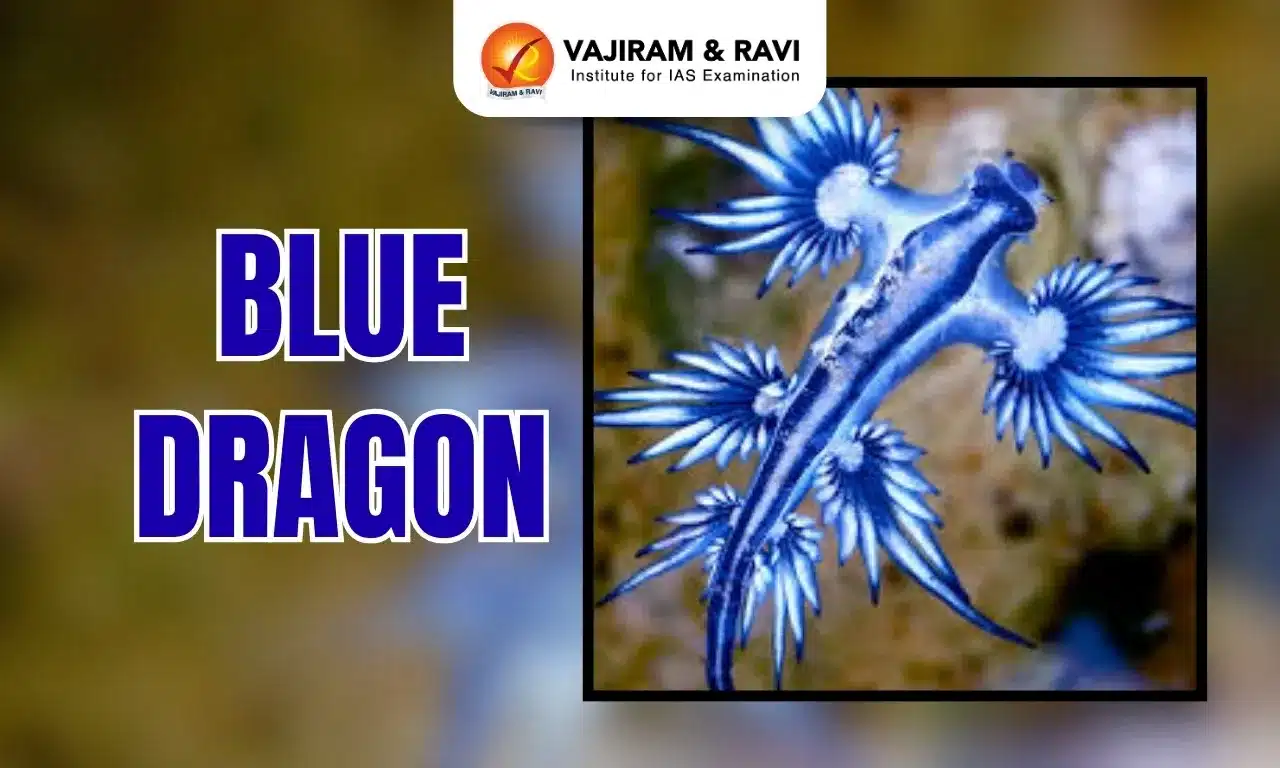
  • The blue dragon (Glaucus atlanticus) is a type of mollusk known as a nudibranch.
  • They also are known as blue sea slugs, blue angels, and sea swallows
  • Distribution: It can be found drifting on the surface of the Atlantic, Pacific and Indian oceans in temperate and tropical waters.
  • They are hermaphrodites, meaning they have both male and female reproductive organs.

Diet of Blue Sea Dragon

  • They feed on venomous siphonophores such as the Portuguese man-o-war and bluebottle, which also occur in ocean surface waters.
  • When a blue sea dragon consumes its venomous prey, it doesn’t just digest the toxins. Instead, through a complex biological process, it transports the stinging cells or nematocysts from its digestive system to specialised finger-like projections called cerata on its back and sides.
  • They incorporate these cells into multiple finger-like structures protruding from their body which provides them with a potent form of protection from predators.
  • The slug isn’t venomous all on its own, however, it stores the stinging nematocysts created by the creatures on which it feeds.

How does the Blue Sea Dragon Affect Humans?

  • Its sting can cause problems, especially to children and elderly.
  • One sting from this little creature can lead to nausea, pain, vomiting, acute allergic contact dermatitis, and post-inflammatory hyperpigmentation.

Source: IE

Blue Sea Dragon FAQs

Q1: How venomous is the blue sea dragon?

Ans: The blue dragon stores the man o' war's stinging nematocysts within its finger-like appendages, making itself equally venomous to predators.

Q2: What is an example of a hermaphrodite?

Ans: Earthworms, flatworms, mollusks, and fish(rarely) are all examples of each member who can act as both a man and a woman.

Koya Tribe

Koya Tribe

Koya Tribe Latest News

The Supreme Court recently issued notice on a plea by Koya tribe members challenging Telangana HC’s order on the ST status of Lambadi, Sugali & Banjara communities, citing the impact on reservation benefits.

About Koya Tribe

  • The Koya are one of the few multi-racial and multi-lingual tribal communities in India.
  • They live in the forests, plains, and valleys on both sides of the Godavari River, in the states of Andhra Pradesh, Telangana, Chhattisgarh, and Odisha. 
  • According to the 2011 census, the total population of these tribes in India is 7,38,629.
  • The Koyas call themselves as "Koithur"
  • They are said to have migrated to central India from their original home in Bastar, northern India.

Koya Tribe Language

  • Koyas speaks the Koya language, also known as koya basha, and is a member of the Dravidian language family. It is closely related to Gondi and has been strongly influenced by Telugu.
  • Most Koyas speak either Gondi or Telugu, in addition to Koyi.

Koya Tribe Occupation

  • Traditionally, they were pastoralists and shifting cultivators, but nowadays, they have taken to settled cultivation supplemented by animal husbandry and seasonal forest collections.
  • They grow Jowar, Ragi, Bajra, and other millets. 

Koya Tribe Society and Culture

  • All Koya belong to one of five sub-divisions called gotrams. Every Koya is born into a clan, and he cannot leave it.
  • The Koyas have a patrilineal and patrilocal family. The family is called “Kutum”. The nuclear family is the predominant type.
  • Monogamy is prevalent among the Koyas.
  • The Koya usually live in villages located near dependable water sources. 
  • Villages vary in size from three to more than sixty houses.
  • The chief of every Koya village is called “Peda’.
  • The Koya practice their own ethnic religion, but also worship a number of Hindu gods and goddesses.
  • Many Koya deities are female, the most important being the “mother earth.”
  • They maintain community funds and grain banks at the village level to help the needy families and provide food security.
  • Koyas either bury or cremate the dead. They erect menhirs in memory of the dead.
  • Their main festivals are Vijji Pandum (seeds charming festival) and KondalaKolupu (festival to appease Hill deities).
  • Koyas perform a robust, colourful dance called Permakok (Bison horn dance) during festivals and marriage ceremonies.

Source:  LB

Koya Tribe FAQs

Q1: The Koya tribe primarily inhabits the regions along which river?

Ans: Godavari River

Q2: What do the Koya people call themselves?

Ans: Koithur

Q3: According to the 2011 Census, what is the population of the Koya tribe in India?

Ans: 7,38,629

Q4: What type of dance is performed by the Koya tribe during festivals and marriage ceremonies?

Ans: Koyas perform a robust, colourful dance called Permakok.

Ramon Magsaysay Award 2025

Ramon Magsaysay Award

Ramon Magsaysay Award Latest News

Recently, the Ramon Magsaysay Award, 2025 has been announced for ‘Educate Girls’, an Indian organisation that works to educate unprivileged girls across the country.

About Ramon Magsaysay Award

  • It is Asia’s premier prize and highest honor, celebrates greatness of spirit and transformative leadership in Asia.
  • The Awardees, annually selected by the RMAF board of trustees, are presented with a certificate and a medallion with an embossed image of Ramon Magsaysay facing right in profile.
  • From 1958 to 2008, the Award was given in six categories annually:
    • Government Service: To recognize outstanding service in the public interest in any branch of government, including the executive, judicial, legislative, or military;
    • Public Service: To recognize outstanding service for the public good by a private citizen;
    • Community Leadership: To recognize leadership of a community toward helping the disadvantaged have fuller opportunities and a better life;
    • Journalism, Literature, and Creative Communication Arts: To recognize effective writing, publishing, or photography or the use of radio, television, cinema, or the performing arts as a power for the public good;
    • Peace and International Understanding: To recognize contributions to the advancement of friendship, tolerance, peace, and solidarity as the foundations for sustainable development within and across countries.
    • Emergent Leadership: To recognize an individual, forty years of age or younger, for outstanding work on issues of social change in his or her community, but whose leadership may not yet be broadly recognized outside of this community.
  • The category of Emergent Leadership was inaugurated in 2000 and is supported by a grant from the Ford Foundation.
  • Starting in 2009, the Ramon Magsaysay Award is no longer being given in fixed Award categories, except for Emergent Leadership.
  • The winners are presented with a certificate and a medallion with an embossed image of Ramon Magsaysay.
  • It is presented in formal ceremonies in Manila, Philippines on August 31st, the birth anniversary of the much-esteemed Philippine President whose ideals inspired the Award’s creation in 1957.

Source: TH

Ramon Magsaysay Award FAQs

Q1: What is the Ramon Magsaysay Award for?

Ans: It is an annual award established to perpetuate former Philippine President Ramon Magsaysay's example of integrity in governance, courageous service to the people, and pragmatic idealism within a democratic society.

Q2: How many Indians get the Ramon Magsaysay Award?

Ans: Magsaysay Award winners in India are - Mother Teresa, Arun Shourie, Maheshweta Devi, Kiran Bedi, Ravish Kumar, Arvind Kejriwal, Sonam Wagnchuk, Anshu Gupta.

Enquire Now