Vikram 3201

Vikram 3201

Vikram 3201 Latest News

India unveiled its first fully indigenous 32-bit microprocessor, the Vikram 3201, at the Semicon India 2025 conference recently.

About Vikram 3201

  • It is India’s first fully indigenous 32-bit microprocessor.
  • Designed by the Vikram Sarabhai Space Center (VSSC), Vikram 3201 has been built by the Indian Space Research Organisation’s (ISRO) Semiconductor Laboratory (SCL) in Chandigarh.
  • Unlike processors in everyday devices like smartphones or laptops, this one is designed specifically for rockets and satellites.
  • It is an upgrade to Vikram 1601, a 16-bit processor that has powered ISRO’s launch vehicles since 2009.
  • The Vikram 3201 marks the first time India has indigenously designed and fabricated a processor of this scale and specification for launch vehicle avionics.

What will the Vikram 32-bit Processor do?

  • The chip's job is to handle navigation, control, and mission management in launch vehicles, performing the split-second calculations needed to keep rockets stable and on course. 
  • Because space environments are harsh, the chip is manufactured to military-grade standards and rigorously tested to ensure it can keep working in extreme heat, cold, vibration, and radiation.
  • The Vikram 3201 is built to withstand the extreme conditions of space missions, including temperatures from –55 degrees Celsius to +125 degrees Celsius.
  • Unlike its predecessor, the new chip supports 64-bit floating-point operations, Ada programming language compatibility, and features on-chip 1553B bus interfaces for reliable communication during missions.
  • It can handle substantial memory and execute complex instructions needed for launching satellites and space vehicles.

Source: BS

Vikram 3201 FAQs

Q1: What is Vikram 3201?

Ans: It is India’s first fully indigenous 32-bit microprocessor.

Q2: Who designed Vikram 3201?

Ans: Vikram Sarabhai Space Center (VSSC)

Q3: For what purpose is Vikram 3201 used?

Ans: It is designed specifically for rockets and satellites.

Equity Derivatives

Equity Derivatives

Equity Derivatives Latest News

SEBI has come out with a new framework for monitoring intraday positions in equity index derivatives, a move aimed at preventing risks caused by large exposures.

What are Derivatives?

  • Derivatives are financial contracts that derive value from an underlying asset. 
  • Derivatives allow traders to bid on the direction of the underlying asset’s price change without owning them. 
  • They allow investors to speculate on price movements, hedge against risks, or enhance portfolio returns.

About Equity Derivatives

  • Equity derivatives are financial instruments whose value is derived from the movements of a stock or a stock index. 
  • Equity derivatives serve various purposes for investors and traders, including risk management, speculation, and portfolio optimisation.

Equity Derivative Types

  • Futures Contracts: These obligate the buyer to purchase and the seller to sell an underlying equity asset at a predetermined price and future date.  Equity index futures, like the BSE S&P and Nifty IT, are popular examples.
  • Options: Equity options give the holder the right, but not the obligation, to buy (call option) or sell (put option) an underlying stock or index at a specified price before or on a specific expiration date.
  • Swaps: Equity swaps involve exchanging cash flows based on the return of an underlying equity asset. These can be used for hedging or investment purposes.
  • Forwards: Forwards are the same as futures, where the parties are obligated to perform the contract. But forwards are non-standardised, over-the-counter contracts that don’t trade on the stock exchanges.

Advantages of Equity Derivatives

  • Leverage: Equity derivatives typically require a smaller upfront investment compared to buying the underlying assets directly.This  allow investors to control a larger position in the underlying asset with a smaller investment, magnifying potential gains (but also losses).
  • Hedging against price volatility: They provide a means to protect against adverse price movements in the stock market, reducing the risk of financial losses.
  • Access to premium assets: By investing in these derivatives, investors can gain exposure to high-value, unaffordable or inaccessible assets.
  • Cost efficiency: Trading equity derivatives typically requires lower transaction costs than directly investing in the underlying assets, making it a cost-effective choice.
  • Arbitrage opportunities: They can be utilised to exploit price discrepancies between different markets, enabling investors to profit from market inefficiencies.
  • Portfolio diversification: Including these derivatives in an investment portfolio can diversify risk by adding different asset classes and strategies.
  • Flexibility: They offer various strategies and contract types, allowing investors to adapt their positions based on market conditions and investment objectives.
  • Liquidity: The derivatives market tends to have high liquidity, ensuring ease of buying and selling positions without significant market impact.
  • Risk management: They provide tools for managing risk exposure, allowing investors to mitigate losses and protect their portfolios.
  • Income generation: Through option writing or other derivative strategies, investors can generate income from their equity positions, enhancing overall returns.

Source: TH

Equity Derivatives FAQs

Q1: What is the key difference between futures and forwards?

Ans: Futures are traded on exchanges, while forwards are over-the-counter contracts.

Q2: Which type of equity derivative gives the holder the right, but not the obligation, to buy or sell an asset?

Ans: Options

Q3: What are the 4 types of derivatives?

Ans: Forwards, Futures, Options, and Swaps.

Wet and Dry Lease of Aircrafts

Wet and Dry Lease of Aircrafts

Wet and Dry Lease Latest News

Wet and dry (aircraft sans crew) leases are increasingly being adopted by airlines in order to overcome the shortage of new aircraft globally that has grown acute since the pandemic because of supply chain challenges.

About Wet and Dry Lease

  • In a wet lease, airlines acquire a fully operational aircraft along with a crew (pilots and cabin crew), maintenance personnel, and insurance (aircraft, crew, maintenance, and insurance). 
    • The lessee retains control over commercial operations (schedules, routes), while the lessor manages the operational aspects. 
    • This option is ideal for short-term exigencies such as seasonal spikes, route testing, or covering for grounded aircraft.
  • In a dry lease, the airline rents only the aircraft itself, without crew, maintenance, or insurance. 
    • The lessee assumes full responsibility for these operational components, employing their own crews, arranging maintenance in accordance with DGCA (Directorate General of Civil Aviation) regulations, and obtaining appropriate insurance coverage. 
    • Dry leases are well-suited for long-term fleet expansion or modernization strategies.
  • Aircraft leasing in India is governed by a robust legal framework, with the DGCA playing a pivotal role. 
  • Operations of an aircraft on wet lease are not encouraged by the DGCA, as the crew is often not approved by Indian authorities.

What is Damp Leasing?

  • The damp lease is a more limited variant of the wet lease. 
  • It is a leasing agreement under which an airline, the lessor, leases one of its aircraft, including flight crew and maintenance services, to another air operator. 
  • However, unlike wet leasing, damp leasing does not include cabin crew, who must be assigned by the lessee.
  • For this reason, a damp lease is referred to as a partial wet lease: the lessee is responsible for providing his own competent cabin crew.

Source: TH

Wet and Dry Lease FAQs

Q1: Which type of lease involves only the aircraft, leaving crew, maintenance, and insurance responsibilities to the lessee?

Ans: Dry lease

Q2: Wet leases are usually considered suitable for which situations?

Ans: Wet lease is ideal for short-term exigencies such as seasonal spikes, route testing, or covering for grounded aircraft.

Q3: What is a damp lease commonly referred to as?

Ans: Partial wet lease

Q4: Dry leases are best suited for which situations?

Ans: Dry leases are well-suited for long-term fleet expansion or modernization strategies.

BHARATI Initiative

BHARATI Initiative

BHARATI Initiative Latest News

Recently, the Agricultural and Processed Food Products Export Development Authority (APEDA) launched its new initiative BHARATI.

About BHARATI initiative

  • BHARATI, stands for Bharat’s Hub for Agritech, Resilience, Advancement and Incubation for Export Enablement.
  • It has been designed to empower 100 agri-food and agri-tech startups, accelerate their journey, promote innovation and create new export opportunities for young entrepreneurs.
  • It is conceived as APEDA’s vision to achieve $50 billion in agri-food exports for its Scheduled Products by 2030,
  • It is structured to complement and enhance industry and government-led incubation programmes in the agriculture, food and food processing sectors.
  • It seeks to drive innovation in high-value categories such as GI-tagged agri-products, organic foods, superfoods, novel processed Indian agri-foods, livestock products and AYUSH products.
  • The initiative also aims to attract startups working on advanced technologies such as AI-based quality control, blockchain-enabled traceability, IoT-enabled cold chains and agri-fintech, while addressing critical areas like innovative packaging, sustainability and sea protocols.
  • BHARATI seeks to resolve export challenges related to product development, value addition, quality assurance, perishability, wastage and logistics.
  • By fostering a collaborative ecosystem, the programme will connect agri-food innovators, tech-driven solution providers and SPS-TBT-focused startups to deliver scalable, cost-effective solutions that enhance India’s global competitiveness.
  • It will create globally competitive agri-products, fuel demand-driven backward integration for food innovation and boost global demand for Indian food, beverage and processed food products and services.
  • The initiative includes a nationwide awareness campaign to engage stakeholders and attract solution-oriented startups from across India, along with an application and selection process through the APEDA website to shortlist 100 startups for the export enablement programme.
  • Selected startups will undergo a three-month acceleration programme focusing on product development, export readiness, regulatory compliance, market access and collaborative solutions to address export challenges.
  • To strengthen this ecosystem, APEDA will partner with state agricultural boards, agricultural universities, premier institutions like IITs and NITs, industry bodies and existing accelerators to attract startups for agri-export enablement.
  • The pilot cohort will serve as a model for a scalable annual incubation programme, driving continuous innovation and long-term export growth.
  • Significance: The initiative marks a significant step to strengthen India’s agricultural and processed food exports.

Source: PIB

BHARATI Initiative FAQs

Q1: Where is the headquarter of APEDA?

Ans: New Delhi

Q2: What does agritech mean?

Ans: AgriTech is a term used for agricultural technology, which involves the use of technology to improve farming and agriculture across different value chains.

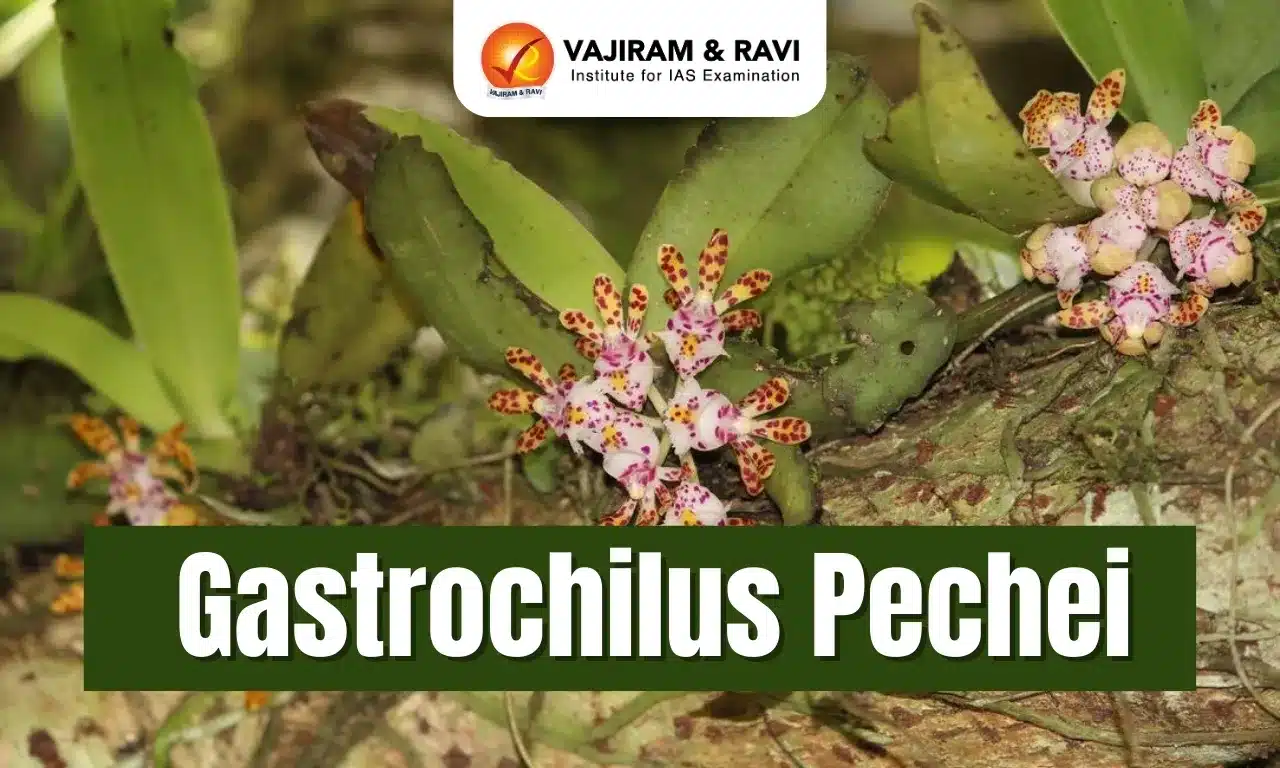
Gastrochilus Pechei

Gastrochilus Pechei

Gastrochilus pechei  Latest News

Recently, researchers discovered a new orchid plant in Vijoynagar, Arunachal Pradesh.

About Gastrochilus pechei 

  • It is a new orchid plant belonging to the Gastrochilus  genus.
  • Habitat: It flowers in September-October and thrives in moist, evergreen rainforest on small trees near riverbanks.
  • The Gastrochilus pechei was known to bloom only in Myanmar. 
  • Before the Vijoynagar find, 22 species of the Gastrochilus genus had been recorded from India. Of these, 15 are from Arunachal Pradesh.
  • Arunachal Pradesh is often referred to as the Orchid State of India, boasts approximately 60% of the country’s varieties.
  • First recorded in 1825, Gastrochilus is a monopodial orchid genus comprising 77 species widely distributed in tropical, subtropical, and temperate Asia.
  • This genus is characterised by a short axillary inflorescence, often with brightly coloured flowers, a distinct epichile on the front of the saccate hypochile, and two porate, globose pollinia that are borne on a slender stipe.

Source: TH

Gastrochilus Pechei FAQs

Q1: Which state is called the land of orchids?

Ans: Arunachal Pradesh

Q2: Which is the largest orchid in India?

Ans: Tiger Orchids

Exercise MAITREE

Exercise MAITREE

Exercise MAITREE Latest News

Recently, the 14th edition of the Exercise MAITREE-XIV commenced with a grand opening ceremony at Joint Training Node (JTN), Umroi, Meghalaya.

About Exercise MAITREE  

  • It is the joint military exercise between India and Thailand.
  • Exercise MAITREE, instituted in 2006, is one of the important joint training exercises between India and Thailand.
  • The bilateral exercise is part of the ongoing military-to-military exchange programme between the two countries and aims to enhance cooperation, interoperability and mutual understanding between the Indian Army and Royal Thai Army.
  • The current edition further reinforces the bilateral defence cooperation and reflects the shared commitment of both Armies towards peace, stability and security in the region.
  • The 13th edition of the exercise was held at Fort Vachiraprakan in Tak Province, Thailand.
  • The Indian Army contingent is being represented by a Battalion of the Madras Regiment.
  • The joint exercise will focus on company level counter-terrorist operations in semi-urban terrain under Chapter VII of the United Nations Charter.
  • The programme includes tactical drills, joint planning, special arms skills, physical fitness and raiding operations. The exercise will culminate with a 48-hour validation exercise, simulating realistic operational scenarios.

Source: PIB

Exercise Maitree FAQs

Q1: Exercise Maitree is a joint military exercise between India and which country?

Ans: Thailand

Q2: The 14th edition of Exercise Maitree is scheduled to be held in which Indian state?

Ans: Meghalaya

Q3: What is the main focus of Exercise Maitree 2024?

Ans: Joint counter-terrorism operations in semi-urban terrain.

Coconut Development Board

Coconut Development Board

Coconut Development Board  Latest News

Recently, the Coconut Development Board (CDB) has celebrated World Coconut Day by launching its newly revised schemes.

About Coconut Development Board  

  • It is a statutory body established under the Ministry of Agriculture and Farmers Welfare, Government of India
  • It was established for the integrated development of coconut production and utilization in the country with focus on productivity increase and product diversification.
  • The board came into existence on 12th January 1981.
  • Regional offices: It has regional Offices at Bangalore in Karnataka, Chennai in Tamil Nadu, Guwahati in Assam and Patna in Bihar.
  • Headquarters: Kochi in Kerala

Functions of Coconut Development Board

  • Adopting measures for the development of the coconut industry, inter alia
  • Imparting technical advice to those engaged in coconut cultivation and industry
  • Providing financial and other assistance for the expansion of the area under coconut
  • Encouraging adoption of modern technologies for processing of coconut and its products
  • Adopting measures to get incentive prices for coconut and its products
  • Recommending measures for improving marketing of coconut and its products
  • Recommending measures for regulating imports and exports of coconut and its products
  • Fixing grades, specifications and standards for coconut and its products

Source: PIB

Coconut Development Board FAQs

Q1: What are Statutory bodies?

Ans: These are organizations or institutions created by an act of legislation or statute passed by the government.

Q2: Where is the headquarter of Coconut Development Board?

Ans: Kochi, Kerala

Foreigners Tribunal

Foreigners Tribunal

Foreigners Tribunal Latest News

The Union Ministry of Home Affairs (MHA) has given Foreigners Tribunals (FT), so far unique to Assam, the powers of a first class judicial magistrate.

About Foreigners Tribunal

  • These are quasi-judicial bodies formed through the Foreigners (Tribunals) Order of 1964 under Section 3 of the Foreigners’ Act of 1946, to let local authorities in a State refer a person suspected to be a foreigner to tribunals.
  • Are FTs meant only for Assam?
    • The Foreigners (Tribunals) Order, 1964, applies to the whole of India, yet FTs exist only in Assam as of now. 
    • In other states, if any illegal immigrant is found, he is produced before a local court and dealt with as per the Foreigners Act, 1946. 
    • Prior to the 2019 amendment to the Foreigners (Tribunals) Order, 1964, only the Centre was empowered to establish FTs in states, but after this amendment, the power has been granted to states as well.
  • Composition: Each FT is headed by a member drawn from judges, advocates, and civil servants with judicial experience.
  • Powers: According to the 1964 order, an FT has the powers of a civil court in certain matters, such as summoning and enforcing the attendance of any person and examining him or her on oath and requiring the production of any document.

Foreigners Tribunal Functioning

  • A tribunal is required to serve a notice in English or the official language of the State to a person alleged to be a foreigner within 10 days of receiving the reference from the authority concerned.
  • Such a person has 10 days to reply to the notice and another 10 days to produce evidence in support of his or her case.
  • An FT has to dispose of a case within 60 days of reference. 
  • If the person fails to provide any proof of citizenship, the FT can send him or her to a detention centre, now called transit camp, for deportation later.

Immigration and Foreigners Order, 2025:

  • The order is part of recently passed Immigration and Foreigners Act, 2025. This order replaces the Foreigners (Tribunal) Order, 1964.
  • It allows FTs to issue arrest warrants and detain individuals who can't prove they're not foreigners. This was previously done through executive orders.
  • It empowers FTs to issue arrest warrants if a person whose nationality is disputed fails to appear in person.
  • FTs “shall have the powers of a civil court while trying a suit under the Code of Civil Procedure, 1908 (5 of 1908), and the powers of a judicial magistrate of the first class under the Bharatiya Nagarik Suraksha Sahita, 2023, (46 of 2023) in matters including- 
    • summoning and enforcing the attendance of any person and examining him on oath;
    •  requiring the discovery and production of any document;
    • issuing commissions for the examination of any witness;
    • directing the proceedee to appear before it in person;
    • issuing a warrant of arrest against the proceedee, if he fails to appear before it.”

Source: TH

Foreigners Tribunal FAQs

Q1: Foreigners Tribunals (FTs) were constituted under which legal framework?

Ans: Foreigners Act, 1946

Q2: At present, Foreigners Tribunals exist only in which Indian state?

Ans: Assam

Q3: Who generally heads a Foreigners Tribunal?

Ans: Each FT is headed by a member drawn from judges, advocates, and civil servants with judicial experience.

Q4: Within how many days must a Foreigners Tribunal dispose of a case after receiving a reference?

Ans: 60 days

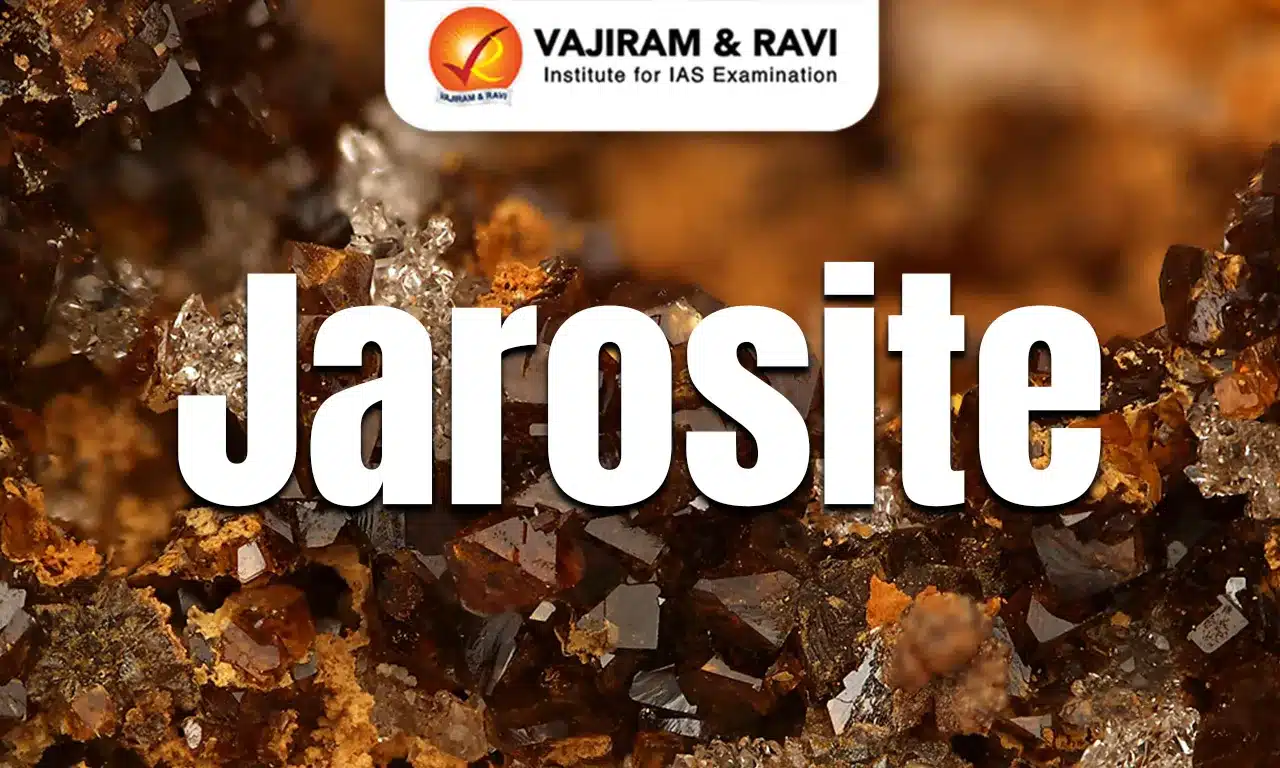
Jarosite

Jarosite

Jarosite  Latest News

Researchers confirmed the presence of jarosite in Matanomadh in Kutch, Gujarat similar to what was discovered on Mars a couple of decades ago.

About Jarosite 

  • Jarosite is a yellow-brown mineral composed of potassium, iron, and sulphate, commonly found in arid, saline environments.
  • Jarosite formation is a signal of extreme geochemical conditions and a clue to unlocking complex environmental and planetary processes.
  • On Earth, jarosite is formed when some minerals rich in oxygen, iron, sulphur and potassium react in the presence of water.
  • Jarosite formation is typically associated with volcanic activity.
  • In 2004, NASA’s Opportunity mission to Mars was the first to detect traces of jarosite at the Meridiani Planum landing site.
  • The discovery of jarosite on Mars was one of the strongest pieces of evidence of the presence of water on the planet at some point of time.
  • In Matanomadh, the mineral dating 55 million years old, corresponding with the Paleocene period in the geological timeline was found.
  • In India its presence has also been confirmed along Kerala’s Varkala cliffs.
  • Similar deposits have been found in Mexico, Canada, Japan, Spain, and in Utah and California in the US.
  • Significance of the discovery: It could help decode the palaeo-evolution of the Martian geology and the past chemical interactions on the planet.
  • Moreover, as sulphates such as jarosite could trap organic molecules and elements that support life within them, examining these samples in Kutch could open a window of opportunity for designing strategies for future Mars missions that will explore life on the red planet.

Source: IE

Jarosite FAQs

Q1: What is jarosite used for?

Ans: Jarosite precipitation is used in hydrometallurgy, especially the zinc industry, to control iron, sulfate and other impurities.

Q2: What is the significance of finding jarosite on Mars?

Ans: On Mars, Jarosite may represent the key to unlocking the geological history and environmental context of water on the red planet.

Enquire Now