Avalanche

Avalanche

Avalanche Latest News

Three Army personnel, including two Agniveers, lost their lives recently in a major avalanche at the Siachen base camp in Ladakh.

About Avalanche

  • An avalanche is a large amount of snow that quickly moves down a slope. 
  • An avalanche can be deadly because it will bury or sweep away anything in its path. 
  • Large amounts of sliding rocks, earth, or other materials may also be called avalanches. But these are often known as landslides.
  • Many different conditions make an avalanche possible. 
    • An avalanche is more likely to happen on a slope without trees or large rocks. These things help to keep snow in place. 
    • A weak layer of snow also makes an avalanche likely. 
  • Once the conditions are right, several things can start an avalanche.
    • Heavy snowfall, strong wind, and rising temperatures all can loosen snow on a slope. 
    • Falling rocks or ice also can cause snow to slide. 
    • Even the movement of a skier, a snowboarder, or a snowmobile can trigger an avalanche.
  • There are two main types of snow avalanches—sluffs and slabs. 
  • Sluff avalanches occur when the weak layer of a snowpack is on the top. 
    • A sluff is a small slide of dry, powdery snow that moves as a formless mass. 
    • Sluffs are much less dangerous than slab avalanches.
  • A slab avalanche occurs when the weak layer lies lower down in a snowpack. 
    • This layer is covered with other layers of compressed snow. 
    • When the avalanche is triggered, the weak layer breaks off, pulling all the layers on top of it down the slope. 
    • These layers tumble and fall in a giant block, or slab.
  • Avalanches vary in destructive power from harmless to large enough to destroy mature forests or flatten villages.
  • When an avalanche stops, the snow becomes solid like concrete, and people are unable to dig out. 
  • People caught in avalanches can die from suffocation, trauma, or hypothermia.
  • People in mountainous areas protect themselves from avalanches in several ways. 
    • Special fences help to hold snow in place. 
    • Barriers help to stop sliding snow or change its direction. 
    • Explosives help to clear snow from places where avalanches are likely to occur.

Source: IT

Avalanche FAQs

Q1: What is an avalanche?

Ans: An avalanche is a large amount of snow that quickly moves down a slope.

Q2: What are the two main types of snow avalanches?

Ans: Sluffs and slabs

Q3: What happens during a slab avalanche?

Ans: A weak lower snow layer breaks, pulling compressed layers above it.

Pallas’s Cat

Pallas’s Cat

Pallas’s Cat Latest News

A wildlife survey conducted in Arunachal Pradesh has brought out first-ever photographic evidence of the elusive Pallas’s cat in the state.     

About Pallas’s Cat

  • The Pallas’s cat (Otocolobus manul) is a small wild cat well camouflaged and adapted to the cold continental climate in its native range.
  • It was named Pallas’s cat after Peter Simon Pallas, who first described it in 1776 based on specimens collected near Lake Baikal, Russia.

Distribution of Pallas’s Cat

  • They are primarily found in Central Asia, with their range extending to western Iran, Mongolia, China, Russia (on the border of Mongolia and China), Kazakhstan, and Kyrgyzstan.
  • Habitat:  It inhabits rocky montane grasslands and shrublands, where the snow cover is below 15-20 cm and preys foremost on lagomorphs and rodents.

Features of Pallas’s Cat

  • It is a soft-furred animal about the size of a house cat and is pale silvery gray or light brown in colour.
  • The Pallas’s cat is distinguished by a broad head with high-set eyes and low-set ears.
  • The end of its tail is ringed and tipped with black, and some individuals have vague, dark markings on the body.
  • The fur of the underparts is about twice as long as that of the upper parts and possibly represents an adaptation to the cat’s habitual lying and crouching on cold ground.

Conservation Status of Pallas’s Cat

  • IUCN Red List: Least Concern
  • CITES: Appendix II

Source: TOI

Pallas’s Cat FAQs

Q1: Where is IUCN headquarters?

Ans: Gland, Switzerland.

Q2: What is the meaning of montane grasslands?

Ans: Montane (mountain) grasslands and shrublands occur at high altitudes, where temperatures are cooler than in lowland grasslands.

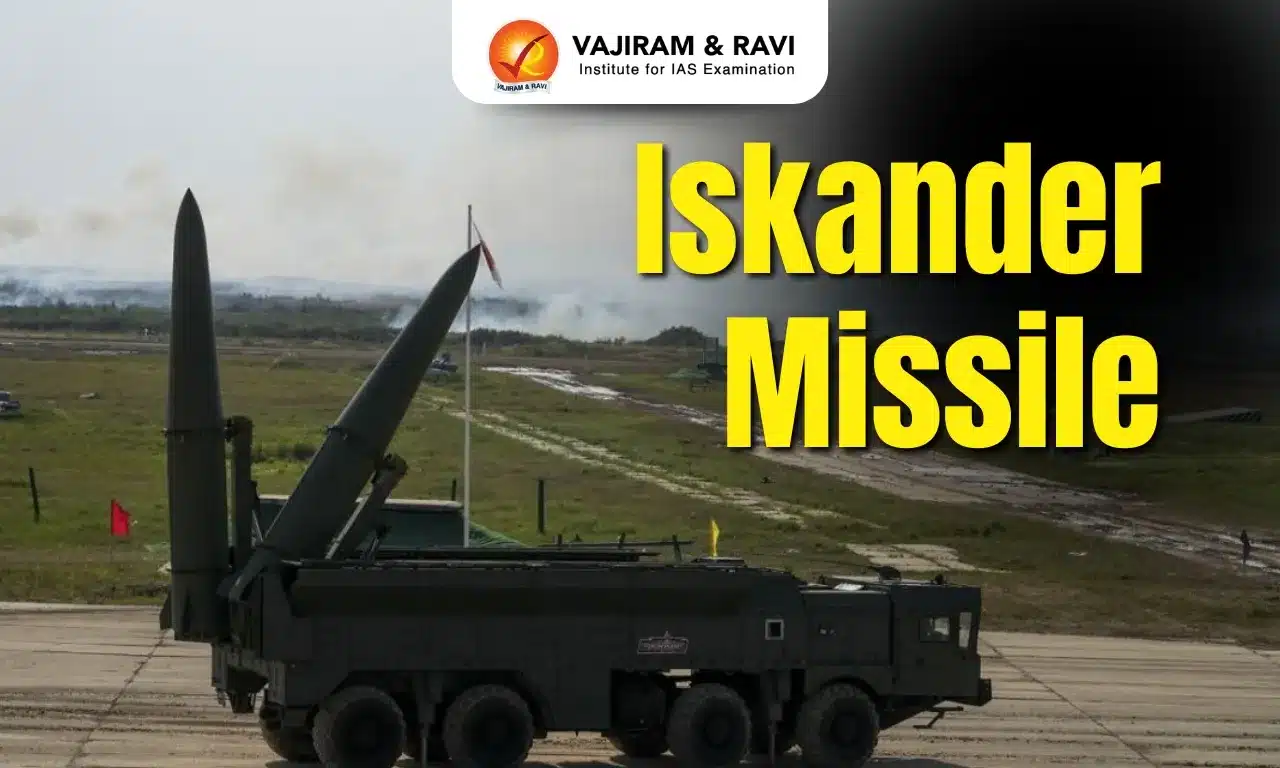
Iskander-K

Iskander-K

Iskander-K Latest News

Russia struck Ukraine's Cabinet building with an Iskander-K missile recently.

About Iskander-K

  • It is a Russian-made mobile short-range cruise missile launcher vehicle based on an 8x8 military truck chassis.
  • The design of the Iskander-K is very similar to the Iskander-M, which is a ballistic missile launcher vehicle. 
  • The Iskander-K, also referred to as SSC-8, entered service with the Russian Armed Forces in February 2017.
  • It is designed to perform tactical-operational strikes.

Iskander-K Features

  • For the Iskander-K, the vehicle can be fitted with two to six container launcher units.
  • The truck launcher can run at a maximum road speed of 70 km/h with a maximum cruising range of 1,000 km. 
  • The Iskander-K can launch two types of cruise missiles, including the 9M728 (SSC-X-7), also known as the R-500 and the 9M729 (SSC-X-8), a new long-range missile.
  • The 9M728 cruise missile has a maximum firing range of 500 km, while the 9M729 cruise missile is designed to destroy land targets and is able to fly at a low altitude to reduce the risks of detection and complicate countermeasures. 

Source: BI

Iskander-K FAQs

Q1: What is the Iskander-K?

Ans: A mobile short-range cruise missile launcher vehicle.

Q2: Which cruise missiles can the Iskander-K launch?

Ans: The Iskander-K can launch two types of cruise missiles, including the 9M728 (SSC-X-7), also known as the R-500 and the 9M729 (SSC-X-8), a new long-range missile.

Q3: What is the maximum firing range of the 9M728 (R-500) cruise missile?

Ans: 500 km

Swachh Vayu Survekshan (SVS) 2025

Swachh Vayu Survekshan 2025

Swachh Vayu Survekshan 2025 Latest News

Indore, India's cleanest city, topped the 'Swachh Vayu Survekshan 2025' for air pollution mitigation, despite a slight PM10 increase.

About Swachh Vayu Survekshan 2025

  • SVS is an annual survey conducted by the Ministry of Environment, Forest and Climate Change (MoEFCC) under the National Clean Air Programme (NCAP).
  • It is structured as a rigorous, multi-tiered evaluation mechanism, founded on comprehensive due diligence under the NCAP. 
  • The programme is conducted annually for 130 cities under NCAP to promote healthy competition among cities and encourage them to take expeditious actions to improve air quality.
  • The SVS assesses cities on eight key parameters, including road dust mitigation, solid waste management, vehicular and industrial emission control, C&D waste handling, and public awareness, as well as measurable improvements in particulate matter levels.

Highlights of Swachh Vayu Survekshan 2025

  • Indore topped the list of million-plus-population cities in the SVS 2025. Jabalpur and Agra/Surat followed.
  • It has put Navi Mumbai at 4th position, Kanpur at 5th, Bhopal at 6th, Allahabad at 7th, Chandigarh at 8th, Ahmedabad, Pune, and Nagpur at 10th, Varanasi and Raipur at 11th, Lucknow at 15th, Hyderabad at 22nd, Mumbai at 25th, Jaipur at 26th, Delhi at 32nd, Bengaluru at 36th, Kolkata at 38th, and Chennai at 41st in the list of million-plus-population cities.
  • Amravati secured first rank in the 3-10 lakh population category, followed by Jhansi and Moradabad (joint second rank) and Alwar (third rank).
  • In the third category of cities (population under 3 lakh), Dewas (MP) secured first rank, followed by Parwanoo (Himachal Pradesh) and Angul (Odisha).
  • PM10 levels went down in 103 out of the 130 cities under NCAP.
  • Mumbai registered the highest decline of 44% in PM10 level in 2024-25 compared to 2017-18. It was followed by Kolkata (37%), Hyderabad and Bengaluru (26% each), Delhi (15%), and Chennai (12%) among the six big metro cities.
  • Though a total of 22 out of the 130 cities have met the national ambient air quality standards (NAAQS) by reporting annual average PM10 concentrations of less than 60 micrograms per cubic metre (μg/m3), Chennai is the only big metro that met the acceptable limit, recording an annual average of 58 μg/m3.

Source: TOI

Swachh Vayu Survekshan 2025 FAQs

Q1: Swachh Vayu Survekshan (SVS) is conducted annually under which programme?

Ans: National Clean Air Programme (NCAP)

Q2: Which ministry conducts the Swachh Vayu Survekshan (SVS)?

Ans: Ministry of Environment, Forest and Climate Change

Q3: How many cities are covered under Swachh Vayu Survekshan (SVS) annually?

Ans: 130

Q4: What is the primary objective of Swachh Vayu Survekshan?

Ans: To encourage cities to improve air quality through competition.

Q5: Which city topped the list of million-plus-population cities in Swachh Vayu Survekshan (SVS) 2025?

Ans: Indore

Cross River Gorilla

Cross River Gorilla

Cross River Gorilla Latest News

Deep within the Nigeria-Cameroon border's misty mountains, the critically endangered Cross River gorilla struggles for survival, with fewer than 300 individuals remaining.

About Cross River Gorilla

  • It is a subspecies of the western gorilla. 
  • Scientific Name: Gorilla gorilla diehli
  • With fewer than 300 individuals estimated to exist in the wild, it is the most endangered of the gorilla subspecies.
  • They are the most endangered primate in Africa.
  • Cross River gorillas are scattered in at least 11 groups across the rugged, hilly terrain that straddles the Nigeria-Cameroon border on the African continent, known as the Cross-Sanaga-Bioko Coast Forest ecoregion.
  • Lowland, submontane, and montane forests situated on the upper drainage of the Cross River on either side of the border provide habitat.

Cross River Gorilla Features

  • These gorillas have brownish-grey or black fur. However, the face, hands, and feet have no fur at all. 
  • They have cone-shaped heads, above which rests a reddish crest. 
  • Adult males sport a silvery swath of hair down the center of their backs, a notable feature they share with all adult male gorillas, earning them the descriptive nickname “silverback.” 
  • These gorillas are very social and usually live in groups of 2 to 20. 
  • The groups are led by a dominant male. 
  • Apart from the dominant leader, there are 6-7 females and their children.
  • They are herbivores and usually feed on branches, nuts, leaves, and berries that they hunt for from different plants.

Cross River Gorilla Conservation Status

It is classified as ‘Critically Endangered’ under the IUCN Red List. 

Source: TOI

Cross River Gorilla FAQs

Q1: How many Cross River gorillas are left?

Ans: Fewer than 300 cross river gorillas remain in the wild making them the world's rarest great ape.

Q2: What countries do Cross River gorillas live in?

Ans: Cameroon and Nigeria

Q3: What is the IUCN Red List status of the Cross River Gorilla?

Ans: Critically Endangered

Employees’ State Insurance Corporation (ESIC) Initiatives

Employees’ State Insurance Corporation (ESIC) Initiatives

Employees’ State Insurance Corporation (ESIC) Initiatives

In a significant step towards strengthening the social security framework and simplifying compliance for industries, the Employees’ State Insurance Corporation (ESIC) recently launched two major initiatives — SPREE-2025 and the AMNESTY Scheme-2025.

About SPREE-2025

  • The SPREE-2025 (Scheme for Promoting Registration of Employers and Employees) will remain operational till 31st December 2025.
  • Under this scheme, industries and employees who are not yet associated with ESIC can register through the ESI Portal, Shram Suvidha Portal, and Company Affairs Portal without the demand of old dues. 
  • Employers registering under SPREE-2025 will be considered covered from the date of their registration or the date declared by them, and newly registered employees will start receiving ESI health and social security benefits from the date of registration itself.
  • The focus of this scheme is on voluntary compliance rather than punitive measures, as it seeks to reduce litigation, encourage formal registration, and foster a climate of mutual trust and cooperation between employers and employees.

AMNESTY Scheme-2025

  • It will be in effect from 1st October 2025 to 30th September 2026.
  • This one-time dispute resolution initiative has been designed to settle issues related to damages, interest, and coverage under the ESI Act. 
  • The scheme seeks to provide employers with an opportunity to resolve pending disputes and strengthen compliance, thereby reducing the number of lawsuits and ensuring the smooth delivery of social security benefits to employees.
  • Under the scheme, the regional directors have been empowered to withdraw cases where contributions and interest have been paid, and also to withdraw cases filed against insured persons over five years ago where no notices were issued.
  • For the first time, disputes along with cases involving damages and interest regarding coverage are included.

Source: PIB

Employees’ State Insurance Corporation (ESIC) Initiatives FAQs

Q1: The SPREE-2025 scheme will remain operational till which date?

Ans: 31st December 2025

Q2: SPREE-2025 is a scheme under which organisation?

Ans: Employees’ State Insurance Corporation (ESIC)

Q3: What is unique about Amnesty Scheme-2025 compared to earlier schemes?

Ans: It allows disputes on coverage, damages, and interest to be included.

Q4: Under SPREE-2025, when will newly registered employees start receiving ESI health and social security benefits?

Ans: From the date of registration itself.

Exercise ZAPAD 2025

Exercise ZAPAD

Exercise ZAPAD Latest News

An Indian Armed Forces contingent departed for the Mulino Training Ground, Nizhniy, Russia, to participate in the exercise ZAPAD 2025.

About Exercise ZAPAD

  • It is a multilateral joint military exercise.
  • Participating forces from India: The Indian contingent consists of 65 personnel, including 57 from the Army, seven from the Air Force and one from the Navy. 
  • Aim: This exercise is aimed at enhancing military cooperation, improving interoperability, and providing a platform for participating armies to exchange tactics, techniques and procedures in the domains of conventional warfare and counter-terrorism operations.
  • Focus area: It will focus on joint company level operations in open and plain terrain, wherein troops will undertake missions ranging from joint planning, tactical drills, and special arms skills.
  • It will offer a valuable opportunity to hone joint operational capabilities, integrate emerging technologies, and operate in a multinational combat environment.
  • Significance: It will further strengthen defence cooperation and foster camaraderie between India and Russia, thereby reinforcing the spirit of collaboration and mutual trust.

Source: PIB

Exercise ZAPAD FAQs

Q1: Where exercise ZAPAD 2025 is being held?

Ans: Russia

Q2: Where is the main headquarters of the Indian Army?

Ans: New Delhi

Bhil Tribe

Bhil Tribe

Bhil Tribe Latest News

A translated collection of folk tales of the Bhil tribe in Madhya Pradesh will be made available on the Ministry of Tribal Affairs’ Adi Vaani website and the app.

About Bhil Tribe

  • Bhils are considered as one of the oldest tribes in India and identified as one of the Dravidian racial tribes of Western India and belong to the Australoid group of tribes.
  • They are the most widely distributed tribal groups in India. 
  • The name ‘Bhil’ is derived from the word villu or billu, which according to the Dravidian language is known as Bow. 
  • Occupation: Nearly all of the Bhil engage in agriculture, some using the slash-and-burn (jhum) method but most employing the plow.
  • Language: They speak Bhili (blend of Gujarati and Marathi), which is an Indo Aryan language.

Distribution of Bhil Tribe

  • They are mainly divided into two main groups: the central and eastern or Rajput Bhils.
  • The central Bhils are found in the mountain regions in the Indian states of Madhya Pradesh, Maharashtra, Gujarat and Rajasthan. 
  • Bhils are also found in the north eastern parts of Tripura.

Beliefs and Customs of Bhil Tribe

  • Almost all Bhils practice ethnic religions that have been highly influenced by Hinduism. 
  • Most of them worship local deities like Khandoba, Kanhoba, Bahiroba, and Sitalmata. Some worship the Tiger God called ‘vaghdev’.
  • Main festivals: The Baneshwar fair is the main festival celebrated among the Bhils. This fair is held during the period of Shivratri and is dedicated to Baneshwar Mahadev also known as Lord Shiva.

Source: TH

Bhil Tribe FAQs

Q1: What is the main festival of the Bhil tribe?

Ans: The Baneshwar fair

Q2: Which is the famous dance of Bhils?

Ans: Ghoomar

Innovations for Defence Excellence

Innovations for Defence Excellence

Innovations for Defence Excellence Latest News

Recently, the Innovations for Defence Excellence - Defence Innovation Organisation has inked an MoU with EdCIL (India) Limited to foster the development of dual-use cutting-edge technologies , driven by the new ASPIRE (Accelerating Strategic Progress in Research and Education) program. 

About Innovations for Defence Excellence

  • It is the flagship initiative launched in 2018 by the Ministry of Defence, Govt of India
  • Objective: The objective of the scheme is to cultivate an innovation ecosystem in the Defence and Aerospace sector by collaborating with startups, innovators, MSMEs, incubators, and academia.
  • Funding: It will be funded and managed by a ‘Defence Innovation Organization (DIO)’
  • Defence Innovation Organization has been formed as a ‘not for profit’ company as per the Companies Act 2013 for this purpose, by the two founder members. Defence Public Sector Undertakings (DPSUs) Hindustan Aeronautics Limited (HAL) and Bharat Electronics Limited (BEL).
  • iDEX functions as the executive arm of DIO, carrying out all the required activities while DIO  provides high level policy guidance to iDEX.
  • It offers grants and support for R&D with significant potential for future adoption in Indian defence and aerospace
  • It is currently engaged with over 650 start-ups and MSMEs.

Source: PIB

Innovations for Defence Excellence FAQs

Q1: When was iDEX launched?

Ans: April 2018

Q2: What is the innovation for Defence excellence iDEX initiative?

Ans: It is the operational framework of the Defence Innovation Organization (DIO), a special purpose vehicle under the aegis of the Department of Defence Production, Ministry of Defence.

Universal Postal Union (UPU)

Universal Postal Union

Universal Postal Congress Latest News

The 28th Universal Postal Congress, the supreme decision-making body of the Universal Postal Union (UPU) , opened recently.

About Universal Postal Congress

  • It is a United Nations specialized agency and the postal sector’s primary forum for international cooperation.
  • It was established by the Treaty of Bern of 1874. It is the second oldest international organization worldwide.
  • Headquarters: Bern, Switzerland.

Functions of Universal Postal Congress

  • It coordinates postal policies among member nations in addition to the worldwide postal system. 
  • It sets the rules for international mail exchanges and makes recommendations to stimulate growth in mail, parcel and financial services volumes and improve the quality of service for customers.

Governance Structure

  • The Congress: It is the supreme authority of the UPU and meets every four years.
  • The Council of Administration: It ensures the continuity of the UPU’s work between Congresses, supervises its activities and studies regulatory, administrative, legislative and legal issues.
  • The Postal Operations Council: It is the technical and operational mind of the UPU and consists of 48 member countries elected during Congress.
  • The International Bureau: Fulfilling a secretariat function, the International Bureau provides logistical and technical support to the UPU’s bodies.

Member Countries of Universal Postal Congress

  • Any member country of the United Nations may become a member of the UPU.
  • Any non-member country of the United Nations may become a UPU member, provided that its request is approved by at least two-thirds of the member countries of the UPU.
  • Member countries: At present it consists of 192 member countries.


Source: News on Air

Universal Postal Congress FAQs

Q1: Where the Universal Postal Congress 2025 is held?

Ans: Dubai, United Arab Emirates

Q2: When did India become a member of the Universal Postal Union?

Ans: July 1, 1876

Enquire Now