Red Fort

Red Fort

Red Fort Latest News

A ‘black crust’ is forming on the walls of the Red Fort due to high levels of air pollution, a recent study has found.

About Red Fort

  • The Red Fort, or Lal Qila, is a Mughal fort located in Delhi, India.
  • Formerly known as Quila-e-Mubarak, or the Blessed Fort, the Red Fort lies along the banks of the river Yamuna, whose waters fed the moats surrounding the fort. 
  • It was built as the palace fort of Shahjahanabad – the new capital of the fifth Mughal Emperor of India, Shah Jahan.
  • Shah Jahan constructed it in 1639. It was designed by architects Ustad Ahmad Lahauri and Ustad Hamid.
  • Named for its massive enclosing walls of red sandstone, it is adjacent to an older fort, the Salimgarh, built by Islam Shah Suri in 1546, with which it forms the Red Fort Complex.
  • The fort complex served as the residence of Mughal Emperors for nearly 200 years, until 1857.
  • The fort was designated a UNESCO World Heritage site in 2007.
  • From the fort each year on Independence Day (August 15), the Indian prime minister participates in a flag-raising ceremony and delivers a televised address to the country.

Red Fort Architecture

  • The Red Fort’s massive red sandstone walls, which stand 75 feet (23 metres) high, enclose a complex of palaces and entertainment halls, projecting balconies, baths and indoor canals, and geometrical gardens, as well as an ornate mosque.
  • The planning of the palace is based on Islamic prototypes, but each pavilion reveals architectural elements typical of Mughal buildings, reflecting a fusion of Persian, Timurid, and Hindu traditions.
  • The fort is octagonal, with the north-south axis longer than the east-west axis.
  • Among the most famous structures of the complex are the Hall of Public Audience (Diwan-i-ʿAm), which has 60 red sandstone pillars supporting a flat roof, and the Hall of Private Audience (Diwan-i-Khas), which is smaller and has a pavilion of white marble.
  • The marble, floral decorations, and double domes in the fort's buildings exemplify later Mughal architecture.
  • It has 2 principal gates–Lahore Drawaza and Delhi Darwaza along its western and southern sides, respectively.

Source: TH

Red Fort FAQs

Q1: Who built the Red Fort?

Ans: The Mughal Emperor Shah Jahan built the Red Fort in the mid-17th century.

Q2: What was the original name of the Red Fort?

Ans: Quila-e-Mubarak

Q3: Who were the principal architects of the Red Fort?

Ans: It was designed by architects Ustad Ahmad Lahauri and Ustad Hamid.

Q4: The Red Fort lies adjacent to which older fort built by Islam Shah Suri?

Ans: Salimgarh Fort

Exercise Pacific Reach 2025

Exercise Pacific Reach 2025

Exercise Pacific Reach 2025 Latest News

Indian Navy’s latest indigenously designed and constructed Diving Support Vessel (DSV) INS Nistar is participating in Exercise Pacific Reach 2025 in Singapore.        

About Exercise Pacific Reach 2025

  • It is a multinational conducted in Singapore.     
  • It is a biennial exercise which will witness participation of more than 40 nations.
  • The exercise is mainly conducted in two phases, including the harbour and sea phases.
  • Focus of the Exercise: The harbour phase will involve in-depth discussions on submarine rescue systems, Subject Matter Expert Exchanges (SMEE), a medical symposium and cross-deck visits between the participating nations.
  • The Sea phase of the exercise would witness INS Nistar and Submarine Rescue Unit (E) engaging in multiple intervention and rescue operations with participating assets in the South China Sea.

Key Facts about INS Nistar

  • It was commissioned on 18 Jul 2025.
  • It was developed by HSL, Visakhapatnam, under the Ministry of Defence’s ‘Aatmanirbhar Bharat’ initiative.
  • The ship with its Side Scan Sonar, Work & observation class ROVs and expansive deep sea diving systems will be carrying out the role of mothership (MoSHIP) for Deep Submergence Rescue Vehicle (DSRV).
  • Diving and Rescue Capabilities
    • Integrated Saturation Diving System (ISDS): Enables diver deployment at depths up to 300 meters, supporting underwater repairs, salvage, and rescue operations.
    • Remotely Operated Vehicles (ROVs): These can be deployed for underwater surveillance and recovery missions in deep waters.
    • Side Scan Sonar and Integrated Platform Management System (IPMS): Aid in locating submerged vessels or wreckage and managing onboard systems, respectively.
    • Submarine Rescue System: Especially crucial for submarine emergencies, allowing the timely and safe recovery of personnel from disabled submarines.

Source: News On AIR

Exercise Pacific Reach 2025 FAQs

Q1: Which country is hosting the Exercise Pacific Reach 2025?

Ans: Singapore

Q2: Which countries border the South China Sea?

Ans: Brunei, Indonesia, Malaysia, Myanmar, Laos, China, Philippines, Thailand, Vietnam, and Singapore.

Carlsberg Ridge

Carlsberg Ridge

Carlsberg Ridge Latest News

The government recently signed a contract with the International Seabed Authority to explore polymetallic sulphur nodules in the Carlsberg Ridge.

About Carlsberg Ridge

  • It is a mid-oceanic ridge (a divergent plate boundary) located in the Indian Ocean. 
  • The ridge extends from the triple junction of the African, Indian, and Australian tectonic plates (where it connects to the Mid-Indian Ridge) northwest to the Gulf of Aden. 
  • The ridge separates the Arabian Sea to the northeast from the Somali Basin to the southwest. 
  • It marks the boundary between the Somali Plate and the Indian Plate.
  • The mean depth of the Carlsberg Ridge is between some 6,000 and 12,000 feet (1,800 and 3,600 meters) below the sea surface, and it rises to a mean elevation of about 7,000 feet (2,100 meters) above the seafloor.
  • The ridge turns westward around the island of Socotra and eventually connects with the East African Rift System by way of the Gulf of Aden.
  • It is the most prominent mid-ocean ridge segment of the western Indian Ocean, which contains a number of earthquake epicenters.

Source: TH

Carlsberg Ridge FAQs

Q1: The Carlsberg Ridge is located in which ocean?

Ans: Indian Ocean

Q2: What plate boundary is the Carlsberg Ridge on?

Ans: The ridge extends from the triple junction of the African, Indian, and Australian tectonic plates.

Q3: Which two regions does the Carlsberg Ridge separate?

Ans: Arabian Sea and Somali Basin

Q4: What is the mean depth of the Carlsberg Ridge below the sea surface?

Ans: 6,000–12,000 feet

Red Coral Kukri Snake

Red Coral Kukri Snake

Red Coral Kukri Snake Latest News

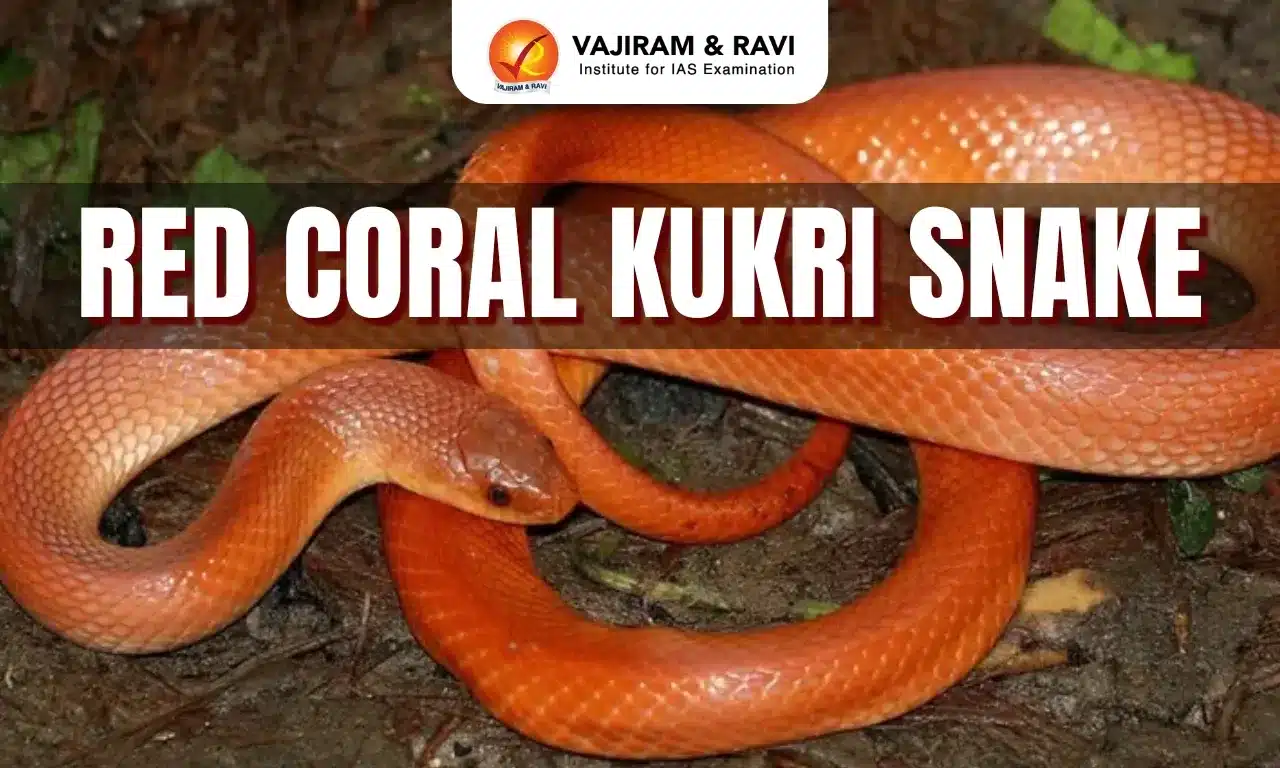
Recently, a rare Red Coral Kukri Snake species, last reported in 1936, was recently found trapped in a net in a village field near Pilibhit Tiger Reserve.

About Red Coral Kukri Snake

  • It is identified as Oligodon kheriensis. 
  • It is one of the rarest non venomous snake species.
  • This nocturnal and fossorial snake is specialized with curved teeth like kukri (Nepalian Knife). Hence, they are called “Kukri”.
  • Appearance: Its whole body including the head is uniform bright coral-red without any patterns and the underside is yellowish or pinkish hence it is one of the most distinct snakes of its range.
  • Its head is short, not broader than the neck and bears an obtusely pointed snout.
  • Distribution: It is widely distributed in lowlands (below 1500ft) of Himalayan foothills from Uttrakhand, Nepal, northern parts of Uttar Pradesh, Bihar and West Bengal to Sikkim and western Assam.

Conservation Status of Red Coral Kukri Snake

  • IUCN: Least Concern (LC)
  • Wild Life Protection Act: Schedule –IV

Key Facts about Pilibhit Tiger Reserve

  • It is located in the state of Uttar Pradesh.
  • It lies along the India-Nepal border in the foothills of the Himalayas and is part of the Terai Arc Landscape.
  • Rivers: The river Gomti originates from the PTR, which is also the catchment of several others like Sharda, Chuka, and Mala Khannot.
  • Habitat: The habitat is characterized by dense sal forests and tall alluvial grasslands, savannahs, and impenetrable swamps, maintained by periodic flooding from rivers. 
  • The Sharda Sagar Dam, extending up to a length of 22 km, is on the boundary of the reserve.
  • It has a dry and hot climate, which brings a combination of dry teak forest and Vindhya Mountain soils.

Source: PTI

Red Coral Kukri Snake FAQs

Q1: Is Red coral kukri snake poisonous?

Ans: It is a nocturnal non venomous reptile.

Q2: What is the study of snakes called?

Ans: The study of snakes is called Herpetology.

Doctrine of Escheat

Doctrine of Escheat

Doctrine of Escheat Latest News

The Supreme Court recently held that a State Government cannot invoke the doctrine of escheat under Section 29 of the Hindu Succession Act once a Hindu male has executed a Will, which has been declared to be valid and has been granted probate by a Court.

About Doctrine of Escheat

  • It is a significant legal concept that ensures no property is left without ownership, reverting it to the state if the original owner dies without legal heirs or fails to make a will. 
  • This legal process addresses the handling of unclaimed assets, protecting societal interests and maintaining order within the legal framework.
  • The doctrine addresses two primary situations: 
    • when a person dies intestate (without a will) and without heirs, and 
    • when property remains unclaimed or abandoned for a specific period.
  • The underlying principle of escheat is that property must always have an identifiable owner, and in the absence of heirs, the government assumes ownership. 
  • In modern legal systems, escheat serves as a way to maintain orderly succession and prevent assets from being wasted or misused.

Historical Origins of Escheat

  • Escheat originates from the Old French word “eschete,” meaning “to fall to”.
  • The concept of escheat is rooted in the feudal system of medieval Europe, where land was held by tenants under a lord.
  • If the tenant died without an heir or was convicted of certain crimes like treason, the land would escheat, or revert, to the lord. 
  • This system allowed for continuous control of land, ensuring that property remained within the hierarchy of the feudal structure. 
  • Over time, this evolved to include the monarch or the state as the ultimate recipient of property without heirs.

Escheat in Modern Legal Systems

  • In modern legal systems, escheat ensures that unclaimed or ownerless property does not remain in limbo but is transferred to the state. 
  • The state assumes ownership of such property, either permanently or temporarily, until rightful claimants can be found. 
  • Escheat laws vary across jurisdictions, with some countries having well-defined processes for handling unclaimed assets.
  • In India, escheat is regulated primarily through Section 29 of the Hindu Succession Act, 1956, and Article 296 of the Constitution. 
    • These provisions outline the circumstances under which property escheats to the state, safeguarding against unclaimed or abandoned property.
    • However, the Supreme Court made it clear that the doctrine of escheat under Section 29 of the Hindu Succession Act, 1956, is a remedy of last resort; it comes into play only when a person dies intestate and without any legal heirs.
    • Where a valid will is executed and duly probated, the property must devolve strictly in line with the testator’s intent, leaving no room for the State to assert rights over the estate.

Source: LIVELAW

Doctrine of Escheat FAQs

Q1: What does the Doctrine of Escheat primarily deal with?

Ans: Reversion of property to the state when there are no heirs or will.

Q2: The term “escheat” originates from which language?

Ans: Escheat originates from the Old French word “eschete,” meaning “to fall to”.

Q3: In modern legal systems, what is the purpose of escheat?

Ans: To ensure property always has an identifiable owner

Q4: Is the doctrine of escheat regulated in India?

Ans: In India, escheat is regulated primarily through Section 29 of the Hindu Succession Act, 1956, and Article 296 of the Constitution.

Centre for Cellular and Molecular Biology (CCMB)

Centre for Cellular and Molecular Biology

Centre for Cellular and Molecular Biology Latest News

Scientists at CSIR-Centre for Cellular and Molecular Biology (CCMB) recently discovered how white blood cells can adapt their internal skeletons to combat pathogens.

About Centre for Cellular and Molecular Biology

  • It is India’s premier research organization in frontier areas of modern biology. 
  • The objectives of the Centre are to conduct high-quality basic research and training in frontier areas of modern biology, and promote centralized national facilities for new and modern techniques in the interdisciplinary areas of biology.
  • Located in Hyderabad, Telangana, CCMB is a constituent laboratory of the Council of Scientific and Industrial Research (CSIR), a renowned national organization under the Ministry of Science and Technology, Government of India.
  • Established in 1977, CCMB has emerged as a global leader in cellular and molecular research and is known for its contributions to understanding the molecular mechanisms that govern biological systems.
  • CCMB’s work spans various disciplines of biology, including genetics, biotechnology, bioinformatics, immunology, and molecular medicine. 
  • The institution is well-regarded for its cutting-edge research in molecular biology, genomics, proteomics, and cellular mechanisms.
  • The centre’s research is both fundamental and translational, focusing on problems that have wide-ranging implications for medicine, disease management, agricultural improvement, and environmental sustainability. 
  • CCMB has state-of-the-art facilities for research, including a high-throughput genomics facility and a bioinformatics centre.
  • The institute also offers training programs and workshops for students and researchers and collaborates with national and international institutions.
  • CCMB is a designated "Center of Excellence" by the Global Molecular and Cell Biology Network, UNESCO.

Source: NIE

Centre for Cellular and Molecular Biology FAQs

Q1: Where is the Centre for Cellular and Molecular Biology (CCMB) located?

Ans: Hyderabad, Telangana

Q2: Centre for Cellular and Molecular Biology (CCMB) is a constituent laboratory of which organization?

Ans: CCMB is a constituent laboratory of the Council of Scientific and Industrial Research (CSIR).

Q3: In which year was the Centre for Cellular and Molecular Biology (CCMB) established?

Ans: 1977

Polypropylene

Polypropylene

Polypropylene Latest News

Recently, the Prime Minister of India laid the foundation stone for a polypropylene (PP) plant at Numaligarh Refinery Limited (NRL) at Golaghat in Assam.

About Polypropylene

  • It is a thermoplastic polymer produced by the addition polymerization of propylene.
  • It is a synthetic resin built up by the polymerization of propylene.
  • It is one of the important families of polyolefin resins.
  • Polypropylene is molded or extruded into many plastic products in which toughness, flexibility, light weight, and heat resistance are required.

Properties of Polypropylene

  • It is highly resistant to chemical corrosion, making it an excellent choice for packaging of cleaning products and bleaches.
  •  It is a commodity plastic with low density and high heat resistance. 
  • Flammability: PP is a highly flammable material.
  • Density: PP is one of the lightest polymers among all commodity plastics.

Application of Polypropylene

  • It is widely used in polymer materials in the plastic manufacturing industry to produce various end products, especially plastic packaging.
  • Polypropylene has high insulation properties too, making it safe to use for plastic casing in electrical goods and cables. 
  • It offers impressive chemical and biological-resistant properties and makes polypropylene an obvious choice for the medical industry.

Source: PIB

Polypropylene FAQs

Q1: What is a Polymer?

Ans: It is a substance composed of molecules with a large molecular mass of repeating structural units or monomers connected by covalent chemical bonds.

Q2: What is propylene used for?

Ans: It is used mainly in the preparation of alkylates for gasoline and in the production of polypropylene, acrylonitrile, propylene oxide.

Eustoma

Eustoma

Eustoma Latest News

Recently, the National Botanical Research Institute (NBRI), a research arm of the Council of Scientific and Industrial Research (CSIR), has achieved a breakthrough by cultivating Eustoma flower in Odisha.      

About Eustoma

  • It is commonly known as Lisianthus or Prairie Gentian or Texas Bluebell.
  • It is a perennial herbaceous ornamental species that is used as a cut flower and is among the top ten popular cut flowers globally.
  • The plant originates from the grasslands of North America.
  • Features: It is admired for its wide colour range, long vase life and suitability for cut flowers and potted plants.       
  • Because of its enormous rose‐like blossoms, long stems and extended vase life, its sales have increased dramatically in recent years, earning it the title of ‘next rose’. 
  • Habitat: It typically grows in grasslands and disturbed areas, thriving in warm climates.
  • Soil Required: Well drain, moisture-retentive soil and garden compost or well-rotted manure.
  • It is native to Mexico, southern USA, Caribbean, and northern South America.
  • It has a great cosmopolitan demand mainly for its large and attractive flowers, long and hard stem, wide range of colors.

Source: TH

Eustoma FAQs

Q1: Where is CSIR's headquarters located?

Ans: New Delhi

Q2: What are herbaceous ornamental plants?

Ans: Herbaceous ornamentals are plants that have flexible stems and die back to the ground each year.

Lake Natron

Lake Natron

Lake Natron Latest News

Recently, Tanzania's government halted a planned large-scale soda ash mining project at Lake Natron.        

About Lake Natron

  • Location: It is a salt lake located on the border between Tanzania and Kenya.
  • It is part of the eastern branch of the Great Rift Valley.
  • It has a unique composition of warm waters and salt, caustic soda, and magnesite deposits that provide ideal conditions for flamingos to thrive.
  • It was designated as a Ramsar Site of International Importance in 2001.
  • Primarily, the lake is fed by the Ewaso Ng’iro River, which originates from the central region of Kenya.
  • One of the most striking features of this Lake is its striking red coloration. The primary reason for its hue lies in its extreme alkalinity.
  • It is the only reliable breeding ground for Lesser Flamingos in Africa, supporting up to 75 per cent of the world’s population. 
  • Lesser flamingos feed on Lake Natron with Shompole volcano (situated on the border of Kenya and Tanzania) in the distance at the northern end of the lake.
  • Threats: Several factors, including agriculture, pollution, and climate change, are threatening the beauty of this unique ecosystem.

Source: DTE

Lake Natron FAQs

Q1: Is Lake Natron a Ramsar site?

Ans: Lake Natron was designated as a Ramsar Site.

Q2: Which river drains into Lake Natron?

Ans: Southern Ewaso Ng'iro

Nankana Sahib

Nankana Sahib

Nankana Sahib Latest News

Political parties and Sikh bodies recently urged the Centre to reconsider its decision asking State governments not to process applications for pilgrimage to Nankana Sahib in Pakistan on the occasion of the birth anniversary of Guru Nanak Dev.

About Nankana Sahib

  • It is a city located in the Punjab province of Pakistan, which is historically significant to the Sikh community.
  • It is the birthplace of Guru Nanak, the founder of the Sikh religion.
  • Formerly known as Rai-Bhoi-Di Talwandi, Rai Bhullar Bhatti (grandson of Talwandi founder Rai Bhoi) renamed it Nankana Sahib in honor of Guru Nanak Sahib’s birth. 
  • Guru Nanak Dev Ji spent his early years in Nankana Sahib, and from here began his divine calling and spiritual journey.
  • It is where Gurdwara Janam Asthan (also called Nankana Sahib Gurdwara) is located.
    • The shrine is built over the site where Guru Nanak was believed to be born in 1469.
    • It was constructed by Maharaja Ranjit Singh after he visited Nankana Sahib in 1818-19 while returning from the Battle of Multan.
  • Besides Gurdwara Janam Asthan, Nankana Sahib has several important shrines, including Gurdwara Patti Sahib, Gurdwara Bal Leela, Gurdwara Mal Ji Sahib, Gurdwara Kiara Sahib, and Gurdwara Tambu Sahib—all dedicated to stages in the life of the first Guru.
  • There is also a Gurdwara in memory of Guru Arjan (5th Guru) and Guru Hargobind (6th Guru). Guru Hargobind is believed to have paid homage to the town in 1621-22.

Source: TH

Nankana Sahib FAQs

Q1: Where is Nankana Sahib located?

Ans: It is a city located in the Punjab province of Pakistan.

Q2: What is the significance of Nankana Sahib?

Ans: It is the birthplace of Guru Nanak, the founder of the Sikh religion.

Q3: What is the old name of Nankana Sahib?

Ans: Rai-Bhoi-Di Talwand

Q4: Who constructed the Gurdwara Janam Asthan at Nankana Sahib?

Ans: Maharaja Ranjit Singh

Enquire Now