Iridogorgia Chewbacca

Iridogorgia Chewbacca

Iridogorgia Chewbacca Latest News

Scientists have discovered a unique deep-sea coral and given it the name Iridogorgia Chewbacca.

About Iridogorgia Chewbacca

  • It is a new deep-sea coral species belonging to genus Iridogorgia.
  • The coral was discovered in the tropical western Pacific Ocean.
  • The new coral was first seen in waters off Molokaʻi in 2006 and later near the Mariana Trench in 2016.
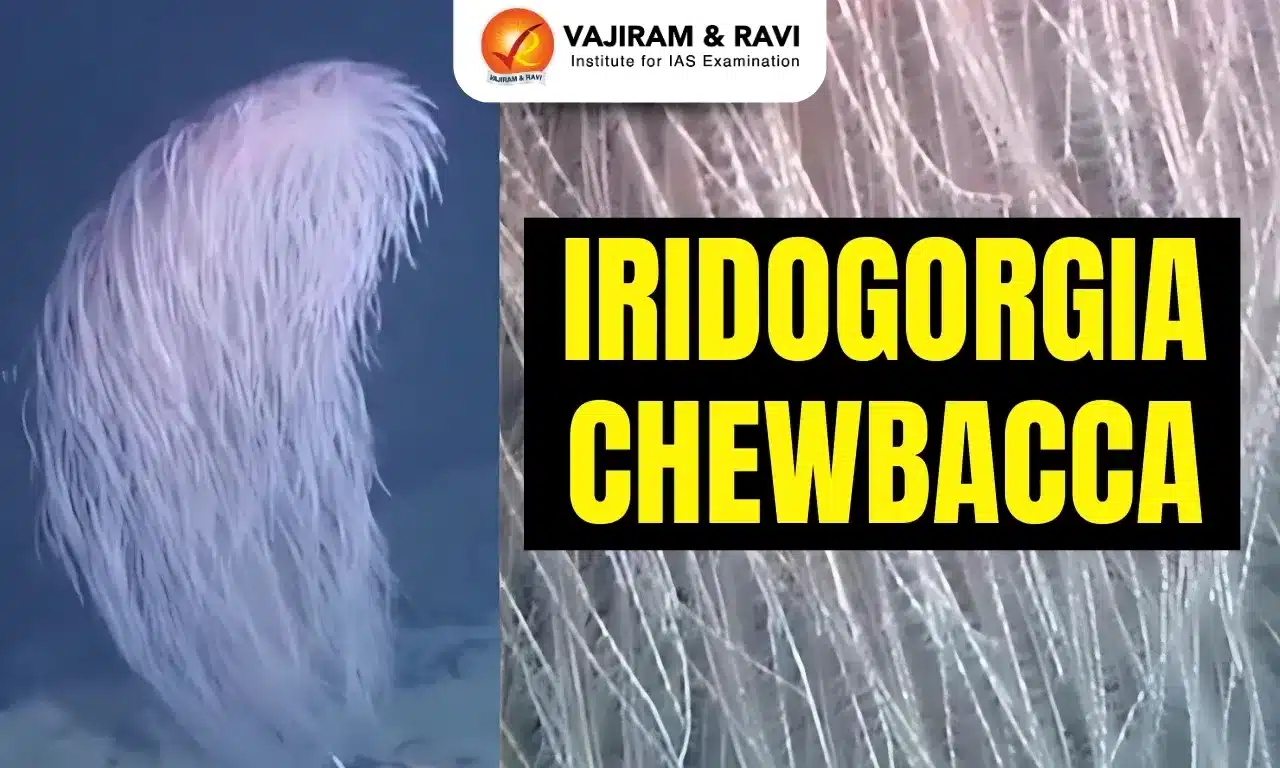
  • It is named after the furry Star Wars fictional character Chewbacca because of its hairy-looking branches.

Features of Iridogorgia Chewbacca

  • The species belongs to the genus Iridogorgia, a group of deep-sea corals with long, spiraling structures.
  • It is known for its long, flexible branches and shiny surface.
  • Each coral colony is made up of thousands of tiny polyps, which work together to form the larger structure.
  • Despite its large size and striking appearance, I. chewbacca usually occurs alone, scattered across deep-sea rocky bottoms.

What is a Coral?

  • Corals are essentially animals, which are sessile, meaning they permanently attach themselves to the ocean floor.
  • Corals share a symbiotic relationship with single-celled algae called zooxanthellae.
  • The algae provide the coral with food and nutrients, which they make through photosynthesis, using the sun’s light.
  • They use their tiny tentacle-like hands to catch food from the water and sweep into their mouth.
  • Each individual coral animal is known as a polyp and it lives in groups of hundreds to thousands of genetically identical polyps that form a ‘colony’.

Source: HT

Iridogorgia Chewbacca FAQs

Q1: What is a coral?

Ans: Corals are colonial marine invertebrates within the subphylum Anthozoa of the phylum Cnidaria.

Q2: What is symbiosis?

Ans: Symbiosis is defined as a close, prolonged association between two or more different biological species.

Industrial Park Rating System 3.0

Industrial Park Rating System 3.0

Industrial Park Rating System 3.0 Latest News

Recently, the Union Minister of Commerce and Industry launched the Industrial Park Rating System (IPRS) 3.0 in New Delhi.

About Industrial Park Rating System 3.0

  • It is developed by the Department for Promotion of Industry and Internal Trade (DPIIT) with support from the Asian Development Bank (ADB).
  • It aims to further strengthen India’s industrial ecosystem and enhance the competitiveness of industrial infrastructure.
  • Previous IPRS: It was started in 2018 and again IPRS 2.0 was launched in 2021.

Features of Industrial Park Rating System 3.0

  • It will help assess and benchmark facilities, infrastructure, and competitiveness of industrial parks across the country.
  • The initiative will provide stakeholders with reliable data, encourage best practices, and support the creation of world-class infrastructure.
  • It introduced an expanded framework with new parameters, including sustainability, green infrastructure, logistics connectivity, digitalization, skill linkages, and enhanced tenant feedback.
  • Under IPRS 3.0, industrial parks will be benchmarked and categorized as Leaders, Challengers, and Aspirers based on their performance across key indicators.

Significance of Industrial Park Rating System 3.0

  • It will provide investors with transparent and credible information, foster healthy competition among States and Union Territories, and guide policymakers in designing targeted interventions.
  • For States and UTs, it offers an opportunity to showcase best-performing parks, identify gaps for improvement, attract investments, generate employment, and strengthen their industrial ecosystem.

Source: PIB

Industrial Park Rating System 3.0 FAQs

Q1: What is the purpose of the Asian Development Bank?

Ans: It is dedicated to reducing poverty in Asia and the Pacific through inclusive economic growth, environmentally sustainable growth, and regional integration.

Q2: What is meant by industrial park?

Ans: An industrial park, also known as industrial estate or trading estate, is an area zoned and planned for the purpose of industrial development.

Achanakmar Tiger Reserve

Achanakmar Tiger Reserve

Achanakmar Tiger Reserve Latest News

According to officials, a tigress named Jhumri helped in reviving the tiger population in Achanakmar Tiger Reserve (ATR).

About Achanakmar Tiger Reserve

  • Location: It is situated in Bilaspur district of Chhattisgarh. 
  • Achanakmar Wildlife Sanctuary was established in 1975 and was declared a tiger reserve in 2009. 
  • It is part of the huge Achanakmar - Amarkantak Biosphere Reserve.
  • It is one of three tiger reserves in Chhattisgarh. It plays a crucial role in the tiger corridor network, vital for the movement of wildlife.
  • It has a corridor connecting Kanha and Bandhavgarh Tiger Reserve and plays a critical role in the dispersal of tigers among these reserves.
  • River: The Maniyari River flows right from the centre of this reserve, which is the forest’s lifeline.
  • Tribe: It is home to the Baigas, (Particularly Vulnerable Tribal Group), Gond and Yadav communities residing inside of this tiger reserve.
  • Vegetation: Tropical moist deciduous vegetation covers the majority of the area.
  • Flora: Sal, bija, saja, haldu, teak, tinsa, dhawara, lendia, khamar, and bamboo bloom here, along with over 600 species of medicinal plants.
  • Fauna: It includes the tiger, leopard, bison, flying squirrel, Indian giant squirrel, chinkara, wild dog, hyena, sambar, chital, and over 150 species of birds.

Source: IE

Achanakmar Tiger Reserve FAQs

Q1: Which river flows through Achanakmar Tiger Reserve?

Ans: Maniyari River

Q2: Where is Achanakmar Tiger Reserve situated?

Ans: Chhattisgarh

Red-Necked Phalarope

Red-Necked Phalarope

Red-Necked Phalarope Latest News

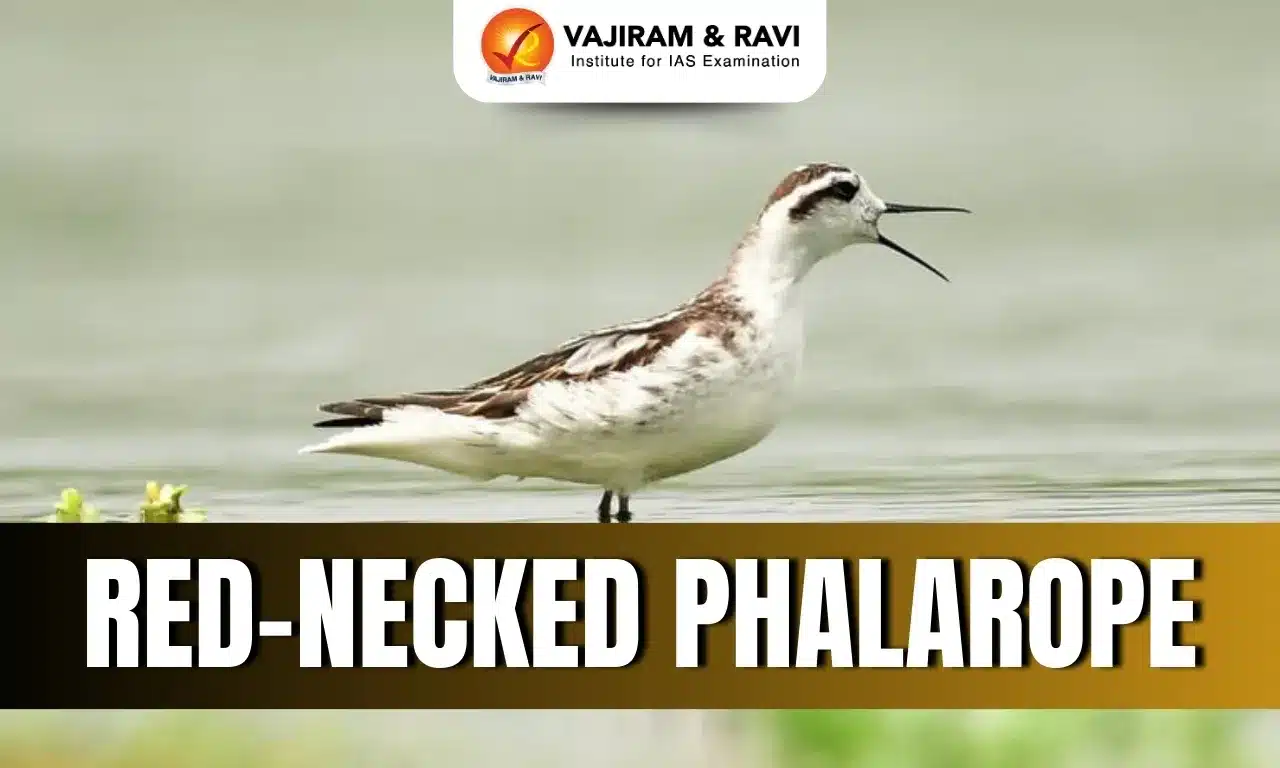
Recently, Red-necked Phalarope (Phalaropus lobatus), a rare species, has been spotted at the Nanjarayan bird for the first time.

About Red-Necked Phalarope

  • It is a fairly small shorebird known for spinning frantically on water to stir up small invertebrates.
  • Distribution: It has a circumpolar distribution and is found in both boreal and tundra zones between 60 and 70 degrees latitude.
  • These phalaropes can be found in coastal regions of the Arctic Ocean, south to the Aleutians and Northwest to Britain.
  • In the winter, it spends most of its time on the ocean.
  • During this non-breeding season, phalaropes can be found off central-west South America, in the Arabian Sea and from central Indonesia to western Melanesia.

Appearance and Behavior of Red-necked Phalarope

  • Food: The bird mainly feeds on small aquatic invertebrates and plankton.
  • It exhibits a typical feeding behavior of spinning on the surface of water. This rapid circling is believed to bring the prey to its feeding range.
  • During the breeding period, the species have a chestnut-red plumage from behind the ear to the down sides of the neck.
  • Females are observed polyandrous, that is mating with more than one male.
  • The males brood chicks and feed them.
  • Conservation status: IUCN: Least concern

Source: TH

Red-necked Phalarope FAQs

Q1: What is the red-necked phalarope habitat?

Ans: It mainly inhibits in Arctic and Subarctic tundra and tundra-transition vegetation near freshwater lakes, pools, bogs, marshes, and streams.

Q2: What is distinctive about the Red-necked Phalarope's breeding habits?

Ans: Males build nests and incubate eggs

Dada Saheb Phalke Award

Dada Saheb Phalke Award

Dada Saheb Phalke Award Latest News

Recently, the Government of India announced that Shri. Mohanlal will be conferred with the prestigious Dadasaheb Phalke Award for the year 2023.

About Dada Saheb Phalke Award

  • It is given by the Indian government for lifetime contribution to Indian cinema.
  • It was instituted in 1969 the birth centenary year of Dadasaheb Phalke.
  • It is the highest award in the field of cinema in India.
  • It was introduced by the Government of India to commemorate Dadasaheb Phalke's contribution to Indian cinema.
  • The award's inaugural recipient was Devika Rani, aptly titled "the first lady of Indian cinema".
  • The recipients are recognized for their ‘outstanding contribution to the growth and development of Indian cinema’.
  • Award includes: The award comprises a Swarna Kamal (Golden Lotus) medallion, a shawl, and a cash prize of ₹10 lakh.
  • It is presented by the President of India. 

Key Facts about Dhundiraj Govind Phalke

  • He was born on April 30, 1870, in Trimbak, Maharashtra.
  • Phalke was a multifaceted genius — a painter, photographer, stage playwright, and a magician — before venturing into filmmaking.
  • He was a film director who is considered the father of Indian cinema. 
  • He directed India's first full-length feature film, Raja Harishchandra in 1913.

Source: PIB

Dadasaheb Phalke Award FAQs

Q1: Who was the first winner of Dadasaheb Award?

Ans: Devika Rani

Q2: What was the most famous film of Dadasaheb Phalke?

Ans: Devika Rani

Exercise Amogh Fury

Exercise Amogh Fury

Exercise Amogh Fury Latest News

Indian Army recently conducted a major integrated firepower exercise, codenamed 'AMOGH FURY', at the Mahajan Field Firing Ranges in Rajasthan’s Thar desert.

About Exercise Amogh Fury

  • It is an Integrated Fire Power Exercise conducted by the Sapta Shakti Command of the Indian Army.
  • Location: Mahajan Field Firing Ranges in Rajasthan’s Thar Desert. 
  • The drill aimed to test combat power, coordination, and operational readiness in real-time battle scenarios, reflecting the force’s preparedness for multi-domain operations. 
  • The exercise featured coordinated manoeuvres involving battle tanks, infantry combat vehicles, attack helicopters, long-range artillery, and drones. 
  • These platforms were deployed together to demonstrate the Army’s ability to synchronise ground and air assets for effective offensive and defensive actions.
  • A key focus of 'Amogh Fury' was the integration of modern technologies, including network-centric communication, command-and-control architecture, and real-time surveillance and targeting systems. 
  • These capabilities enabled the creation of a unified operational picture, enhancing decision-making and coordination across units.
  • The drill provided pragmatic training for all ranks under realistic combat conditions while refining procedures to counter emerging threats.

Source: IT

Exercise Amogh Fury FAQs

Q1: What is Exercise Amogh Fury?

Ans: It is an Integrated Fire Power Exercise.

Q2: Which Indian Army Command organised Exercise Amogh Fury?

Ans: It was conducted by the Sapta Shakti Command of the Indian Army.

Q3: Where was Exercise Amogh Fury conducted?

Ans: Mahajan Field Firing Ranges in Rajasthan’s Thar Desert.

Papikonda National Park

Papikonda National Park

Papikonda National Park Latest News

A recent study has documented 51 species of herpetofauna in Papikonda National Park.

About Papikonda National Park

  • It is located in the East Godavari and West Godavari Districts of Andhra Pradesh.
  • Established in 2008, the park covers an area of approximately 1,012.86 sq.km.
  • It lies along the banks of the Godavari River, encompassing a rugged landscape with steep slopes, hills, and deep valleys. 
  • The geology of the park is characterized by the Eastern Ghats range.
  • There are 62 named mountains in the park. Devara Konda is the highest point. The most prominent mountain is Verala Konda.
  • The national park has been recognized as an Important Bird and Biodiversity Area by BirdLife International.
  • The area plays a key role in high precipitation and the consequent origin of various small streams and rivulets which drain and enrich the perennial River Godavari.
  • A unique dwarf breed of goat known locally as the “kanchu mekha” originates in this region.
  • Vegetation: The park is characterized by tropical, moist deciduous forests mixed with patches of semi-evergreen and dry deciduous forests.
  • Flora: The park is home to several types of trees, including teak, rosewood, sandalwood, bamboo, eucalyptus, sal, mahua, pterocarpus, terminalia, and cassia.
  • Fauna
    • Wildlife in Papikonda includes Bengal tiger, Indian leopard, sloth bear, and Indian wild dog (dhole). 
    • The park is also home to various deer species, including sambar and spotted deer.

Source: NIE

Papikonda National Park FAQs

Q1: In which state is Papikonda National Park located?

Ans: Andhra Pradesh

Q2: Which river passes through Papikonda National Park?

Ans: Godavari River flows through the park.

Q3: Which mountain is the highest point in Papikonda National Park?

Ans: Devara Konda

New Austrian Tunnelling Method (NATM)

New Austrian Tunnelling Method

New Austrian Tunnelling Method Latest News

The Mumbai-Ahmedabad bullet train project recently achieved a 4.88 km tunnel breakthrough under Thane Creek using NATM (New Austrian tunnelling method), marking major progress in excavation.

About New Austrian Tunnelling Method 

  • It was developed between 1957 and 1965 in Austria.
  • The main idea is to use the geological stress of the surrounding rock mass to stabilize the tunnel itself.
  • It is both a construction method and a design philosophy.
  • The philosophy looks to use the strength of the surrounding soil to the greatest extent possible to strengthen the tunnel structure.
  • In other words, ground conditions drive the tunneling operation. 
  • The NATM philosophy also promotes constant monitoring.
  • The NATM construction method is about flexibilitydrilling and designing depending on the results of the ongoing monitoring. 
  • The operation occurs sequentially to take most advantage of the ground conditions. 
  • Additionally, NATM installs ground support on the go and on an as-needed basis, adding reinforcement to the shotcrete where necessary.
  • NATM is best suited for short-range (> 2 km) tunnels in regions with variable soil conditions.

Key Facts about Thane Creek

  • It is one of the largest creeks in Asia and is located partly on the coast of the Mumbai metropolis. 
  • It is an inlet along the shoreline of the Arabian Sea that isolates the city of Mumbai from the Indian mainland.
  • The east bank lies in the Thane and Navi Mumbai districts, while the west bank is in the Greater Mumbai district. 
  • The creek runs about 26 km north from Mumbai harbour before it joins the Ulhas river through a small channel.
  • There are several sources of fresh water for the creek, of which Ulhas river is the largest, followed by numerous drainage channels from various suburban areas of Mumbai, Navi Mumbai, and Thane, making the water brackish. 
  • The site is a mixture of saltpans as well as stretches of mangroves.
  • Thane Creek is a very important wintering ground for waterbirds. It supports over 1,00,000 birds during winter, including the iconic flamingos.
  • A major part of the creek has been declared a bird sanctuary called Thane Creek Flamingo Bird Sanctuary (TCFS).
  • It was designated as a Ramsar site, a wetland of international significance, in 2022.

Source: TIMES

New Austrian Tunnelling Method FAQs

Q1: What is the key principle of the New Austrian Tunneling Method (NATM)?

Ans: To use geological stress of the surrounding rock mass to stabilize the tunnel itself.

Q2: New Austrian Tunneling Method (NATM) is best suited for which type of tunnels?

Ans: NATM is best suited for short-range (> 2 km) tunnels in regions with variable soil conditions.

Q3: Which Indian tunnel was the first to use the New Austrian Tunneling Method?

Ans: The Pir Panjal Railway Tunnel was the first major project in India to employ the New Austrian Tunneling Method (NATM) for construction.

Striped Dolphin

Striped Dolphin

Striped Dolphin Latest News

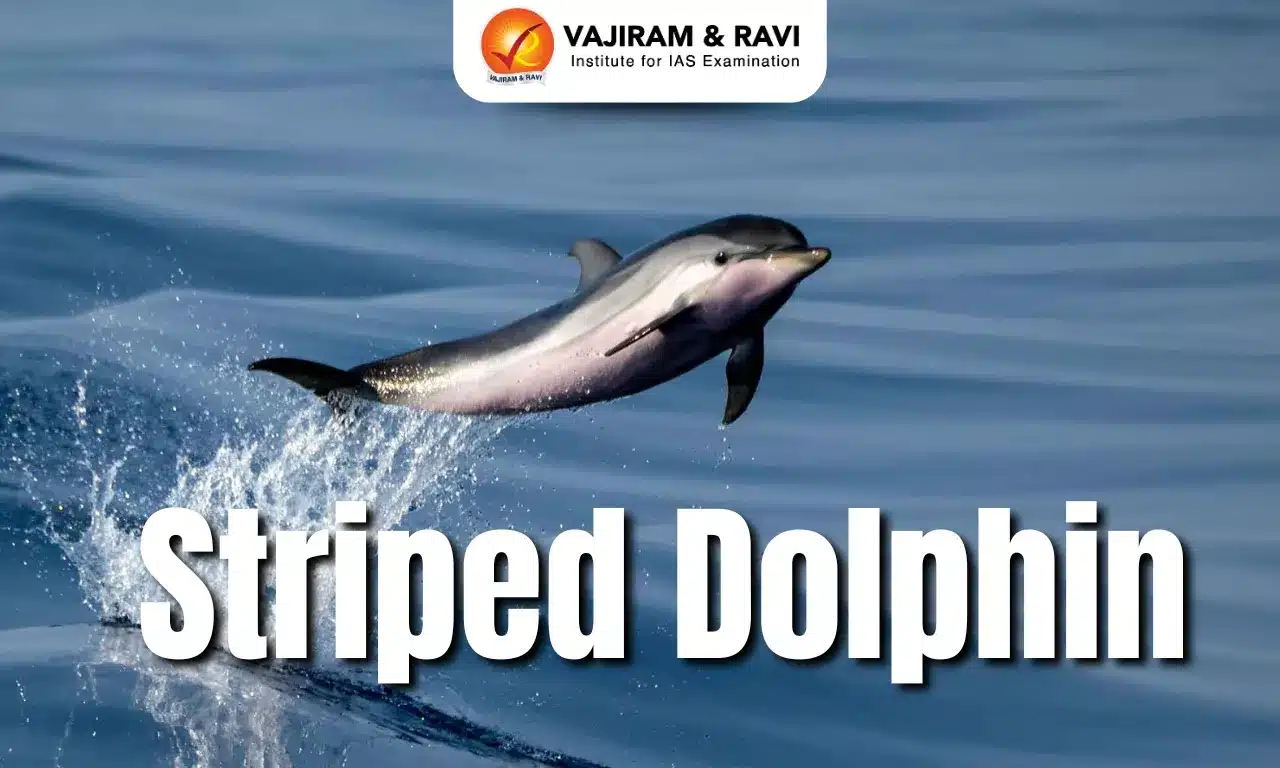
A pod of striped dolphins, uncommon in Andhra waters, was recently spotted off the coast of Visakhapatnam.

About Striped Dolphin

  • The striped dolphin is a streamlined oceanic dolphin, similar in shape and size to the common dolphin.
  • Scientific Name: Stenella coeruleoalba
  • They are among the most abundant and widespread dolphins in the world. 

Striped Dolphin Distribution

  • It is found in temperate and tropical waters of all the world's oceans. 
  • Their range includes waters off Greenland, northern Europe (United Kingdom, Denmark), the Mediterranean Sea, Japan, Argentina, South Africa, western Australia, and New Zealand.

Striped Dolphin Habitat

  • They tend to prefer deeper, more offshore waters and can be found in oceanic waters over the continental shelves.
  • They are attracted to upwelling areas, where deep, cold, nutrient-rich water rises toward the surface, and convergence zones, where ocean currents meet.

Striped Dolphin Features

  • The striped dolphin reaches 2.5-2.6 m (averaging around 2.2-2.3 m) in length, the males being slightly larger.
  • They a long, defined rostrum and round forehead (known as a melon). 
  • Their dorsal fin is hooked, tall, and located mid-back.
  • As the name suggests, the most recognisable features are the ‘stripes’. A dark grey stripe runs from the beak, above the eye, across the flank, and then down to the underside of the body. A second stripe runs below the eye to the pectoral flipper.
  • Above these stripes, the dolphin's flanks are coloured light blue or grey. All appendages are black, as well. The underside is blue, white, or pink. 
  • They are usually found in tight, cohesive groups of about 25 to 100 individuals and have been observed breaching, jumping, and leaping over 20 feet above the surface of the water. 
  • They display a unique behavior called roto-tailing, when the animal leaps high out of the water and vigorously rotates its tail while airborne.
  • The estimated lifespan of striped dolphins is up to 58 years. 

Striped Dolphin Conservation Status

It is classified as 'Least Concern' under the IUCN Red List.

Source: NIE

Striped Dolphin FAQs

Q1: The striped dolphin is primarily found in which type of waters?

Ans: They tend to prefer deeper, more offshore waters and can be found in oceanic waters over the continental shelves.

Q2: Which oceans/regions are included in the range of striped dolphins?

Ans: It is found in temperate and tropical waters of all the world's oceans.

Q3: What is the estimated lifespan of striped dolphins?

Ans: Up to 58 years

Q4: What is the IUCN Red List status of the striped dolphin?

Ans: Least Concern

One-In, One-Out Scheme

One-In, One-Out Scheme

One-In, One-Out Scheme Latest News

An Indian man has become the first to be deported from the UK under the new "one-in, one-out" migration deal with France, which swaps illegal arrivals for approved asylum seekers.

About One-In, One-Out Scheme

  • It is a migration agreement between the UK and France.
  • The deal is aimed at deterring migrants from making dangerous trips across the English Channel from France to the UK in small boats.
    • Many migrants without visas or permits departing France by sea attempt to cross to the UK in small, inflatable boats. 
    • They frequently pay large sums of money to gangs who arrange the boats in northern France. 
    • Journeys can be incredibly dangerous, and people have died making the crossing.
  • Under the new agreement, France will agree to take back asylum seekers who have crossed over to the UK and who cannot prove a family connection to the UK. 
  • For each migrant France takes back, the UK will grant asylum to one migrant from France who can prove a family connection to the UK and who have not previously attempted to enter the country illegally.
  • The plan will start as a pilot, with initial reports suggesting the UK could return up to 50 people per week (2,600 per year). 
    • That is roughly 6% of small boat arrivals in 2024
    • The remaining arrivals will continue to be processed under the UK’s existing system.

Source: LIMINT


One-In, One-Out Scheme FAQs

Q1: The One-In, One-Out Scheme is a migration agreement between which two countries?

Ans: It is a migration agreement between the UK and France.

Q2: What is the objective of One-In, One-Out Scheme?

Ans: It is aimed at deterring migrants from making dangerous trips across the English Channel from France to the UK in small boats.

Q3: Under the One-In, One-Out Scheme, France will take back which category of migrants?

Ans: Asylum seekers in the UK who cannot prove a family connection to the UK.

Q4: Which dangerous route is directly targeted by the One-In, One-Out Scheme?

Ans: The English Channel crossing.

Enquire Now