K Visa

K Visa

K Visa Latest News

Recently, China has introduced a new visa category called the “K Visa” aimed at attracting foreign science and technology talent.

About the K Visa

  • The K Visa is a new category of Chinese visa created by revising the Regulations on the Administration of the Entry and Exit of Foreigners.
  • It comes into effect from October 1, 2025.
  • It is aimed at attracting foreign youth and professionals in STEM (Science, Technology, Engineering, Mathematics) fields.
  • Eligible applicants include graduates from renowned universities or research institutions with a bachelor’s degree or higher, as well as professionals engaged in STEM-related teaching and research.
  • Compared to existing visas, the K Visa offers:
    • Greater flexibility in entry frequency and validity period.
    • Expanded scope of activities (education, science, technology, culture, entrepreneurship, business).
    • No requirement for local enterprise sponsorship.

Source: IE

K Visa FAQs

Q1: What is the K Visa?

Ans: The K Visa is a new Chinese visa category aimed at attracting foreign STEM graduates and professionals, offering them flexible entry, wider activities, and no employer sponsorship requirement.

Q2: When will the K Visa come into effect?

Ans: The K Visa will be operational from October 1, 2025, as per the revised Chinese immigration regulations.
Sixth Schedule

Sixth Schedule

Sixth Schedule Latest News

Recently, Ladakh witnessed one of its worst episodes of violence in decades over demands for statehood and inclusion under the Sixth Schedule.

About the Sixth Schedule

  • The Sixth Schedule of the Indian Constitution is a special provision that deals with the administration of tribal areas in the Northeast.
  • It was framed on the recommendations of the Bordoloi Committee (Sub-Committee of the Constituent Assembly on the North-East Frontier (Assam) Tribal and Excluded Areas).
  • The framers recognised the distinct cultural identity and vulnerability of the tribal population in these areas and thus provided for a system of autonomous governance.
  • It came into effect along with the Constitution in 1950, under Articles 244(2) and 275(1).
  • Unlike the Fifth Schedule, which applies to other tribal areas of India, the Sixth Schedule provides greater autonomy through elected Autonomous Councils with legislative, judicial, and financial powers.
  • These provisions are unique to the four Northeastern states of Assam, Meghalaya, Tripura, and Mizoram.

 Provisions under the Sixth Schedule

  • Article 244(2): Applies Sixth Schedule provisions to tribal areas of Assam, Meghalaya, Tripura, and Mizoram.
  • Autonomous Districts & Regions: Tribal areas are administered as Autonomous Districts, which may be subdivided into Autonomous Regions by the Governor.
  • Governor’s Powers: Can reorganise districts, alter boundaries, and rename autonomous areas.
  • District & Regional Councils: Each Autonomous District has a District Council (up to 30 members, 4 nominated by the Governor, others elected by adult suffrage).
    • Regional Councils created for distinct tribal groups.
  • Law-making Powers: Councils can legislate on land, forests (except reserved forests), inheritance, customary laws, and money-lending/trading by outsiders.
    • All such laws require the Governor’s assent.
  • Administration of Justice: Councils can establish Village and District Council Courts for disputes where both parties are tribals.
    • Jurisdiction excludes serious crimes (punishable with death or imprisonment for over 5 years).
  • Revenue & Resource Control: Councils can levy taxes, collect land revenue, and regulate mineral extraction.
  • Local Administration: Councils manage primary schools, dispensaries, markets, roads, fisheries, transport, and waterways.
  • Parliament/State Laws: Apply only with exceptions or modifications in these areas.
  • Governor’s Commission: Can review and report on the administration of autonomous regions. 

Source: IE

Sixth Schedule FAQs

Q1: What is the Sixth Schedule of the Constitution?

Ans: It is a set of provisions under Article 244(2) that provides for autonomous governance of tribal areas in Assam, Meghalaya, Tripura, and Mizoram.

Q2: Why was the Sixth Schedule introduced?

Ans: To protect tribal land, culture, and rights in the Northeast and to allow self-governance through Autonomous District and Regional Councils.

Q3: Can the Sixth Schedule be extended to other regions like Ladakh?

Ans: Yes, Parliament can amend the Constitution to include other areas. Currently, there are growing demands to extend the Sixth Schedule to Ladakh to safeguard tribal rights.

Capacity Building and Human Resource Development Scheme

capacity building and human resource development scheme

Capacity Building and Human Resource Development Scheme Latest News

Recently, the union cabinet has approved the Department of Scientific and Industrial Research / Council of Scientific and Industrial Research (DSIR/CSIR) Scheme on “Capacity Building and Human Resource Development” for the period of the Fifteenth Finance Commission Cycle 2021-22 to 2025-26.

About Capacity Building and Human Resource Development Scheme

  • It is implemented by the Council of Scientific and Industrial Research (CSIR).
  • It will cover all R&D institutions, national laboratories, Institutes of National Importance, Institutes of Eminence, and Universities across the country.
  • It provides a wide platform for young, enthusiastic researchers aspiring to build careers in universities, industry, national R&D laboratories, and academic institutions.
  • It is guided by eminent scientists and professors and will foster growth in Science, Technology & Engineering, Medical, and Mathematical Sciences (STEMM).
  • It has four sub-schemes such as
    • Doctoral and Postdoctoral Fellowships
    • The Extramural Research Scheme, the Emeritus Scientist Scheme, and the Bhatnagar Fellowship programme
    • Promotion and Recognition of Excellence through the Award Scheme; and
    • Promoting knowledge sharing through the Travel and Symposia Grant Scheme
  • Significance: It plays an important role in the achievement of the Sustainable Development Goals (SDGs) for the S&T sector in India by increasing the researchers per million population.

Source: PIB

Capacity Building and Human Resource Development Scheme FAQs

Q1: What is Council of Scientific and Industrial Research (CSIR)?

Ans: It is a premier research and development (R&D) organization in India which was established in 1942.

Q2: What is the objective of Bhatnagar Fellowship?

Ans: It is to recognize and enable outstanding scientists to pursue excellence in scientific research and innovative technology development.

Apterichtus kanniyakumari

Apterichtus kanniyakumari

Apterichtus kanniyakumari Latest News

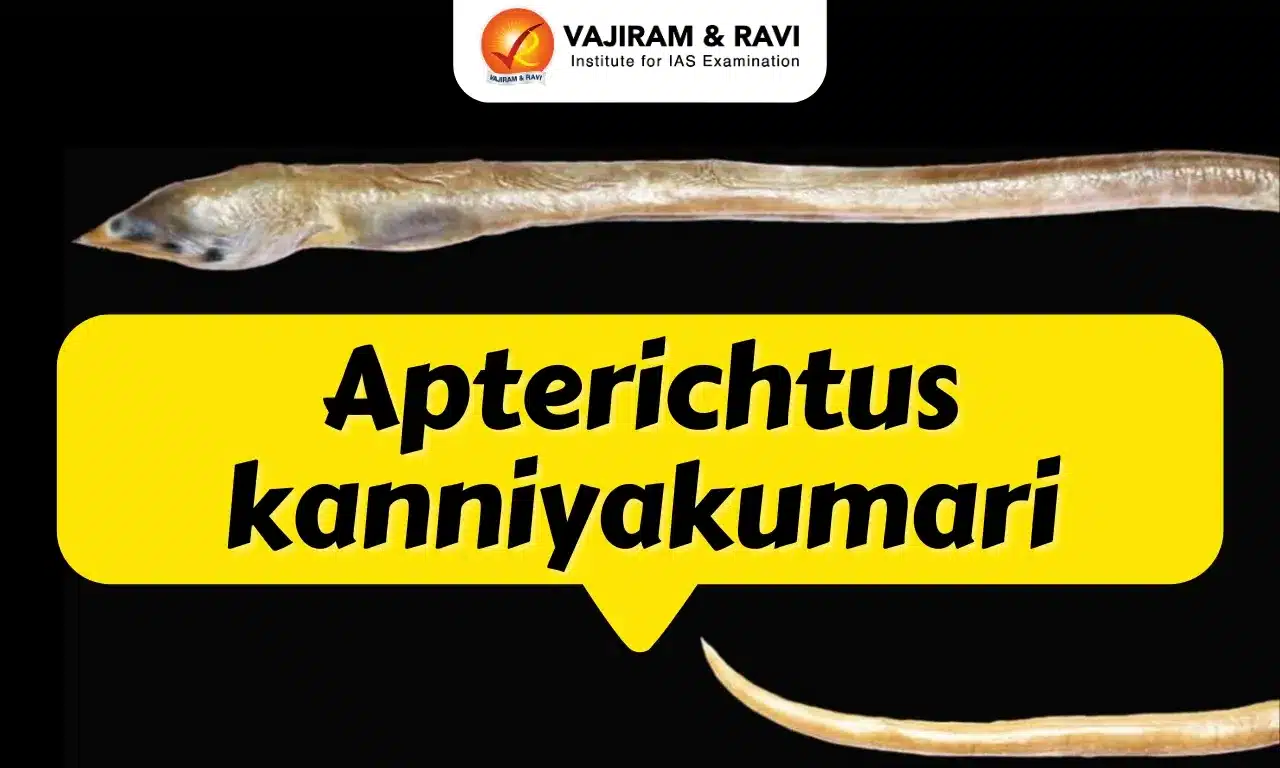
Researchers from National Bureau of Fish Genetic Resources (NBFGR) have discovered a new species of finless snake eel and named it after Kanniyakumari as Apterichtus kanniyakumari. 

About Apterichtus kanniyakumari

  • It is a species of finless snake eel belonging to the genus Apterichtus was discovered off the Colachel coast. 

Features of Apterichtus kanniyakumari

  • It has distinct golden-yellow body colouration, ventral side of head pale white with yellow lines along the lower jaw.
  • It consists of three black blotches including one behind the eyes followed by one in rictus and another behind the origin of rictus.
  • Molecular analysis based on mitochondrial CO1 gene exhibits that this new species forms a distinct clade with its sympatric species, Apterichtus nanjilnaduensis.

Key Facts about Snake eels

  • Snake eels are members of the family Ophichthidae, and are named for their snake-like appearance
  • Distribution: They are found in both tropical and temperate waters in oceans around the world.
  • Habitat: These eels mainly live in sandy areas in shallow seas, however some live in depths to 800m.
  • The snake eel uses its tail to burrow backward into the sea bottom, creating a protective burrow.

Source: TH

Apterichtus kanniyakumari FAQs

Q1: What is an eel?

Ans: Eels are elongated fishes, distinct from most others due to their cylindrical bodies and a continuous fin running around the tail tip.

Q2: What does the CO1 gene do?

Ans: It can be used to identify individuals belonging to the same species, as well as to distinguish between individuals from different species.

Goods and Services Tax Appellate Tribunal

Goods and Services Tax Appellate Tribunal

Goods and Services Tax Appellate Tribunal Latest News

Recently, the Union Minister for Finance and Corporate Affairs formally launched the Goods and Services Tax Appellate Tribunal (GSTAT) in New Delhi.

About Goods and Services Tax Appellate Tribunal

  • It is a statutory appellate body established under the Central Goods and Services Tax Act, 2017 (CGST Act).
  • It hears various appeals under the said Act and the respective State/UT GST Acts.
  • The Tribunal will function through a Principal Bench in New Delhi and 31 State Benches across 45 locations in India.

Composition of Goods and Services Tax Appellate Tribunal

  • It consists of the President (Head), a Judicial Member, and 2 Technical Members (one from the state and another from the Centre).
  • The state bench consists of two Judicial Members, a Technical Member (Centre) and a Technical Member (state).

Eligibility of members of Goods and Services Tax Appellate Tribunal

  • The president must be a Supreme Court judge or have served the High Court as the Chief Justice.
  • The Judicial member must be a High Court Judge or has served as an Additional District Judge or a District Judge for a period of 10 years. 
  • The Technical Member (Centre) must be an Indian Revenue Service member belonging to Group A or must be a member of All India Service with three years of experience in administering GST in the Central Government.
  • Also, the Technical Member from the Centre should have completed twenty-five years in Group A services. 
  • The Technical Member (state) must be a state government officer or All India Service officer with the rank above Additional Commissioner of Value Added Tax; also, the rank should be above the First Appellate Authority.
  • The Technical Member from the state must have completed twenty-five years in Group A Services or equivalent and three years administering GST or finance and taxation in the State Government. 
  • Age limit and Tenure: The president and judicial and technical members of GSTAT shall hold office for four years, or until he attains the age of 70 years and 67 years.
  • It is equivalent to a Civil Court for trying a case. It can pass orders, hear cases, impose penalties, and revoke or cancel registrations.

Source: PIB

Goods and Services Tax Appellate Tribunal FAQs

Q1: Where is the Principal Bench of Goods and Services Appellate Tribunal located?

Ans: New Delhi

Q2: What is the eligibility criteria for the President of Goods and Services Appellate Tribunal ?

Ans: Supreme Court judge or have served the High Court as the Chief Justice is eligible the President of Goods and Services Appellate Tribunal.

Varkala Cliff

Varkala Cliff

Varkala Cliff Latest News

Recently, UNESCO has placed the Varkala Cliff on its tentative list of World Heritage Sites. 

About Varkala Cliff

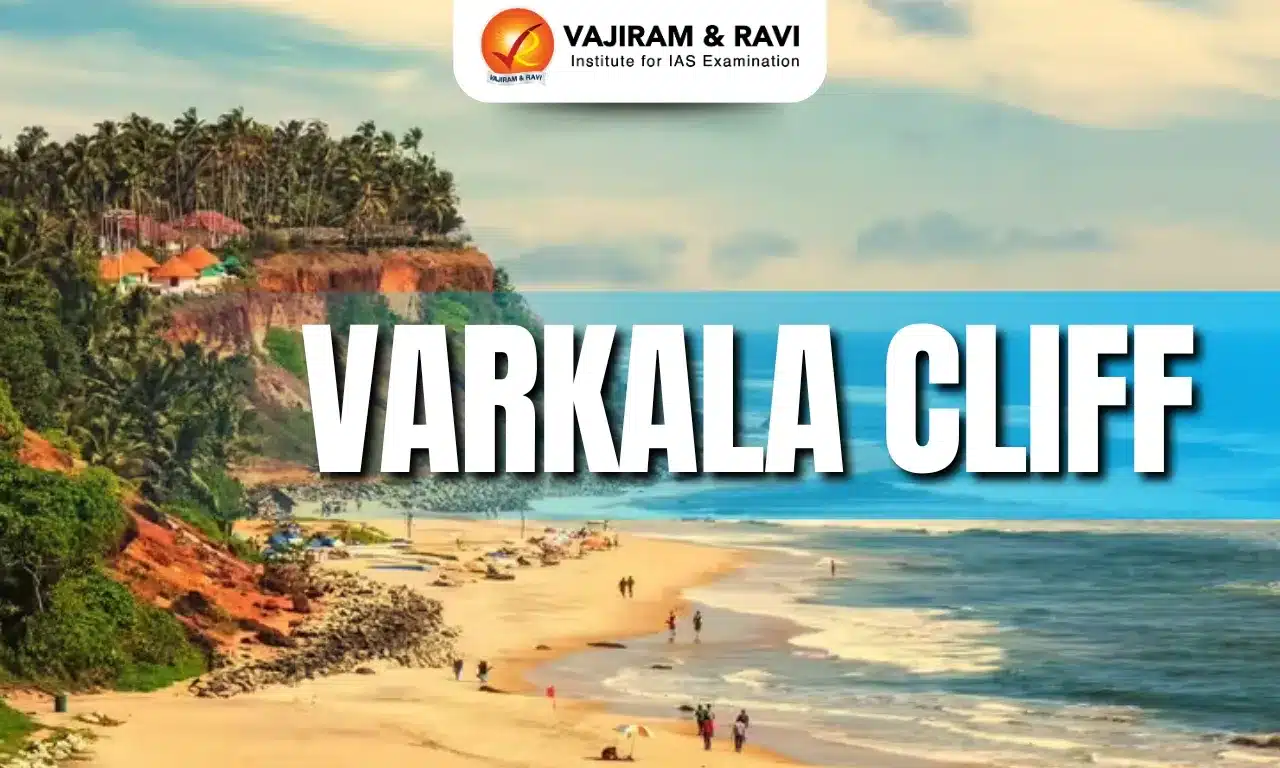
  • It is a beautiful natural formation located in Varkala, a coastal town in Thiruvananthapuram district of Kerala.
  • This cliff along Kerala’s coastline exposes the Warkalli Formation of the Mio-Pliocene age (13 lakh to 2.5 crore years ago), along with natural springs and striking erosional landforms, offering both scientific and touristic value.
  • It is locally called Sivagiri Thuruthu.
  • Its laterite and sedimentary layers hold fossils and traces of ancient climates.
  • The Papanasam Beach, located at the base of the cliff, is revered for its natural springs and believed to have therapeutic properties.
  • It is a crucial aquifer and natural water harvesting system for coastal communities, hosted unique biodiversity in its microhabitat, and supports underwater reefs essential for local fishing communities.
  • It is the 27th national geological monument in the country and the second in Kerala after the Angadipuram Laterite.

Source: DTE

Varkala Cliff FAQs

Q1: Where is Varkala Cliff located?

Ans: Kerala

Q2: What type of rock formation is Varkala Cliff?

Ans: Sedimentary

Central Water Commission

Central Water Commission

Central Water Commission (CWC) Latest News

The Central Water Commission (CWC) under the Ministry of Jal Shakti organised a virtual workshop on the theme "Technology for Efficient Water Management" as part of the Sujalam Bharat Summit (2025).

About Central Water Commission (CWC)

  • It is a Premier technical organisation in water resources under the Ministry of Jal Shakti.
  • Headquarters: New Delhi.
  • Functions:
    • It formulates & coordinates schemes for flood control, irrigation, drinking water, navigation, and hydropower.
    • It also conducts investigations, construction, and implementation of water projects.
  • Structure:
    • CWC is headed by a Chairman (Ex-Officio Secretary, GoI).
    • Three wings: Designs & Research (D&R), River Management (RM), and Water Planning & Projects (WP&P).
    • National Water Academy, Pune trains engineers from central & state agencies.

About Sujalam Bharat Summit (2025)

  • The Sujalam Bharat Summit is a national initiative led by the Ministry of Jal Shakti and coordinated by NITI Aayog, focusing on water management, sanitation, and sustainable practices.
  • It aims to bring grassroots perspectives into national policy-making, aligning with the vision of the Prime Minister.
  • A series of six Departmental Summits has been planned to gather feedback from the field on the impact and challenges of water-related policies.

Source: PIB

Central Water Commission (CWC) FAQs

Q1: What is the Central Water Commission (CWC)?

Ans: The CWC is a statutory body under the Ministry of Jal Shakti, responsible for planning, developing, and managing water resources in India, including flood control, irrigation, and hydropower projects.

Q2: Under which ministry does the CWC function?

Ans: The CWC functions under the Ministry of Jal Shakti, Government of India, formerly part of the Ministry of Water Resources.

Q3: What is the role of CWC in water management?

Ans: The CWC regulates, plans, and monitors water resources, promotes efficient water use, modern irrigation techniques, and water conservation technologies across India.

Perovskite Solar Cells

Perovskite Solar Cells

Perovskite Solar Cells Latest News

Swedish scientists at Chalmers University of Technology have used AI-enhanced simulations to solve the long-standing puzzle of halide perovskite instability.

About Perovskite Solar Cell (PSC)

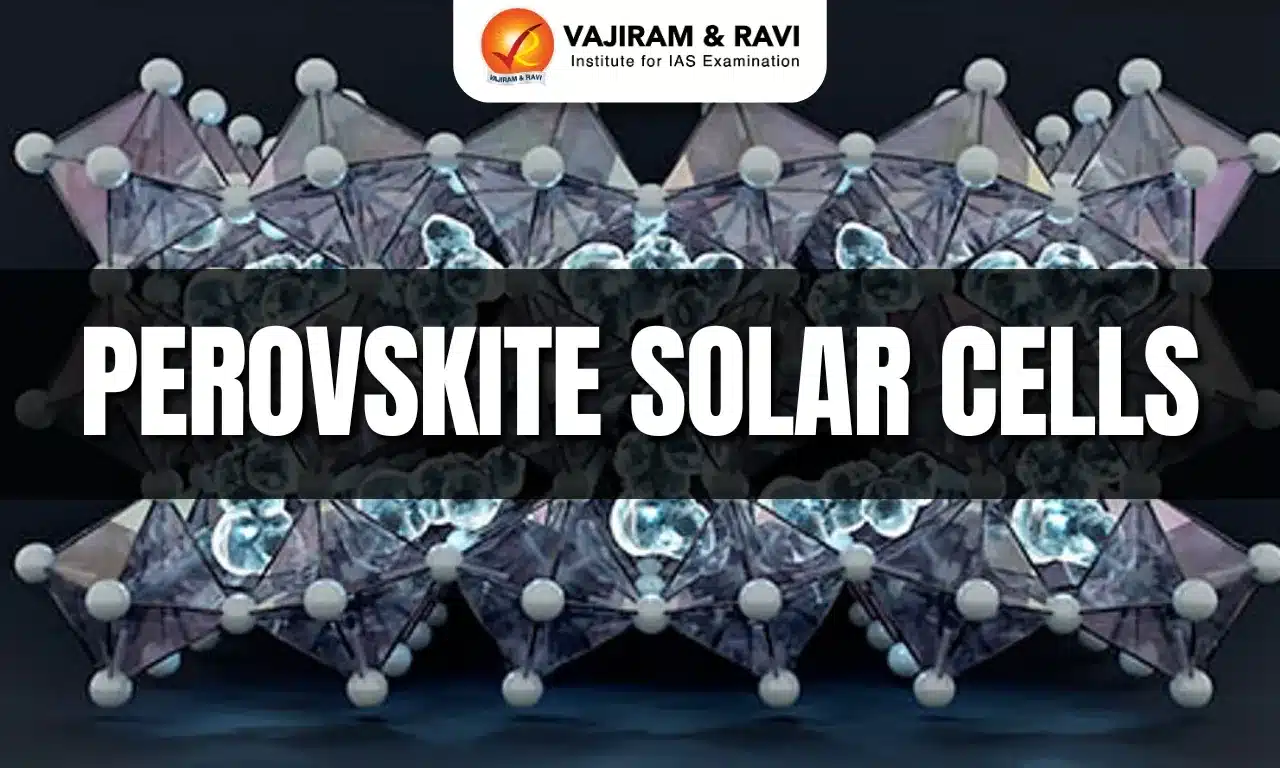
  • A Perovskite Solar Cell (PSC) is a type of thin-film photovoltaic device that uses perovskite-structured compounds (ABX₃) as the light-absorbing active layer.
  • Perovskite Material:
    • Named after the mineral calcium titanium oxide (CaTiO₃).
    • General chemical formula: ABX₃, where ‘A’ and ‘B’ are cations and ‘X’ is an anion.
    •  In solar tech, it usually refers to metal halide perovskites: hybrid organic–inorganic compounds with a metal cation (Pb²⁺, Sn²⁺), halide anion (I⁻, Br⁻, Cl⁻), and organic cation (methylammonium, formamidinium).
  • Advantages:
    • High power conversion efficiency (PCE) (over 25% in labs).
    • Thin, lightweight, and flexible → can be applied on windows, buildings, smartphones, and vehicles.
    • Low-cost fabrication compared to energy-intensive silicon processing.
    • Potential use in tandem solar cells with silicon for even higher efficiency.
  • Efficiency Potential: It is known for high light absorption, excellent charge transport, and bandgap tunability and also  achieved power conversion efficiencies (PCEs) above 25%, comparable to silicon cells.

Source: DTE

Perovskite Solar Cells FAQs

Q1: What is Perovskite?

Ans: Perovskite refers to materials with the crystal structure of calcium titanium oxide (CaTiO₃), discovered in 1839 in Russia. The general formula is ABX₃, where ‘A’ and ‘B’ are cations and ‘X’ is an anion.

Q2: What are Perovskite Solar Cells?

Ans: Perovskite Solar Cells are next-generation photovoltaic devices that use materials with a perovskite crystal structure to convert sunlight into electricity, offering higher efficiency and lower production costs than conventional silicon-based cells.

Q3: Why are Perovskite Solar Cells considered revolutionary?

Ans: They combine high power conversion efficiency, flexibility, and low production costs, making them suitable for coating surfaces like windows, rooftops, and electronic devices.

Q4: What is the main limitation of PSCs?

Ans: The biggest challenge is instability,  they degrade rapidly under moisture, heat, and sunlight exposure. Additionally, the use of toxic lead raises environmental concerns.

Central Board of Film Certification (CBFC)

Central Board of Film Certification (CBFC)

Central Board of Film Certification (CBFC) Latest News

Recently, multiple films faced heavy censorship by the CBFC over caste, mythology, and political references.

About the Central Board of Film Certification (CBFC)

  • The Central Board of Film Certification (CBFC) is a statutory body under the Ministry of Information and Broadcasting, Government of India.
  • Commonly known as the Censor Board, though it functions mainly as a certification authority.
  • It works under:
    • Cinematograph Act, 1952
    • Cinematograph (Certification) Rules, 1983
    • Guidelines issued by the Central Government

Role and Structure of CBFC

  • It regulates the public exhibition of films in India. No film can be released publicly without CBFC certification.
  • Headed by a Chairperson, with 12–25 members appointed by the Central Government.
  • It operates through nine regional offices: Mumbai, Kolkata, Chennai, Bangalore, Thiruvananthapuram, Hyderabad, New Delhi, Cuttack, and Guwahati.
  • Supported by Advisory Panels (nominated by the Government for two-year terms) to assist in film examination.

Categories of Certification

  • U (Universal): Suitable for all age groups.
  • U/A: Universal with parental guidance (below 12).
  • A: Adults only.
  • S: Restricted to special classes (e.g., doctors, farmers).
  • New Sub-Categories (2023 Amendment): UA 7+, UA 13+, UA 16+ – aligning with global best practices.

Source: IE

Central Board of Film Certification (CBFC) FAQs

Q1: What is CBFC’s primary mandate?

Ans: The CBFC certifies films for public exhibition in India, ensuring compliance with the Cinematograph Act, 1952 and safeguarding public order, decency, and morality.

Q2: Can the CBFC ban a film?

Ans: The CBFC cannot impose a blanket ban but can refuse certification if a film violates legal provisions. An outright ban is the prerogative of the Central Government

Q3: Why is CBFC often criticized?

Ans: It is criticized for arbitrary censorship, lack of transparency, and political influence. Recent controversies show inconsistency in applying rules across different films.

Enquire Now