Jal Prahar 2025

Jal Prahar 2025

Jal Prahar 2025 Latest News

The Indian Navy recently concluded the ‘Jal Prahar 2025’ joint exercise with the Indian Army to enhance amphibious operations along the eastern seaboard.

About Jal Prahar 2025

  • It is a biannual joint amphibious exercise conducted by the Indian Navy in close coordination with the Indian Army
  • The Jal Prahar 2025 showcased synergy, coordination, and interoperability between the Indian Navy and Indian Army, enhancing operational readiness, maritime security, and national defence capabilities.
  • The exercise was conducted in two phases. 
    • The Harbour Phase at Visakhapatnam focused on the induction and integration of army troops onboard INS Gharial. 
    • This included onboard training, safety briefings, orientation towards a mariner’s life, sports and interactions sessions to foster camaraderie, the release stated.
    • The Sea Phase witnessed the execution of amphibious operations, which included hard beaching at Kakinada, launching of LCAs and BMPs, and validation of SOPs and Joint Training Protocols.

Source: TH

Jal Prahar 2025 FAQs

Q1: Jal Prahar 2025 is a joint exercise between which two defence forces?

Ans: It is a biannual joint amphibious exercise conducted by the Indian Navy in close coordination with the Indian Army.

Q2: Where was the Harbour Phase of Jal Prahar 2025 held?

Ans: Visakhapatnam

Q3: Which naval ship was used for induction and integration of Army troops during Jal Prahar 2025?

Ans: INS Gharial

Q4: What was the main objective of conducting Jal Prahar 2025?

Ans: Showcasing synergy and interoperability between Army and Navy.

Yellow-tailed Ashy Skimmer

Yellow-tailed Ashy Skimmer

Yellow-tailed Ashy Skimmer Latest News

At the Yamuna Biodiversity Park, Yellow-tailed Ashy Skimmer (Potamarcha congener) has been recorded for the first time during a recent Dragonfly survey in Delhi.

About Yellow-tailed Ashy Skimmer

  • It is a species of dragonfly in the family Libellulidae.
  • Scientific Name: Potamarcha congener
  • It is one of two species in its group, called Potamarcha. The other species is Potamarcha puella.
  • It is also known as the common chaser, or swampwatcher. 
  • Distribution: It is common through much of its range, which stretches through parts of South Asia, Southeast Asia, and Oceania, including in countries such as India, Indonesia, China, Australia, and Vietnam.

Yellow-tailed Ashy Skimmer Features

  • It is a medium-sized dragonfly. 
  • Its body is bluish-black near the head. 
  • Its tail is yellow with black marks.
  • The face of this dragonfly can be yellowish-green to dark brown. 
  • Its eyes are reddish-brown on top. They are bluish-grey underneath.
  • Male Dragonflies: Adult males have a bluish powder-like coating. This covers their upper body and the first part of their abdomen.
  • Female Dragonflies: Females have yellow and black stripes on their sides. Their abdomen is black with dull orange marks
  • It can fly backward, showcasing incredible aerial agility uncommon in other flying insects.

Yellow-tailed Ashy Skimmer Conservation Status

It is classified as 'Least Concern' under the IUCN Red List.

Source: IE

Yellow-tailed Ashy Skimmer FAQs

Q1: What is Yellow-tailed Ashy Skimmer?

Ans: It is a species of dragonfly in the family Libellulidae.

Q2: The Yellow-tailed Ashy Skimmer is found in which regions?

Ans: South Asia, Southeast Asia, and Oceania.

Q3: What is a distinguishing feature of the male Yellow-tailed Ashy Skimmer?

Ans: Bluish powder-like coating on upper body and first part of abdomen.

Q4: What is a characteristic feature of female Yellow-tailed Ashy Skimmers?

Ans: Yellow and black stripes on sides with black abdomen and dull orange marks

Q5: What is the IUCN Red List status of the Yellow-tailed Ashy Skimmer?

Ans: Least Concern

Lachipora Wildlife Sanctuary

Lachipora Wildlife Sanctuary

Lachipora Wildlife Sanctuary Latest News

District Magistrate Baramulla recently ordered the immediate closure of 14 gypsum mining units operating within the prohibited 1-km radius of Lachipora Wildlife Sanctuary.

About Lachipora Wildlife Sanctuary

  • It is situated in the Baramulla district of Jammu and Kashmir near the village of Lachipora.
  • It is located on the northern banks of the Jhelum River. 
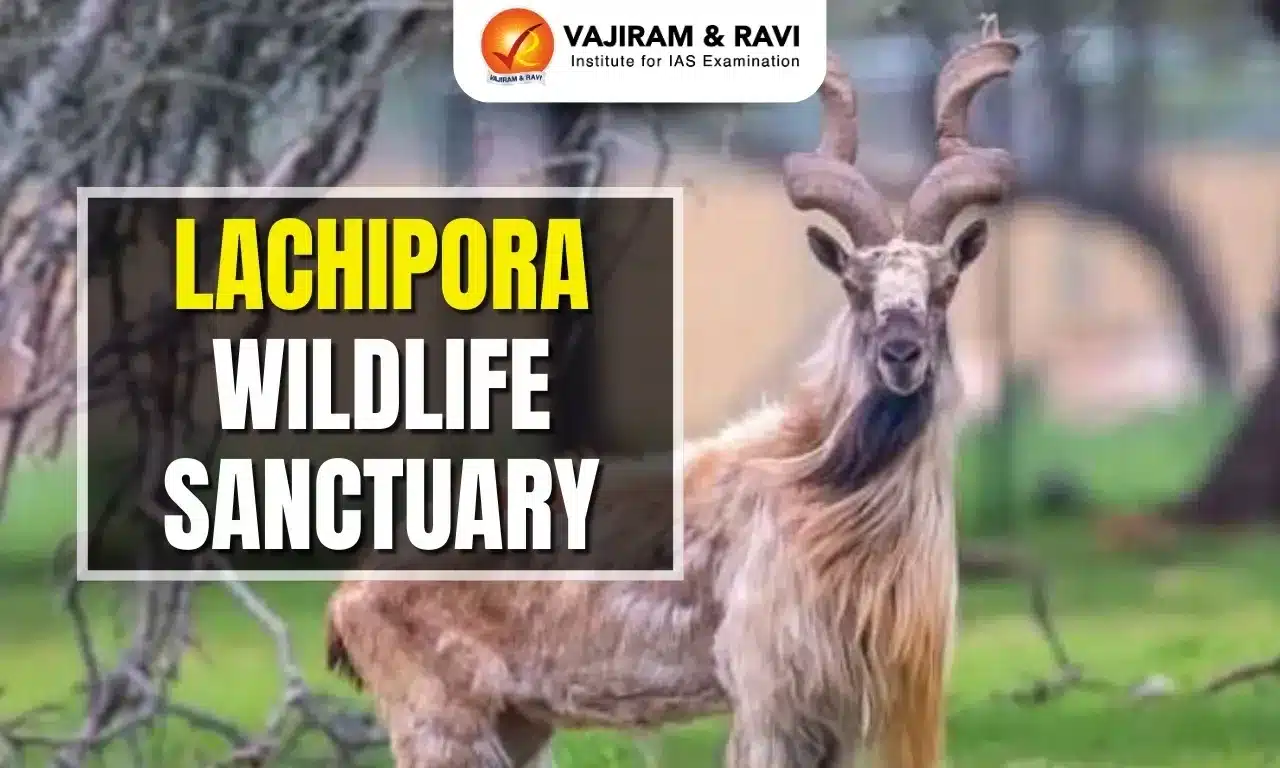
  • Established in 1987, the sanctuary was primarily created to protect the endangered Markhor, a wild goat species known for its distinctive twisted horns.
  • It is spread over an area of 141 sq.km. 
  • The sanctuary's elevation ranges from 1,630 to 3,300 meters, contributing to alpine meadows and rich biodiversity. 
  • The sanctuary features a diverse landscape with gentle to steep slopes and rocky cliffs.
  • Flora: It supports a variety of flora, including coniferous forests of deodar, Himalayan white pine, and blue pine, and broadleaf forests with trees like birch, horse chestnut, West Himalayan fir, and Persian walnut.
  • Fauna: 
    • It is particularly renowned for being the habitat of the endangered Hangul deer, often referred to as the Kashmir stag.
    • It is also home to several other mammal species, such as the Himalayan black bear, Snow leopard, Musk deer, and many more.
    • Lachipora is also designated as an Important Bird Area (IBA). It is home to the vulnerable Western Tragopan bird species.

Source: GK

Lachipora Wildlife Sanctuary FAQs

Q1: Lachipora Wildlife Sanctuary is located in which district of Jammu and Kashmir?

Ans: Baramulla

Q2: What was the primary purpose behind the creation of Lachipora Wildlife Sanctuary?

Ans: Established in 1987, the sanctuary was primarily created to protect the endangered Markhor, a wild goat species known for its distinctive twisted horns.

Q3: On the banks of which river is Lachipora Wildlife Sanctuary located?

Ans: It is located on the northern banks of the Jhelum River.

Q4: What is the total area of Lachipora Wildlife Sanctuary?

Ans: It is spread over an area of 141 sq.km.

Agri-Stack Scheme

Agri-Stack Scheme

Agri-Stack Scheme Latest News

The Uttar Pradesh govt recently issued a stern warning to district magistrates, emphasizing that strict action will be taken against those who fail to complete farmer registration under the Agri-stack scheme within the specified timeframe.

About Agri-Stack Scheme

  • It is the digital foundation being set up by the government to enable the rollout of data-centric digital services to improve Indian agriculture and enable farmer empowerment.
  • It integrates farmer data, land records, and scheme benefits into a centralized digital platform.
  • It is being implemented by the Ministry of Agriculture and Farmer Welfare at the Centre in close collaboration with the Revenue and Agriculture departments of State governments.
  • It is an infrastructure and foundational layer that enables various government and private entities to provide farmers with tailored services by providing them access to high-quality, validated, attested, and current data. Thus, Agri Stack will:
    • Provide the right support to farmers in terms of finance and agricultural inputs at the right time.
    • Provide localized and tailored early warning systems for disasters, including pest attacks, droughts, floods, etc.
    • Simplify government scheme benefits lifecycle for farmers.
    • Enable quick and easy access to affordable finance.
    • Enable private participation in farmer service delivery, thereby increasing farmers' choices.
    • Enable ease of governance by providing required data at the right place for enhanced decision-making, policy implementation, and feedback management.
    • Improve targeting of government benefits (by maximizing inclusion and minimizing exclusion and fraud).

Building Blocks of Agri Stack

  • Farmer and Farmland Registries:
    • At the center of Agri Stack is a Farmer Registry, a federated registry of all the farmers in the country, compiled by States according to common standards, and cached by the Centre.
    • Each farmer will be assigned a unique FarmerID (a functional ID, based on Aadhaar as per IndEA 2.0) and a digitally verifiable credential.
    • The Farmer Registry will be dynamically linked to their farmland plot records for non-legal, planning and advisory, and scheme-delivery purposes only.
  • Unified Farmer Service Interface (UFSI):
    • It is the building block that enables interoperability across stakeholders in Agri Stack.
    • UFSI is envisioned to be used by government and authorized private users, such as Banks, Agri-Techs, agriculture value-chain companies, etc.
    • UFSI will enable a center-state federation of data, authorized and consent-brokered access to the core registries' data, and standards-based interactions between various public and private stakeholders.
  • Crop sown Registry:
    • It is designed to be a federated registry of crops being sown and grown across the country every season, on every farm, by each farmer.
    • It aims to streamline and improve previously prevalent paper-based methods of surveying crops by introducing smartphone- and image-based (including drone and satellite images in the future), more fool-proof methods of crop survey.
  • Agri Stack Sandbox:
    • It is a subset of the Agri Stack that will provide a simulated environment with access to the UFSI along with sample data for the various registries and databases to authorized stakeholders.
    • Purpose: To allow them to test and safely fail, or succeed and get fully authorized access to the production environments. 
  • Consent Manager:
    • The Consent Manager facilitates data-blind sharing of personal data only with persons/entities for whom the data principal (i.e., a farmer) has provided consent.
    • Consent once given may also be revoked, preventing future sharing of data.

Source: TOI

Agri-Stack Scheme FAQs

Q1: What is the main purpose of the Agri-Stack Scheme?

Ans: To enable data-centric digital services for farmer empowerment and improved agriculture.

Q2: Which ministry is responsible for implementing the Agri-Stack Scheme?

Ans: Ministry of Agriculture and Farmer Welfare

Q3: Which data sources does Agri-Stack integrate to provide services to farmers?

Ans: Agri-Stack integrates farmer data, farmland records, and government scheme benefits into a centralized digital platform.

Beddome’s Cat Skink

Beddome’s Cat Skink

Beddome’s Cat Skink Latest News

A biodiversity survey has, for the first time, recorded the presence of Beddome’s cat skink (Ristella beddomii) at the Aralam and Kottiyoor Wildlife sanctuaries.

About Beddome’s Cat Skink

  • It is also called Beddome's ristella.
  • Beddome’s cat skink is named after British naturalist Richard Henry Beddome, the species is considered rare and endemic to the Western Ghats region.
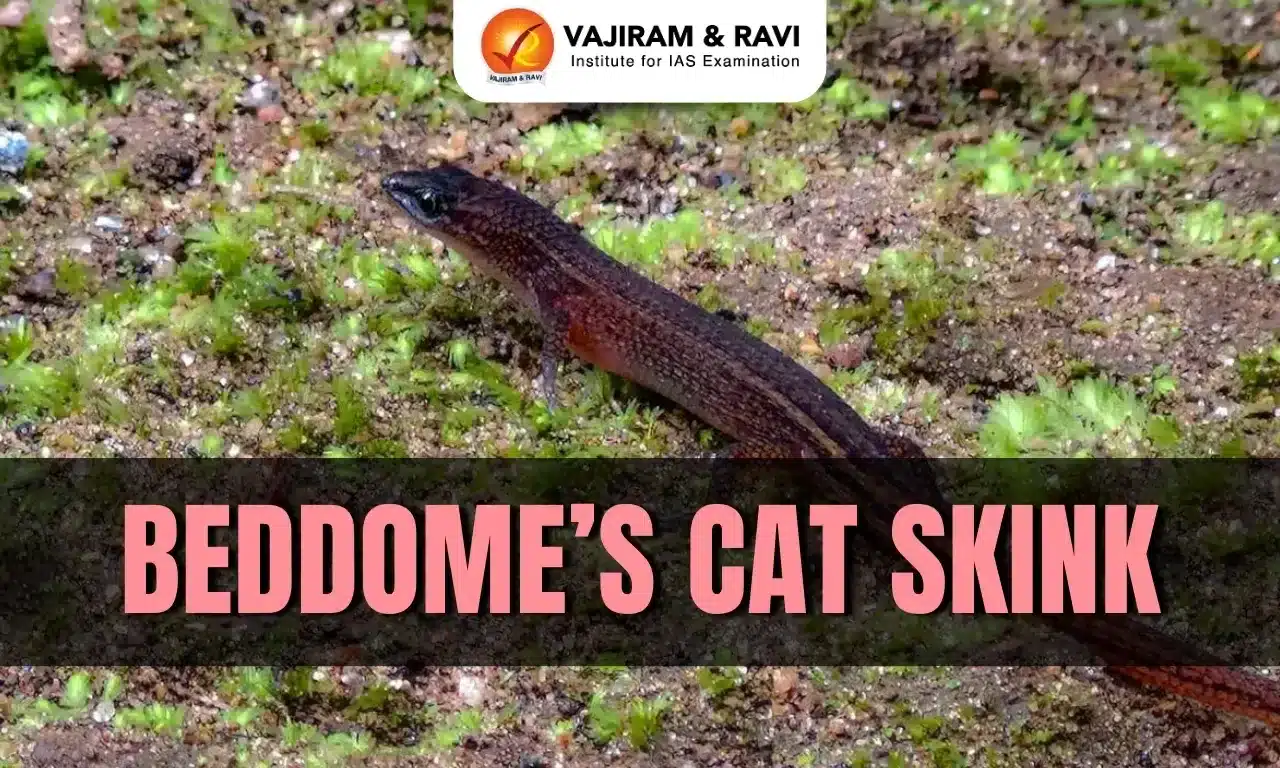
  • Appearance: It is a small reddish brown lizard with retractile claws and bicarinate scales.
  • Distribution: It is found in the forests of the Western Ghats at an altitude of 400-1,300 metres.
  • Reproduction: It is an oviparous species and egg laying coincides with the southwestern monsoons.

Key Facts about Skink

  • It is the common name for the lizards that comprise the family Scincidae.
  • It is a type of reptile that has been around since the time of the dinosaurs.
  • It is typically smooth and shiny with small or rudimentary legs.
  • They are mostly secretive ground dwellers or burrowers.
  • Behavior: Skinks are highly alert, agile and fast moving and actively forage for a variety of insects and small invertebrates. 
  • Habitat: They can be found in a variety of habitats, from deserts to rainforests, and are well-known for their ability to camouflage with their surroundings. 
  • Distribution: These are represented throughout most of the world but are especially diverse in Southeast Asia and its associated islands, the deserts of Australia, and the temperate regions of North America.

Source: TH

Beddome’s Cat Skink FAQs

Q1: Where is Beddome's Cat Skink primarily found?

Ans: Western Ghats

Q2: What is a notable behavior of Beddome's Cat Skink?

Ans: They are terrestrial to semi-fossorial. They inhabit deep leaf-litter and grasslands in montane forests and rainforests

Bhima River

Bhima River

Bhima River Latest News

Continuous heavy rains in Kalaburagi and parts of Maharashtra have led to a sharp rise in the water levels of the Bhima River recently, triggering widespread flooding in several villages.

About Bhima River

  • The Bhima River (also known as the Chandrabagha River) is the largest tributary of the Krishna River.
  • Course:
    • It originates near Bhimashankar Temple in the Bhimashankar hills on the western side of the Western Ghats in Pune District of Maharashtra.
    • Bhima flows southeast through the states of Maharashtra, Karnataka, and Telangana.
    • It merges into the Krishna River in Karnataka’s Raichur district.
    • Total Length: 861 km
  • The Bhima drainage area is defined by the Western Ghats (west), the Balaghat Range (north), and the Mahadeo Hills (south).
  • The total basin area of the river is 48,631 sq.km., out of which 75 percent lie in the state of Maharashtra. It is known as Sahyadri in Maharashtra. 
  • It runs in a well-entrenched valley, and its banks are heavily populated. 
  • Its water level is marked by monsoonal changes.
  • Tributaries: Major tributaries are the Indrayani River, Mula River, Mutha River, and Pavana River.
  • Throughout history, the Bhima River has been a lifeline for the Maratha Empire and the region surrounding Pune, with many historic battles and events occurring near its banks. 
  • The area around the Bhima River, particularly near the city of Pune, saw extensive trade and commerce routes, making it a vital hub during medieval times.
  • Pandharpur is an important pilgrimage centre located on the right bank of the Bhima River.

Source: HANS

Bhima River FAQs

Q1: The Bhima River is the largest tributary of which river?

Ans: Krishna

Q2: The Bhima River originates from which location?

Ans: It originates near Bhimashankar Temple in the Bhimashankar hills on the western side of the Western Ghats in Pune District of Maharashtra.

Q3: The Bhima River flows through which Indian states?

Ans: Maharashtra, Karnataka, Telangana

Q4: What is the total length of the Bhima River?

Ans: 861 km

Andaman Sea

Andaman Sea

Andaman Sea Latest News

The Union Petroleum Minister recently announced that natural gas has been discovered in the Andaman basin, confirming the long-held belief that the Andaman Sea is rich in natural gas.

About Andaman Sea

  • It is a semi-enclosed marginal sea in the northeastern Indian Ocean.
  • It lies between the eastern coast of India and the Malay Peninsula, with Myanmar to the north and the Indonesian island of Sumatra to the south.
  • The Bay of Bengal bounds the Andaman Sea to the west and the Strait of Malacca to the east.
  • The sea, covering an area of approximately 307,994 square miles, extends about 750 miles in length and 400 miles in width.
  • It is a complex geological region with a tectonically active plate boundary.
  • It is part of the larger Sunda Plate, which the Indian Plate borders to the northwest and the Australian Plate to the southeast. 
  • The ongoing tectonic convergence between these plates has resulted in the formation of the Andaman Basin, characterized by undersea ridges, trenches, and faults. 
  • The most prominent geological feature in the region is the Andaman Trench, which is formed by the subduction of the Indian Plate beneath the Eurasian Plate. 
  • This tectonic activity has given rise to numerous earthquakes and volcanic eruptions in the region, making the Andaman Sea seismically active.
  • It is home to extensive coral reef systems, seagrass meadows, and mangrove forests, which provide critical habitats for a multitude of marine organisms.
    • It hosts many endangered fauna species –Whale Shark, Devil Manta Ray, Dugong, several dolphin species, such as Irrawaddy Dolphin and four species of sea turtles. 
    • It is also an important site for migratory birds, with several key stopover locations along the East Asian-Australasian Flyway.
  • Islands: Most of the islands are part of the Andaman and Nicobar Islands, a Union Territory of India, while the Coco Islands and Preparis Island are part of the Yangon Region of Myanmar.
  • The climate of the Andaman Sea is tropical, with two distinct seasons: the southwest monsoon (May-September) and the northeast monsoon (November-February).

Source: NOA

Andaman Sea FAQs

Q1: The Andaman Sea is a part of which ocean?

Ans: It is a semi-enclosed marginal sea in the northeastern Indian Ocean.

Q2: What bounds the Andaman Sea to the east?

Ans: Strait of Malacca

Q3: What is the most prominent geological feature in the Andaman Sea?

Ans: Andaman Trench

Q4: What type of climate does the Andaman Sea region have?

Ans: The climate of the Andaman Sea is tropical, with two distinct seasons: the southwest monsoon (May-September) and the northeast monsoon (November-February).

Cold Desert Biosphere Reserve

Biosphere Reserve

Cold Desert Biosphere Reserve Latest News

Recently, the Cold Desert Biosphere Reserve (CDBR) in Himachal Pradesh has been included in the World Network of Biosphere Reserves (WNBR) by UNESCO.

About Cold Desert Biosphere Reserve

  • It is perched high in the trans-Himalayan region.
  • It spans approximately 7,770 sq. km. across the landscapes of Himachal Pradesh’s Lahaul-Spiti district.
  • It was declared a biosphere reserve in 2009.
  • Terrain: It encompasses windswept plateaus, glacial valleys, alpine lakes, and rugged high-altitude deserts.
  • This is India’s first high-altitude cold desert biosphere reserve and one of the coldest and driest ecosystems in UNESCO’s WNBR.
  • With this addition, India now has 13 biospheres listed in UNESCO’s World Network of Biosphere Reserves (WNBR).
  • It covers the Pin Valley National Park and its surroundings, Chandratal and Sarchu & Kibber Wildlife Sanctuary.
  • Flora: It harbours 732 species of vascular plants, including 30 endemics and 157 near-endemics of the Indian Himalayas,
  • This fragile cold desert ecosystem supports hardy alpine grasses, medicinal herbs, and rare stands of Willow-leaved sea-buckthorn, Himalayan birch and Persian juniper.
  • Fauna: It is home to leopard, Himalayan ibex, blue sheep, Himalayan wolf, and rich bird life such as the Himalayan snowcock and golden eagle.

 Source: IE

Cold Desert Biosphere Reserve FAQs

Q1: Where is the Cold Desert Biosphere Reserve located?

Ans: Himachal Pradesh

Q2: What is the Cold Desert Biosphere Reserve known for?

Ans: Snow leopard conservation efforts.

Study in India (SII) portal

Study In India (SII) Portal

Study In India (SII) Portal Latest News

The University Grant Commission (UGC) recently mandated that all foreign nationals studying in Higher Education Institutions (HEIs) and universities in the country have to register themselves in a new Study In India (SII) portal.

About Study In India (SII) Portal

  • It is a flagship project of the Ministry of Education (MoE), Government of India, to encourage international students to explore educational opportunities at top Indian universities. 
  • It is a single-window interface for international students, which facilitates submission of applications, admission processes, and visa applications for those seeking to pursue regular, short-term, or long-term courses in Indian academic institutions or HEI’s.
  • It serves as a seamless digital gateway to India’s higher education ecosystem. 
  • The website will illustrate academic programs, including undergraduate (UG), postgraduate (PG), and doctoral-level programs. 
  • It will also provide information about courses in the Indian Knowledge System, such as Yoga, Ayurveda, classical arts, etc
  • Additionally, the portal will present information about the academic facilities, research support, and related information.
  • All foreign students who wish to study in India, are mandated to register on the SII portal and submit the required information on the portal.
  • Upon registration, the portal generates a unique ID or ‘SII-ID’, which must be quoted on the student visa application.

Source: TH

Study In India (SII) Portal FAQs

Q1: The Study in India (SII) Portal is an initiative of which government body?

Ans: It is a flagship project of the Ministry of Education (MoE), Government of India.

Q2: What is the main purpose of the Study In India (SII) Portal?

Ans: To encourage international students to explore educational opportunities in India.

Q3: The SII Portal serves as a digital gateway for which level of academic programs?

Ans: Undergraduate, postgraduate, and doctoral programs.

Q4: Is registration on the SII Portal mandatory for all foreign students wishing to study in India?

Ans: Yes, all foreign students who wish to study in India, are mandated to register on the SII portal.

AstroSat

AstroSat

AstroSat Latest News

Recently, India’s first dedicated Space Astronomy Observatory, AstroSat completed a decade of operations. 

About AstroSat

  • It is the first dedicated Indian astronomy mission.
  • It was launched by PSLV-C30 (XL) rocket from Satish Dhawan Space Centre in Sriharikota  on September 28, 2015.
  • The minimum useful life of the AstroSat mission was around 5 years but still it is providing valuable information.
  • It was designed to observe the universe in the Visible, Ultraviolet, low and high energy X-ray regions of the electromagnetic spectrum simultaneously with the help of its five payloads.
  • Payloads of Astrosat: Ultra Violet Imaging Telescope (UVIT), Large Area X-ray Proportional Counter (LAXPC), Cadmium–Zinc–Telluride Imager (CZTI), Soft X-ray Telescope (SXT) and Scanning Sky Monitor (SSM).
  • The spacecraft control center at Mission Operations Complex (MOX) of ISRO Telemetry, Tracking and Command Network (ISTRAC), Bengaluru, manages the satellite during its entire mission life.

Objectives of Astrosat

  • To understand high energy processes in binary star systems containing neutron stars and black holes.
  • Estimate magnetic fields of neutron stars.
  • Study star birth regions and high energy processes in star systems lying beyond our galaxy.
  • Detect new briefly bright X-ray sources in the sky.
  • Perform a limited deep field survey of the Universe in the Ultraviolet region.

Source: TH

AstroSat FAQs

Q1: What is the primary objective of AstroSat

Ans: To observe celestial bodies in multiple wavelengths.

Q2: When was AstroSat launched?

Ans: September 28, 2015.

PM E-DRIVE Scheme

PM E-DRIVE Scheme

PM E-DRIVE Scheme Latest News

The Centre recently unveiled operational guidelines for the rollout of nearly 72,300 public electric vehicle (EV) charging stations across the country, with an outlay of Rs 2,000 crore under the Rs 10,900 crore PM E-DRIVE scheme.

About PM E-DRIVE Scheme

  • The PM E-DRIVE (Electric Drive Revolution in Innovative Vehicle Enhancement) scheme is a flagship initiative launched in October 2024 with a financial outlay of Rs.10,900 crore.
  • It came into effect from October 1, 2024, and will remain in force until March 31, 2026. Its primary aim is to accelerate the adoption of electric vehicles (EVs), establish charging infrastructure, and build a robust EV manufacturing ecosystem in the country.
  • It promotes mass mobility through the support of public transportation systems. 
  • The key objective is to speed up the transition to EVs by offering upfront incentives for EV purchases and encouraging the development of charging infrastructure. 
  • The scheme seeks to reduce transportation-related environmental impacts and improve air quality while also promoting an efficient and competitive EV manufacturing sector in line with the Aatmanirbhar Bharat initiative. 
  • This is to be accomplished through a phased manufacturing program (PMP) designed to boost domestic manufacturing and strengthen the EV supply chain.
  • The PM E-DRIVE scheme to be implemented through the following key components:
    • Subsidies: Demand incentives to be provided for electric vehicles such as e-2 wheelers (e-2W), e-3 wheelers (e-3W), e-ambulances, e-trucks, and other emerging categories of EVs.
    • Grants for creation of capital assets: Funding to be provided for the acquisition of electric buses (e-buses), the establishment of a comprehensive network of charging stations, and the upgrading testing facilities of the Ministry of Heavy Industries (MHI).
    • Administration of the Scheme including IEC (Information, Education & Communication) activities and fee for project management agency (PMA).
  • States are encouraged to offer additional fiscal and non-fiscal incentives, such as road tax waivers, reduced toll and parking fees, and permit exemptions, to further promote EV adoption. 
  • The scheme will be overseen by an inter-ministerial body, the Project Implementation and Sanctioning Committee (PISC), chaired by the Secretary of Heavy Industries. 
    • The PISC will be responsible for monitoring progress and ensuring the scheme’s successful rollout.
    • It will also have the authority to address any challenges, including revising incentives, increasing the number of e-buses, and approving guidelines for testing agencies.
  • To qualify for the PM E-DRIVE incentives, vehicles must be registered as “Motor Vehicles” under the Central Motor Vehicle Rules (CMVR) and equipped with advanced battery technology.
  • Bharat Heavy Electricals Limited (BHEL) is the nodal agency for:
    • Demand aggregation for charging infrastructure.
    • Development of a Unified EV Super App for users across India.
      • The app will offer real-time charger availability, slot booking, payment integration, and deployment progress tracking, ensuring digital ease-of-use for all EV stakeholders.

Source: TOI

PM E-DRIVE Scheme FAQs

Q1: What is the total financial outlay of the PM E-DRIVE Scheme?

Ans: Rs. 10,900 crore

Q2: What is the primary aim of the PM E-DRIVE Scheme?

Ans: To accelerate adoption of electric vehicles and build EV ecosystem.

Q3: Which entity is the nodal agency for demand aggregation and development of the Unified EV Super App under PM E-DRIVE?

Ans: Bharat Heavy Electricals Limited (BHEL)

Q4: What services will the Unified EV Super App provide to EV users?

Ans: Real-time charger availability, slot booking, payment integration, and deployment progress tracking.

Enquire Now