Bathukamma Festival

Bathukamma Festival

Bathukamma Festival Latest News

Recently, in Telangana, the celebrations of Bathukamma Festival, organised by the state Government, have set two new Guinness World Records.

About Bathukamma Festival

  • Bathukamma is a floral festival celebrated by the women folk of Telangana.
  • History Behind Bathukamma
    • The term “Bathukamma” translates to “Mother Goddess Come Alive”, reflecting the divine feminine energy and protection.
    • Folklore connects the festival to legends of Goddess Gauri and her miraculous survival as well as King Dhramangada and Queen Satyavati of the Chola dynasty. 
    • Historically, the Kakatiya dynasty emphasized Bathukamma as a celebration of feminine strength and agricultural prosperity.
  • Every year this festival is celebrated usually in September–October of the Gregorian calendar.
  • It is celebrated for nine days during Durga Navratri and the 9-day festivities will culminate on "Saddula Bathukamma" or "Pedda Bathukamma" festival.
  • Bathukamma is followed by Boddemma, which is a 7-day festival.
  • It has been declared as the Telangana State Festival. 

Source: News On Air

Bathukamma Festival FAQs

Q1: How many days does the Bathukamma Festival last?

Ans: Nine Days

Q2: What is the significance of the Bathukamma Festival?

Ans: Bathukamma is a festival celebrated to honor Goddess Gauri, an incarnation of Goddess Parvati


Biomedical Research Career Programme Phase III

Biomedical Research Career Programme Phase III

Biomedical Research Career Programme Phase III Latest News 

Recently, the Union Cabinet has approved the continuation of the Biomedical Research Career Programme (BRCP), Phase-III. 

About Biomedical Research Career Programme Phase III

  • It will nurture top-tier scientific talent for cutting-edge biomedical research and promote interdisciplinary research for translational innovation. 
  • It is being implemented in partnership between the Department of Biotechnology (DBT) and the Wellcome Trust (WT), United Kingdom and the SPV, India Alliance
  • Time Period: Between 2025-26 and 2030-31 with an additional six-year support period until 2037-38. 
  • Funding:  It will have a total outlay of ₹1,500 crore, of which DBT will contribute ₹1,000 crore and the Wellcome Trust ₹500 crore.
  • In Phase-III, the following programmes are proposed to be implemented:
    • Early Career and Intermediate Research Fellowships in basic, clinical and public health: These are globally recognized and tailored for the formative stages of a scientist's research career.
    • Collaborative Grants Programme: These include Career Development Grants and Catalytic Collaborative Grants for 2-3 Investigator teams for early and mid-senior career researchers respectively with strong research track record in India.
    • Phase III will also focus on strengthening mentorship, networking, public engagement, and developing new and innovative national and international partnerships.

What is the Biomedical Research Career Programme” (BRCP) ?

  • It was first launched in in 2008-2009 through the DBT/Wellcome Trust India Alliance (India Alliance), a dedicated Special Purpose Vehicle (SPV)
  • It offered research fellowships, based in India, for biomedical research at the world class standards.
  • Subsequently, Phase II was implemented in 2018/19 with an expanded portfolio.

Source: PIB

Biomedical Research Career Programme Phase III FAQs

Q1: What is the funding agency for BRCP Phase III?

Ans: Department of Biotechnology and Wellcome Trust India Alliance.

Q2: What is the primary objective of the Biomedical Research Career Programme (BRCP) Phase III?

Ans: To foster a career path for clinician-scientists in biomedical research.

Mission for Aatmanirbharta in Pulses

Aatmanirbharta in Pulses

Mission for Aatmanirbharta in Pulses Latest News

Recently, the Union Cabinet has approved the Mission for Aatmanirbharta in Pulses.

About Mission for Aatmanirbharta in Pulses

  • It is aimed at boosting domestic production and achieving self-sufficiency (Aatmanirbharta) in pulses.
  • Time Period: The Mission will be implemented over a six-year period, from 2025-26 to 2030-31.

Key Features of Mission for Aatmanirbharta in Pulses

  • Comprehensive strategy: The mission covers research, seed systems, area expansion, procurement, and price stability.
  • Focus on quality seeds: It focuses on developing and disseminating the latest varieties of pulses which are high in productivity, pest-resistant and climate-resilient. Multi-location trials will be carried out in major pulse-growing states to ensure regional suitability.
  • Seed Production: To ensure availability of premium quality seeds, states will prepare five-year rolling seed production plans.
    • The breeder seed production will be supervised by the Indian Council of Agricultural Research (ICAR).
    • Foundation and certified seed production will be done by state and central level agencies, and closely tracked through the Seed Authentication, Traceability & Holistic Inventory (SATHI) portal.
  • Capacity building: Structured training programmes for farmers and seed growers to promote sustainable techniques and modern technologies.
  • Post-harvest infrastructure:  To strengthen markets and value chains, the Mission will help develop 1000 processing units, thereby reducing crop losses, improving value addition.
    • A maximum subsidy of Rs. 25 lakhs will be available for setting up of processing, packaging units.
  • Cluster-Based Approach: Tailoring interventions to the specific needs of each cluster to enhance productivity, and promote geographic diversification of pulse production.
  • Procurement: Assured maximum procurement of Tur, Urad, and Masoor under Price Support Scheme (PSS) of PM-AASHA.
    • NAFED and NCCF will undertake 100% procurement in participating states for the next four years from farmers who register with these agencies and enter into agreements. 
  • Additionally, to safeguard farmer confidence, the Mission will establish a mechanism for monitoring global pulse prices.

Source: PIB

Mission for Aatmanirbharta in Pulses FAQs

Q1: Which pulses are the focus of the Mission for Aatmanirbharta in Pulses?

Ans: Tur, Urad, and Masoor.

Q2: What is the duration of the Mission for Aatmanirbharta in Pulses?

Ans: The mission will be implemented over a six-year period, from 2025-26 to 2030-31.

Payments Regulatory Board

Payments Regulatory Board

Payments Regulatory Board Latest News

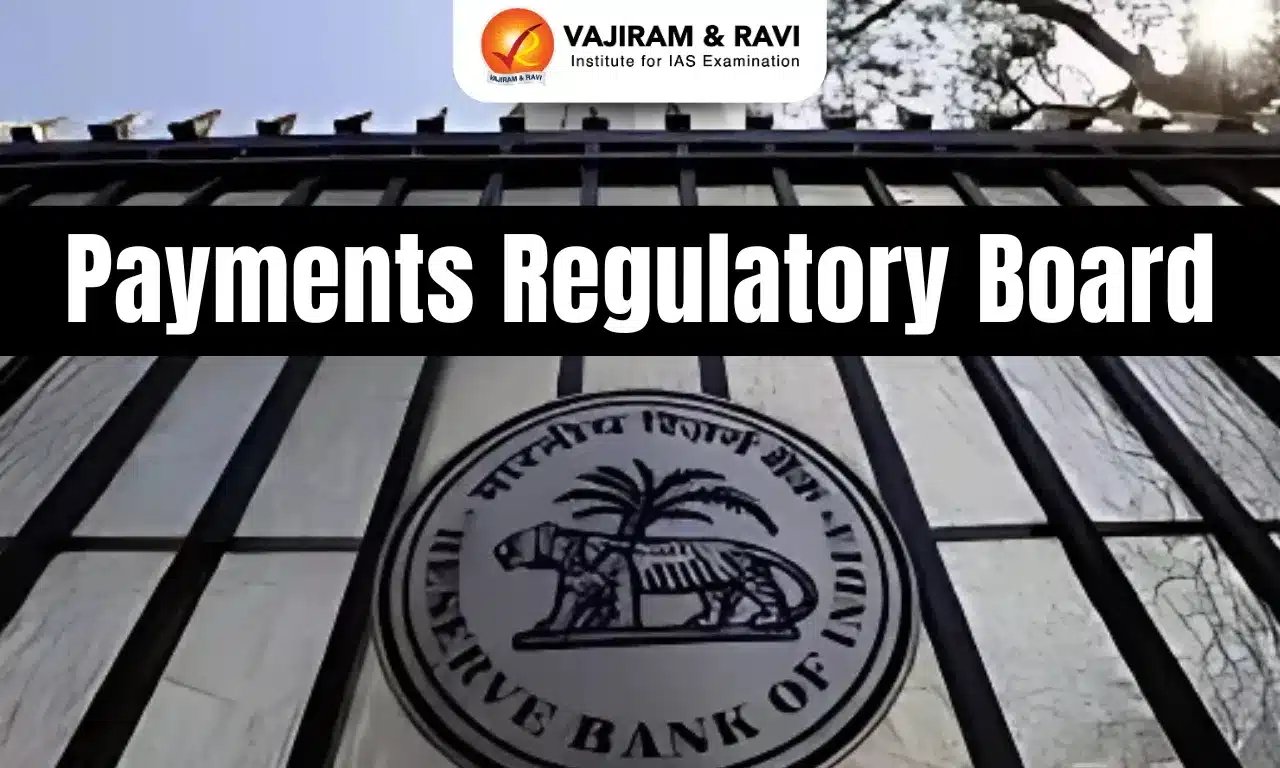
Recently, the Reserve Bank of India (RBI) constituted a six-member Payments Regulatory Board (PRB). 

About Payments Regulatory Board

  • It derives its authority from the Payment and Settlement Systems Act, 2007.
  • It replaces the Board for Regulation and Supervision of Payment and Settlement Systems (BPSS), a committee of the RBI’s Central Board.
  • Composition of Payments Regulatory Board
    • Ex officio Chairperson: RBI Governor
    • Ex officio members: Deputy Governor and the Executive Director in charge of Payment and Settlement Systems.
    • Government nominees: Central government nominates 3 members to the board.
    • The principal legal adviser of the RBI is a permanent invitee to the meetings of the board.
  • The PRB will be supported by the RBI’s Department of Payment and Settlement Systems (DPSS), which will report directly to the PRB.
  • Decision Making: Decisions by a majority of members present and voting. In the event of a tie, the chairperson — or in his absence, the deputy governor will have a second or casting vote.
  • The Board is required to meet at least twice a year.
  • Function of PRB: It is responsible for the regulation and supervision of all payment systems including electronic and non-electronic, domestic and cross-border systems.

Source: IE

Payments Regulatory Board FAQs

Q1: What is the primary purpose of the Payments Regulatory Board (PRB)?

Ans: The PRB aims to ensure the stability and efficiency of payment systems, promote innovation, and protect consumer interests

Q2: How often does the Payments Regulatory Board meet?

Ans: At least twice a year.

Fatah-4 Missile

Fatah-4 Missile

Fatah-4 Missile Latest News

Pakistan recently announced the successful test of its new long-range cruise missile, Fatah-IV.

About Fatah-4 Missile

  • It is Pakistan’s indigenously developed long-range cruise missile.
  • It has a range of 750 kilometers (470 miles) and is equipped with advanced avionics and modern navigation systems.
  • It can reach speeds of Mach 0.7 (865 kmph) during flight.
  • Weighing around 1,530 kilos, the missile is around 7.5 metres in length.
  • The missile can be fired from transporter-erector-launcher (TEL) vehicles. 
  • It uses solid-propellant propulsion, which allows it to be readied for launch and fired quickly.
  • It can carry a warhead weighing around 330 kilos. It is made to carry conventional munitions and not nuclear warheads.
  • The missile is guided by a navigation suite comprising global positioning system (GPS) and an inertial navigating system (INS).
  • It is said to use electronic countermeasures and AI to lock on to targets in difficult environments. 
  • The most significant feature of the Fatah-4 missile is its circular error probability (CEP). 
    • The Fatah-4 can hit its target with an error of just 4 meters, which is considered very low for Pakistani missiles.
  • It is capable of evading enemy air defences through terrain-hugging flight.

Source: N18

Fatah-4 Missile FAQs

Q1: The Fatah-4 missile, recently in the news, belongs to which country?

Ans: Pakistan

Q2: What is the range of the Fatah-4 missile?

Ans: It has a range of 750 kilometers (470 miles).

Q3: What type of propulsion system does the Fatah-4 missile use?

Ans: It uses solid-propellant propulsion.

INS Imphal

INS Imphal

INS Imphal Latest News

The Indian Navy's INS Imphal successfully participated in a Passage Exercise (PASSEX) with the U.S. Navy Arleigh-Burke class destroyer USS Gridley (DDG 101) recently.

About INS Imphal

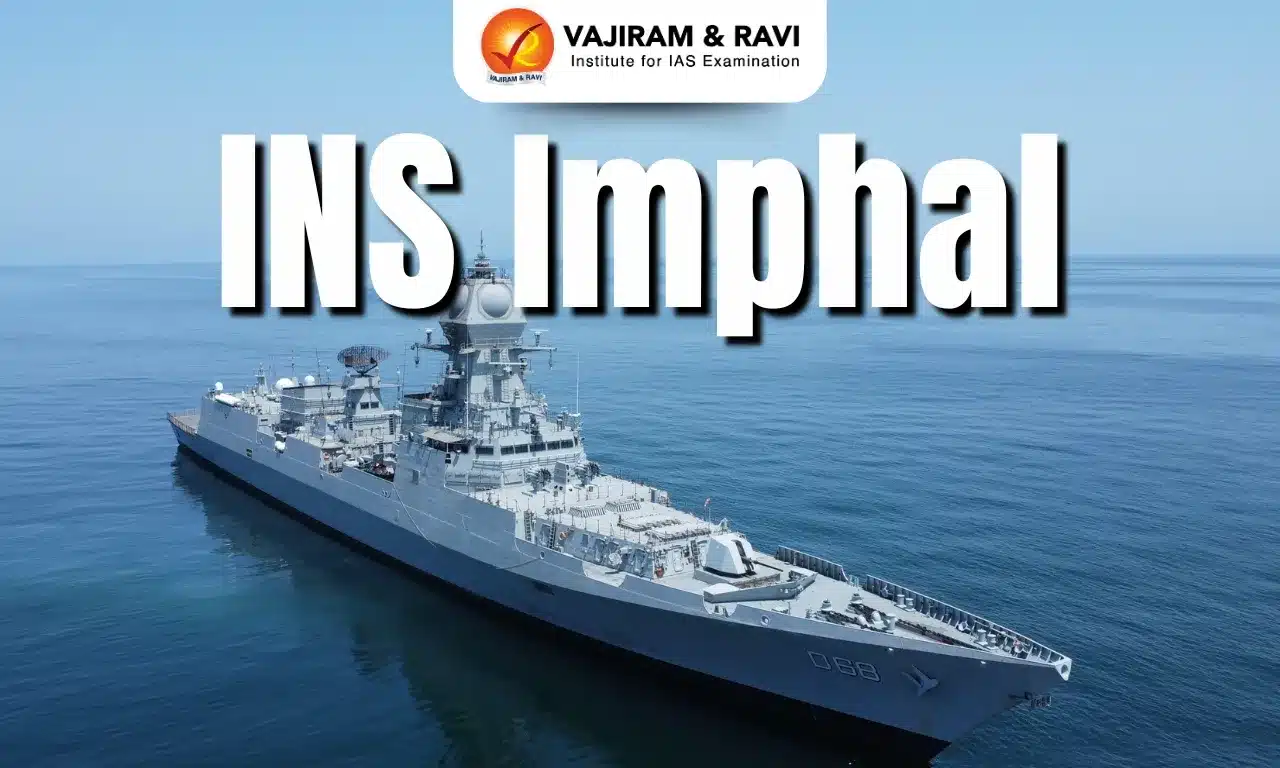
  • It is an indigenously built stealth guided missile destroyer of the Indian Navy.
  • It is the third ship to be built under the Project P-15B series of stealth destroyers, otherwise known as the Visakhapatnam-class.
    • The other destroyers in the Visakhapatnam class are INS Visakhapatnam, INS Mormugao, and INS Surat.
  • It was commissioned into the Indian Navy in December 2023.
  • The Navy’s Warship Design Bureau designed the ship in-house, and Mazagon Dock Ltd. (MDL) was responsible for its construction.
  • It is the first warship to be named after a city in the Northeast, Imphal — the capital of Manipur.
  • It was the first naval warship commissioned with accommodation for women officers and sailors.
  • It is a unit of the Indian Navy's Western Fleet.
  • Missions include anti-air warfare (AAW), anti-surface warfare (ASuW), and anti-submarine warfare (ASW).

INS Imphal Features

  • It is among the largest destroyers constructed in India, with an overall length of 164 metres and a displacement of over 7500 tonnes.
  • It has a crew complement of 50 officers and 250 enlisted personnel.
  • It is propelled by four powerful Gas Turbines, in a Combined Gas & Gas configuration, and is capable of achieving speeds in excess of 30 knots (56 km/hour).
  • It has a maximum operating endurance of 45 days.
  • The ship has BrahMos missiles, medium-range surface-to-air missiles, indigenous anti-submarine rocket launchers, and a 76 mm super rapid gun mount.
  • It has modern surveillance radar, which provides target data to the gunnery weapon systems.
  • It has a total atmospheric control system (TACS) that offers protection to the crew from chemical, biological, and nuclear threats.

Source: FPJ

INS Imphal FAQs

Q1: INS Imphal belongs to which class of warships?

Ans: It is the third ship to be built under the Project P-15B series of stealth destroyers, otherwise known as the Visakhapatnam-class.

Q2: Which organisation was responsible for designing INS Imphal?

Ans: Navy’s Warship Design Bureau

Q3: INS Imphal was built by which shipyard?

Ans: Mazagon Dock Shipbuilders Ltd. (MDL)

Q4: INS Imphal is part of which fleet of the Indian Navy?

Ans: Western Fleet

Bhagwan Mahavir Wildlife Sanctuary

Bhagwan Mahavir Wildlife Sanctuary

Bhagwan Mahaveer Wildlife Sanctuary Latest News

Goa’s State Board for Wildlife recently recommended that the proposal for wildlife clearance for iron ore handling at Kalem railway station in Bhagwan Mahaveer Wildlife Sanctuary and National Park be placed before the National Board for Wildlife (NBWL) for their “consideration”.

About Bhagwan Mahaveer Wildlife Sanctuary

  • It is located on the eastern border of the state of Goa, near the village of Mollem.
  • Set amidst the foothills of the Western Ghats, it covers an area of 240 sq. km, out of which 170 sq.km. is dedicated to the Mollem National Park built at the core of the sanctuary. 
  • Originally known as the Mollem Game Sanctuary, it was declared a wildlife sanctuary in 1969 and then renamed the Bhagwan Mahavir Wildlife Sanctuary.
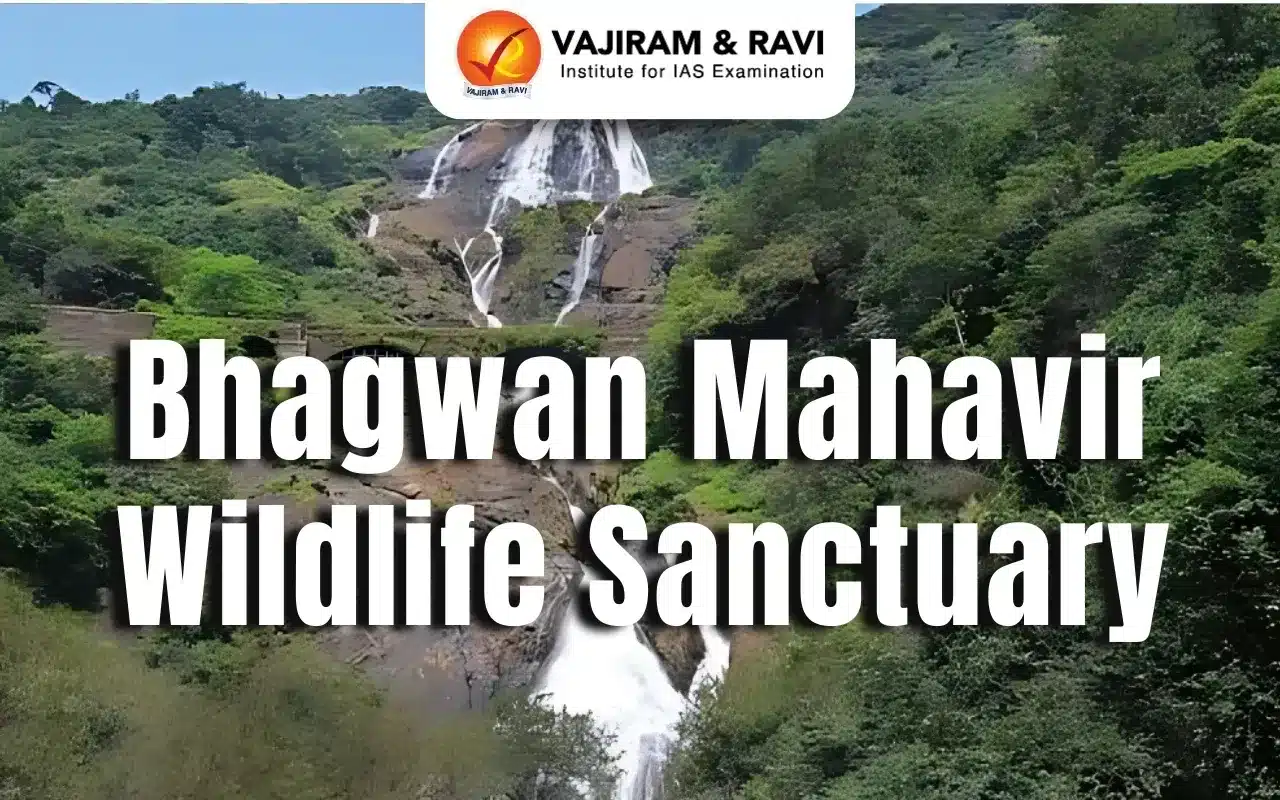
  • It is also home to the famous Dudhsagar waterfall, the Devil’s Canyon, the Tambdi Surla temple, the Tambdi falls, and a number of other historic and religious sites.
  • Vegetation: West Coast tropical evergreen forests, West Coast semi-evergreen forests, and moist deciduous forests. 
  • Flora: Teak, bamboo, cashew, and eucalyptus trees dominate the landscape.
  • Fauna
    • The sanctuary is particularly known for its Leopards, Elephants, Deers & Gaur, or Indian Bison.
    • The chief attraction of the sanctuary is the King Cobra, which is found here in abundance.
    • It is home to around 200 species of various types of birds, like the Malabar pied hornbill, Indian black woodpecker, great Indian hornbill, kingfishers, paradise flycatcher, shrikes, grey jungle fowl, etc.

Source: IE

Bhagwan Mahaveer Wildlife Sanctuary FAQs

Q1: The Bhagwan Mahaveer Wildlife Sanctuary is located in which Indian state?

Ans: Goa

Q2: Which famous waterfall is located inside the Bhagwan Mahaveer Wildlife Sanctuary?

Ans: Dudhsagar Falls

Q3: What is the total area of the Bhagwan Mahaveer Wildlife Sanctuary?

Ans: It covers an area of 240 sq. km.

Mutual Legal Assistance Treaty

Mutual Legal Assistance Treaty

Mutual Legal Assistance Treaty Latest News

Recently, the central government invoked the Mutual Legal Assistance Treaty with Singapore over the singer's death.

About Mutual Legal Assistance Treaty

  • It is a mechanism whereby countries cooperate with one another in order to provide and obtain formal assistance in prevention, suppression, investigation and prosecution of crime.
  • It aims to ensure that the criminals do not escape or sabotage the due process of law for want of evidence available in different countries.
  • India provides mutual legal assistance in criminal matters through Bilateral Treaties/Agreements, Multilateral Treaties/Agreements or International Conventions or on the basis of assurance of reciprocity. 
  • The Mutual Legal Assistance Treaties (MLATs) in criminal matters are the bilateral treaties entered between the countries for providing international cooperation and assistance.
  • India has entered into Mutual Legal Assistance Treaties with more than 45 countries.
  • Nodal Ministry: Ministry of Home Affairs (MHA).
  • Common forms of assistance provided to or sought by India are as follows:
    • Identifying and locating persons and objects;
    • Taking evidence and obtaining statements; assisting in the availability of person in custody or others to give evidence or assist in investigations or appear as a witness;
    • Effecting service of judicial documents;
    • Executing searches and seizures;
    • Providing information, documents, records and other evidentiary items;
    • Taking measures to identify, locate, attach, freeze, restrain, confiscate or forfeit the proceeds and [7]instrumentalities of crime;

Source: TH

Mutual Legal Assistance Treaty FAQs

Q1: What is the primary purpose of a Mutual Legal Assistance Treaty (MLAT)?

Ans: To provide a framework for exchanging information and evidence in criminal investigations.

Q2: What type of assistance can countries request under an MLAT?

Ans: Various forms of assistance, including taking evidence, serving documents, and executing searches and seizures.

Niger River

Niger River

Niger River Latest News

An accident involving a boat carrying passengers on the Niger River in north-central Nigeria has killed at least 26 people recently.

About Niger River

  • It is the principal river of western Africa. 
  • With a length of 4,200 km, it is the third longest river in Africa, after the Nile and the Congo.
  • In West Africa, it’s the longest and largest river and is nicknamed the “Boomerang River” due to its serpentine shape.
  • Course
    • It takes one of the most unusual routes of any major river.
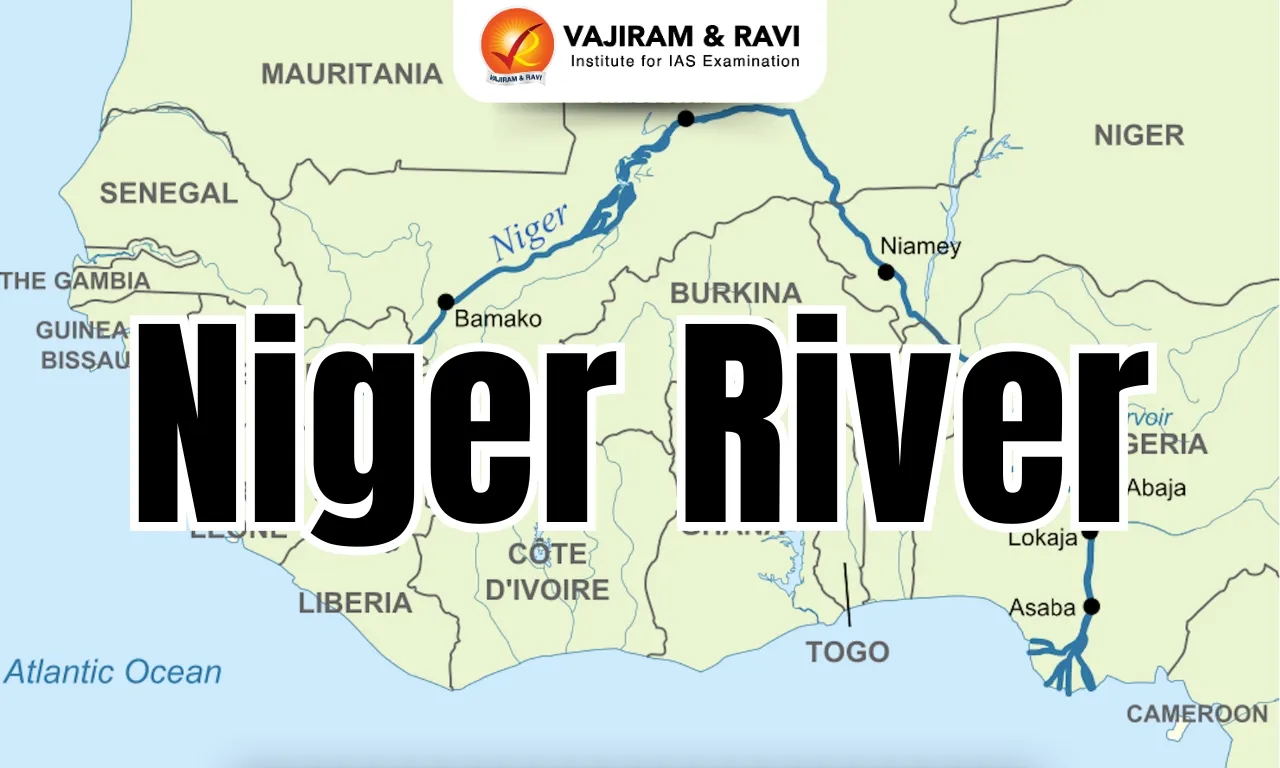
    • It rises in Guinea, just 240 kilometers from the Atlantic Ocean, but the river runs away from the sea into the Sahara Desert. 
    • It then takes a sharp right turn near Mali’s Timbuktu city.
    • It flows through Mali, Niger, Benin, and Nigeria, and empties into the Atlantic Ocean via the Niger Delta. 
  • Niger Delta:
    • It is located in southern Nigeria, where the Niger River meets the Atlantic Ocean (Gulf of Guinea).
    • It is the largest river delta in Africa and features the fifth largest mangrove forest on Earth.
  • The Niger passes through virtually all of the vegetational zones of western Africa, including grasslands, rainforests, and swamps. 
  • The Niger River Basin covers 7.5 percent of the African continent, and its main tributary is the Benue River.
  • The northern part of the river, known as the Niger Bend, is an important area because it is the closest major river and source of water to the Sahara desert.
  • The Niger Valley is sparsely settled. The largest cities are Bamako in Mali, Niamey in Niger, and Onitsha in Nigeria.

Source: HT

Niger River FAQs

Q1: In which country does the Niger River originate?

Ans: It rises in Guinea.

Q2: What is the total length of Niger River?

Ans: 4,200 k

Q3: Which river is the main tributary of the Niger River?

Ans: Benue River

Q4: Name three cities situated along the Niger River?

Ans: The largest cities are Bamako in Mali, Niamey in Niger, and Onitsha in Nigeria.

Enquire Now